
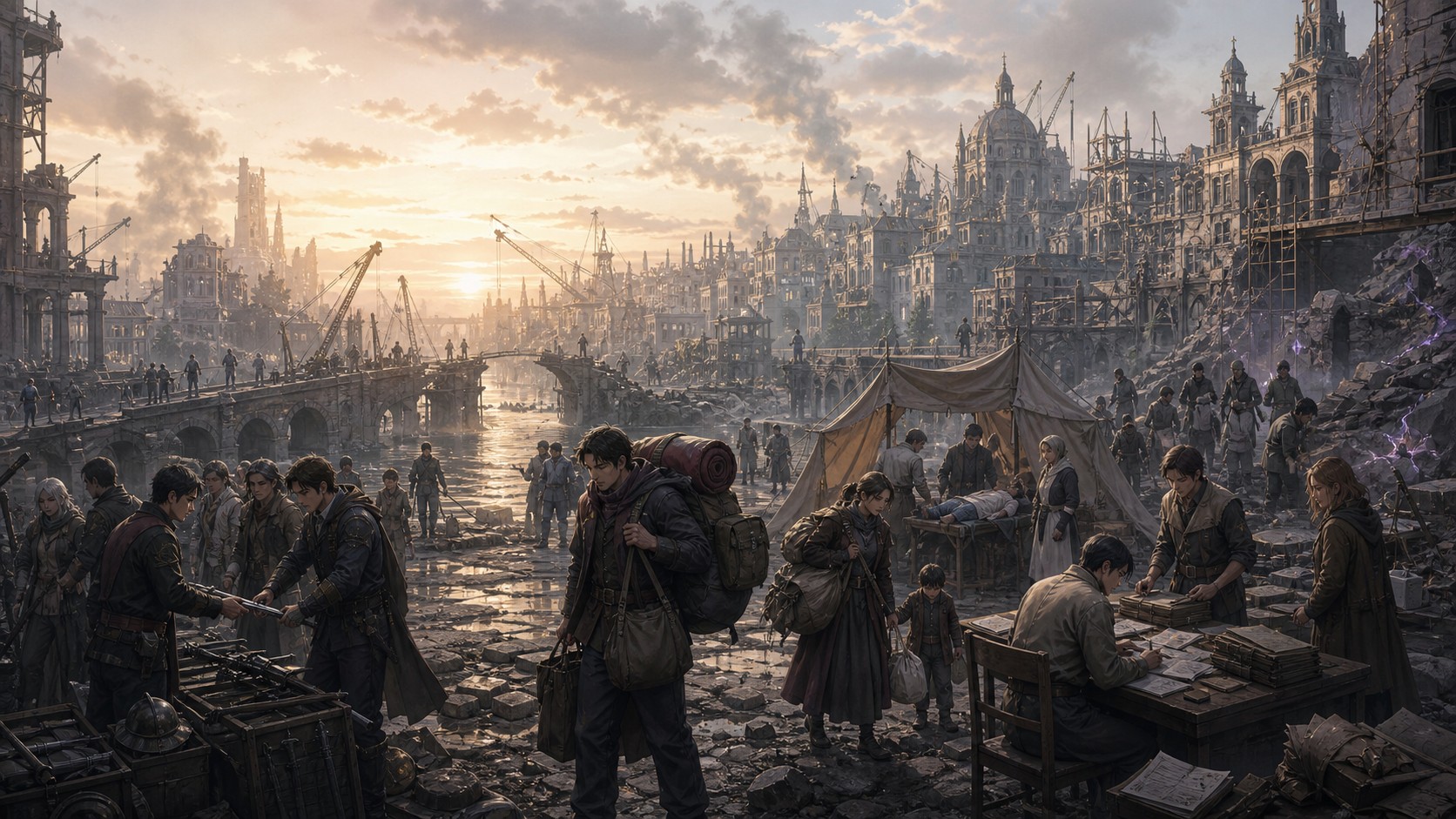
Anime Endings Keep Skipping the Reconstruction That Makes Peace Real
The villain falls, the sky clears, and the credits act like homes rebuilt themselves, refugees found their paperwork, soldiers returned to normal, and nobody had to remove the cursed weapons buried under the playground.
Bottom line first: anime postwar reconstruction begins when the battle ends because ending the battle is not the same as ending the war. A victory can stop the immediate killing while leaving destroyed housing, broken water systems, missing records, displaced families, unemployed soldiers, traumatized children, contaminated land, revenge politics, and a government with less money than the ruins require. Anime loves the moment peace becomes possible. Too many endings leave before anybody has to make peace function.
The shortcut feels satisfying because battles have visible objectives. Break the weapon. Defeat the emperor. Seal the demon. Stop the ritual. Reconstruction has no single health bar. A bridge can reopen while a school remains closed. A family can return while another family occupies the same house. A veteran can survive the front and fail to survive the silence afterward. Success arrives unevenly, which makes a clean final montage harder to sell.
That unevenness is exactly why reconstruction belongs in the story. War rearranges ownership, labor, authority, memory, and trust. Somebody profits. Somebody disappears. Somebody keeps a weapon. Somebody gets called a hero for destroying the infrastructure that somebody else must rebuild. When the ending skips those arguments, peace becomes a lighting change instead of a social condition.
The victory shot hides a housing crisis
Every collapsed building was somebody’s home, shop, clinic, school, warehouse, or workplace. Rubble is not empty scenery. Rubble is lost rent, missing tools, interrupted records, dead customers, scattered neighbors, and families sleeping wherever authorities allow. A city can win the war and still become unlivable.
Housing raises the first ugly postwar question: who owns what remains? Land registries may burn. Owners may die. Tenants may return before landlords. Refugees may occupy abandoned buildings because no other shelter exists. Soldiers may receive confiscated homes as rewards. Developers may buy damaged districts cheaply and push survivors farther out. A rebuilding plan can restore walls while creating a new class system.
Temporary camps can last for years because temporary solutions develop politics. Aid agencies build latrines and schools. Traders arrive. Local officials decide who qualifies for food. Residents find work nearby. Closing the camp may sound like progress while forcing people back toward unsafe land or towns that reject them. A believable ending would treat return as a decision with risks, not a parade route.
Magic does not remove the conflict. Earth mages can raise apartment blocks quickly, but somebody chooses the location and receives the contracts. Time magic can repair stone without restoring deeds. A purification spell can clean one district while the poor wait in another. Reconstruction magic makes state capacity stronger, which makes unequal use of that capacity harder to excuse.
Naruto rebuilds fast because the story wants the village back
Naruto understands emotional reconstruction better than physical reconstruction. Konoha survives catastrophic attacks, mourns leaders, absorbs orphaned children, and eventually modernizes. Bonds, memory, and recognition matter. The village can feel like a community because characters argue about what the village owes its people.
The physical recovery after Pain’s assault moves at story speed. Buildings return, administration resumes, and the population regathers because the final war needs Konoha functioning. Yamato’s abilities help explain rapid construction, but timber is not the whole problem. Households lost belongings, businesses lost inventory, families lost income, and medical workers faced mass casualties. Rebuilding every wall would not settle any of those losses.
The Fourth Shinobi World War creates an even larger gap. Multiple villages mobilize, thousands fight, and entire landscapes change. The later peace and technological growth show that cooperation produced something lasting. The missing middle contains veterans, widows, injured shinobi, village budgets, memorial politics, captured enemies, displaced civilians, and the reintegration of people trained to solve danger through violence.
Naruto becoming Hokage provides symbolic closure because the excluded child reaches the center of civic life. Institutional closure asks a different question: did the system that produced child soldiers change enough to stop producing the same wounds? A title can prove that one person entered the building. A reconstruction story would show whether the building learned anything.
Fullmetal Alchemist remembers that policy comes after confession
Fullmetal Alchemist: Brotherhood gives reconstruction more substance because the ending connects responsibility to institutions. Amestris cannot become decent through Father’s defeat alone. Military leadership, the occupation of Ishval, research abuses, command structures, and public legitimacy all remain. Characters talk about reform because the state caused harm through policy, not only through one supernatural villain.
Roy Mustang’s ambition matters most when tied to accountability and rebuilding. Scar and Miles moving toward Ishvalan recovery matters because survivors need land, security, culture, and political power. Those threads remain brief, but the story at least admits that peace requires budgets, offices, law, and people willing to work inside damaged institutions.
The series also understands records. Research notes, orders, names, evidence, and hidden histories move the plot. After mass violence, records determine who can prove what happened. Records support trials, pensions, property claims, missing-person searches, and memorials. Destroying evidence can protect perpetrators long after their weapons disappear.
Reconstruction becomes credible when truth changes material decisions. An apology without land return stays symbolic. A memorial without survivor support can become public decoration. A trial without institutional reform removes a few people while preserving the machine. Fullmetal Alchemist does not solve every part, but the ending points toward the right battlefield.
Violet Evergarden lives in the missing middle
Violet Evergarden begins where many action series stop. The war is over. The body and social identity built for war remain. Violet needs work, language, relationships, and a reason to exist outside command. Her mechanical arms are visible evidence that survival carries maintenance.
The postal company and Auto Memories Dolls may look far removed from reconstruction, yet communication is infrastructure. Families need death notices, legal letters, job applications, property documents, and messages across damaged regions. People separated by war need help turning experience into words. A letter can reconnect a household or confirm a loss that rumor left unresolved.
The series also shows that emotional recovery becomes labor, often feminized and undercounted. Someone listens. Someone writes. Someone carries grief between homes. The work does not rebuild a bridge, but a society cannot rebuild trust when people cannot name what happened or contact the people who survived elsewhere.
Violet’s journey avoids the fantasy that one victory makes a weapon into a civilian. Skills must be redirected. Authority must be unlearned. A veteran needs community, income, healthcare, and time. Personal recovery is not a substitute for public reconstruction, but personal recovery shows what every victory montage edits out.
Attack on Titan refuses the clean peace that fans want
Attack on Titan makes the aftermath part of its argument. Mass violence does not create stable understanding merely because the people who planned the violence are gone. Survivors inherit fear, propaganda, militarization, grief, and competing versions of history. Reconstruction can rebuild cities while political institutions prepare the next conflict.
The final images are disturbing because physical recovery and moral recovery separate. Buildings rise. Generations pass. Technology advances. Security anxiety remains available for leaders who need an enemy. A rebuilt skyline does not prove that the social causes of war were repaired.
The series also shows the scale problem. Violence that reaches across continents produces displacement and ecological damage beyond any single hero’s ability to address. Who delivers food when ports are destroyed? Who treats survivors when hospitals vanished? Who establishes borders when populations moved? A global catastrophe cannot receive a village-sized epilogue.
Some viewers wanted firmer reassurance. The lack of reassurance serves the theme, but the ending still leaves enormous administrative work off screen. That absence does not make the work irrelevant. The absence makes the final political uncertainty feel earned because nobody possesses a spell large enough to restore trust.
Physical recovery: Housing, water, power, roads, hospitals, schools, farms, communications and hazardous debris determine whether people can return. A rebuilt monument means little when the surrounding neighborhood still lacks safe water or a road for ambulances.
Human recovery: Healthcare, disability support, veteran services, family reunification, education, jobs and trauma care determine whether survival becomes a life. Those systems also reveal which survivors the new peace values and which ones leaders expect families to absorb quietly.
Political recovery: Records, courts, local government, elections, policing, rights, reparations and oversight determine whether peace belongs to civilians. Without those structures, the same commanders who won the war can keep ruling through emergency power and personal loyalty.
Security recovery: Disarmament, demobilization, reintegration, mine clearance, weapons control and civilian protection determine whether the war truly stops. A ceasefire can end open battles while leaving armed groups, abandoned weapons and frightened communities ready for the next spark.
Weapons do not vanish when soldiers go home
Postwar land remains dangerous. Mines, unexploded shells, cursed artifacts, unstable portals, poisoned zones, and abandoned laboratories can kill civilians long after the front moves. Children enter ruins. Farmers return to contaminated fields. Scrap collectors dismantle objects without knowing what still carries power.
Fantasy settings have endless ways to make explosive remnants worse. A dormant spell may react to blood. Summoned creatures may lose handlers. Automated golems may continue following old orders. A sealed weapon may leak corruption into water. Clearing the land requires maps, specialists, protective equipment, public warnings, and years of work.
The strongest warrior may be useless at that job. Demining rewards patience, procedure, and local knowledge. One careless victory pose can kill the crew. Stories that celebrate battlefield improvisation could create sharp tension by forcing heroes to respect technicians who refuse to move fast.
Land clearance also determines economic recovery. Farmers cannot plant dangerous fields. Builders cannot lay foundations in contaminated districts. Refugees cannot return to homes surrounded by magical traps. Every uncleared road raises transport costs and isolates services. Security work becomes development work because safe land is the first public asset.
Demobilization asks what happens to people trained for violence
An army cannot simply dismiss thousands of fighters and expect calm. Soldiers need identification, transport, final pay, healthcare, counseling, education, and jobs. Commanders may resist surrendering power. Units may become criminal groups. Veterans may keep weapons because the new government cannot promise protection.
Disarmament sounds simple until a weapon is also a livelihood, family heirloom, magical focus, proof of status, or defense against revenge. Turning in a sword may leave a former soldier helpless in a district controlled by yesterday’s enemy. A credible program provides security and a future, not only a collection bin.
Child soldiers need different support. Returning home does not restore missed education or erase the survival skills adults taught them. Communities may fear them. Families may be gone. Some children may identify more strongly with former units than with villages they barely remember. A school uniform cannot function as instant moral repair.
Anime heroes often recruit former enemies into the next adventure, which works for a small cast. A country has thousands of less charming combatants. Reintegration needs local trust, income, accountability, and monitoring. Forgiveness cannot be ordered from the capital, and permanent exclusion can create the next armed group.
Justice and stability pull against each other
After war, leaders often claim that trials would disturb peace. Survivors may hear that demand as another order to carry the cost quietly. Punish everyone and the administration may collapse because former officials hold essential knowledge. Punish nobody and victims learn that power still protects itself.
Different tools answer different harms. Criminal trials address individual responsibility. Truth commissions build public records. Reparations recognize losses materially. Vetting removes dangerous officials. Local reconciliation can repair relationships that national courts never reach. None of these tools can substitute for all the others.
Fantasy stories can make the conflict concrete. Does the mage who designed a city-killing spell receive immunity for helping disable the remaining weapons? Does a conscript face the same judgment as a commander? Can a transformed soldier control actions taken under magical compulsion? Who decides whether a royal apology counts when the royal family keeps the land?
A clean execution scene may satisfy anger while hiding institutional complicity. One minister could not run prisons, move troops, seize farms, and erase records alone. Reconstruction requires naming the network. Otherwise, the next leader inherits the same offices, files, and incentives with a nicer speech.
Property records can decide whether refugees become citizens again
Returning home often depends on proof. A family may know exactly where a house stood while officials demand a deed that burned with the house. Women may have lived on land registered to dead husbands. Informal communities may never have held documents. Minorities may discover that wartime authorities rewrote ownership.
Records restoration sounds dull until two families claim one doorway. One fled early. Another was displaced later and moved into the empty structure. Both lost homes. Removing one family to restore the other does not produce justice by itself. Housing policy, compensation, mediation, and new construction must work together.
Identity papers also control services. No document can mean no food ration, school enrollment, pension, travel permit, or vote. Refugees born during displacement may have no recognized citizenship. A fantasy kingdom with magical blood tests could make exclusion even harsher by treating biology as destiny.
Clerks become powerful because bureaucracy allocates belonging. A corrupt clerk can erase a claimant. A brave clerk can preserve evidence. A transparent appeals process can prevent a desk from becoming another battlefield. Reconstruction needs heroes who know where the files went.
Women do not stop carrying the war when the battle ends
Postwar care work expands. Injured relatives need assistance. Children return to damaged schools. Water sources move farther away. Food becomes harder to find. Missing family members must be traced. Much of that labor falls on women and girls without wages or public recognition.
Conflict may also change gender roles. Women run farms, shops, clinics, local councils, and resistance networks while men fight. Returning soldiers and political leaders may expect the old order to resume, pushing women out of work and authority. Reconstruction can rebuild inequality as efficiently as a bridge.
Sexual violence survivors need confidential healthcare, legal support, income, and protection from retaliation. Children born from violence may face stigma. A heroic national story may pressure survivors into silence because their experiences complicate the victory narrative. Public memory chooses whose pain fits the flag.
Anime endings that pair everybody into marriages can accidentally turn social recovery into romantic placement. A wedding proves that two characters chose each other. A wedding does not prove that housing, healthcare, childcare, inheritance law, or public safety recovered. Domestic happiness cannot carry the whole state on its back.
Schools rebuild the future and rewrite the past
Reopening schools gives children routine, meals, safety, and a path away from recruitment. Schools also decide how the war will be taught. One textbook may call a battle liberation. Another may call the same battle invasion. Students bring family memories that contradict both.
Teachers need training to handle mixed classrooms of returnees, former enemies, displaced children, and students with disabilities. Buildings need repair. Records need reconstruction. Older students may never return because families need income. A government can announce that schools reopened while quietly losing a generation.
Curriculum becomes part of peace. Teaching only national innocence protects pride and prepares repetition. Teaching only guilt can become another political weapon. Good reconstruction creates room for evidence, multiple experiences, and responsibility without assigning inherited blame to children.
Fantasy schools add magical risk. Students may carry uncontrolled powers shaped by trauma. Former military academies may need civilian oversight. Dangerous techniques may remain in textbooks. Teachers may be veterans with no preparation for ordinary classrooms. The school arc after the war could be more politically interesting than the tournament arc before it.
Peace needs a budget, not a montage
Reconstruction costs compete. A government must choose between housing and a new palace, rural roads and a victory memorial, veteran pensions and foreign debt, mine clearance and military expansion. Donors may fund photogenic projects while sewage remains broken. Contractors may profit from emergency rules.
Money also decides geography. Capitals rebuild first because cameras and officials are nearby. Remote villages wait. Regions associated with the enemy may receive punishment through neglect. Wealthy districts attract private investment while poor districts depend on slow public funds. A rebuilt nation can look impressive from the palace balcony and remain shattered at the edges.
Debt gives outside powers influence. Loans may restore ports and power plants while requiring policies that anger citizens. Aid can save lives while strengthening unelected administrators. Reparations can support victims while becoming impossible for a defeated economy to pay. Every source of money carries political conditions.
A believable ending does not need to balance every account. One budget dispute can show priorities. One unfinished clinic can reveal who lost. One corrupt contract can connect victory elites to new inequality. The reconstruction economy tells viewers what kind of peace replaced the war.
How anime can show reconstruction without adding another season
Start with consequences that match the destruction. If a city fell, show housing and utilities. If armies recruited children, show education and reintegration. If magic poisoned land, show clearance and health monitoring. Specific damage deserves specific recovery.
Give recovery to named institutions and workers. Engineers inspect bridges. Local councils register returnees. Nurses run mobile clinics. Archivists restore records. Demobilization teams collect weapons. Teachers reopen classrooms. Characters do not need long biographies, but visible labor prevents the city from rebuilding through weather.
Let former heroes face limits. The strongest fighter may lack authority to settle a land claim. The beloved commander may be terrible at civilian management. The brilliant mage may design a purification system that municipalities cannot afford. Victory skills do not automatically become governance skills.
Keep disagreement inside peace. Survivors can want justice and stability at the same time. Refugees can want to return and fear returning. Veterans can deserve care and accountability. Citizens can celebrate liberation while resenting taxes. Peace becomes believable when conflict changes form instead of disappearing.
The ending begins after the weapon breaks
Anime does not owe viewers a municipal report after every finale. Anime does owe its own destruction a memory. A story cannot flatten five cities, scatter a population, recruit children, poison the land, and then use one festival to declare the social order repaired.
The better ending shows what victory made possible and what victory failed to solve. A bridge reopens while families argue over housing. A veteran starts work while another keeps a weapon. A trial begins while records remain missing. A school welcomes children into a classroom built beside ruins.
That ending does not need a motivational speech. Reconstruction is repetitive, political, expensive, and unequal. Some damage remains. Some people never return. Some officials steal. Some institutions improve because citizens force them to improve. Peace survives through maintenance, not destiny.
So let the heroes stand under the clear sky. Then turn the camera toward the clerks, cleaners, builders, teachers, nurses, deminers, families, and exhausted local officials walking into the wreckage. The villain’s defeat ended the plot’s emergency. Their work decides whether the ending was true.