
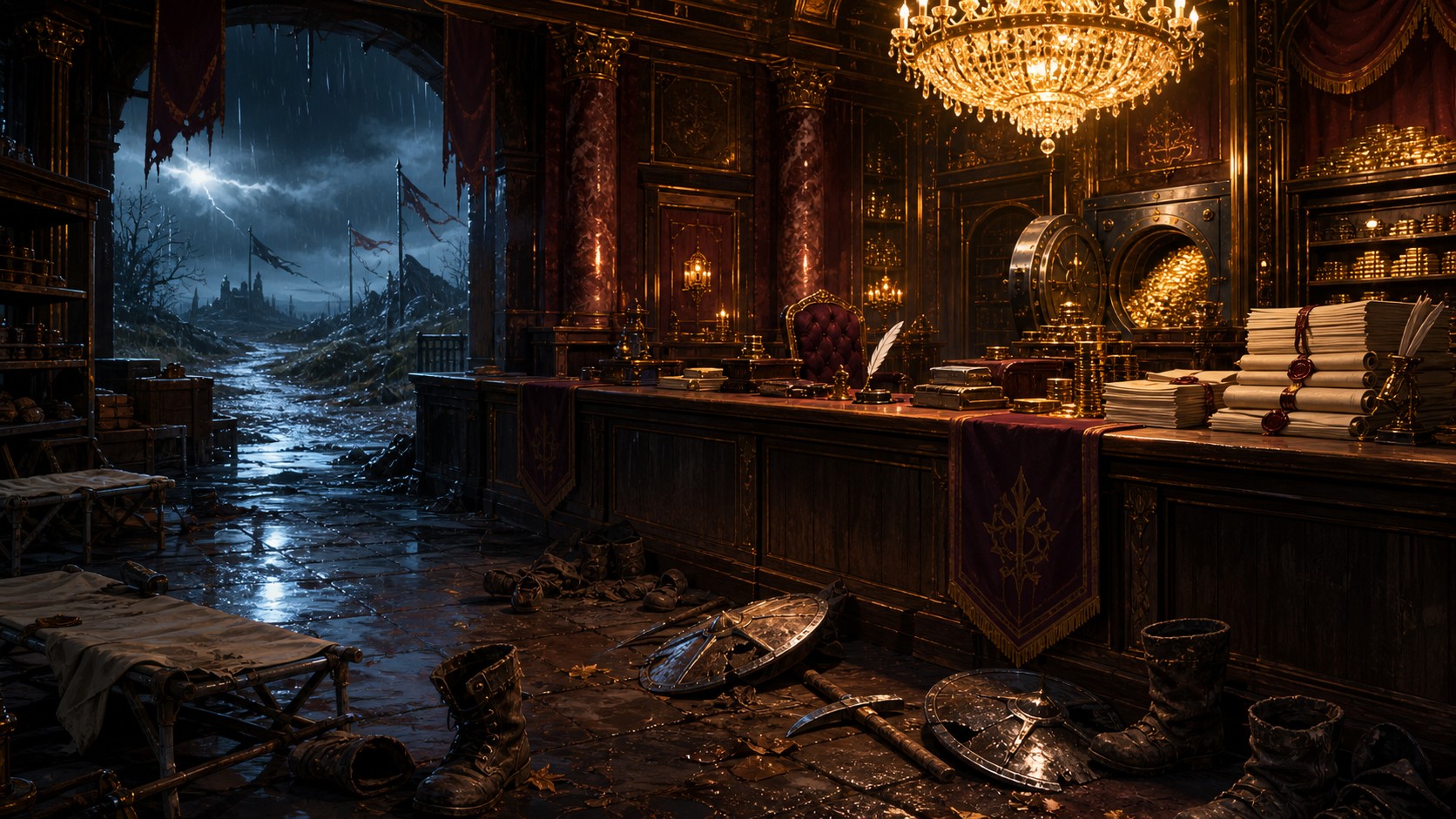
Anime Adventurer Guilds Are Labor Exploitation With Better Branding
The guild owns the counter, controls the jobs, sets the rank, takes a cut, protects the client, and still acts shocked when the adventurer asks who pays for the broken ribs.
Bottom line first: the guild cannot control the work, collect the fees, and dump every predictable cost on the adventurer. Anime adventurer guilds sell a gorgeous fantasy of freedom. Walk into a warm hall, choose a quest from the board, gather friends, defeat the monster, and return with coin. No manager watches the clock. No office traps anybody under fluorescent lights. The adventurer looks independent right up until the contract goes wrong. Then the guild keeps the fee, the client denies responsibility, the healer sends a bill, the ranking office blames poor judgment, and the worker discovers that freedom meant carrying every risk alone.
The Complaint Is Not That Quests Pay Money
Fantasy worlds need people who clear roads, rescue villagers, investigate ruins, escort merchants, hunt dangerous creatures, and respond when local guards cannot handle a threat. A guild can solve real coordination problems. Clients need a place to request help. Workers need reliable information about jobs. Towns need standards for deciding who can accept dangerous assignments. A shared hall can create community in a profession defined by travel, injury, and uncertain income.
The complaint begins when the guild performs the functions of an employer, licensing board, temp agency, insurer, police contractor, and credit bureau while accepting the duties of none. Guild staff verify jobs, classify danger, control access, punish misconduct, distribute payment, preserve reputation records, and decide who advances. Adventurers depend on that system for income. Yet stories often call those workers independent whenever injury, bad information, or unpaid labor raises the question of responsibility.
That arrangement is not freedom. That arrangement is a powerful intermediary transferring risk downward. The organization collects information from clients but may not guarantee accuracy. The guild controls the ranking system but may not provide enough training to meet rank expectations. The guild sends workers into public danger but may offer no equipment, medical coverage, survivor support, pension, death benefit, or appeal process. A pretty quest board does not make the bargain fair.
What the Trope Gets Right
Guild stories understand the appeal of visible work. A quest has a clear need, a named reward, and a result that matters to somebody. Modern work often hides its purpose behind layers of administration. Fantasy labor puts the worker close to the person who needs help. Fix the bridge and travelers cross safely. Find the medicine and a family survives. Defeat the creature and farmers return to their fields. That direct connection gives labor emotional weight.
The trope also respects skill earned through practice. New adventurers begin with simple tasks because experience matters. Teams form around complementary abilities. A healer, scout, defender, negotiator, and damage specialist solve different problems. Reputation can reward reliability instead of family status. A functioning guild could open a profession to people who lack noble connections by publishing opportunities and recognizing demonstrated competence.
Shared halls create informal safety networks too. Veterans warn beginners about dishonest clients. Workers hear which roads are unsafe. Parties recruit replacements. Missing people are noticed. Rival teams sometimes cooperate during emergencies because professional identity becomes larger than competition. Those details make guilds feel alive and explain why workers tolerate flawed institutions. The hall provides friends, information, and belonging that nobody else offers.
Good fantasy labor should preserve those strengths. The answer is not replacing every quest with a government desk and six forms. The answer is asking who carries predictable costs. Independence can be real when workers have bargaining power, clear information, multiple sources of income, control over methods, access to insurance, and the ability to refuse bad jobs. Independence becomes branding when refusal means hunger and the platform controls every route to paid work.
Fairy Tail Shows the Guild as Family and Workplace
Fairy Tail makes guild membership emotionally powerful because the hall is more than a job market. Members eat together, fight together, celebrate together, and protect one another from threats that official systems cannot handle. The guild gives abandoned and lonely people a home. Masters know their members personally. Stronger workers step in when younger members face danger. The tattoo represents belonging, not only registration.
That family model can protect workers where formal rules fail. A member hurt on a job is surrounded by people who care. A client who targets one member may face the whole guild. Experienced mages share knowledge. The organization can absorb risk across many workers instead of leaving every individual alone. Those are real advantages, and the series understands why loyalty grows from care rather than contracts.
Family language can also hide workplace power. A guild master still controls discipline, recognition, and organizational direction. Members cause enormous property damage, take dangerous assignments, and face conflicts that extend far beyond ordinary contract work. Emotional loyalty can make refusal feel like betrayal. The guild’s ability to solve problems through personal devotion depends heavily on having a good leader. A cruel or careless master could exploit the same structure with very little formal resistance.
A believable guild would keep the family while adding rights that do not depend on affection. Members would know how job fees are divided. A common fund would cover injuries, disability, families of dead workers, emergency housing, and equipment loss. Elected representatives would review discipline. Independent investigators would examine misclassified quests. Loyalty would remain meaningful because workers choose the community, not because survival requires pleasing one powerful adult.
Goblin Slayer Reveals the Cost of Bad Classification
Goblin Slayer builds much of its horror around society underestimating low-status threats. Beginner adventurers accept goblin work because the quests appear simple, the rewards are small, and experienced fighters chase more prestigious targets. Villages suffer because the market undervalues prevention. New workers suffer because danger is classified through reputation rather than evidence. The guild knows goblins are a recurring threat, yet the labor pipeline still feeds unprepared people into predictable disasters.
The series gets something painfully right: low pay does not mean low risk. Essential work can remain cheap when the people needing help are poor and the workers accepting the job lack alternatives. A remote village cannot offer a dragon-sized reward. A beginner needs income and experience. The gap between social value and market price becomes a trap. Everybody behaves rationally inside a structure producing terrible outcomes.
A competent guild would pool public resources for threats that private clients cannot afford. Repeated goblin activity would trigger regional prevention funds, verified intelligence, minimum party standards, protective equipment, veteran supervision, and emergency support. Beginners would train in controlled environments before entering nests. Clients would not be asked to personally finance the full cost of public safety. Prestige incentives could reward experienced teams for prevention instead of only spectacular victories.
Most importantly, classification errors would create responsibility. If a guild labels a job safe after receiving warnings, injured workers should not bear the loss alone. Investigators should review the intake process. Families should receive compensation. Records should change future assignments. A system that merely adds another name to a memorial wall has turned casualties into operating expenses.
Konosuba Understands Precarious Work Better Than Many Serious Shows
Konosuba jokes about poverty, debt, useless skills, property damage, and jobs that pay less cleanly than promised. The comedy lands because the financial pressure is recognizable. The party cannot survive on glory. Equipment costs money. Housing costs money. Injuries interrupt earnings. A reward may vanish into repairs or debt. Powerful abilities do not guarantee stable income when the team’s labor process is chaotic.
The guild hall looks social and welcoming, but jobs still function as piecework. No completed quest means no pay. Preparation time is unpaid. Failed attempts can create new costs. Workers supply much of their own equipment. Seasonal danger changes demand. A spectacular success can briefly solve money problems without creating long-term security. The fantasy mirrors gig work even while characters laugh through the consequences.
Comedy should not erase the system hiding under the jokes. A guild in that world could charge membership dues in exchange for equipment pools, training, legal help, group insurance, and emergency loans with fair terms. Workers could organize parties into cooperatives that share income across good and bad months. Public disaster contracts could pay retainers so capable teams remain available before a crisis instead of scrambling after damage begins.
Those changes would create more comedy, not less. Imagine adventurers arguing over reimbursement rules, a reckless fighter trying to classify an explosion as normal wear, or a goddess attempting to submit a healing claim without documentation. Labor structure gives characters new reasons to clash. Financial reality already powers the series. A more visible system would sharpen the joke.
Is It Wrong to Pick Up Girls in a Dungeon? Turns Risk Into a Family Economy
Is It Wrong to Pick Up Girls in a Dungeon? connects adventuring to Familias, which provide identity, training, power development, housing, and social status. The arrangement offers more support than a bare quest board because workers belong to organizations with leaders and shared resources. A caring deity can invest in members who would otherwise be ignored. Small Familias can feel intimate and loyal, while large ones can coordinate dangerous expeditions requiring complex logistics.
The power imbalance remains huge. A worker’s abilities, reputation, housing, debt, and social circle may all depend on one Familia. Leaving can mean losing the only institution capable of updating status or opening career opportunities. Competition among Familias can turn members into symbols of prestige. Recruitment becomes personal because leaders offer belonging alongside work. The same emotional promise that saves an isolated adventurer can make exploitation harder to name.
Debt matters especially. Equipment, housing, medical care, and organizational expenses may be framed as support, but unclear debt can bind workers more tightly than a wage contract. A good leader may forgive costs. A bad leader may use costs to control movement. Workers need written terms, transparent accounts, limits on deductions, portable records, and a real exit path. Affection cannot replace those protections because affection changes when power is challenged.
The Guild Resembles a Labor Platform
Modern digital platforms connect clients with workers, set rules for access, rank performance, process payment, and still describe workers as independent contractors. Fantasy guilds perform a similar role with parchment instead of an app. The guild owns the reputation system. Clients see only approved workers. Adventurers see only posted jobs. A worker who loses access may lose the entire market.
The International Labour Organization describes disguised employment as an arrangement that gives work a different appearance from the underlying reality in order to weaken legal protection. Dependent self-employment can occur when a person is formally independent but relies on one or a few sources for income and receives direction about how work is performed. Fantasy law may differ, but the idea helps readers identify the same power pattern.
Control should create duties. If the guild sets prices, assigns ranks, requires specific conduct, penalizes refusal, and controls payment, the organization should not disappear when responsibility becomes expensive. Workers deserve clear contracts, timely payment, protection against retaliation, access to records, and an impartial dispute process. A client who lies should face consequences. A guild that withholds critical information should share liability.
Real independence would also allow alternatives. Adventurers could form cooperatives, negotiate directly with communities, join competing guilds without losing their records, or establish specialized associations. Reputation should be portable. Training certificates should belong to the worker. A guild should earn loyalty through service instead of locking the door to every other income source.
Ranking Systems Can Become Economic Cages
Ranks help match skill to danger. Sending a beginner against a threat designed for veterans is irresponsible. Certification can protect clients too. A village deserves confidence that the person accepting a rescue job understands basic procedures. Problems arise when rank becomes a single number controlling income, dignity, and access while the evaluation process remains secret.
Workers need to know how advancement works. Does the guild measure completed quests, difficulty, teamwork, client satisfaction, survival, property damage, or political favor? Can a healer advance without delivering a killing blow? Does refusing an unsafe job lower reputation? Can a client retaliate with a dishonest review? Do wealthy adventurers advance faster because superior equipment makes early work easier?
A fair system would use multiple measures, publish criteria, allow appeals, and separate safety reporting from performance penalties. Workers should not hide injuries or near misses to protect rank. Group achievements should not vanish behind one famous fighter. Support roles should receive credit. Temporary disability should not erase years of competence. Rank should describe current certification, not human worth.
The guild should also audit outcomes across class, race, species, gender, disability, nationality, and magical ability. A neutral-looking test can reproduce inequality when preparation costs are private. If only wealthy candidates can afford potions, armor, travel, and unpaid training, the rank measures resources alongside skill. A serious guild would fund equipment grants and paid apprenticeships because competence grows from access.
Occupational Safety Does Not Ruin Adventure
Fantasy stories sometimes treat safety as cowardice. The reckless hero ignores protocol, wins through instinct, and proves that rules only slow exceptional people down. That pattern works once. Repeated across an industry, the same pattern kills ordinary workers. Most adventurers are not chosen by prophecy. They need reliable maps, tested equipment, threat reports, backup plans, rest limits, and somebody checking whether the bridge actually holds.
The ILO recognizes a safe and healthy working environment as a fundamental principle and right at work. Occupational safety focuses on identifying hazards, assessing risk, preventing harm, and building systems that learn from accidents. A guild facing monsters, ruins, curses, weather, bandits, and magical contamination would need stronger safety management than an ordinary workplace.
Safety can generate suspense. A team follows the correct plan and discovers that somebody altered the map. A client pressures the guild to hide contamination. A senior adventurer refuses an assignment after recognizing a pattern in near-miss reports. A corrupt official disables an evacuation route. The danger becomes specific and political rather than random. Competence gives the story stakes because viewers understand what should have protected the workers.
Near misses should matter too. When a party barely escapes, the guild should record why. Did the threat evolve? Was the client wrong? Did equipment fail? Did exhaustion reduce judgment? Did the rank system encourage overconfidence? Learning before a funeral is the entire point of prevention. A guild that only counts completed quests has confused luck with safety.
Who Pays After the Quest?
The reward posted on the board is not the worker’s real income. Adventurers buy weapons, armor, food, travel, information, lodging, medicine, potions, repairs, and replacement supplies. They spend unpaid time preparing, traveling, waiting, negotiating, and recovering. A job that looks generous can become a loss after costs. Dangerous work also creates future costs through chronic injury, disability, and trauma.
Contracts should explain expenses before acceptance. Clients may reasonably cover specialized supplies needed only for their job. Guilds can operate shared equipment libraries. Travel advances can prevent poor workers from borrowing at abusive rates. Medical funds can spread unpredictable costs across many members. Disability support can recognize that a worker injured protecting the public should not fall into poverty when combat ends.
Death benefits matter in worlds where death is a normal occupational risk. Families should not depend on teammates passing a hat. A guild that takes fees from every successful quest can fund survivor payments. Public contracts can contribute to the pool. Wealthier clients can pay risk-based premiums. Transparent accounting would show whether the guild serves workers or uses tragedy as branding.
Payment timing matters as much as payment size. Workers cannot buy dinner with a promise that the client will settle next month. The guild should guarantee verified contracts and pursue the client separately. If administrators control the money, they should bear collection risk. Delayed payment is not an inconvenience when the worker already financed the mission.
Adventurers Need the Right to Organize
Guilds often call all members family while discouraging collective disagreement. Individual heroes negotiate through charisma or strength. Ordinary workers need a different tool. They need meetings where they can compare pay, report patterns, elect representatives, and refuse unsafe conditions together without being labeled disloyal.
Collective bargaining fits fantasy worlds beautifully. Healers might demand minimum staffing. Porters might refuse dungeon work without hazard pay. Scouts might insist that clients provide accurate maps. Low-ranked adventurers might challenge fees that consume small rewards. Veteran parties might support a strike after too many beginners die. Political leaders could threaten to replace them with desperate outsiders, revealing who benefits from division.
Worker voice would also restrain reckless stars. Famous adventurers can create hazards for everyone by destroying property, escalating fights, or accepting impossible deadlines. A professional association could enforce standards while protecting due process. Accountability should run in both directions: the guild owes workers protection, and workers owe communities competent service.
The ILO includes freedom of association and collective bargaining among fundamental principles and rights at work. Fantasy settings do not need modern unions copied word for word, but workers still need independent power. A complaint box controlled by the guild master is not independent power. A real organization can survive members saying the rules are wrong.
How to Build a Better Guild Without Killing the Fantasy
First, separate the guild’s roles. A job broker should not be the only safety inspector, disciplinary court, insurer, rank evaluator, and appeals body. Independent review prevents one office from protecting its own mistakes. Small towns can share regional services when resources are limited. Magical communication can support emergency reporting without turning every quest into surveillance.
Second, price the full job. Rewards should include labor, preparation, travel, equipment wear, hazard, team size, and recovery time. Public subsidies should cover essential work for poor communities. Clients should place funds in escrow. Deliberate deception should trigger penalties and compensation. Workers should see the same information administrators see.
Third, make training paid and portable. Beginners should not finance weeks of mandatory instruction while the guild benefits from a larger labor pool. Apprentices can earn wages through supervised lower-risk work. Certifications should travel with the worker. Leaving one guild should not erase skill or reputation. Portability turns loyalty into a choice.
Fourth, create care that lasts beyond the final panel. Healers need budgets. Injured adventurers need rehabilitation. Disabled veterans need respected roles in training, planning, research, mediation, and administration. Trauma care should not depend on finding one unusually patient teammate. Retirement should exist before the body collapses.
Finally, let reform create story. Guild owners can resist costs. Clients can flee to cheaper brokers. Workers can disagree about risk. Villages can demand service during a strike. A beloved master can discover that kindness never became policy. A young adventurer can realize that changing the contract may save more lives than completing one more impossible quest.
A Guild Worth Joining Carries Its Share of the Risk
The tunnel starts beneath the fantasy of freedom. Adventurers look independent because nobody guarantees a wage. The guild looks helpful because the counter is warm and the staff smiles. Follow the money and control, though, and the structure becomes clear. The guild organizes the market, collects fees, distributes reputation, and transfers the cost of failure to people with the least power.
The vision keeps everything fans love: strange jobs, found family, rival teams, monster roads, hard-earned rank, warm meals after danger, and the thrill of choosing a quest. The difference is that the institution becomes believable. Workers know the risks, share the rewards, carry portable credentials, receive care, and possess enough collective power to challenge the counter.
The journey ends when the guild stops calling exploitation adventure. Danger can remain part of the profession. Nobody can promise that every ruin is safe or every client is honest. Responsibility begins before certainty. A guild worthy of loyalty prepares for predictable harm, learns from failure, and refuses to build a chandelier with money saved by leaving injured workers in the rain.
Receipts and Further Reading
- International Labour Organization: The Employment Relationship, on reciprocal rights and obligations and how employment status connects workers to protection.
- ILO: Disguised Employment and Dependent Self-Employment, on arrangements that look independent while workers remain economically dependent.
- ILO: A Safe and Healthy Working Environment, on occupational safety as a fundamental principle and right at work.
- ILO: Occupational Safety and Health Management Systems, on hazard identification, risk assessment, prevention, and organizational learning.
- ILO Recommendation No. 198, on effective worker protection, disguised employment, and responsibility across contractual arrangements.
- ILO: Fundamental Principles and Rights at Work, including freedom of association, collective bargaining, and safe work.
RaeRae’s Bottom Line
Adventuring can be dangerous without making exploitation sacred. The guild gets to keep the roaring fireplace, the ridiculous quests, the rival parties, the dramatic rank-ups, and the first drink after everybody returns alive. The workers get honest information, fair pay, medical care, portable records, a voice in the rules, and somebody besides themselves carrying the cost when the system fails. That bargain sounds less romantic only if the romance depended on disposable people.