
ANIMATION 101 · ALADDIN WATCH ORDER · MOVIES, SERIES, CROSSOVER, REMAKE
Aladdin Watch Order: The Animated Movies, Television Series, Crossover, and Live-Action Retelling
Start with the 1992 movie. Then decide whether you want one complete night or the entire Agrabah continuity with every branch labeled correctly.
The short answer if you want the cleanest story route
Watch the 1992 feature first, then The Return of Jafar, the animated television series, and Aladdin and the King of Thieves. That route follows the order in which Disney released the central animated story and preserves the major relationship changes. The first movie forms the family. Return of Jafar brings Iago back and establishes the television status quo. The series turns Agrabah into a weekly adventure world. King of Thieves closes the animated run with Aladdin and Jasmine’s wedding and the arrival of Aladdin’s father, Cassim.
You can stop after the 1992 film and still have a complete story. The sequels and series are additions rather than missing final chapters. If you continue, however, do not jump directly to King of Thieves and expect every relationship to feel untouched. Iago’s place beside the heroes comes from Return of Jafar and the series. Genie’s return and Aladdin’s public role also make more sense when the middle branch is allowed to exist.
The 2019 live-action film is a separate retelling. Watch it after the 1992 film if you want to compare adaptation choices, or save it until after the animated branch if you want one uninterrupted continuity first. It does not replace the animated sequels, television episodes, or their character history. It starts over with a new cast, new political emphasis for Jasmine, and a different solution for Genie’s freedom.
Step one: Aladdin (1992)
The original feature establishes Agrabah, Aladdin, Jasmine, Genie, Abu, Carpet, Jafar, Iago, the Sultan, the lamp, and the emotional rule that matters most: Aladdin’s problem is not poverty alone. He has learned to believe that honesty will disqualify him from love and belonging. The wishes can change his clothes, procession, and apparent rank. They cannot make the lie safe.
This movie also contains the visual and musical language every later branch borrows. The Cave of Wonders, the palace silhouette, the color opposition between Genie and Jafar, the flight over the city, and the release of Genie become franchise grammar. Starting elsewhere means encountering those symbols after a sequel has already assumed you know why they matter.
For a first watch, use the currently available official cut in your region and remember that Disney has revised the opening lyric over time. The existence of several audio versions does not create a different plot order, but it belongs in any honest conversation about the film’s representation history. The movie changed because criticism reached the studio.
Step two: The Return of Jafar (1994)
The Return of Jafar began life as the launch mechanism for the television series, and you can feel that practical assignment. Animation is less lavish, songs are smaller, and the plot spends its energy moving Iago from Jafar’s side toward an uneasy place near Aladdin. Treating it as a theatrical-scale sequel creates the wrong expectation. Treating it as a bridge makes its choices clearer.
Jafar escapes because Abis Mal finds the lamp. Genie has returned from traveling. Aladdin is living at the palace without having settled every class insecurity the first movie exposed. Iago wants safety, reward, and recognition, then discovers that choosing people only when they are useful reproduces Jafar’s entire moral system. His eventual act of resistance gives the series a reason to keep him around.
Watch this before the series even if you are tempted to skip it. The television branch assumes Iago can participate in the group while remaining selfish, loud, and distrusted. That tension is one of the more interesting continuities Disney accidentally built. Forgiveness does not make him pleasant. It makes him responsible for what he does next.
Step three: Aladdin: The Series
The television series expands Agrabah through monsters, sorcerers, rival kingdoms, magical objects, old enemies, and new allies. It aired in a complicated broadcast arrangement, including preview episodes and syndicated ordering differences, so platform numbering may not match every fan list. For story purposes, watch after Return of Jafar and before King of Thieves.
Many episodes are designed to stand alone. That means you do not need a spreadsheet to understand every adventure, but recurring characters reward continuity. Mozenrath, Mirage, Mechanicles, Sadira, Amin Damoola, and other figures make Agrabah feel larger than Jafar’s shadow. Jasmine gets more opportunities to act outside the marriage plot, although the writing remains uneven about how much authority she actually holds.
The series also reveals the cost of turning a feature-film world into weekly television. Magic becomes common enough to power a new crisis almost every episode. Genie’s abilities fluctuate according to the joke and plot. Cities appear when the story needs a diplomatic problem. The branch is expansive rather than perfectly regulated. Watch for character choices and recurring relationships before trying to force every spell into one technical system.
If availability prevents a full run, prioritize recurring-villain episodes, Sadira’s arc, episodes centered on Jasmine’s governance, and stories that develop Iago’s loyalty. A partial route is better when it is transparent about being partial. Do not label a handful of favorites a complete canon watch order and quietly drop the seventy-plus episodes that made the animated franchise a television world.
The Hercules crossover belongs near the end of the television branch
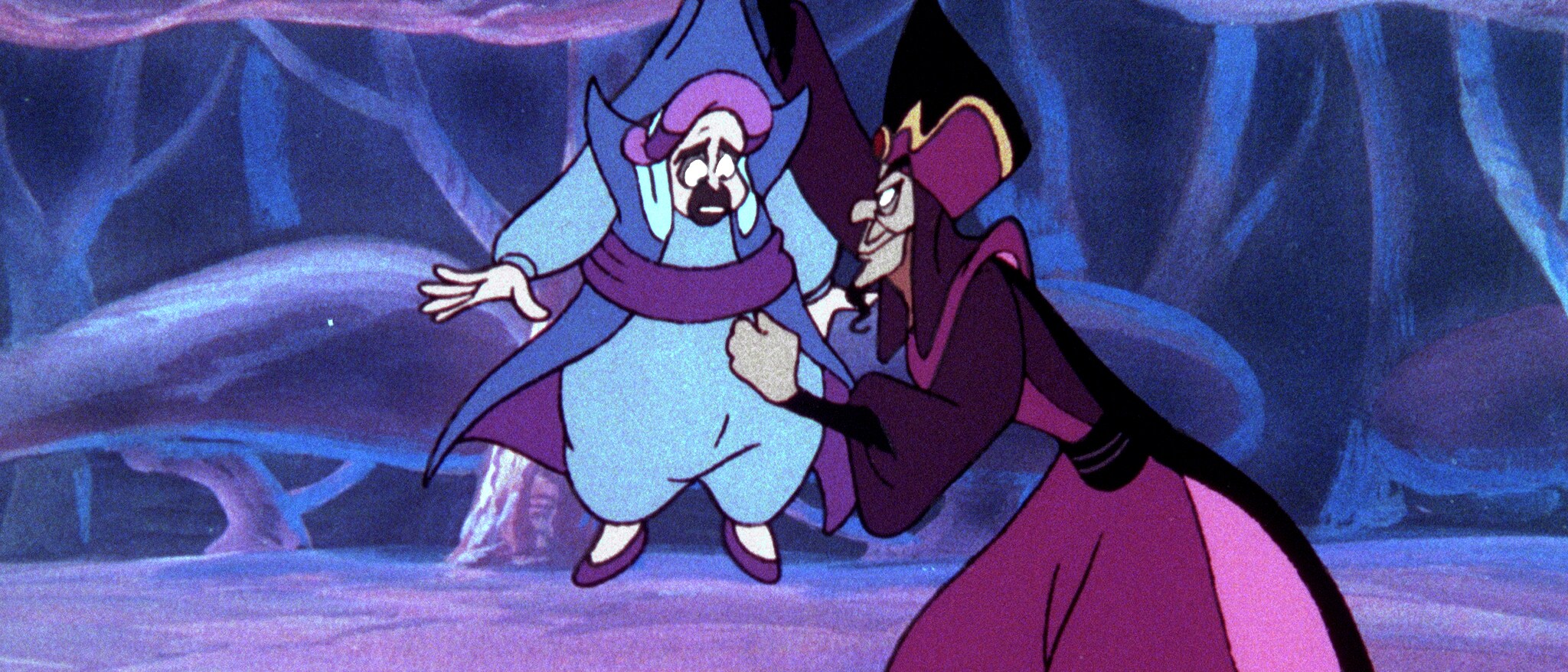
The Hercules animated-series episode commonly called “Hercules and the Arabian Night” brings Jafar and Hades into the same plot. Crossovers are continuity trouble by design. They want the audience pleasure of recognition more than a clean calendar. Watch it after you understand both animated series, or treat it as a bonus after Aladdin’s television run.
The episode does not need to control the main Aladdin chronology. Jafar’s presence can generate arguments about when and how he is available, but a crossover built around two villains trading schemes is already operating with flexible rules. Label it as an official television crossover and preserve the fun without using it to rewrite every ending around it.
Step four: Aladdin and the King of Thieves (1996)
King of Thieves returns to a feature-length event and brings Robin Williams back as Genie. Aladdin and Jasmine are finally preparing to marry when the Forty Thieves interrupt the wedding. Cassim’s arrival turns Aladdin’s old shame about being parentless and poor into a direct family conflict. The Hand of Midas gives that conflict a magical object capable of making greed literal.
This works best as the animated finale because the wedding carries accumulated history. Aladdin is no longer trying to impersonate a prince to enter Jasmine’s world. He is trying to decide what kind of husband and son he can be when a lost parent appears with explanations and another dangerous obsession. Jasmine’s patience exists beside boundaries. Genie’s comedy exists beside the knowledge that this family has survived a lot of magical men with plans.
The film does not close every possible story. Agrabah can obviously have more adventures. It closes the central romantic delay and gives Aladdin an answer about his father. That emotional finality is why it should remain after the television series even if a platform interface presents the franchise as a row of unrelated movies.
Where the 2019 Aladdin belongs
The live-action remake repeats the 1992 spine while adding Dalia, Prince Anders, a stronger governing ambition for Jasmine, new lyrics, and a human future for Genie. Watch it as a parallel branch. Characters share names and recognizable scenes, but the remake’s Sultan, Jafar, Genie, Jasmine, and Aladdin make choices inside a different political and tonal structure.
Comparing it immediately after the animated original highlights adaptation. Jasmine’s new song and political goal answer a limitation of the earlier script. Jafar’s youth and restrained performance change the shape of his menace. Genie receives a framing device and family life. The marketplace and palace gain live-action texture while losing some of animation’s impossible line and speed.
Watching it last highlights inheritance instead. By then you have seen the animated branch spend years extending relationships the remake must rebuild in two hours. The comparison becomes less about whether one actor copied a cartoon and more about what a modern Disney blockbuster chose to preserve, repair, or smooth over.
What about the stage musical, games, books, and park stories?
The Broadway musical is its own adaptation branch. It restores and reshapes material connected to Howard Ashman’s earlier conception, adds human friends for Aladdin, removes animal companions, and changes how the story moves. It is worth covering, but it does not sit between two screen installments. Watch or listen after the 1992 film so the adaptation choices have a reference point.
Games, storybooks, comics, and park attractions vary in how closely they follow screen continuity. Some retell the first movie. Some invent new adventures. Some exist to support a ride queue or gameplay system. Give each one its medium label. “Official” describes who released something, while “same continuity” requires evidence inside the work. Those statements are not synonyms.
The full CVM Sekai route
For the richest route, use this order: Aladdin (1992), The Return of Jafar, Aladdin: The Series, the Hercules crossover as a labeled bonus, Aladdin and the King of Thieves, then Aladdin (2019) as a separate retelling. Add the stage musical after the animated original or after the full screen run, depending on whether you want adaptation comparison early or late.
The point of an order is to keep relationships legible, not to make fandom feel like compliance training. If you only want the original movie tonight, watch it and stop. If Iago’s redemption bothers you, continue into the series and see whether repeated choices earn more trust. If Jasmine’s political life interests you, compare her television episodes with the 2019 film. The route should help you find the question that already has you opening another tab.
What changes when you watch by character instead of release date
An Aladdin-centered route makes the franchise look like a long argument about identity. The 1992 film asks whether he can be loved without performing wealth. The television series repeatedly tests whether palace access has changed his instincts or only his address. King of Thieves adds a father whose charm and criminal survival make Aladdin confront the life he might have lived without Jasmine, Genie, and the Sultan’s protection. The 2019 film restarts that argument and gives his performance of royalty a more political audience.
A Jasmine-centered route produces a different map. Begin with her refusal to be transferred through marriage, continue through television episodes where she negotiates, fights, investigates, and sometimes has to rescue the men who were assigned the adventure, then compare that uneven expansion with the remake’s explicit desire to govern. Her screen time does not always equal agency. Watch who gives her information, who makes the final decision, and whether the story lets her consequences last beyond one episode.
Iago’s route needs Return of Jafar and the series. The first movie leaves him as an abused accomplice who also helps abuse everyone below Jafar. The sequel gives him a choice that costs something. Weekly television then makes redemption repetitive rather than ceremonial. He can perform one brave act and still spend the next episode bargaining, lying, or protecting himself. That inconsistency feels more psychologically honest than a single sacrifice washing his record clean.
Genie’s route is about the difference between returning and being summoned. In the first movie he is bound. In the sequel he comes home after choosing travel. The series can overuse his power for jokes, but his presence is voluntary. King of Thieves lets him participate in a wedding as family rather than magical property. The remake gives that freedom a human domestic future. Watching by character makes the ownership change more visible than a plot summary does.
How platform order can scramble the television branch
The animated series was built for more than one distribution route. Preview broadcasts, syndicated packages, regional schedules, production numbering, and streaming presentation can disagree. A platform may label an episode as the beginning because it leads the available package, while another database follows original broadcast or production order. The solution is to name the ordering source in the directory rather than announce one list as naturally correct.
Most standalone adventures survive rearrangement. Recurring characters create the pressure points. An episode cannot introduce a rival after the audience has already watched several stories that assume the rivalry. Iago’s moral position needs the sequel bridge. Jasmine’s changing relationship with Sadira reads differently when their meetings are scrambled. When two lists disagree, preserve introductions and relationship progression before obeying a platform number that may have been assigned for packaging.
A CVM Sekai episode directory should therefore carry episode image, title, summary, viewing route, and React link while also stating the numbering convention. That small receipt saves readers from wondering whether they skipped something when a title appears under another season elsewhere. Availability can change. The directory should remain honest about what it is sorting even when the current streaming shelf moves again.
A weekend route, a completionist route, and a comparison route
For one weekend, watch the 1992 film, The Return of Jafar, and King of Thieves. You will get the main romance, Iago’s turn, Jafar’s return, Cassim, and the wedding. The television world will be missing, so treat the route as a movie trilogy rather than a summary of everything animated. Add a few recurring-character episodes only if somebody in the sequels makes you curious.
For completion, keep the release spine and place the full series between the two direct-to-video features. Add the crossover as a labeled bonus and the 2019 remake afterward. That route takes longer because Agrabah became a weekly world, not because the franchise has a confusing pile of interchangeable films. The time belongs to the series. Hiding that scale makes the order look cleaner while making the ecosystem less truthful.
For adaptation comparison, pair the 1992 and 2019 films first. Then watch the animated sequels and selected television stories before returning to the stage musical. Track what each version does with Jasmine’s authority, Genie’s freedom, Jafar’s ambition, Aladdin’s friends, the Sultan’s competence, and Agrabah’s cultural mixture. The repeated plot is useful because the differences reveal what each production believed a contemporary audience needed changed.
Official sources and the route back
Disney’s official film pages confirm the 1992 feature and The Return of Jafar release information and credits. Release order, on-screen relationship changes, and each branch’s narrative role shape the route above. Platform episode numbering can vary, so an episode directory should always state which ordering system it follows.
Return to the Aladdin hub for reviews, characters, rants, guides, and each screen branch.
The watch order needs emotional logic, not only release dates
Release order remains the cleanest first route because each branch assumes a slightly different version of what the audience remembers. The 1992 feature establishes the lamp, the romance, Jafar, and Genie’s freedom. The Return of Jafar turns Iago’s complicity into the central repair question and launches the television arrangement. The series expands daily life before King of Thieves closes the animated marriage arc. Watching in that order lets consequences accumulate even when broadcast lists disagree about individual episodes.
The television series is the difficult shelf because preview broadcasts, syndication, platform numbering, and production order do not always match. A viewer should not be shamed for following the sequence available in a legal service. The practical rule is to keep multi-part stories together, place the series after Return of Jafar, and finish before King of Thieves. If a platform changes the numbering, the guide should name the discrepancy instead of pretending one list has always been universal.
The remake, stage musical, crossovers, games, and specials are parallel adaptations or expanded branches rather than missing chapters in one perfect timeline. They can be watched after the animated core without forcing contradictions into a single canon. The guide should tell readers what kind of continuity they are entering, what prior knowledge helps, and whether the branch completes an arc or simply reuses a recognizable world. That is more useful than declaring everything mandatory.
How to use this receipt
Aladdin Watch Order: The Animated Movies, Television Series, Crossover, and Live-Action Retelling should help a reader notice the difference between a recurring franchise claim and evidence that appears in one branch. The feature, sequels, television series, stage adaptation, and remake do not share every rule or priority. When this guide moves between them, it names the version instead of smoothing contradictions into a false universal. That small habit prevents a convenient scene from becoming proof of how the entire franchise supposedly works.
Choosing an Aladdin route without inventing one perfect canon
The Return of Jafar belongs before the television series because Iago’s break with Jafar creates the household arrangement the episodes use. Starting the series first does not make every adventure incomprehensible, but it removes the emotional cost from Iago’s presence. The bird is not simply another comic roommate. He helped enforce Jafar’s rule, chose self-preservation, warned the people he harmed, and entered a form of probation. Release order protects that unstable trust.
King of Thieves works best after the series even though the feature does not require encyclopedic knowledge of eighty-six episodes. The long middle branch lets Aladdin and Jasmine live as an established couple, gives Iago time inside the group, and turns Genie’s freedom into an ongoing condition rather than a final-scene surprise. The wedding then feels like closure for a relationship that has survived more than one feature-length crisis. Skipping the series remains possible, but the emotional scale changes.
The crossover appearances need labels because a shared screen does not always mean shared continuity. House of Mouse, Disney Princess collections, Once Upon a Studio, games, theme-park stories, and television crossovers use characters according to the rules of their own format. They can reveal how Disney markets Aladdin or which traits remain recognizable, but they should not be forced into the animated timeline as unseen weekends between numbered adventures.
Stage order is adaptation order, not sequel order. The Broadway musical revisits the first film with new songs, restored ideas, different comic machinery, humanized companions, and performance choices designed for a live room. Seeing it after the animated feature makes comparison richer. It does not continue the marriage plot or explain the television series. The same boundary applies to junior productions and touring revisions, which may change material again for venue, audience, or licensing needs.
The 2019 film should be approached as a retelling that remembers the animation rather than a polished replacement for it. Jasmine’s political material, Dalia, Genie’s framing story, choreography, casting, and production design create new arguments. Familiar songs and plot beats keep the older film visible underneath. Watching both makes the differences easier to judge, but neither version needs to be declared the one that invalidates the other.