
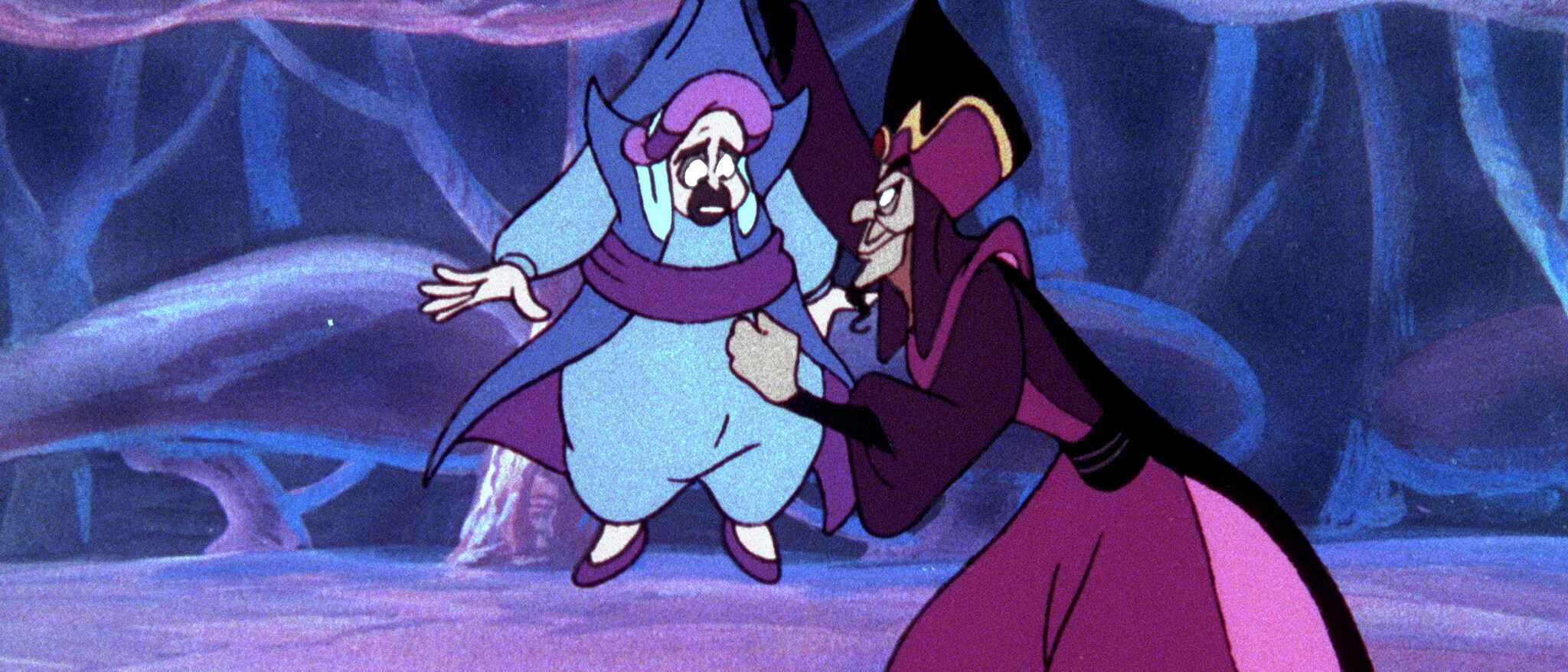
MOVIE REVIEW · THE RETURN OF JAFAR · REDEMPTION IS AN OPENING, NOT A RECEIPT MARKED PAID
The Return of Jafar Review: Iago, Accountability, Abuse, Forgiveness, and the Cassette That Changed Disney
The animation got smaller. The moral problem got harder. Iago leaves an abuser before he knows how to become trustworthy, and everybody he harmed is expected to decide what one brave act can actually repair.
The verdict before the cave collapses
The Return of Jafar looks smaller than Aladdin because it was built for a different screen, schedule, budget, and production pipeline. The drawings move with less theatrical abundance, backgrounds simplify, songs arrive without the original film’s musical confidence, and the Genie cannot hide that Robin Williams is absent. Those losses are visible. They are not the whole verdict. Under the compromised surface is the franchise’s most useful argument about complicity: what somebody owes after helping an abuser, whether fear explains betrayal without excusing it, and why the injured people are allowed to distrust a redemption story that has become emotionally convenient for everybody else.
Iago becomes the center because the sequel gives him the problem Aladdin solved too easily. Aladdin lied about status, confessed under crisis, and entered a happy ending. Iago spent years assisting Jafar, insulting victims, enforcing access, and benefiting from proximity to power. Leaving Jafar does not erase that work. Saving Aladdin once does not purchase immediate membership in the family. The movie understands this in flashes, then rushes because seventy-two minutes and television pacing keep pulling toward the next trap. Its moral instincts are better than its patience. That tension makes the film worth examining long after the cheap-sequel jokes have become automatic.
The first direct-to-video sequel changed Disney
Disney released the film on May 20, 1994 after production through its Television Animation group. D23 records it as the company’s first direct-to-video sequel and notes that it became one of the top-selling videos within weeks. That history matters because the movie was not an isolated side project. Its commercial success helped normalize a production model that would revisit major animated properties outside the theatrical feature pipeline. The format created more stories, more work, more shelf life, and a persistent hierarchy in which viewers learned to expect recognizable characters with reduced visual resources.
Home video changed what “a Disney movie” could mean inside a family. The cassette lived beside the original, replayed without a theatrical ticket, and reached children who did not care which division financed the in-betweens. Corporate distinctions remained visible through craft, marketing, and prestige, yet domestic repetition could make the sequel as familiar as the feature. That familiarity deserves analysis without pretending every frame received equal care. The film helped open a large commercial road. Some later sequels used that road for meaningful character work. Others treated recognition as sufficient reason to sell another ending. Return of Jafar carries both possibilities in its DNA.
A television bridge wearing movie clothes
The plot functions as a bridge into Aladdin: The Series. It introduces Abis Mal, repositions Iago, establishes Genie’s return, and creates an episodic status quo where Aladdin remains close to the palace without marrying Jasmine yet. The structure often feels like connected television episodes because that is close to its industrial purpose. Conflicts arrive in compact units, songs announce emotional turns quickly, and locations serve action with less time for atmosphere. Calling that rhythm a failure misses the design. Calling it a feature excuses places where emotional scenes needed another breath.
A bridge has a difficult job. It must honor the feature’s ending, reopen enough problems for weekly adventure, and avoid resolving the wedding reserved for King of Thieves. Genie’s freedom must permit his return. Jafar’s lamp must be found. Iago must become usable around the heroes. Aladdin needs a public role that sends him outside palace walls. The script solves all four efficiently, sometimes too efficiently. Its greatest achievement is recognizing that Iago cannot simply walk into the ensemble unchanged. Its greatest evasion is allowing one climactic sacrifice to carry more repair than the relationships have actually completed.
Iago leaves Jafar before he becomes good
Iago’s break begins in resentment, not conscience. He is tired of disrespect, angry that Jafar never shares power, and alert to the possibility of surviving without him. That motive is morally ordinary and dramatically honest. People often leave abusive or exploitative alliances because the arrangement stops benefiting them before they can name every person they helped harm. Departure still matters. It reduces Jafar’s reach and creates the possibility of change. It should not be misread as proof that the departing person has already developed empathy.
The film lets Iago remain selfish, frightened, funny, defensive, and intermittently brave. He does not transform into a soft mascot the moment he switches sides. His old instincts keep returning because habits formed under power do not disappear when the boss is trapped in a lamp. He manipulates Aladdin’s gratitude, conceals information, and wants the privileges of belonging before enduring the vulnerability of confession. That mess is the character. A cleaner redemption would be easier to summarize and much less true to what complicity does to judgment.
Jafar and Iago were never equal partners
The first film gives Iago access, tasks, and the fantasy that proximity makes him indispensable. Jafar uses his labor and treats his complaints as noise. The sequel makes that imbalance explicit when Jafar returns expecting obedience as though abandonment never occurred. Iago knows the threat is real because he has watched Jafar punish resistance. His fear is not invented to win sympathy. It grows from a relationship where usefulness offered conditional protection and no security.
Naming that abuse does not clear Iago’s account with Jasmine, Aladdin, the Sultan, Rajah, or Agrabah. A subordinate can be abused by a superior and still abuse people with less power. Both facts are necessary. Flattening Iago into Jafar’s victim erases the choices he made while carrying messages, arranging access, encouraging coercion, and enjoying the palace’s humiliation. Flattening him into an unchangeable villain erases the danger involved in defection. The sequel is strongest when it refuses to choose only one of those truths.
Aladdin wants the rescue to mean more than it can
Iago saves Aladdin from Abis Mal’s men, and Aladdin responds with gratitude that quickly becomes advocacy. That reaction fits him. Aladdin understands being judged by a category and knows what one generous opening can change. He also has a habit of deciding that his private reading should settle a public problem. He brings Iago toward the palace before the people harmed by Iago have agreed to proximity. Compassion becomes another decision Aladdin makes first and explains later.
The movie does not condemn compassion. It asks whether generosity without process can create a new injury. Aladdin believes Iago deserves a chance. Jasmine has reasons to hear the proposal as another concealed choice involving a man who once helped imprison and degrade her family. The Sultan has been hypnotized under Jafar’s influence. Rajah was stripped of power. Their consent matters separately from Aladdin’s debt. A person may offer personal forgiveness without possessing the authority to grant institutional access on everyone’s behalf.
Jasmine’s anger is the sane response
Jasmine is often positioned as the obstacle when she refuses Aladdin’s case for Iago. That framing can make patience look morally superior to boundaries. Her anger is grounded in evidence. Iago served Jafar, mocked victims, and has not disclosed the full danger of Jafar’s return. Aladdin hides Iago’s presence because he expects resistance. The concealment repeats the Prince Ali problem: he decides what Jasmine can handle, curates the truth, and hopes a favorable outcome will make the method irrelevant.
Jasmine does not owe Iago immediate comfort because the audience has followed his internal struggle. Viewers receive scenes she never sees. Dramatic access can create unfair expectations, asking an injured character to respond to information available only outside the story. From Jasmine’s position, Iago appears when convenient, seeks palace safety, and carries a history of deliberate participation. Her refusal protects the household and her own dignity. Forgiveness becomes meaningful only when saying no remains an available outcome.
The Sultan and the problem of easy mercy
The Sultan’s warmth makes him receptive to reconciliation, yet his political judgment has already failed around Jafar. Mercy from a ruler cannot be only an emotional preference. Allowing a former palace conspirator back into royal space raises questions of security, testimony, accountability, and information. Iago may know how Jafar operated, which guards were compromised, where magical objects moved, and what vulnerabilities remain. A serious government would want that knowledge without treating cooperation as automatic absolution.
The film keeps the palace at family scale, so public consequences stay mostly invisible. Agrabah’s residents endured Jafar’s takeover and would have their own memory of Iago. The Sultan can forgive personal insults. He cannot erase civic harm by welcoming a funny bird at dinner. This gap is part of the franchise’s fairy-tale compression. It also reveals why Iago’s redemption works more comfortably as television ensemble logic than as a complete political reckoning.
Jafar returns without learning anything
Jafar emerges from the lamp with more raw power and the same emotional poverty. His plan remains organized around humiliation, possession, and revenge. Omnipotence cannot give him a self beyond domination because domination was never merely a tool. It was the identity. He wants Aladdin frightened, Jasmine controlled, the Sultan degraded, and Iago returned to his old place. Every relationship must prove hierarchy. The genie form enlarges capacity without enlarging imagination.
That limitation explains why Iago can eventually defeat him. Jafar cannot understand loyalty built through choice because he only recognizes obedience produced by leverage. He assumes fear will restore the old arrangement. He reads Iago’s hesitation as weakness rather than evidence that another community has begun to matter. Absolute power makes him less perceptive. Nobody around him can safely correct a mistake, so his confidence expands while his knowledge shrinks.
The lamp keeps power from becoming freedom
Jafar wished to become an all-powerful genie and inherited the lamp’s captivity. The sequel uses that rule more clearly than the original ending had time to explore. He can transform bodies, landscapes, and danger, but his existence remains attached to an object another person can hold, hide, command, or destroy. Power without autonomy becomes a grotesque version of Genie’s original condition. Jafar wanted superiority and received servitude with extraordinary range.
The comparison should not make Jafar and Genie morally equivalent. Genie performs care under coercive rules and longs for self-direction. Jafar uses every available opening to reproduce coercion. Shared captivity does not create shared character. It does expose the lamp system as dangerous regardless of occupant. A universe where conscious beings can be bound to objects and compelled through wishes has a structural problem that defeating one villain cannot solve.
Abis Mal is funny because greed has no plan
Abis Mal releases Jafar and imagines the lamp will convert incompetence into wealth. Jason Alexander gives the thief an irritated, vain rhythm that fits a man always certain somebody else mishandled his success. He can command a genie in theory and cannot manage the relationship in practice. Jafar flatters, delays, intimidates, and redirects him because formal control means little when the person holding it cannot recognize manipulation.
His thieves extend the film’s interest in bad leadership. Abis Mal wants loyalty without competence, reward, or respect. Jafar wants obedience without personhood. The contrast is comic rather than subtle, yet both groups depend on people beneath them continuing to participate. Iago’s exit matters inside this pattern. The sequel keeps showing leaders who believe title settles the relationship, then act surprised when fear and greed fail to produce durable allegiance.
Genie comes home and the performance changes
Dan Castellaneta voices Genie after Robin Williams’s original performance. The difference is audible because Williams shaped the character’s speed, improvisational texture, celebrity impressions, and emotional switches so forcefully that imitation becomes an unfair assignment. Castellaneta brings professional elasticity and warmth, but the movie cannot reproduce the specific collision between Williams and theatrical animation. Pretending otherwise insults both performers.
The more useful question is whether this Genie remains emotionally legible. He returns because freedom gave him a world to explore and relationships worth revisiting. His jokes carry less anarchic surprise, while his affection for Aladdin still reads. The sequel needs him as friend and magical problem-solver without allowing freedom to become absence. That compromise works best when he chooses involvement and worst when the script uses him like the old wish machine with the legal language removed.
Freedom includes the right to return
Leaving the lamp does not require Genie to sever every bond formed during captivity. Freedom means he can travel, refuse, return, help, rest, and define the terms. His homecoming is emotionally important because audiences sometimes imagine liberation as permanent flight from every person connected to the harmful setting. Genie’s friendship with Aladdin was real even though the wish system was coercive. Choosing Aladdin afterward confirms the relationship without retroactively making ownership harmless.
The sequel could spend more time on what travel changed in him. He arrives with stories, souvenirs, and comic references, then folds back into the ensemble. A deeper version would ask how a being with cosmic mobility understands home after ten thousand years of confinement. The film gestures toward that life and moves on because Jafar needs to attack. Even the gesture matters. Genie now has an offscreen existence nobody commands.
The songs are emotional shortcuts with uneven fuel
The soundtrack carries the burden of fast character explanation. Iago sings through resentment and self-justification. Jafar turns revenge into performance. Genie announces return through comic energy. The songs are functional, memorable to many viewers who grew up with the tape, and plainly smaller than the Menken-Ashman-Rice architecture of the original feature. Comparison is unavoidable because the franchise taught us to expect songs that alter character and story at the same time.
“Forget About Love” gives the triangle of Aladdin, Jasmine, and Iago a theatrical device for conflict and persuasion, though it asks music to smooth over distrust before conversation has done enough work. “You’re Only Second Rate” is Jafar’s strongest number because contempt is his native language. He attacks Genie’s identity through comparison, turning performance into domination. The song understands that Jafar does not merely want victory. He wants another powerful being to feel small while witnessing it.
Television animation is visible in the bodies
Character proportions, line stability, facial acting, crowd density, effects, and spatial continuity do not maintain the theatrical feature’s standard. Some shots carry expressive intent; others move from pose to pose with the urgency of schedule. The difference can become distracting because the original designs were built for fluid transformation and musical spectacle. Genie suffers most when elastic possibility meets limited animation. Jafar’s controlled silhouette survives the reduction more comfortably.
Budget is context, not a magic phrase that converts every weak image into a strong one. Viewers can recognize labor conditions and still describe what reaches the screen. The fair reading separates aesthetic consequence from contempt for the artists. Television Animation made a commercially significant sequel under different constraints. The result contains staging compromises and genuine character ideas. Respecting labor means examining both, not pretending criticism is cruelty or reduced resources are moral failure.
Agrabah becomes a repeatable television space
The city shifts from theatrical dreamscape toward reusable geography. Market streets, palace rooms, desert routes, and hideouts must support continuing adventures. That transition can flatten atmosphere while giving the franchise somewhere to live. The original film’s Agrabah often operates as spectacle and symbol. The sequel begins treating it as an environment where Aladdin stops thieves, guards respond, citizens watch ceremonies, and recurring villains can return.
A working world needs more than repeatable backgrounds. It needs people whose lives are affected by royal decisions and magical disasters. The film remains focused on the central household, so Agrabah’s public mostly becomes crowd reaction. The television series has more opportunities to widen that lens. The sequel opens the door without fully walking through it. Its version of the city is transitional in every sense: less lavish than the feature and more available for episodic continuity.
Aladdin’s new role is still undefined
Aladdin captures thieves and returns stolen goods, acting like an unofficial protector with palace access. His class position has changed without becoming clear. He is no longer surviving outside the law, not yet married into royalty, and not visibly employed through a defined office. Heroism fills the administrative gap. That suits adventure storytelling and avoids asking whether the palace has simply absorbed a useful street kid without changing the structures that made his hunger possible.
His friendship with ordinary residents and knowledge of the city could make him a valuable adviser. It could also turn him into a romantic vigilante whose personal judgment outruns accountability. The Iago conflict demonstrates the risk. Aladdin acts decisively, keeps secrets, and expects trust because his heart is in the right place. The sequel likes that heart and keeps showing why good intentions need another person in the room.
Jasmine gets less story than she deserves
Jasmine’s distrust carries moral weight, but the film rarely grants her an independent objective beyond relationship repair and survival. The original feature already fought to make her more than a prize while still centering Aladdin’s transformation. A sequel organized around Iago could have deepened her political work, her response to the prior coup, or her role in rebuilding palace security. Instead, her strongest material remains reactive because men bring danger and concealment back into her home.
Her response is still characterization. She refuses to let charm overwrite evidence and makes Aladdin face the cost of secrecy. The problem is proportion. Boundaries become the only visible political work she performs while the franchise prepares another adventure led by Aladdin. Later adaptations would give Jasmine more explicit ambition to govern. This film shows why that expansion was necessary. She already possesses judgment. The script needs to let that judgment shape more than whether a boyfriend is forgiven.
Iago’s sacrifice is real and insufficient
At the climax, Iago turns against Jafar and risks himself to destroy the lamp. The action is courageous because fear has defined their relationship and Jafar’s retaliation could be annihilating. Iago chooses people he has only begun to trust over the master who conditioned obedience. That choice should count. Redemption without meaningful risk becomes branding. Here the risk is physical, emotional, and relational.
One brave act cannot settle every debt. It can become the clearest evidence that change is possible. The palace may reasonably change Iago’s status after he saves their lives, yet ongoing trust still requires truth, consistency, restitution, and room for old anger. The television series can perform that slower work through repetition if it remembers the history. The movie’s ending feels earned as an opening and rushed as a completion. Both readings can coexist.
Destroying the lamp ends Jafar’s power
The final solution takes the lamp system seriously: Jafar’s existence is anchored to the vessel, so destroying it destroys him. The scene gives Iago agency that brute strength cannot replace. Aladdin, Genie, Jasmine, and the others cannot simply overpower an all-powerful genie. Victory depends on understanding the rule Jafar dismissed as beneath him. The object he regarded as an inconvenience becomes the limit that ends him.
There is unease inside the triumph. A conscious being is destroyed through his container, and the story treats that destruction as necessary because Jafar is actively attempting mass murder and permanent domination. The ethics are not difficult in the immediate crisis. The larger lamp system remains disturbing. If vessels can be broken, hidden, stolen, and used to end or command a person, every genie lives inside material vulnerability. The franchise defeats Jafar without reforming the magic that made both his threat and Genie’s captivity possible.
The ending earns a seat, not amnesia
Iago joins the group because his action changes what they know about him. The acceptance works emotionally when read as conditional belonging: he has chosen them under pressure and receives the chance to keep choosing. It works less well if read as complete absolution. Jasmine’s earlier anger, the Sultan’s victimization, and Agrabah’s harm do not vanish when the lamp explodes. A family can celebrate survival while continuing a hard conversation the next morning.
The television future benefits from keeping Iago irritable and morally unfinished. His greed, fear, loyalty, vanity, and growing attachment can create conflicts without resetting him to villain. Growth does not require personality replacement. It requires new decisions when the old temptation returns. The sequel’s final gift is a character positioned to make those decisions repeatedly. That is richer than a halo and more useful than a prison cell written as the only possible form of accountability.
What the film teaches the franchise about sequels
A sequel does not need to recreate the first plot at lower resolution. It can move a supporting character into moral focus, examine the consequences of the ending, and build infrastructure for another form. Return of Jafar succeeds when it follows those principles. It fails when speed replaces consequence, nostalgia substitutes for musical invention, or palace reconciliation ignores public harm. The unevenness became a template Disney would repeat in many combinations.
The direct-to-video era is easy to mock because quality varied and corporate appetite was obvious. It also gave side characters, daughters, rivals, communities, and unresolved endings more screen time. Commercial motive and creative value can occupy the same cassette. The responsible review asks what the new story notices, what the production conditions permit, and what the company sells without sufficient care. This movie provides evidence for every answer.
Final verdict
The Return of Jafar is not the visual equal of Aladdin, and pretending it is would make criticism useless. It is more morally interesting than its reputation as a cheap sequel allows. Iago’s story understands that leaving an abuser can begin in selfishness, fear can coexist with accountability, injured people do not owe fast forgiveness, and one brave decision matters without rewriting every earlier choice. The film cannot give those ideas all the time they deserve. It gives them enough shape to survive the production around them.
I return for Iago, Jasmine’s refusal, Jafar’s second-rate cruelty, and the strange historical moment when a television-animation bridge became a home-video blockbuster and changed Disney’s sequel economy. I do not return for smoother animation or a replacement version of the original magic. The movie earns its place by opening a harder question: after the villain is trapped, what happens to everybody who helped him and still has to decide who they are without his orders? That question carries the franchise farther than another wish ever could.
The opening robbery rewrites Aladdin’s relationship to the street
Aladdin first entered the franchise stealing food because hunger and class exclusion had narrowed his choices. The sequel opens with him stopping Abis Mal’s thieves and returning wealth, placing him on the enforcement side of the same city. The reversal can show growth, public trust, and a desire to protect neighbors. It can also hide the economic question that made his original theft morally legible. Not every thief is Aladdin, and organized robbery is not survival. Still, the story moves him from criminalized poverty toward informal authority without examining who granted that authority or whether the market changed for anyone else.
His competence comes from knowing rooftops, alleys, crowds, timing, and the assumptions wealthy people make about street boys. Those skills remain valuable after palace acceptance. The sequel treats them as action assets rather than evidence about government. A politically curious Sultan would ask Aladdin why children steal, where guards fail, and which systems make Abis Mal’s crew attractive. Instead, the palace receives a hero who can catch symptoms. Agrabah’s inequality remains useful scenery because solving it would change the adventure machine.
Iago’s treasure fantasy reveals what power taught him
Iago imagines freedom through ownership, comfort, jewels, and a protected place near whoever controls resources. That imagination did not appear from nowhere. Years beside Jafar taught him that security comes from attaching himself to power and extracting enough benefit before the arrangement turns. When he leaves, he repeats the same logic with Aladdin. Saving the hero becomes an investment. Palace entry becomes return. Friendship is initially another economy because domination has trained him to understand relationships as transactions.
The film allows attachment to complicate that economy. Iago begins caring about outcomes that do not maximize profit, then resents the vulnerability. Genuine affection is terrifying when every previous bond depended on leverage. It creates a need he cannot control. His jokes and complaints protect against admitting that Jasmine’s opinion matters, Aladdin’s disappointment can hurt him, and Jafar’s return threatens more than bodily safety. Redemption begins when another person’s wellbeing becomes real enough to interrupt calculation.
Secrecy repeats the Prince Ali wound
Aladdin hides Iago because he wants time to produce a favorable result before Jasmine can object. The plan echoes his earlier performance as Prince Ali. In both cases he believes a curated version of events will create the emotional conditions for truth. He does not lie because Jasmine is unintelligent. He lies because he fears her informed answer. That is precisely why the method violates trust. A relationship cannot call consent central while one partner decides when the other has earned access to relevant facts.
The sequel could have treated this repetition as a major relationship problem. It acknowledges anger, then pushes everyone toward Jafar’s threat. External danger often rescues protagonists from completing uncomfortable conversations. Aladdin learns that hiding Iago was wrong, but the palace crisis supplies urgency and eventual forgiveness before he explains why his fear kept overruling Jasmine’s agency. Romantic love survives. The habit remains available for another story unless accountability reaches beyond apology.
“Forget About Love” asks a song to negotiate consent
Iago tries to repair Aladdin and Jasmine’s conflict through performance, insisting that affection should outrun the argument. The number is charming because Gilbert Gottfried’s abrasive voice turns romantic mediation into comic intrusion. Its premise is dangerous when separated from tone. Love cannot require forgetting why trust broke. The better reading is that Iago creates enough emotional space for conversation, not that Jasmine should abandon evidence because the melody says the couple belongs together.
Jasmine participates rather than being musically overpowered, which protects the scene from becoming pure pressure. Even so, reconciliation moves at sequel speed. Her anger contains two wounds: Iago’s history and Aladdin’s concealment. The song focuses on the couple’s bond while reducing the institutional question of allowing a former conspirator into the palace. Music resolves the intimate layer and leaves the security layer to the plot. The emotional lift works. The ethical paperwork is still waiting on the table.
“You’re Only Second Rate” is domination disguised as comparison
Jafar does not need to prove that Genie is weaker. He needs Genie to experience humiliation. The number attacks identity through spectacle, transforming the environment so every visual joke becomes evidence for Jafar’s superiority. This is how an abuser uses performance: not merely to win, but to control the witness’s understanding of himself. Genie’s freedom and popularity are intolerable because they represent power that can coexist with affection. Jafar must redefine that power as embarrassing.
The song also exploits the recasting anxiety outside the story. Viewers are already comparing Dan Castellaneta with Robin Williams. Jafar’s repeated insistence on second-rate status lands on a character and a production carrying unavoidable comparison. The movie cannot fully escape the meta-text. It turns vulnerability into villain material, whether deliberately or not. Genie survives the insult because friendship, not rank, defines his return. Jafar remains trapped in a contest nobody else needs to enter.
Nasira is absent, and the franchise still leaves a family-shaped hole
Later game material would introduce Nasira as Jafar’s sister, but this film treats his life as entirely organized around office, power, Iago, and revenge. No family, mentor, community, or former tenderness interrupts the silhouette. That absence keeps him mythically clean and psychologically narrow. It also makes Iago the only person who has known him outside public authority, which raises the emotional stakes of defection. Jafar does not lose a servant alone. He loses the witness who helped sustain his preferred version of himself.
A villain does not need a sympathetic childhood to become complex. Explanation can become an excuse when stories treat pain as a coupon for cruelty. What Jafar needs is not absolution but dimension: a clearer account of why domination became the only relationship he recognizes. The sequel chooses momentum over excavation. That works for menace and limits the revenge plot. Jafar returns as concentrated appetite, while Iago receives the moral interiority the villain refuses to develop.
Abis Mal’s wishes expose the command problem
The lamp rules give Abis Mal theoretical authority, but Jafar controls interpretation, timing, attention, and fear. A wish contract cannot protect a master who lacks knowledge and courage. The dynamic mirrors the Sultan’s dependence on Jafar as adviser. Formal hierarchy says one person commands. Practical hierarchy belongs to the person controlling information. Agrabah repeatedly confuses title with control, then discovers that access, expertise, and manipulation can govern from below the official seat.
Abis Mal deserves little sympathy because his goal is exploitation. His incompetence still demonstrates why enslavement through wishes is unstable. The system encourages adversarial wording and strategic deception. Genie’s kindness made the arrangement appear safer in the original film than the rules deserve. Jafar removes that cushion. Every exchange becomes proof that compelled magical labor invites sabotage, coercion, and escalation. The answer is not a smarter master. The answer is ending ownership.
Transformation is Jafar’s preferred language of contempt
Jafar changes bodies and surroundings because magic lets his judgment become material. He can make a person small, ridiculous, trapped, or physically unrecognizable, then demand that the victim accept the new definition. The violence is theatrical and intimate. It does not stop at injury. It declares that another person’s body belongs to his argument. That method connects the sequel to his treatment of Rajah, Jasmine, the Sultan, and Genie across the franchise.
Animated transformation can make domination entertaining because design inventiveness produces visual pleasure. The review has to hold both experiences. A clever shape change may be funny or beautiful while representing forced embodiment inside the story. Disney often uses transformation as wonder when chosen and horror when imposed. Jafar’s magic stays on the horror side because every spectacle removes somebody else’s authorship. His powers are large. His imagination keeps arriving at the same prison.
Rajah remembers even when the screenplay hurries
Rajah has direct reason to reject Iago. The parrot helped Jafar access Jasmine, supported the takeover, and belonged to the machinery that transformed Rajah into a powerless cub. Nonverbal distrust is therefore memory, not an animal gag. The film cannot give Rajah a testimony scene, so posture, pursuit, and resistance carry the history. A tiger’s boundary becomes one of the few reminders that reconciliation is occurring in a household where bodies were magically violated.
Acceptance from Rajah should not function as a magical purity certificate. The tiger responds to observed behavior and Jasmine’s safety. Iago can earn reduced hostility through consistent choices without becoming universally safe. Their future television interactions have room to preserve irritation and mutual testing. Friendship is optional. Coexistence with boundaries can be a successful outcome. Not every redeemed character needs every victim to become a fan.
The Sultan’s toys become a security warning
The Sultan’s attention remains easy to redirect, and the palace still relies on intimate trust more than robust process. Jafar’s prior coup should have transformed security. Magical artifacts need tracking, advisers need review, guards need training against hypnosis, and the ruler needs counsel from more than one gatekeeper. The sequel instead restores domestic normality quickly enough for Iago and Jafar to exploit familiar weaknesses. Fairy-tale continuity wants the palace recognizable. Governance would demand visible change.
That gap creates a frustrating pattern: Jasmine and Aladdin must repeatedly save a state that does not learn at institutional scale. Heroism becomes maintenance for preventable vulnerability. The Sultan’s kindness remains appealing, yet a kind ruler owes citizens systems that function while he is distracted. The film’s compact runtime cannot build a ministry. It can show a locked door, a new adviser, or one changed protocol. The absence makes Jafar’s return feel inevitable for reasons beyond magic.
Rasoul represents enforcement without reflection
Rasoul and the guards are positioned to protect the palace, capture thieves, and respond to visible danger. They rarely challenge the rules producing danger or recognize manipulation before a hero explains it. That is not unusual for adventure guards. It is politically revealing. Enforcement reacts to bodies in forbidden places while advisers, lamps, and royal decisions move through privileged access. The system watches the gate and misses the room where power changes hands.
Aladdin’s uneasy relationship with guards could have become a useful partnership. He understands how official suspicion targets poverty and how criminals exploit routine. Rasoul understands palace procedure and public risk. Mutual education would give Agrabah institutional growth. The sequel prefers comic friction because cooperation would reduce chase energy. The choice preserves entertainment and wastes a chance to let Aladdin’s class history change more than his own address.
Comedy is labor, and Iago performs it under pressure
Iago’s abrasive timing carries scenes that would otherwise become exposition. He can announce fear, mock ceremony, resist sentiment, and expose hypocrisy without stopping the plot. That comic function resembles labor he performed for Jafar: making proximity bearable while translating the powerful man’s moods. After defection, the audience still expects entertainment from him. The community may begin valuing him as a person, while the franchise values him because jokes keep television pacing alive.
A thoughtful redemption story notices when humor is armor. Iago jokes before confession, during danger, and after tenderness threatens to expose need. Laughter lets him control the room’s response. If everyone is annoyed, nobody has to see shame. The sequel occasionally drops the armor long enough for fear and loyalty to register. Those pauses are small because Gottfried’s performance is built around relentless vocal identity. They matter precisely because the noise stops protecting him.
Jasmine’s singing voice and split performance
Linda Larkin voices Jasmine while Liz Callaway provides her singing voice in this sequel. Split performance is common in animation and deserves acknowledgment because character continuity depends on collaboration. The speaking and singing voices must share emotional intention even when timbre changes. Jasmine’s musical reconciliation works when the handoff preserves her intelligence and warmth rather than turning song into a different, softer person who exists only to forgive.
Voice credits also reveal how home-video productions maintain familiarity through a mixture of returning and replacement artists. The character belongs to no single performer, though individual performances shape what audiences recognize. Respectful criticism names the change without treating replacement as theft. Callaway is not attempting to erase Larkin. Castellaneta is not Williams. Each enters an established design, carries required continuity, and contributes under conditions the audience can hear but not always see.
The seventy-two-minute runtime makes morality sprint
Disney+ lists the film at approximately seventy-two minutes. Within that space the story must stage a robbery, introduce Abis Mal, free Iago from Jafar, return Genie, repair a romance, release Jafar, expose betrayal, imprison the heroes, mount revenge set pieces, complete Iago’s turn, destroy the lamp, and establish the television ensemble. The efficiency is impressive and costly. Emotional transitions often receive a song, joke, or action beat where another scene would deepen them.
Length alone does not create depth. A longer cut could add noise. What the film needs is selective room: Jasmine and Iago speaking without Aladdin mediating, Iago disclosing Jafar’s return earlier, Genie describing freedom, and the Sultan confronting why the palace remained penetrable. Ten additional minutes placed there would matter more than another chase. The existing runtime reveals priorities. Plot infrastructure wins because the television series needs its starting configuration.
Home-video children became the repeat audience
The film was built for domestic replay, where children could rewind songs, memorize jokes, and encounter the story without the ceremony of a theater. Repetition changes criticism. A scene that feels thin once may become emotionally foundational after fifty viewings. A musical phrase can outlive a more sophisticated composition because the cassette is always available. The direct-to-video audience contract values immediate clarity, recognizable voices, and reusable entertainment.
That contract should not become an excuse for shallowness. Children notice betrayal, unfairness, fear, and whether adults listen. The movie’s Iago material endured because it gives young viewers a legible version of a difficult problem: somebody who did bad things can change, and change does not make everybody trust him on command. The animation may signal lower prestige. The moral question does not become smaller because the screen is in a living room.
Commercial success created both opportunity and extraction
The film’s rapid sales success proved that audiences would buy continuations produced outside the theatrical feature system. That proof funded more animation and extended worlds. It also encouraged a corporate habit of treating beloved films as reservoirs of recognizable assets. A sequel could be approved because characters remained marketable before a story justified return. The resulting catalog contains sincere craft, uneven experiments, and products where affection did more work than the screenplay.
Return of Jafar sits at the beginning of that contradiction. Its reason for existence is plainly commercial. Its Iago story is creatively specific. Industry analysis becomes dishonest when it assumes profit motive cancels every artistic choice or artistic value erases extraction. Disney discovered a lucrative format through a movie whose best idea concerns escaping a powerful figure who treats relationships as resources. The irony is too useful to ignore.
The sequel’s cultural imagination does not improve enough
The original film mixed Arab, Persian, South Asian, Islamic, and Hollywood adventure references into a generalized Agrabah. The sequel inherits the setting and reduces visual detail, leaving even less room for cultural specificity. Names, clothing, architecture, music cues, markets, deserts, and magical stereotypes continue functioning as a familiar elsewhere. The production’s smaller scope explains simplification. It does not answer the representational problem.
A continuation could deepen the city by introducing residents with professions, histories, regional knowledge, and relationships beyond palace adventure. The television series attempts expansion through recurring figures and travel, with mixed results. This film mostly treats Agrabah as franchise property already explained by the first movie. Familiarity substitutes for inquiry. That choice keeps the sequel moving and preserves the original blend without confronting who was blended, why, or what disappeared in the mixing.
Accountability needs restitution, not permanent performance
Iago cannot spend every future scene proving he deserves oxygen. Endless probation can become another form of control, especially when the group enjoys his labor but withholds belonging indefinitely. Accountability should have goals: truthful disclosure, changed behavior, repair where possible, acceptance of boundaries, and consequences proportionate to harm. Once those are practiced consistently, the community must decide what reintegration means rather than keeping redemption forever available as a threat.
Restitution does not require victims to offer intimacy. Jasmine can accept Iago’s help and decline closeness. The Sultan can permit residence with conditions. Rajah can remain watchful. Aladdin can be a friend without speaking for everyone. This differentiated outcome is more humane than a single verdict of forgiven or condemned. The sequel gestures toward group acceptance because ensemble television needs a clear status. A deeper franchise lets each relationship move at its own speed.
The title belongs to Iago as much as Jafar
Jafar physically returns, yet the more consequential return is Iago’s movement back toward people he helped betray. Jafar arrives unchanged and therefore has nowhere emotionally interesting to go. Iago returns to the palace carrying altered allegiance, concealed danger, and the possibility of repair. The title promises villain resurrection. The story earns attention through the sidekick’s unstable homecoming.
That imbalance explains why Jafar can feel both entertaining and dramatically static. Jonathan Freeman restores vocal menace, precision, and contempt. The character supplies pressure strong enough to force Iago’s choice. He does not need a new philosophy because his function is to make the old relationship unavoidable. Iago cannot claim change while safety protects him from testing. Jafar returns so the former servant must answer with action when obedience becomes the easiest way to survive.
What a stronger remake of this sequel should preserve
A future retelling should preserve Iago’s morally compromised defection, Jasmine’s right to refuse quick trust, the lamp as Jafar’s limit, and the direct conflict between coerced loyalty and chosen community. It should resist turning Iago into an innocent victim or a sarcastic mascot. The story works because he did harm, experienced harm, and must decide what to do with both histories when excuses stop protecting him.
The remake should expand palace accountability, Genie’s freedom, Jasmine’s governing role, Agrabah’s cultural specificity, and public consequence. It should give Aladdin a reason to hide Iago that reveals character without rewarding secrecy. It should let victims set different boundaries. Better animation alone would produce a prettier evasion if the moral relationships were simplified. The original sequel’s roughest images contain an argument worth carrying forward intact.
The banquet turns belonging into a public test
Palace meals in the Aladdin films are never only meals. Seating, service, performance, and access reveal who counts as family and who remains a tolerated visitor. Bringing Iago into that space makes private advocacy public. Aladdin can no longer frame the parrot as one personal debt. The household must eat beside somebody whose voice once accompanied their captivity. Comedy keeps the scene moving, but every place setting carries memory.
Iago wants the reward of admission before understanding the emotional labor his presence demands from others. He performs helpfulness, suppresses impulses briefly, and expects visible progress. That impatience is believable. A person trying to change often experiences boundaries as proof that change is being ignored. The victims experience those same boundaries as the minimum condition for safety. The banquet places both clocks in one room and lets neither run fast enough for comfort.
Jafar uses nostalgia as a weapon
The sequel knows the audience remembers Jafar’s voice, silhouette, cobra imagery, red palette, and theatrical cruelty. His return is built from recognition before new action. Inside the story, Jafar also weaponizes memory. He recreates fear by reviving positions everyone hoped were finished: the Sultan as powerless, Jasmine as target, Aladdin as impostor, Genie as lesser power, and Iago as servant. Revenge means forcing the household back into old roles.
Iago’s resistance matters because refusing the assigned role interrupts Jafar’s script. Jafar expects recognition to produce obedience. The audience may enjoy familiar menace while the character rejects familiar subordination. That split gives the sequel one of its sharpest effects. Nostalgia brings the villain back; growth prevents the old relationship from operating exactly as before. A continuation becomes worthwhile when memory creates pressure rather than replacing development.
The frame-up weaponizes Aladdin’s uncertain status
Jafar’s plan works because Aladdin still occupies an ambiguous place near the throne. He is loved by Jasmine, favored by the Sultan, and celebrated as a hero, yet his authority is informal. A convincing accusation can reactivate the class suspicion attached to his street identity. Palace belonging built through personal affection remains fragile when procedure, title, and public office have not caught up. Jafar understands that insecurity and pushes directly into it.
The story turns wrongful accusation into action without fully examining legal process. Who investigates? What evidence counts? Can the Sultan’s personal favor protect Aladdin or make the proceeding less credible? Agrabah needs institutions capable of resisting both royal whim and magical fabrication. The sequel supplies danger, escape, and vindication. The missing courtroom is part of the larger pattern: heroes resolve the crisis because government cannot reliably determine truth.
The execution sequence remembers the franchise’s violence
Threatening Aladdin with execution darkens the television-scale adventure. The state that welcomed him can become lethal when information is controlled. That danger makes Jafar’s manipulation more than personal revenge. He recruits law as an instrument, turning official procedure against the person who exposed him. The scene connects magical coercion to institutional violence. Jafar does not need to strike every blow himself when authority can be made to do it.
Family animation often lets execution remain stylized enough for children while preserving emotional terror. The audience understands the finality without graphic detail. Aladdin’s fear, Jasmine’s urgency, and the guards’ compliance create a question the film does not answer later: what prevents another false order? Defeating Jafar removes the immediate manipulator. Repairing the state would require safeguards against the next adviser, spell, forgery, or frightened ruler.
Jasmine and the Sultan experience repeated political trauma
The first film ended with liberation, yet the sequel returns Jasmine and her father to another seizure of home and agency. Repetition can become franchise convenience if trauma resets between installments. It can also reveal what recovery looks like when the threat returns before trust is rebuilt. Jasmine’s guarded response to Iago makes more sense when the household has learned that apparently minor access can become a coup.
The Sultan’s cheerfulness after victory should not be mistaken for absence of impact. Animation often restores visual normality because the next story needs a recognizable palace. Emotional continuity can survive beneath that reset if later episodes remember fear, changed habits, and new vigilance. The franchise rarely gives the Sultan sustained trauma language. Jasmine carries more visible alertness, which risks making the woman responsible for remembering danger while men resume adventure.
Genie cannot solve a genie
Returning Genie could easily destroy narrative tension. His power helped the first film escape impossible situations, and freedom removes the wish quota as a simple limit. The sequel responds by making Jafar a magical peer with fewer ethical restraints. Genie’s presence becomes emotionally reassuring and strategically insufficient. The problem cannot be solved through larger spectacle alone because the lamp rule, not raw power, determines the outcome.
That constraint protects Iago’s importance. If Genie could erase Jafar immediately, the former sidekick’s choice would become decorative. Instead, knowledge of Jafar’s habits and access to the lamp matter more than magical scale. The film redistributes heroism toward the person least physically impressive. It also shows why power systems need rules readers can understand. A climax feels earned when earlier conditions become usable rather than when somebody discovers a larger beam of light.
The black lamp and the color of ownership
Jafar’s lamp visually separates his captivity from Genie’s familiar vessel while preserving the object-person relationship. Darker colors signal menace, yet the ethical structure remains the same. A conscious magical being is attached to portable property. Design invites viewers to treat one lamp as dangerous and the other as wondrous because occupants differ. The rule itself deserves suspicion before character coding tells us how to feel.
Objects in the franchise carry social status as well as magic. A royal treasure room can hide a prison. A street thief can possess a source of cosmic labor. A cave tests worth through access to property. The sequel keeps returning to who holds the lamp because possession becomes authority faster than moral qualification. Nobody can become an ethical owner of another person by wishing carefully. Genie’s freedom remains the only defensible resolution the system has offered.
Jafar’s revenge avoids the work of ruling
Jafar wanted the throne in the first film and barely governed once he seized it. The sequel removes even the pretense. He does not return with policy, constituency, or a vision for Agrabah. He returns to punish. This confirms that political office was valuable as proof of superiority, not as responsibility. The city exists as audience and hostage. Jafar’s desired state is a room where nobody can contradict him.
That emptiness distinguishes ambition from leadership. Wanting the highest seat can look like political desire while containing no interest in public life. Jafar’s intelligence is tactical, theatrical, and administrative when manipulation serves him. It never becomes care. The sequel’s revenge plot narrows the character and clarifies him. Once the throne has been won and lost, only the emotional appetite remains. He would rather destroy Agrabah than belong to it without mastery.
Iago and Abu mirror survival without sharing a history
Both companions are small, quick, acquisitive, expressive, and attached to a human whose choices reshape their future. Abu steals through street survival and appetite. Iago schemes through palace complicity and learned transaction. Their comic rivalry can obscure the class difference. Abu began beside somebody excluded from wealth. Iago began beside somebody accumulating control over it. Similar greed does not produce identical accountability.
Their relationship could become a quiet measure of Iago’s change. Abu knows what loyalty looks like when resources disappear and danger rises. He is also jealous, impulsive, and imperfect, so he cannot serve as pure moral judge. Mutual recognition would allow both to remain funny without flattening them into interchangeable mascots. The sequel uses their energy around action. The television series has room to make the comparison relational.
Carpet performs trust without a spoken verdict
Magic Carpet helped expose Aladdin’s honesty problem and carried the couple through their most intimate original sequence. In the sequel, Carpet’s movement continues functioning as rescue, transportation, and response. Because the character cannot speak, acceptance of Iago cannot be delivered through a convenient declaration. Proximity, assistance, hesitation, and positioning become the available vocabulary.
Nonverbal characters protect the ensemble from explaining every moral conclusion aloud. Carpet can help during crisis without announcing complete forgiveness. Action may reflect commitment to Aladdin or Jasmine rather than a settled opinion about Iago. That ambiguity is useful. Communities often cooperate before every relationship is repaired because immediate safety requires coordination. Shared action can create evidence for later trust without pretending emergency teamwork completed the conversation.
The Cave of Wonders remains an unanswered moral institution
Although the sequel moves elsewhere, every lamp story carries the Cave of Wonders behind it. The Cave selected Aladdin, guarded treasure through lethal tests, and stored conscious magical captivity among riches. Jafar’s lamp later moves through ordinary thieves without an equivalent moral gatekeeper. Magical artifacts escape supposedly secure spaces because the franchise treats containment as adventure setup rather than stewardship.
Agrabah needs people who understand, catalog, and protect dangerous magic without converting it into royal property. Genie would be an obvious adviser if freedom includes the choice to prevent similar captivity. The series eventually expands magical bureaucracy through varied episodes, but the films leave the work informal. Jafar’s return demonstrates the cost. Destroying one lamp solves one emergency. A world full of unexamined vessels guarantees another.
The animation’s strongest moments prioritize readable intention
Limited resources hurt spectacle most when crowds, transformations, effects, and complex motion require density. Character intention can survive through a held expression, clean silhouette, or well-timed reaction. Iago benefits because vocal rhythm and sharp poses carry thought. Jafar benefits because stillness and angular design already communicate control. Jasmine suffers when subtle emotional transitions receive less facial nuance than the scene deserves.
The fair comparison is not a spreadsheet of frames. It is whether staging directs attention toward the necessary emotional fact. Some sequences succeed with economical clarity. Others feel like storyboards hurried into final movement. Acknowledging both avoids romanticizing scarcity. Artists can make intelligent choices inside constraint, while the company remains responsible for choosing how much time and money a profitable continuation receives.
Jonathan Freeman restores the threat through precision
Freeman’s Jafar rarely needs volume to establish danger. Lengthened consonants, measured contempt, and controlled amusement make other people sound like objects already sorted beneath him. The sequel gives him broader musical mockery and explosive revenge, yet the performance remains most effective when certainty becomes intimate. He speaks as though resistance is a temporary misunderstanding the victim will soon regret.
Voice continuity helps compensate for visual reduction. The audience hears the villain before every drawing proves him. That is not a reason to undervalue animation; it shows how departments carry one another. Freeman supplies psychological consistency while new production conditions reshape the body around the voice. Jafar remains recognizable because performance, design, writing, music, and memory overlap. No single component owns the effect.
Gilbert Gottfried makes shame sound like aggression
Gottfried’s Iago is built from attack: volume, rasp, complaint, impatience, and comic outrage. The sequel asks that instrument to carry fear and conscience without becoming gentle. Shame often emerges as anger because direct vulnerability feels impossible. Iago snaps when cornered, performs indifference when attachment grows, and converts panic into noise. The performance lets redemption occur inside the established voice instead of replacing the character with a polite lesson.
That continuity prevents morality from becoming respectability. Iago does not earn belonging by sounding quieter, prettier, or more socially acceptable. He earns a chance through choices made while remaining irritating. Fandom redemption arcs often confuse goodness with softened personality. This film understands that somebody can keep the abrasive laugh and stop assisting a tyrant. Ethical growth changes behavior before it changes taste.
Dan Castellaneta’s assignment was structurally impossible
Any performer replacing Robin Williams would be heard through absence. The original Genie was marketed, animated, and remembered around a specific collision of improvisation and celebrity. Castellaneta enters a sequel with fewer visual resources and a script that still expects rapid impressions. Criticism should identify the reduced effect without turning a production decision into personal failure. The assignment asks continuity and reinvention at once, then gives little space for either.
Castellaneta finds warmth in reunion and workable energy in ensemble scenes. The performance is strongest when Genie acts like a friend rather than a required imitation engine. Later franchise entries would continue negotiating who Genie can be across actors, formats, and languages. The character survives because freedom, humor, affection, and theatrical possibility remain larger than one vocal texture, even when one interpretation remains culturally dominant.
The sequel does not make Jasmine responsible for rehabilitating Iago
Jasmine’s eventual acceptance is connected to observed action, not a private caretaking project. She does not tutor Iago through every moral realization or absorb abuse so he can practice growth. Aladdin becomes the early advocate because his debt and identification drive the relationship. That distribution prevents a common story problem where the harmed woman must supply endless empathy to prove the narrative believes in redemption.
The film still asks Jasmine to reconcile quickly, and her screen time remains limited. Yet it allows anger without portraying cruelty. She is not vindictive for remembering. She is not cold for demanding evidence. Those choices matter in a family film because children absorb whose discomfort receives priority. Iago’s fear deserves concern. Jasmine’s safety does not become negotiable to demonstrate that concern.
Forgiveness, trust, access, and love are different decisions
The sequel often compresses four decisions into one group embrace. Forgiveness concerns what emotional debt a victim chooses to release. Trust concerns predictions about future behavior. Access concerns practical permission to enter spaces or receive information. Love concerns attachment that may grow without settling the other three. Iago can receive one and remain accountable in the others. Separating them makes the ending more credible.
Aladdin offers trust early. Jasmine withholds it. The Sultan leans toward access. Rajah signals caution. Genie offers fellowship through his own generous temperament. None of these responses must become the universal answer. A healthy community can hold differentiated boundaries while coordinating against Jafar. The movie’s ensemble ending suggests unity. Its character history supports a more textured unity where belonging is real and permissions remain specific.
The Easter eggs are less important than the continuity echoes
The film offers familiar poses, musical callbacks, transformation humor, palace imagery, and character business that reward viewers of the original. Cataloging references can be fun, but the stronger “Easter eggs” are emotional echoes. Aladdin hides truth again. Jafar uses spectacle to make others small. Genie returns by choice after captivity. Jasmine refuses to let romance erase judgment. Iago repeats old tactics and gradually changes their purpose.
A reference earns its place when it changes meaning. Jafar’s lamp is no longer a punchline attached to his final wish; it becomes the mechanism of revenge and defeat. Prince Ali’s deception is no longer one plot twist; it becomes precedent for Jasmine’s anger at concealment. The sequel gains depth when familiar material behaves like memory rather than merchandise. Recognition should open analysis, not end it.
The rating can be for children without the review becoming childish
The G rating and domestic market shape how violence, coercion, execution, and abuse appear. Threats stay stylized, bodies recover, and comedy interrupts dread. Those conventions do not remove the themes. Children often understand the emotional geometry before adults supply vocabulary: Jafar scares Iago, Iago helped Jafar hurt people, Aladdin wants to believe him, and Jasmine does not feel safe yet.
A serious review respects that literacy. It does not praise the film merely for being darker or dismiss moral complexity because songs and talking animals carry it. Family animation can provide an accessible model of accountability precisely because abstraction creates room to think. The lamp, parrot, palace, and genie make difficult relationships visible. Adults bring additional language. The core problem was already on the cassette.
What the sequel earns from nostalgia
Nostalgia supplies patience. Viewers who love Aladdin, Jasmine, Genie, Iago, and Jafar are willing to accept a smaller image to spend more time in Agrabah. The sequel benefits from affection it did not create alone. That inheritance is not illegitimate. Continuation always begins with prior investment. The question is whether the new work returns anything besides recognition.
Iago’s accountability arc is the return. The home-video history is another. The television bridge is a third. Songs, jokes, and villain spectacle provide pleasure, but they could not sustain the film’s long afterlife by themselves. Nostalgia opens the door. The sequel stays in the conversation because it complicates a character the original could only use as a comic accomplice. It turns leftover machinery into a moral engine.
What nostalgia cannot repair
Affection cannot add missing frames, deepen Jasmine’s independent arc, clarify Agrabah’s cultures, build palace safeguards, or give Genie a fuller account of freedom. Rewatching can reveal overlooked strengths and normalize visible weaknesses. The review has to distinguish discovery from accommodation. A scene may feel beloved because it accompanied childhood, not because every choice succeeds.
That distinction need not insult memory. Personal attachment is evidence about reception, repetition, and emotional life. It is not objective proof of craft. The honest fan can say the cassette mattered, Iago’s choice still lands, the animation often hurts, and the cultural imagination remains insufficient. Fandom becomes more durable when love can survive complete sentences about failure.
The final scorecard without a number
The story succeeds as a bridge, an Iago character study, and a compact demonstration that Jafar’s power cannot create loyalty. It partially succeeds as a romance repair, a Genie continuation, and a musical. It struggles as theatrical animation, cultural expansion, political follow-through, and a complete account of forgiveness. Those categories should not collapse into one numerical rating that pretends precision. The movie’s importance and polish are separate questions.
Its historical importance is substantial because commercial success altered Disney’s home-video strategy. Its artistic value is concentrated rather than even. Its emotional value depends heavily on Iago and on viewers willing to meet a television-scale production where it is. Its failures are visible enough that praise should never require denial. Its strengths are specific enough that dismissal as “cheap” becomes intellectually lazy.
The review after the review
Hours after watching, the image that remains is not Jafar’s largest spell. It is Iago approaching the lamp while every survival instinct tells him to obey. The moment works because the film spent its limited time showing how fear, greed, shame, and attachment fight inside him. Destroying the lamp becomes the external shape of breaking an abusive allegiance. The act is simple. The history inside it is not.
The sequel survives scrutiny because it accidentally launched a corporate model capable of exploiting nostalgia while deliberately telling a story about refusing the powerful figure who treats everyone as useful property. The contradiction belongs in the verdict. Disney found a profitable new container. Iago learned that escaping one requires more than finding a nicer master. Freedom begins when he accepts responsibility for choosing.