
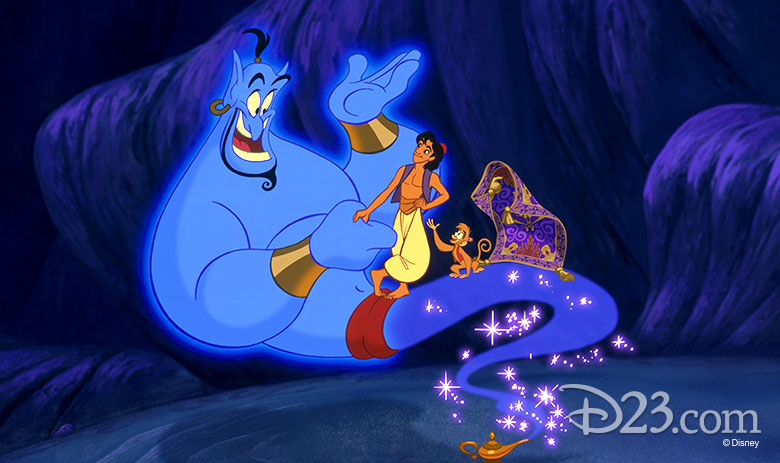
ALADDIN REACT · FRIEND LIKE ME · THE FUNNIEST SALES PITCH IS ALSO A LABOR CONTRACT
Friend Like Me React: Genie Performs Freedom While Aladdin Thinks About Power
Genie turns captivity into the greatest show in the cave, while Aladdin hears unlimited possibility before he understands the person producing it. The confetti is real, the friendship is possible, and the labor contract is still sitting beneath every joke.
The cave opens and Robin Williams detonates the movie
The scene does not enter quietly. Genie arrives as voice, shape, joke, orchestra, salesman, audience, and special effect at once. Aladdin has spent the film navigating physical danger through quick reading. Genie gives him too much to read. The speed is the point. A person who survives by controlling a room suddenly meets somebody who can become the room.
My reaction is delight followed by discomfort, because the performance is also an orientation session for enslavement. Genie explains rules, demonstrates value, and makes captivity look like the best party Aladdin has ever attended. Humor protects the pain long enough for the relationship to begin. It never fully removes it.
Friendship language arrives before friendship exists
The title promises a friend, but Genie and Aladdin have only just met. Genie must serve the lamp holder. Calling that arrangement friendship softens the power imbalance and gives the master a flattering emotional role. Genie may genuinely want connection, yet the contract makes consent impossible to measure at the beginning.
Aladdin responds to warmth because he has been alone. Genie responds to attention because centuries of masters likely treated him as equipment. Their needs can create real affection inside an unequal structure. The film becomes morally interesting when affection eventually pushes Aladdin to end the structure rather than use friendship language to preserve it.
The impressions are animation refusing one stable body
Genie becomes celebrity, waiter, bandleader, machine, animal, sign, and pure graphic rhythm. Eric Goldberg’s animation treats identity as elastic performance. Robin Williams supplies velocity and cultural reference; the drawings translate sound into impossible anatomy. The collaboration makes a character whose body follows thought rather than physics.
That freedom of form makes the lamp’s imprisonment more brutal. Genie can become anything except legally free. The scene keeps showing limitless transformation inside one absolute boundary. Power and autonomy separate in front of us. He can rearrange the cave, but he cannot decide whether he works.
The song sells abundance to somebody shaped by scarcity
Aladdin steals food, sleeps exposed, and measures danger quickly because scarcity has trained him. Genie answers that history with excess. Food, gold, attendants, music, animals, and spectacle arrive faster than Aladdin can name them. The sales pitch knows exactly which wound to target.
Wanting material safety is not vanity. The problem begins when wealth becomes proof of worth and disguise becomes the price of love. Genie offers tools without choosing the wish. Aladdin supplies the hierarchy because Agrabah has already taught him that a poor boy cannot enter the palace honestly.
The rules are funny until somebody tests them
No killing, no forced love, and no resurrection sound like clean boundaries. The comedy keeps the exposition light while establishing that magic has ethics or at least operating limits. Aladdin immediately begins looking for leverage because rules are familiar terrain to a street survivor.
His trick with the cave exit proves intelligence and establishes the relationship’s dangerous rhythm. He can outmaneuver Genie, and Genie can admire the move. Cleverness becomes intimacy. It also teaches Aladdin that the contract can be gamed, which later makes promises feel negotiable when fear rises.
Genie performs service before asking to be seen
The number centers what Genie can do. His desire enters later, almost shyly, when freedom becomes the subject. This ordering mirrors service relationships where competence is required before personhood receives attention. Aladdin first encounters a solution. He has to learn that the solution has a life.
Williams gives Genie emotional turns too fast for a simple comic sidekick. Bravado can collapse into loneliness between jokes. The performance makes the wish for freedom credible because exhaustion sits beneath abundance. Every flourish can be fun and still feel like practiced labor.
The cave becomes a stage because captivity needs an audience
Genie has likely performed variations of this introduction across centuries. The cave gives him no public except the current master, so he manufactures chorus lines, applause, and spectacle. The self-generated audience suggests loneliness hidden inside professional polish.
A person who has been unseen can become spectacular as a survival strategy. If he is useful enough, funny enough, and impossible to ignore, perhaps the master will treat him kindly. That hope is not freedom. It is adaptation to power, and the scene lets us laugh without completely hiding the adaptation.
Aladdin listens like a client before he listens like a friend
His questions concern wishes, limits, and what the power can purchase. That response makes sense because he is trapped and newly introduced to magic. Still, the scene establishes an emotional debt. Genie gives information about his condition while Aladdin focuses on the service.
The later promise of freedom matters because attention changes. Aladdin finally asks what Genie would wish for himself. That question is the first movement away from ownership. Friend Like Me prepares the contrast by showing how easy it is to enjoy a person’s gifts before becoming curious about the cost.
The celebrity impressions age unevenly and animate brilliantly
Some references land immediately for older viewers and pass as strange voices for younger ones. The sequence was built from contemporary performance energy rather than timeless neutrality. That choice gave Aladdin unusual speed and also tied pieces of the comedy to a specific American media world.
Animation keeps the impressions legible even when the reference fades. Pose, timing, silhouette, and facial exaggeration communicate a joke beyond recognition. The scene becomes a record of Williams, Goldberg, directors Ron Clements and John Musker, editors, effects artists, and musicians solving spontaneity through painstaking craft.
The music makes labor sound effortless
Alan Menken’s music and Howard Ashman’s lyric architecture organize an explosion that could otherwise become noise. Lists escalate, rhythms pivot, and visual transformations land on musical decisions. Effort disappears into precision. That disappearance mirrors Genie’s service: the master receives magic without seeing the work.
The sequence deserves praise for coordination rather than vague magic. Voice recording generated enormous material. Artists selected, timed, storyboarded, animated, cleaned, painted, composited, and scored each beat. Calling the result spontaneous honors the feeling but can erase the labor that built spontaneity frame by frame.
The scene makes ownership feel friendly on purpose
Bright color, jokes, food, and direct address make the contract emotionally comfortable. Nobody wants to leave the number thinking about forced labor. The film needs the audience to enjoy Genie before it can make freedom matter. The strategy works, but viewers should notice the cost of the comfort.
Genie’s later anger at Aladdin is stronger because the first scene made service pleasurable. Aladdin can tell himself the arrangement is loving. Many unequal relationships survive through affection that makes naming the structure feel rude. Freedom requires him to accept that kindness as a master cannot replace ending mastery.
The Cave of Wonders becomes the wrong place for a workplace comedy
Aladdin and Abu are trapped underground after Gazeem dies at the entrance and Jafar abandons them. The physical situation is lethal. Genie answers with vaudeville confidence, which lets the audience release fear without forgetting the stakes. Comedy becomes emergency oxygen. He cannot undo the betrayal outside the cave, but he can make possibility feel larger than panic.
That tonal pivot is one reason the movie moves so quickly. The cave transforms from moral test to tomb to stage without pausing for realism. Animation permits emotional geography to change faster than architecture. The sequence trusts the audience to understand that terror and delight can occupy the same chamber because survival often recruits humor before safety has actually arrived.
Abu watches a new power enter the friendship
Abu has been Aladdin’s closest companion and partner in survival. Genie arrives with scale, language, and capability Abu cannot match. The number turns Aladdin’s attention toward a new relationship while the monkey remains present at the edge of the spectacle. That shift quietly anticipates the strain produced when Prince Ali’s world grows around Aladdin.
Abu’s jealousy later can look petty if we forget what Genie represents. Aladdin suddenly has a powerful adult ally who can provide food, status, rescue, and advice. Abu helped build a life through shared scarcity. Magic threatens to make that labor feel obsolete. The film plays the reaction for comedy, but the emotional cause is recognizable: abundance can rearrange old bonds before anybody agrees on the new shape.
The free exit trick changes who controls the scene
Aladdin notices that Genie has demonstrated power before a formal wish is spoken. By pretending doubt and asking for proof, he gets the entire group out of the cave without spending one of the three wishes. The move is clever, funny, and ethically slippery. He manipulates somebody whose service is already compulsory, then celebrates the technical victory.
Genie admires the trick because he values wit and perhaps because a surprising master is better than a boring one. Admiration does not remove the imbalance. The moment establishes why their bond can become affectionate and why it will later fracture. Aladdin knows how to survive through loopholes. Genie needs one promise treated as more important than a loophole.
The number explains why Genie can overwhelm every quieter character
Genie’s speed is intoxicating, but it changes the balance of any scene he enters. Aladdin, Jasmine, Abu, and the Sultan operate through ordinary emotional timing. Genie can interrupt, transform, narrate, and redraw the visual field before another character completes a thought. The movie must keep finding reasons to limit or redirect him so human choices still matter.
That imbalance is part of the character’s loneliness. Being the most entertaining and capable person in the room does not guarantee mutuality. People may wait for the next performance instead of asking what silence feels like for him. Aladdin’s growth depends on learning to meet Genie after the show, when usefulness is no longer the only available subject.
The salesman costume protects Genie from direct refusal
A sales pitch turns need into confidence. Genie does not begin by saying he is lonely, trapped, and desperate for the owner to become different from previous masters. He says the customer has never had a friend like him. The language makes dependence sound like premium service. It protects vulnerability by making Aladdin feel lucky.
This coping strategy has a cost. If Genie always performs delight, a master can claim not to know the arrangement hurts him. The movie eventually gives Genie enough frustration to speak plainly. Friend Like Me is the dazzling before image: a person translating coercion into hospitality because hospitality may be the safest way to survive the next owner.
The applause belongs to Genie even when the power belongs to Aladdin
The sequence gives Genie complete artistic authorship and no legal authority over the result. He composes the experience, controls the timing, creates every performer, and knows how to turn Aladdin’s fear into delight. The lamp still assigns the benefit to its holder. That split between creative ownership and contractual ownership feels painfully familiar beyond fantasy.
Aladdin’s eventual friendship must learn to applaud the person without treating the person as a renewable resource. The number invites admiration first. The rest of the movie tests whether admiration can mature into respect when respect requires giving up access.
What I keep after the last flourish
I keep the velocity, the blue transformations, the musical confidence, and the shock of a side character taking control of the entire movie. I also keep the contract beneath the confetti. Genie is funny because he is brilliant, and the brilliance belongs to a person whose labor has been assigned to whoever holds an object.
Friend Like Me becomes more moving after the ending. The sales pitch introduces power. The final wish recognizes personhood. Between them, Aladdin has to learn that receiving everything from somebody does not create a right to keep receiving it. The best friend he can become is the one who makes the phrase friend true by destroying the master role.
Genie performs the job before anybody asks what the job costs
Friend Like Me is a sales pitch delivered by the product being sold. Robin Williams fills the frame with choice while Genie remains bound to obey, and that contradiction gives the spectacle its nervous energy. The song is delightful. The labor arrangement is horrifying. Both reactions belong in the same paragraph.
Aladdin watches possibility and immediately translates it into social mobility. He wants the performance to solve the shame attached to poverty. Genie wants the performance to create rapport with the person holding the lamp. Their friendship begins inside unequal power, which is why the promised freedom matters long before the third wish arrives.
What stays after the sequence ends
Friend Like Me React: Genie Performs Freedom While Aladdin Thinks About Power does not stop at the final note or the last visual joke. The scene changes what the characters know about one another, and the next decision should carry that knowledge. The React keeps the afterimage because emotional continuity is where spectacle proves it mattered. If the franchise repeats the same conflict later, the useful question is whether the repetition adds pressure and memory or merely restores everybody to a convenient starting position.