
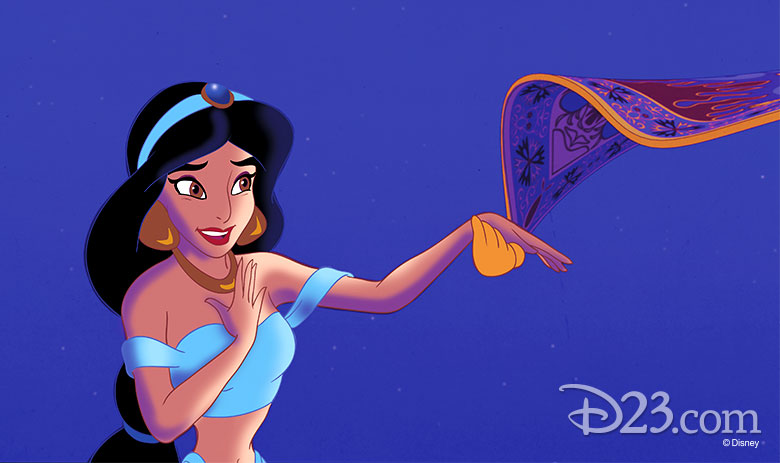
ALADDIN REACT · A WHOLE NEW WORLD · THE FLIGHT IS ROMANTIC BECAUSE JASMINE KEEPS HER MIND
A Whole New World React: Jasmine Chooses the Ride Before She Trusts the Prince
Jasmine steps onto the carpet for freedom, catches Aladdin lying in real time, and decides that wonder does not require surrendering her judgment. She can want the flight, remember the marketplace, and keep gathering evidence about the prince beside her.
My first reaction is still the same: Jasmine knows
The carpet arrives like a dream, but Jasmine does not become dreamy enough to stop thinking. She recognizes Aladdin’s voice, his habits, and the shape of the person beneath the Prince Ali performance. The scene works because she enters the fantasy with evidence already in hand. She is attracted to him, curious about the carpet, and irritated by the lie at the same time. Disney romance usually asks the audience to enjoy immediate certainty. Jasmine gives us something better: pleasure with active judgment.
Her intelligence does not ruin the song. It creates the tension that makes the song worth watching again. She can want the ride while withholding trust. She can lean into wonder while remembering the marketplace. That emotional layering protects her from becoming a passenger in Aladdin’s self-invention. Magic Carpet carries both of them, but Jasmine decides whether the evening moves forward. The agency is quiet, visible, and far more romantic than instant surrender.
The invitation is a test disguised as flirtation
When Aladdin offers his hand, the surface question concerns danger. Does she trust the carpet not to drop her? The deeper question concerns identity. Does she trust the stranger calling himself Prince Ali when every familiar gesture suggests the boy from the marketplace? Jasmine accepts the hand because risk can produce information. She is not certifying his story. She is giving him room to reveal whether the person she liked still exists inside the costume.
That distinction keeps consent alive inside the fairy tale. Jasmine chooses a specific experience, not every implication Aladdin attaches to it. She agrees to fly, to talk, and to see the world beyond palace walls. She has not agreed that his false title is true or that the evening erases her political problem. Romance becomes a negotiated space rather than a prize Aladdin unlocks by presenting enough spectacle.
Magic Carpet is the safest man in the scene
Carpet does the literal work, reads the emotional weather, and never asks Jasmine to praise him for basic competence. He catches bodies, changes direction, creates privacy, and turns cloth into performance without demanding ownership of the moment. Aladdin gets the song and the gaze. Carpet gets them home. The joke is affectionate, but the labor is real. Every romantic image depends on an animated character quietly making sure nobody dies.
The scene understands Carpet’s personality through movement. He hesitates, teases, swoops, steadies, and frames the couple with a tact that feels more emotionally intelligent than Aladdin’s strategy. Carpet helps create intimacy without forcing it. That difference explains why his presence never feels like surveillance. He is a friend facilitating a choice, not a servant delivering a woman to a prince.
Jasmine has been asking for a whole new world since before the song
The palace treats protection as confinement. Suitors treat her as access to a throne. The law gives her a deadline and calls coercion tradition. Jasmine’s desire to see beyond the walls is therefore political before it becomes romantic. The flight does not introduce freedom to her imagination. It briefly gives physical form to a freedom she has already named, attempted, and been punished for pursuing.
Aladdin can share the view because he knows the city from below, yet he is not the author of her longing. The song risks crediting the man with awakening the woman. Jasmine’s earlier actions resist that reading. She climbed the wall on her own. She entered the market on her own. She challenged a prince on her own. Carpet expands her range, and Aladdin becomes meaningful when he respects the person who was already moving.
The geography is beautiful and suspicious
The flight glides across a fantasy map where cultures become romantic landmarks available in seconds. Pyramids, temples, architecture, and costume signals collapse distance into spectacle. The sequence is musically irresistible and culturally careless in the specific way old studio travel fantasies often are. The world becomes a painted buffet for a couple whose own city was already built from mixed Persian, Arabic, Indian, and Hollywood references.
I can love the blue night and still notice what the montage asks other places to do. They provide instant recognition, scale, and exotic texture. Nobody in those places receives interior life. The sequence expresses liberation through movement while treating geography as decoration. That contradiction does not cancel the feeling. It gives the feeling a history and prevents nostalgia from pretending the images arrived without choices.
Aladdin is most honest while performing a song
He lies about his title, dodges Jasmine’s recognition, and surrounds himself with magic, yet the emotional promise inside the song is sincere. He wants to share freedom with her. He understands the pressure of being trapped inside a social identity and wants one night where both of them can move without guards, hunger, law, or expectation deciding the route. Performance gives him access to a truth ordinary conversation keeps burying under fear.
Sincerity cannot make the lie harmless. It can explain why Jasmine remains emotionally present after she recognizes it. The boy speaking through the song is closer to the marketplace Aladdin than the prince speaking between verses. Jasmine hears the difference. Her attraction attaches to the person who notices her confinement, not the title designed to satisfy the Sultan’s rules.
The voice recognition moment is the whole scene
Jasmine does not need a confession before she can identify him. Memory lives in cadence, timing, eye contact, and the little habits a costume cannot rewrite. Her recognition restores continuity between the market and the flight. Aladdin wants the prince disguise to separate his life into an unworthy before and a worthy after. Jasmine’s memory refuses the split. The person she liked survived the transformation because the transformation never created his value.
His panic reveals how thoroughly shame controls the fantasy. Being recognized should feel like relief. He experiences it as exposure because he assumes the truth will end the connection. That assumption produces the next lie. The scene lets us enjoy romance while watching fear actively damage it. Aladdin has the evidence that Jasmine responds to him, and he still trusts the costume more than her judgment.
Jasmine lets him keep talking and that is not the same as believing him
Her decision to play along is sometimes read as total acceptance. I read it as information gathering mixed with desire. She knows the story is unstable, and the flight gives her time to observe what Aladdin does when the obvious question reaches him. He improvises an explanation about royal life and disguise. Jasmine hears the answer, keeps the evening moving, and stores the contradiction.
That response feels human. People do not always stop a beautiful moment the instant they detect dishonesty, especially when they already understand why somebody might hide class or identity. Compassion can delay confrontation without erasing it. Jasmine’s patience becomes generous precisely because the film has shown she is capable of refusal. She is choosing when to press, not losing the ability.
The song gives both characters a temporary country
For a few minutes they belong to motion rather than Agrabah’s hierarchy. Aladdin is neither street thief nor acceptable prince. Jasmine is neither protected daughter nor required bride. They become two people suspended above the institutions defining them. The freedom is temporary, but temporary freedom can reveal what permanent life should change. It gives them a standard against which palace reality will feel even smaller.
Magic makes that temporary country possible, yet the emotional rule is ordinary. They listen, answer, laugh, and allow the other person to see fear without immediately using it. The flight feels expansive because attention expands. The world montage is huge, but the relationship lands in tiny exchanges. The most convincing promise is not that Aladdin can show Jasmine everything. It is that he notices she has been denied the right to look.
The landing returns every unresolved problem
A perfect song cannot settle a false identity, an unjust marriage law, the Sultan’s expectations, Jafar’s manipulation, or Aladdin’s belief that poverty makes him unlovable. The carpet lands and the institutions remain. That return protects the sequence from becoming emotional fraud. Wonder creates a connection. It does not complete the work the connection requires.
Jasmine kisses him because she enjoyed the night and wants him. The kiss is not a legal document certifying Prince Ali. Aladdin interprets success through the disguise because shame has trained him to credit the mask. The audience can see what he cannot: Jasmine responded most intensely when the boy from the market appeared through the performance. The tragedy is not that he lacks proof of love. It is that he cannot yet read the proof accurately.
Lea Salonga and Brad Kane make the conversation feel mutual
The vocal performances matter because the scene could become one character presenting a fantasy while the other simply receives it. Brad Kane gives Aladdin eagerness, nerves, and the careful confidence of somebody trying to keep a fragile plan from collapsing. Lea Salonga answers with brightness that still sounds self-possessed. Jasmine does not dissolve into his melody. Her entrance changes the scene from invitation into duet.
A duet is an argument about equal musical space. Their phrases meet, separate, and return. Jasmine claims part of the song rather than appearing as its beautiful subject. That structure supports what her behavior has already shown: she participates in the romance without becoming material for Aladdin’s transformation. The voices create partnership before the characters have built enough honesty to sustain it.
The scene knows a kiss can be true inside an unfinished relationship
Modern fandom sometimes treats any deception as proof that every feeling around it must be false. The film gives us a harder emotional fact. Aladdin lies, Jasmine recognizes something true, and the connection remains genuine without becoming healthy yet. A real feeling can form inside bad conditions. Naming the conditions protects the feeling from being used as an excuse.
Jasmine’s kiss belongs to her present desire. It does not forgive future revelations in advance. Aladdin still owes her the truth, and the story still owes her a world where marriage is her decision. The scene earns romance by letting the kiss be meaningful without asking it to perform every kind of consent and resolution at once.
The carpet flight changes what the palace balcony means
Before the flight, the balcony is a boundary between Jasmine and the city. Afterward, it becomes a place of return she has chosen rather than the only place she is allowed to stand. The architecture has not changed, but her relationship to it has. She has seen beyond the walls and brought that knowledge home. Confinement becomes harder to disguise as comfort once the body remembers movement.
Aladdin leaves believing the evening proved his disguise worked. Jasmine remains with a more complicated record: the boy she recognized can listen, improvise, lie, make her laugh, and offer a kind of freedom the palace has denied. The balcony now holds evidence against both Prince Ali and the law demanding a prince.
What I keep after the carpet comes home
I keep Jasmine’s alertness, Carpet’s invisible labor, the blue palette, the feeling of a body escaping a wall, and the ache of watching Aladdin receive acceptance he cannot trust. I also keep the cultural shortcut of the world montage and the way romance briefly postpones accountability. A strong React can hold the swoon and the side eye in the same hand.
The scene survives because Jasmine never disappears inside Aladdin’s wish. She chooses the risk, recognizes the lie, enjoys the flight, and carries her own unanswered questions back to the balcony. The whole new world is not a man giving a woman freedom. It is a woman using an offered ride to see farther while deciding whether the man beside her can become honest enough to join the life she already wants.
The carpet ride earns its romance through attention
The sequence works because Jasmine is not impressed by wealth. She responds to recognition. Aladdin remembers the street encounter, makes room for her curiosity, and briefly stops selling Prince Ali. That does not clear the lie. It explains why the connection inside the lie feels real enough to make the eventual betrayal hurt.
The world below becomes a moving argument about access. Jasmine has been protected into confinement, while Aladdin has been exposed to the city without safety. Carpet gives both of them a temporary view neither class position could provide alone. The ride is romantic because the shared perspective changes what they are willing to admit.
What stays after the sequence ends
A Whole New World React: Jasmine Chooses the Ride Before She Trusts the Prince does not stop at the final note or the last visual joke. The scene changes what the characters know about one another, and the next decision should carry that knowledge. The React keeps the afterimage because emotional continuity is where spectacle proves it mattered. If the franchise repeats the same conflict later, the useful question is whether the repetition adds pressure and memory or merely restores everybody to a convenient starting position.