
MOVIE REVIEW · ALADDIN (1992) · THE CARPET FLIES AND THE RECEIPTS COME WITH IT
Aladdin Review: The Magic Carpet Still Flies, but Agrabah Was Built from Everybody Else’s Culture
A full-spoiler editorial review of the animation, songs, class story, romance, wish rules, Genie’s captivity, Jasmine’s agency, Agrabah’s cultural mixture, and every contradiction still riding beside the nostalgia.
The verdict before we enter the cave
Aladdin remains one of Disney’s most exhilarating animated musicals because every department appears to be sprinting in the same direction. The line work moves. The songs move. Aladdin moves because stopping means hunger, arrest, exposure, or the sudden possibility that he may have to explain who he really is. Genie moves because stillness would let the prison catch up with him. Jasmine moves toward the palace wall because everyone inside has mistaken protection for ownership. Even Jafar glides through the story like a knife pretending it belongs at the dinner table.
The movie is also built from a Western fantasy of the Middle East and South Asia that collects architecture, clothing, names, accents, music, folk-tale history, and old adventure-film shorthand into one place called Agrabah. The craft is real. The cultural blur is real. The affection many of us carry is real. None of those facts erases another. I do not need to pretend the movie is innocent to explain why the carpet flight still catches in my chest. I need a review sturdy enough to hold the beauty and the baggage without dropping either one.
My final answer is complicated in the way a lasting fandom answer should be. Aladdin earns its place as a landmark of character animation, musical staging, color design, comic performance, and compact storytelling. It also turns a vast region into an aesthetic supply closet and gives its most sympathetic characters the features and accents closest to American expectations. The movie is not ruined by noticing that. It becomes visible as a work made by artists, executives, traditions, assumptions, revisions, and audiences who kept arguing back.
Aladdin steals bread because the city has already made hunger illegal
The first chase tells us almost everything about Agrabah’s class order. Aladdin takes one loaf. The guards respond with swords, public humiliation, and enough manpower to pursue him across roofs, homes, fabric stalls, and private rooms. Nobody asks why a teenager lives above the city with a monkey and no reliable meal. Property receives immediate protection. Hunger receives a criminal identity. The comedy keeps the sequence buoyant, but the social arrangement underneath it is brutal.
Aladdin’s athletic grace can make survival look like freedom. He knows every route the guards do not, uses the city’s architecture as an extension of his body, and turns insult into timing. Yet the song ends with him eating alone in an abandoned space above people who call him a street rat. His mobility is not access. He can cross the city and still be excluded from every institution that decides whose life counts. The roof gives him a view of the palace, not a path into it.
Then he gives the bread away. The gesture matters because it costs him the thing he risked violence to obtain. Disney often uses generosity as proof that a poor hero deserves elevation, which can quietly imply that suffering people must perform exceptional goodness before audiences grant them dignity. Aladdin is lovable because he shares, but he would remain human if he ate the whole loaf. Hunger does not need a moral audition.
Jasmine owns a palace room and almost nothing about her future
Jasmine enters through a marriage deadline. The law says she must marry a prince by her next birthday, and the men around her treat the problem as a scheduling inconvenience. The Sultan loves her, but love without respect becomes another soft wall. He wants her happy within the structure he controls. Jafar wants the structure and sees her as one more route to it. Visiting princes see a prize. Rajah is the only creature in the palace allowed to respond to disrespect with teeth.
Her escape is not a whimsical adventure by a sheltered girl who finds ordinary life charming. She leaves because the palace has converted adulthood into transfer paperwork. The marketplace immediately shows how badly isolation has prepared her for the economy. She takes an apple for a hungry child because food appears as something available in front of need. The merchant reads theft because his survival also sits inside the transaction. The scene gives Jasmine moral instinct and material ignorance at the same time.
Aladdin rescues her by inventing a relationship and redirecting the crowd’s reading of her. His performance works because he understands how quickly public identity can be rewritten when somebody speaks with confidence. Jasmine notices the skill before she knows the biography. Their bond begins with two people who perform roles under pressure, yet only one of them will later turn performance into a sustained romantic lie. That difference matters.
The balcony scene works because they recognize the cage in each other
On Aladdin’s rooftop, the city finally becomes quiet enough for conversation. Jasmine describes being trapped. Aladdin describes having no control over tomorrow. One is watched because she has political value. The other is hunted because the city assigns him none. Their lives are not the same, but each knows what it means to have strangers decide the acceptable shape of a future. Recognition arrives before attraction gets its grand musical vehicle.
The moment also exposes the movie’s class fantasy. Aladdin imagines palace life as freedom because distance hides the rules. Jasmine imagines the city as freedom because the wall hides hunger and state violence. Each desires the other’s geography before understanding its cost. Their romance becomes strongest when they stop treating location as identity and weakest when Aladdin believes the palace will accept only a manufactured prince.
Jafar is what institutional ambition looks like when it stops pretending to serve
Jafar already occupies the room where power happens. He advises the Sultan, controls information, commands guards, studies forbidden magic, and uses hypnosis to make institutional theft look like routine governance. He does not begin outside the system planning a revolution. He begins close enough to power to understand that the appearance of consent may be easier to obtain than consent itself. His cobra staff is merely the visible version of what his office already does.
Jonathan Freeman gives him patience sharpened by contempt. Jafar rarely needs to shout early because everyone has been trained to lean toward him. His body is a vertical line in rooms built from the Sultan’s round softness. His face seems assembled from angles that never fully relax. The character design and voice performance agree that he has spent years compressing rage into elegance. When the restraint breaks, the movie changes the room’s color to match.
His goal is often summarized as wanting the throne, but the wishes reveal something hungrier. Becoming Sultan does not satisfy him because a title cannot prevent resistance. Becoming the world’s most powerful sorcerer does not satisfy him because Genie remains a comparison. He wants a position from which nobody can make him feel subordinate. That desire cannot be completed. Every new height creates another person or force above it.
The Cave of Wonders recruits the vulnerable person powerful men need
The cave identifies a diamond in the rough, and the phrase sounds like divine recognition. In practice, the test supplies Jafar with a disposable worker. Aladdin is selected for inner worth and then sent into lethal conditions by an adult who disguises exploitation as opportunity. The magical institution can measure purity while remaining indifferent to who benefits from the result. Worthiness tests often work like that in fantasy. They crown a chosen person and ignore the labor arrangement waiting outside.
Inside, the design overwhelms through scale and gold. The rule is simple: touch nothing but the lamp. Simplicity does not make the environment fair. Abu is placed inside a field engineered to provoke desire, and one jewel becomes bright enough to erase caution. When he reaches, the cave treats a small creature’s failure as grounds to kill everyone present. Jafar designed the extraction. Abu triggers the collapse. Those levels of responsibility are not equal.
Carpet changes the cave’s emotional temperature. A trapped magical being helps another trapped person without requiring ownership first. Carpet has no voice, yet the animation gives it shyness, wit, irritation, loyalty, and physical vulnerability. Its tassels function as hands without becoming a cheap imitation of arms. The filmmakers prove that personality does not need dialogue a few minutes before unleashing a character who seems determined to speak every voice ever recorded.
Robin Williams and Eric Goldberg turn Genie into organized excess
Genie arrives as comic velocity. Robin Williams moves through impressions, registers, references, sales pitches, tenderness, irritation, and panic faster than a conventional animated performance could accommodate. Eric Goldberg and the animation team refuse to pin that voice to one stable body. Genie becomes host, bandleader, waiter, magician, commentator, cheerleader, critic, and special effect. The transformations are not decoration around the performance. They are the performance’s grammar.
The speed could have produced noise without character. What saves Genie is the smallness underneath the spectacle. After explaining cosmic power, he describes the lamp’s living space. After making Prince Ali visible to an entire city, he wants one friend to remember a promise. His sadness does not arrive from a separate serious character. It lives inside the same being who cannot stop making the room entertaining. Comedy is his joy, art, defense, labor, and evidence that endless capability does not equal freedom.
The celebrity references have aged unevenly because the movie intentionally imported contemporary recognition into a fairy-tale frame. Some impressions now land as animation history rather than immediate jokes. That aging is part of the experiment. Genie made the film feel startlingly current in 1992 and guaranteed that pieces of it would become a time capsule. The character survives because the emotional contract is older than any reference: the funniest person in the room still wants control over his own life.
Friend Like Me is a sales presentation given by the product
“Friend Like Me” is staged as proof of service. Genie demonstrates what ownership can access, packages infinite possibility into a musical number, and flatters the master who has done nothing yet except rub a lamp. The song is joyous because Genie is genuinely a performer. It is unsettling because the performance is required by a system that treats him as an amenity attached to an object. He sells the arrangement that confines him.
The sequence throws visual styles at the screen with precise control. Scale changes, color fields, transformations, typography-adjacent shapes, dance references, food, animals, hands, and multiplying bodies arrive without breaking the central beat. The excess is legible because poses and silhouettes remain clear. Modern animation can render more particles, hair, fabric, and simulated light. That does not automatically create a stronger idea than one blue arm becoming the entire architecture of a joke.
Prince Ali is what insecurity looks like with a production budget
Aladdin asks to become a prince because the law and his own shame tell him Jasmine cannot choose a poor man. Genie answers with a parade large enough to bury the question of legitimacy under elephants, dancers, gold, servants, and a theme song. The number is hilarious. It is also the movie’s most accurate portrait of branding. If the identity cannot survive scrutiny, increase the launch spectacle until asking for details feels impolite.
The performance fails with Jasmine because every prince has already arrived as a presentation designed for her consumption. Prince Ali is louder, prettier, and more imaginative, but he is still another man entering the palace with a plan about what she should want. Aladdin knows the person and chooses the script. His mistake is not that the disguise looks unconvincing. His mistake is believing access and intimacy require the same performance.
Genie recognizes the danger before Aladdin does. Once the spectacle works on the Sultan, Aladdin becomes more afraid of losing it. The lie creates a maintenance economy. Genie must continue supplying explanations, rescues, and magic because Prince Ali has no independent life. Aladdin’s delayed freedom promise grows directly from that dependency. The false identity is not one bad sentence. It is a system that needs somebody else’s labor to remain standing.
A Whole New World is gorgeous and built on incomplete information
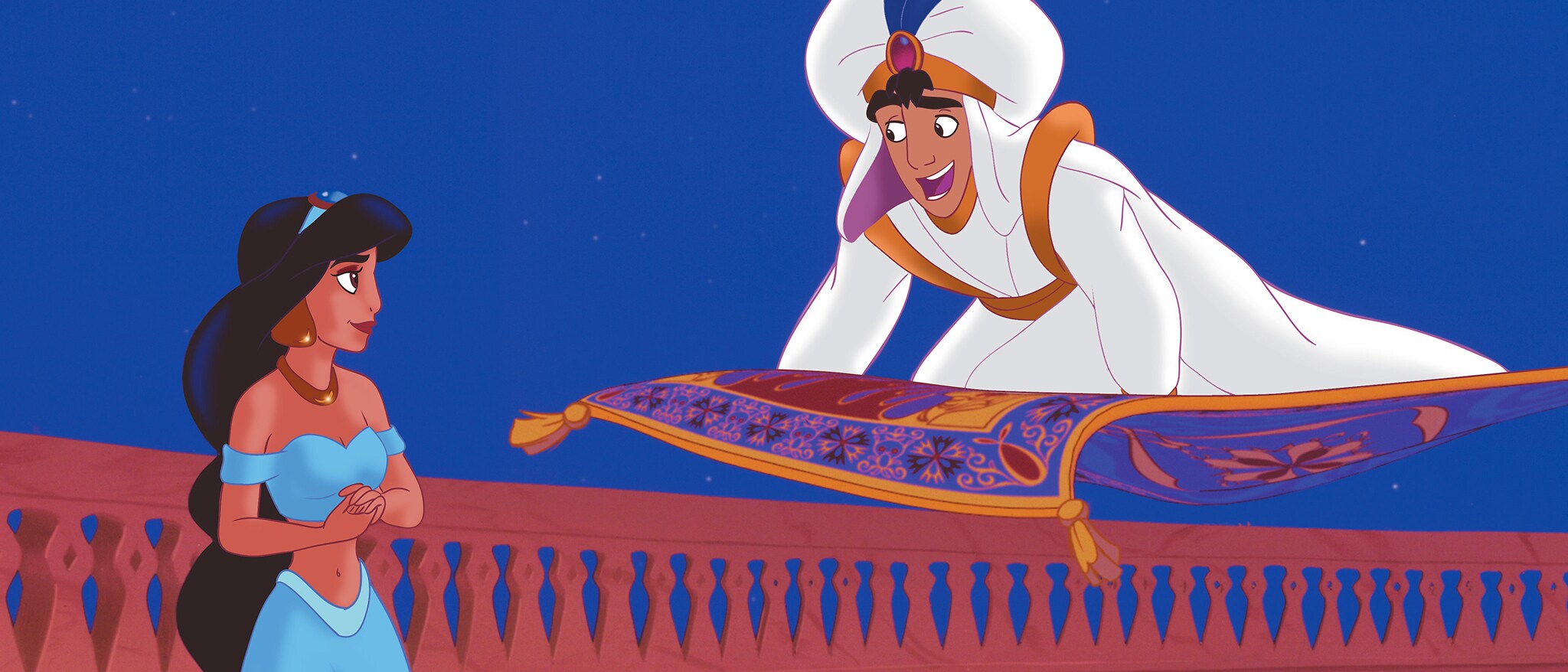
The carpet sequence deserves its reputation. Flight releases Jasmine from walls without making her body a spectacle for the crowd below. The song moves through wonder rather than conquest. Carpet participates as companion and vehicle, guiding two people into a space neither palace law nor marketplace enforcement controls. The night palette makes intimacy feel private even while the world opens beneath them.
Jasmine recognizes Aladdin during the ride because intimacy reveals the performance’s seams. He responds by building another explanation. The scene therefore carries romance and violation together. Her feelings are not magically forced, but they develop while he withholds information he knows matters to her choice. The song asks us to surrender to emotional truth while the plot reminds us that emotional truth cannot make a factual lie harmless.
That contradiction is why the sequence lasts beyond nostalgia. Perfect romance would close the scene. Imperfect romance gives it pressure. Jasmine is seeing more of Aladdin than the costume can hide, and Aladdin is terrified that being seen will end the connection. The flight offers literal freedom while he remains trapped inside the identity built to obtain it.
Jasmine is sharper than the movie’s final power structure
Jasmine catches lies, rejects entitlement, leaves the palace alone, protects a hungry child, confronts Jafar, uses performance strategically, and refuses to be transferred without consent. The character is not passive. The story around her still limits where those instincts can go. She can choose a husband by the ending because the Sultan changes a marriage law. She does not inherit the authority to change the law herself.
Her distraction of Jafar is often discussed as seduction, but the scene is more uncomfortable and more tactical than that label suggests. Jafar has seized political power, restrained her father, transformed her clothing, and treated her body as evidence of his ownership. Jasmine uses his vanity because the people she loves need seconds. The animation lets her control the performance while the situation remains coercive. Calling it empowerment without naming the danger would be cruel.
The film’s visual interest in her body also exceeds what the script knows how to examine. Jasmine is a teenage princess designed through an hourglass ideal and repeatedly framed as the reward around which male plans circulate. Linda Larkin’s vocal performance gives her irritation, intelligence, warmth, and steel. The character keeps pushing beyond the container. The franchise would spend years deciding how often to let her.
The Sultan’s love cannot excuse the law he maintained
The Sultan is kind in tone and dangerous in function. He adores Jasmine, plays with toys, trusts the wrong adviser, and appears genuinely distressed by her unhappiness. He also presides over the law turning her marriage into a deadline. The movie uses his softness to separate him from Jafar, but a gentle ruler can still maintain a coercive institution. Good intentions do not dissolve the power attached to a crown.
His final decision changes the law so Jasmine can marry the person she chooses. That is a meaningful repair and an exposure of how arbitrary the rule was. If he can remove it in one sentence, then every previous claim of helplessness was a choice disguised as tradition. The ending celebrates paternal permission while quietly proving Jasmine’s confinement never needed to exist.
Jafar’s takeover changes the palette because power has always controlled the room
When Jafar becomes Sultan and sorcerer, the palace shifts into red, black, and harsh gold. The transformation is visually immediate because production design turns political seizure into environmental occupation. The soft blue court was never neutral. It reflected the Sultan’s body and self-image. Jafar’s version reveals the same institution serving a different personality. Architecture becomes propaganda before anyone can adjust the banners.
His magical humiliations target identity. Aladdin becomes small and exposed. Jasmine’s clothing becomes part of Jafar’s fantasy. The Sultan becomes a toy. Rajah becomes a cub. Abu becomes a windup object. Jafar does not merely remove opponents. He recasts them into forms that confirm his view of their place. Domination reaches completion when the victim is forced to perform the ruler’s interpretation of them.
The final loophole works because Jafar cannot imagine freedom as power
Aladdin defeats Jafar by naming Genie as the stronger being. Jafar’s envy does the rest. He wishes to become an all-powerful genie and receives power with its architecture of captivity. The solution is satisfying because it uses the villain’s own definition of greatness. Jafar has spent the film confusing control with security. He cannot imagine that the person capable of granting kingdoms might envy an ordinary person who can walk away.
The lamp snaps shut around him and Iago, turning their abusive partnership into literal confinement. Jafar’s fate mirrors Genie’s condition without making the two genies morally equivalent. One is imprisoned after choosing domination and walking into a stated system. The other has served for millennia under a condition he did not choose. The visual rhyme should deepen our awareness of Genie’s suffering, not suggest every captive must have deserved the lamp.
Aladdin frees Genie and finally stops asking magic to make him acceptable
The last wish completes Aladdin’s moral arc because it costs him the solution he thought he needed. He could use magic to repair the prince identity, protect palace access, or secure a future. Instead, he honors the promise to Genie. The choice cannot erase the delay or the ownership that structured their friendship. It can end the structure. Repair becomes credible when it changes what the harmed person is free to do next.
Genie’s bracelets fall away, and the animation resists making freedom another enormous effect. His joy fills the scene, but the key difference is agency. He chooses where to go, what to wear, and whether to return. Aladdin loses command and keeps relationship. That exchange is the movie’s clearest definition of friendship. If the bond survives after control ends, something real was waiting underneath the contract.
The Sultan then changes the marriage rule, allowing Jasmine to choose Aladdin without a final magical status repair. The ending is emotionally effective and politically modest. A benevolent ruler adjusts one law. The monarchy remains. Poverty remains. Agrabah’s guards remain available for the next hungry child. Personal truth repairs the romance while the city that produced the lie receives much less attention.
Howard Ashman’s absence is present inside the songs
Aladdin carries a complicated songwriting history. Howard Ashman and Alan Menken developed an earlier conception with more emphasis on Aladdin’s mother and his desire to make her proud. After Ashman’s death, the project changed and Tim Rice joined Menken for songs that survived into the finished film. “Friend Like Me” and “Prince Ali” preserve Ashman’s theatrical wit and love of a show-stopping sales pitch. “One Jump Ahead” and “A Whole New World” belong to the revised structure.
Knowing the history changes the emotional negative space. The finished Aladdin appears to have no active parent, and his longing for worth attaches to class and romance rather than a mother watching him struggle. King of Thieves later fills part of the family void with Cassim. The stage musical restores some discarded material through Aladdin’s friends and “Proud of Your Boy.” A film can feel tightly complete while carrying the outline of another version underneath it.
The opening lyric controversy is part of the film, not trivia beside it
“Arabian Nights” originally included a lyric describing a place where ears might be cut off under conditions of disapproval. Objections led Disney to revise the wording for home release while retaining another line characterizing the region as barbaric. Later versions changed more. The edits matter because they record a public argument over how the film introduced an entire imagined region before the hero appeared.
Some defenses focus on villainous narration or fairy-tale exaggeration. The opening voice is still the audience’s first guide, and the joke depends on a stereotype of spectacular cruelty. Disney understood the complaint well enough to alter the product. That does not require throwing away the whole score. It requires remembering that beloved media can be revised because people outside the studio refused to accept what executives expected them to absorb as atmosphere.
Agrabah combines cultures, then lets American accents signal who deserves intimacy
The city borrows from Arab, Persian, South Asian, Islamic, and Hollywood fantasy references without establishing a coherent cultural location. The palace evokes forms viewers may associate with the Taj Mahal. Names and story traditions travel through Arabic and Persian transmission histories. Production research included Isfahan. The film places these materials inside a generalized environment designed for immediate recognition rather than geographic accountability.
Accent choices intensify the hierarchy. Aladdin and Jasmine speak in broadly American voices. Jafar receives theatrical British-coded precision. Guards and merchants often carry heavier invented regional coloring. The pattern tells American audiences which characters are modern enough to identify with and which bodies belong to the dangerous or comic environment. The heroes can look culturally marked while sounding safely familiar.
Representation is more than counting attractive lead characters. It includes who is allowed interiority, who becomes a crowd, who carries the accent, who is ugly for comedy, who explains the world, and whose traditions become texture without a name. Aladdin gave many children a treasured hero with brown skin and a princess who did not look like Disney’s earlier European royalty. It also handed them a city filtered through assumptions worth unlearning. Both receipts belong in the file.
The animation is still doing things most remakes cannot reproduce
The film’s graphic confidence is extraordinary. Shapes stretch without apology. Backgrounds simplify to protect a pose. Color takes over from physical realism when emotion needs the room. Carpet thinks through folds. Genie treats anatomy as a suggestion. Abu can move from greed to terror through a few changes in silhouette. The animation does not ask whether an object could exist in photographed space before deciding how it should feel.
This freedom is especially visible in transitions. A joke can become a vehicle, a cloud, a costume, or a new staging area without cutting away. Genie’s body edits the film while the film is playing. Live action can simulate transformation with enormous technical labor, but photoreal surfaces bring expectations about mass, skin, cloth, and light. The animated original wins many comparisons because it never apologizes for being drawn.
Winning that formal comparison does not make every drawing innocent. Caricature is a power. The same exaggeration that gives Genie limitless comic life can give background men racialized faces built for threat and ridicule. Animation’s expressive freedom magnifies the artist’s choices. It does not float above them.
Small Easter eggs reveal how the movie was thinking
The movie is packed with animation play. Genie’s transformations include celebrity impressions and visual references aimed at the 1992 audience. Sebastian from The Little Mermaid briefly appears during a royal-recipe sequence, linking the directors’ earlier film through a blink-fast joke. Pinocchio appears when Genie challenges Aladdin’s honesty. The Beast can be spotted among the Sultan’s toys. Each cameo works as studio memory rather than story canon.
The peddler who opens the film was long the subject of fan theories because Robin Williams voices him and character-design similarities suggested a connection to Genie. Deleted or altered concepts fed the speculation. Later anniversary material played with that relationship. The useful distinction is between a production idea, a fan inference, and what the released 1992 cut explicitly confirms. Fandom gets richer when we label the receipt instead of upgrading every good theory into fact.
Jasmine’s disguise scene lets Aladdin’s street performance echo earlier folk-tale and adventure traditions without turning into a history lecture. The Cave of Wonders resembles a guardian and a devouring threshold. Jafar’s cobra transformation literalizes the staff he used to control the Sultan. These are not hidden objects so much as visual ideas paying off in new forms. The best Easter eggs reward attention without becoming homework required to understand the plot.
The voice cast makes the movie larger than its script
Scott Weinger gives Aladdin a youthful ease that can harden into defensive performance. Brad Kane’s singing voice carries the romantic openness Aladdin struggles to speak. Linda Larkin makes Jasmine’s anger specific rather than generically feisty, while Lea Salonga gives her songs clarity and emotional lift. Jonathan Freeman turns Jafar’s contempt into velvet threat. Gilbert Gottfried makes Iago’s resentment impossible to hide behind court manners.
Douglas Seale gives the Sultan warmth that helps the ending land even when the politics deserve more scrutiny. Frank Welker creates Abu and Rajah through vocal behavior that supports the animation rather than translating animals into ordinary speech. Robin Williams dominates the cultural memory for understandable reasons, but the ensemble keeps Genie’s velocity attached to a story with quieter registers. A one-man show would have exhausted the film. The cast gives him people worth returning to.
What the 2019 remake understood and what it could not inherit
The remake understands that Jasmine needs a political future beyond selecting a husband. “Speechless” announces her refusal to disappear, and the script gives her governing ambition. Dalia gives her a woman friend inside the palace. Genie receives a human framing story and a chosen family. These are direct responses to spaces the animated film left thin. The changes deserve evaluation as choices, not dismissal because they were not present in 1992.
The remake cannot inherit the original’s graphic elasticity without changing media again. Will Smith wisely builds a different Genie rather than attempting a Robin Williams séance, but a human body inside digital effects cannot become line, layout, typography, and cut at the same speed. The new spectacle is expensive and physically textured. The old spectacle feels authored at the level of every curve. More detail produces another pleasure, not an automatic improvement.
The live-action version also tries to make Agrabah more materially multicultural while continuing to invent a generalized place. Casting and design choices became a major part of reception because photographed bodies make cultural ambiguity feel less abstract. The remake repairs some character absences and inherits the central geography problem. Adaptation can move the argument without escaping it.
The movie’s humanity lives in the distance between performance and need
Aladdin performs confidence because need has been punished. Jasmine performs royal control because vulnerability becomes leverage. Genie performs endless entertainment because service is compulsory and silence would expose the cage. Jafar performs loyalty because proximity to authority is useful. The Sultan performs helpless tradition because changing the law would require admitting he has always had the power. Every major character is acting for survival, access, affection, or control.
The moral question is not whether performance is fake. Performance is a human tool. The question is whether it creates room for truth or becomes a structure somebody else must live inside. Genie’s comedy can be authentic and labor. Jasmine’s seduction of Jafar can be strategic and coerced. Aladdin’s Prince Ali persona can express real longing and deceive the person he loves. Contradiction is not bad writing here. It is the place where the characters become recognizable.
That may be why the film survives every argument around it. The plot offers wishes, transformations, royal law, flying carpets, giant animals, magical imprisonment, and a villain turning into a cobra. The emotional engine is painfully ordinary. People who believe their unaltered selves will not be chosen start building versions they think the room can accept. Freedom begins when somebody risks losing the room.
Final review: keep the wonder and keep the receipts
Aladdin is funny enough to feel effortless and engineered enough to reward decades of looking. The songs advance character while functioning as independent cultural events. The animation converts line into performance. The color script makes politics visible. Carpet proves dialogue is optional. Genie proves spectacle can carry sorrow. Jasmine and Aladdin create romantic chemistry before the film builds its largest lie between them. Jafar turns insecurity into a governing philosophy and is defeated by his inability to imagine power without ownership.
The movie also asks viewers to enter a fantasy assembled from cultures it rarely names with precision. Its heroes are visually legible as nonwhite and vocally separated from many people around them. Its opening history includes a lyric changed after protest. Its gender politics give Jasmine unusual force for the era and leave lawmaking with her father. Its class story elevates one generous poor boy while leaving the city’s punishment of poverty intact. These are not footnotes added by people who hate joy. They are part of what the movie did.
I still feel the lift when Carpet clears the balcony. I still laugh at Genie’s panic when Aladdin is drowning. I still want Jasmine to bite every prince herself instead of outsourcing the task to Rajah. I still think the final wish is one of Disney’s clearest moral choices because Aladdin gives up control and discovers the relationship survives. Loving the film with open eyes is not a smaller love. It is a love capable of remembering where the gold came from.
The peddler opens by selling us the story as an object
Before Agrabah becomes a city, it becomes merchandise. The peddler moves through joke objects, failed demonstrations, and increasingly desperate sales language until the lamp appears. He tells us it looks ordinary and then promises the life inside changed a young man’s fate. The framing teaches the audience how to watch: ignore the surface, accept the pitch, and wait for the object to reveal a hidden value. That instruction applies to Aladdin, Genie, the lamp, and the film itself.
The peddler’s comic unreliability also protects the story from geographic accountability. He sounds like a person who will say anything to close a sale. Agrabah can therefore arrive as tale, exaggeration, tourist fantasy, and studio spectacle all at once. The device is clever, but it does not make the imagery harmless. A stereotype offered by an unreliable salesman still becomes the audience’s environment for the next ninety minutes. Framing changes responsibility. It does not erase it.
Robin Williams voices the peddler, and his design shares traits that fueled the old fan theory connecting him to Genie. Whether one treats that as a discarded concept, a playful production echo, or anniversary-era canon teasing, the opening already links storytelling with performance. A voice sells one identity and later erupts from the lamp as another. The film begins by warning that appearances are unstable, then asks us to trust a story whose own map refuses to settle.
One Jump Ahead edits hunger into rhythm without making it disappear
The chase song is a masterpiece of compressed exposition. Aladdin’s route introduces guards, merchants, residential space, the social insult attached to his class, his improvisational skill, and the public pleasure people take in watching punishment. Lyrics trade accusations and jokes while the camera keeps locating the next physical problem. We learn the city because Aladdin has to survive it. Geography arrives through pressure rather than a narrator stopping beside a map.
The reprise after the chase strips away the public tempo. Aladdin looks at the palace and imagines that people would understand him if they knew more than the label. The quieter melody exposes how much the comic chase protected. He is not a carefree rogue who prefers rooftops. He is a lonely boy trying to convert exclusion into pride because admitting how much the insult hurts would give the city another weapon.
That reprise is also where the movie asks audiences to distinguish criminalization from character. The guards know his theft. We know the hunger, generosity, tenderness with Abu, and longing hidden behind it. Later, Jasmine will be deceived by the opposite problem. She sees Prince Ali’s public presentation and needs the private truth. The film keeps arranging conflicts between what institutions record and what intimacy reveals.
Aladdin and Abu are a survival unit before they become comic partners
Abu is often treated as the greedy sidekick whose jewel grab ruins everything. His deeper role is Aladdin’s only stable household. They steal together, eat together, sleep in the same abandoned space, and regulate each other’s fear. Aladdin talks to Abu because no adult has remained to hear him. Abu’s jealousy of Jasmine is comic, but it also reflects the threat of losing the only family structure either one has.
The Cave of Wonders punishes Abu for wanting the jewel while surrounding both characters with wealth beyond imagination. A palace stores comfort behind guarded walls, Jafar hoards political access, and the cave contains treasure nobody uses. The smallest poor creature receives the story’s most spectacular punishment for reaching. Greed is real, yet the distribution of judgment is suspicious. Disney moralizes desire most aggressively when poor characters touch luxury without permission.
Abu’s transformation into an elephant for the Prince Ali performance turns the household into branding. His body becomes proof of Aladdin’s royal scale. Genie makes the change joyfully, but Abu spends the parade carrying the identity rather than choosing it. The comedy foreshadows Jafar’s darker transformations. Magic keeps converting companions into visual arguments for the master’s status.
Carpet has more agency than several speaking courtiers
Carpet volunteers help in the cave before Aladdin owns the lamp’s power. It expresses fear, pride, affection, irritation, and courage through folds and tassels. The animation pays attention to how a flat woven body would shift weight, point, hesitate, and celebrate. Personality emerges from material rather than being pasted onto it. Carpet does not move like a human trapped in fabric. It thinks like fabric capable of choosing.
That agency complicates its role as transportation. Carpet enjoys flight and invites people into it. The magic ride is collaborative rather than extractive. When Jafar captures and unravels Carpet, the violence targets its material body and removes its choice. The film needs no dialogue to make the violation readable. A being introduced as a useful object becomes one of the clearest demonstrations that usefulness and personhood can coexist.
Carpet also mediates the romance. It nudges Aladdin and Jasmine closer, creates privacy, catches them, and turns danger into play. Unlike Genie, it is not bound by the lamp as far as the film explains. Its help feels like friendship from the beginning. Placing that voluntary magical companionship beside Genie’s compelled service lets the movie show the difference without pausing for a speech.
Rajah guards Jasmine because the palace refuses to respect a verbal no
Rajah’s aggression toward princes is a recurring joke built on a serious institutional failure. Jasmine says she is uninterested, and the visitors continue treating access to her as entitlement. Rajah makes refusal physical. Teeth achieve what royal language does not because the men around Jasmine understand risk to their clothing and bodies more quickly than her stated preference.
The tiger also represents the palace relationship Jasmine can trust. Rajah offers affection without a marriage agenda, a political timetable, or a demand that she perform gratitude. Jafar’s takeover shrinks Rajah into a cub, turning the protector into something visually harmless. The transformation is not random spectacle. Jafar removes the form through which Jasmine’s boundaries have been enforced.
When the Sultan imagines the correct husband, he focuses on legal category. Rajah evaluates behavior. The animal is not a perfect judge, but his reactions expose how poorly the human institution listens. A prince can meet the law and fail the tiger. Aladdin can fail the law, lie disastrously, and still demonstrate moments of care. The ending changes the category requirement after the relationships have already proved it was the least useful measure.
Iago is an abuse victim who helps run the abuse downward
Jafar insults, squeezes, silences, and uses Iago while expecting perfect service. Iago’s rage toward the Sultan and court grows partly from watching his labor disappear behind Jafar’s performance of competence. Yet he does not turn solidarity toward people with less power. He mocks, plots, and participates in coercion. Being mistreated explains his volatility. It does not make the damage he helps cause somebody else’s responsibility.
Gilbert Gottfried’s voice removes the smooth court mask Jafar values. Iago says the ugly part loudly. He is appetite, grievance, and impatience perched beside a villain committed to elegant control. Their partnership works because each expresses what the other represses. Jafar supplies strategy and institutional access. Iago supplies the fantasy that revenge will finally make humiliation stop.
The Return of Jafar and the television series become necessary if we want the franchise’s full answer about him. The first film leaves him trapped with Jafar. Later stories ask whether one act of courage and many repeated choices can build another identity. Redemption has more weight when the original harm remains visible. A clean slate would be less honest than an irritating bird who keeps having to decide.
Masculinity becomes a costume Aladdin thinks Jasmine requested
Aladdin hears that Jasmine must marry a prince and translates legal status into a complete performance of manhood. Prince Ali is wealthy, surrounded, fearless, physically displayed, publicly praised, and never uncertain. The persona promises that a desirable man enters with proof rather than asking whether he is welcome. It is every insecurity Aladdin carries rearranged into a parade.
His most appealing moments happen when that performance drops. He gives children food, admits fear to Genie, listens to Jasmine on the roof, laughs during flight, and chooses freedom for somebody else. None of those acts require royal masculinity. The lie persists because he trusts the public script more than the evidence of his own relationships. Jasmine already connected with the person he is hiding.
The film ultimately rewards vulnerability, but it lets the Sultan authorize the reward. Aladdin confesses, loses the performance, and acts courageously. Jasmine chooses him. The ruler changes the law. Masculinity becomes less about proving rank and more about telling the truth, yet the social structure remains generous enough to absorb one exceptional outsider rather than accountable for manufacturing his shame.
Jafar’s masculinity cannot tolerate another source of authority
Jafar’s control is quieter until it is not. He uses office, voice, hypnosis, secret knowledge, and proximity before resorting to open magical force. His body and gestures carry theatrical qualities that animation and performance code as suspicious beside Aladdin’s athletic heterosexual heroism. The film draws danger through elegance, thinness, age, voice, and gendered excess while drawing innocence through youthful conventional attractiveness.
That coding does not reduce Jafar to one stereotype. Jonathan Freeman gives him intelligence, patience, humor, and a capacity to diagnose the Sultan’s weakness accurately. The problem is what he believes accuracy entitles him to do. He reads the system clearly and decides he should own it. He experiences competence as proof that other people’s autonomy is inefficient.
His fury at Genie’s superior power reveals that hierarchy matters more to him than any particular outcome. If he merely wanted policy control, becoming Sultan would suffice. If he wanted protection, sorcery would suffice. He needs nobody above him. The final trap works because of that need. An endless ladder is the perfect prison for a man who cannot imagine stepping away.
The score makes location from instruments without creating a cultural documentary
Alan Menken’s score combines Broadway musical architecture, romantic orchestration, comic timing, and sonic markers audiences associate with an imagined Middle East. The music helps Agrabah feel coherent even when the visual culture is mixed. A few melodic turns and instrumental colors can make the transition from Disney logo to fantasy region feel immediate. That efficiency is craft and shorthand at once.
The songs are carefully assigned dramatic jobs. “Arabian Nights” frames and sells the world. “One Jump Ahead” establishes survival and public identity. “Friend Like Me” explains power through performance. “Prince Ali” builds the lie at civic scale. “A Whole New World” creates intimacy and opens geography. The score avoids the common musical problem where the plot waits politely for a song that says the same thing twice.
The instrumental score also carries emotional continuity after lyrics stop. Themes attached to Aladdin’s longing and the central romance return under choices that complicate them. Music can make a false identity feel sincerely motivated without declaring it harmless. That is one reason the film moves so quickly while retaining emotional shape. Menken gives the edit a memory.
Prince Ali turns the whole city into unpaid background labor
The parade appears to create performers, animals, servants, treasure, and a history for Ababwa. Whether those people are magical constructs, temporarily transformed beings, or theatrical projections is never clarified. The ambiguity is funny until one asks what happens after the number. Spectacle hides labor by making every participant look delighted to support the man at its center.
That is how status often works outside fantasy. A public figure appears self-made while teams build the route, costume, message, lighting, music, transportation, security, and applause. Aladdin has Genie, Abu, and Carpet supplying the infrastructure of identity. The Sultan sees abundance and assumes legitimacy. Jasmine sees another campaign aimed at her and remains unimpressed.
When Aladdin refuses to free Genie because he believes the persona will collapse, the parade’s hidden labor becomes an emotional debt. Genie did not merely grant a cosmetic wish. He maintains the world around it. Aladdin’s fear converts friendship into dependency and dependency into justification for continued ownership. The sequence began as a party and ends as an invoice.
The palace guards are funny until we remember they carry swords for the state
Razoul and the guards function as physical comic obstacles. They crash, fall, misunderstand, and lose to a teenager who knows the city better. Their incompetence makes violence feel survivable. The swords remain real within the story. They pursue food theft with potentially lethal force, obey Jafar’s orders, arrest Aladdin without transparent process, and dump him into confinement where Jafar can arrange his disappearance.
The film separates the charming Sultan from the state violence performed in his city. He may not know how guards treat poor residents, which would be a failure of rule rather than an excuse. Jafar exploits the machinery, but he did not invent every guard, prison, or hierarchy overnight. Agrabah already has institutions capable of making a street child vanish.
Aladdin’s elevation resolves his vulnerability individually. Once connected to the palace, he gains protection and eventual family status. The guards do not receive reform, and the marketplace does not receive a food policy. Disney fairy tales often convert structural danger into proof that the hero deserves access to benevolent power. The ending feels warm because we love the people entering the family. The city outside the frame still knows the chase route.
Magic exposes class without redistributing anything
The lamp can produce a parade, clothing, jewels, architecture-like spectacle, transportation, and apparent royal wealth. It could presumably address hunger or material deprivation on a vast scale, but wishes remain personal and political. Aladdin wants access. Jafar wants control. The Sultan wants a marriage solution. Nobody asks Genie to change the conditions that made bread theft a capital-level emergency.
This is not a plot hole so much as a boundary of imagination. Wish stories reveal what characters believe counts as a solved life. Aladdin has internalized the city’s judgment so deeply that becoming acceptable seems more urgent than making the judgment powerless. Jafar has access to government and imagines only owning more of it. Genie dreams of freedom because unlimited productive capacity has taught him that resources cannot substitute for autonomy.
The final wish is morally right because freeing an enslaved person should outrank another status adjustment. It also leaves the audience with a world where magic exits without public repair. That discomfort can generate better sequel questions than another villain finding another artifact. What does a ruler who has seen infinite abundance owe the people still chased for bread?
The romance succeeds because Jasmine is attracted to recognition, not rescue
Aladdin first helps Jasmine escape immediate harm, but she does not fall in love because he performed a rescue. Their connection grows through shared frustration, humor, risk, and the sense that each sees past a public role. On the roof, they meet as two people without titles. On Carpet, they experience a world outside the rules. The emotional design is mutual even when the deception later makes the information unequal.
Jasmine’s anger when the truth appears is not an obstacle the hero must overcome with one more gesture. It is an accurate response to discovering that somebody used her stated frustration with princes as information for a more persuasive prince performance. Aladdin apologizes through action and confession rather than insisting his motives should control her reaction. The movie moves quickly, but it lets the lie cost him the identity it built.
Their final choice works because Jasmine had already chosen the street boy before the law allowed her to name that choice. The Sultan’s change recognizes a relationship rather than creating it. Romantic destiny can be a dangerous excuse in stories about deception, but the film gives Jasmine enough recognition and refusal to make the ending feel like her decision, even if the political mechanism still belongs to her father.
The editing understands when spectacle needs silence
The movie runs roughly ninety minutes and wastes very little time. Major sequences introduce character, world, conflict, and theme simultaneously. Yet speed does not eliminate pause. The rooftop conversation, Genie’s description of freedom, Aladdin’s lonely reprise, and the quiet before the final wish create room for emotional information spectacle cannot supply. The rhythm depends on contrast.
Genie’s arrival could have forced the rest of the film into permanent escalation. Instead, the edit repeatedly returns to faces, small gestures, and conversations where magic cannot solve the problem. Jasmine’s suspicion survives a world tour. Aladdin’s shame survives a parade. Genie’s captivity survives comedy. The film knows that visual intensity becomes meaningless if nothing is allowed to remain unresolved after the confetti clears.
The final battle moves quickly because every transformation restates a relationship already established. Jafar makes others small because he has always treated them as lesser. Aladdin uses language because clever survival has always been his weapon. Genie grants the disastrous wish because service binds him even when he knows the outcome. Plot mechanics and character history arrive in the same beat.
The film’s comedy punches in several directions and not all of them age equally
Genie’s comedy often punches at performance itself: celebrity, advertising, masculinity, royal display, and the absurdity of translating limitless power into customer service. Aladdin’s chase comedy makes guards look foolish. Iago punctures court etiquette. These jokes destabilize power and help the movie remain lively rather than reverent toward its own fairy tale.
Other jokes use bodies, accents, teeth, femininity, foreignness, or presumed ugliness as immediate signals. Background people receive less protection from caricature than the leads. The movie asks audiences to laugh at a region while loving selected people extracted from it. That pattern ages more painfully because viewers increasingly recognize the design hierarchy that once passed as neutral cartoon shorthand.
Acknowledging a failed joke is not demanding that a thirty-year-old film predict every future conversation. The film was criticized in its own release era, and the studio changed a lyric. Artists and audiences from the represented regions existed in 1992. “It was a different time” can describe an industry norm. It cannot prove nobody knew better.
Why children recognized themselves in Jasmine and Aladdin anyway
For many viewers, Aladdin was the first Disney feature where the romantic leads looked closer to their family than Snow White, Cinderella, Aurora, Ariel, or Belle did. Recognition can arrive through imperfect representation and still matter. A child does not conduct a production audit before feeling the jolt of seeing brown skin, dark hair, and familiar-sounding names placed at the center of Disney spectacle.
That emotional history deserves respect without being used as a shield against criticism from the same communities. One person may remember feeling visible. Another may remember classmates repeating insults, accents, or “barbaric” jokes. The film can supply pride and stereotype in the same school week. Representation is experienced through context, not measured by a studio announcing that a lead counts as progress.
The best response is not to dictate the correct memory. It is to make room for the range and examine what the movie offered each audience. Aladdin and Jasmine’s centrality expanded Disney’s visual field. Agrabah’s cultural mixture narrowed specific traditions into fantasy décor. Holding both truths protects more lived experience than choosing one permitted reaction.
Merchandising flattened the contradictions into icons
Once a film becomes a franchise, characters leave the narrative conditions that made them complicated. Jasmine becomes a princess image. Genie becomes comic blue abundance. Carpet becomes transportation. Jafar becomes villain merchandise. Aladdin becomes romantic silhouette. Products preserve recognizable shapes and remove the class, captivity, coercion, and cultural questions attached to them.
That flattening affects memory. People may remember the carpet ride more clearly than Jasmine’s marriage deadline, Genie’s ownership, or Aladdin giving away food. Disney markets the emotional peaks most compatible with repeat consumption. Fandom work can restore the connective tissue without pretending merchandise is uniquely evil. Icons are useful. The problem begins when the icon replaces the story and then claims the story was always uncomplicated.
The live-action remake arrived inside that memory economy. It had to recreate scenes people knew as products and songs people knew as identity. Every change risked violating nostalgia, and every faithful image risked proving the remake unnecessary. The animated film’s continued power comes partly from the fact that it created the iconography rather than negotiating with it after decades of retail repetition.
A sequel worth making would ask what Agrabah learned
The animated sequels focus on Jafar’s return, Iago’s redemption, Aladdin’s father, the wedding, and expanding adventure. Those are valid branches. The underlying city remains available for deeper questions. Jasmine has seen how easily a vizier captured the government. Aladdin has experienced criminalization and palace privilege. The Sultan has learned that tradition can hide coercion. Genie has lived on both sides of magical ownership.
A politically honest continuation would ask how these people govern differently afterward. Does Jasmine change the guard system? Does Aladdin’s history inform food, housing, or youth policy, or does palace comfort turn poverty into a story he tells at dinners? Does Genie refuse every request that smells like service, or does friendship make boundaries complicated? Does Iago’s knowledge of court corruption become useful evidence or another bargaining chip?
Adventure does not have to disappear for those questions to matter. A magical threat can expose whether the repair lasted. A rival kingdom can test whether Jasmine’s authority exists beyond a song. A new owner finding another bound being can force Aladdin to confront how normal the lamp system once seemed to him. Spectacle becomes richer when the world remembers what happened last time.
The score I would give and the conditions attached
As animated filmmaking, Aladdin is elite Disney craft: visually decisive, musically integrated, rhythmically confident, and packed with performances that still feel alive. As cultural representation, it is a beautiful generalized fantasy built from specific traditions the film combines more readily than it names. As romance, it earns chemistry and creates an ethical wound through deception. As a freedom story, it understands ownership more clearly than it understands monarchy or poverty.
A numeric score would compress those dimensions into a false certainty. The movie is not seventy percent brilliant and thirty percent harmful in a way arithmetic can cleanly separate. The same production design that creates wonder participates in cultural blur. The same magical spectacle that creates comedy reveals enslavement. The same palace romance that gives Jasmine unusual force keeps lawmaking with her father. The contradictions are built into the machinery.
My recommendation is therefore about how to watch rather than whether permission has been granted. Watch the film. Let the songs work. Notice the line. Listen to the performances. Then keep the opening lyric history, accent hierarchy, research sources, class system, and freedom argument in the room. A classic should survive attention. Aladdin does, although it cannot control what attention finds.
Sound effects give the magic weight before the image finishes changing
The sound design does quiet structural work under the songs and voices. Carpet snaps, folds, flutters, and catches air as a textile rather than a generic flying machine. The Cave of Wonders speaks with geological force, making a face in sand feel older and larger than Jafar’s temporary scheme. Genie’s transformations arrive with sonic punctuation that lets the eye accept an impossible new body before logic asks where the old one went.
Agrabah’s market has vendors, animals, metal, fabric, footsteps, and crowd reaction layered beneath music. The environment feels occupied even when background people receive little narrative individuality. During the roof scenes, much of that density falls away. Distance from the street creates emotional privacy. The palace has another acoustic identity, with large rooms, controlled entrances, and voices granted space according to rank.
Jafar’s magic becomes harsher as his control becomes public. The cobra staff’s hypnosis, the mechanical closure of lamps, the impact of transformations, and the collapse of the cave make power sound material. Genie’s magic is more likely to swing, pop, sing, or comment on itself. The contrast gives two users of enormous power different moral textures before either explains what magic means to them.
Authorship belongs to a production, not one famous performance
Robin Williams transformed the movie and its marketing history, but reducing Aladdin to improvised Genie dialogue erases the labor that made improvisation visible. Story artists shaped sequences. Animators selected poses and transitions. Layout artists built space. Background painters controlled atmosphere. Editors decided which velocity the story could survive. Songwriters and orchestrators created structure. Voice performers gave relationships tonal distinction.
The film’s coherence comes from departments responding to one another. Eric Goldberg’s Genie needs Williams, but he also needs a graphic design capable of changing identity without losing character. Aladdin’s movement needs layout paths through Agrabah. Jasmine’s confinement needs architecture and staging. Jafar’s takeover needs color, sound, effects, and performance to make one political act occupy the whole screen.
Production history matters because celebration can reproduce the same hierarchy criticism tries to expose. Celebrity labor becomes visible and marketable. Hundreds of artists become a credit roll many viewers skip. An editorial review should name the famous achievement and keep asking what systems, references, and less visible decisions allowed it to happen. Genie may command the scene. He did not draw himself into it.
Orientalism is a storytelling system, not a magic word that ends discussion
Calling the film Orientalist should begin analysis rather than replace it. The term helps describe a Western tradition that imagines a broad “East” as exotic, sensual, cruel, timeless, irrational, luxurious, and available for exploration. Aladdin inherits that tradition through setting, danger, palace fantasy, market caricature, spectacle, and the confidence with which multiple cultures become one consumable place.
The label becomes useful when attached to specific choices. The opening lyric uses spectacular violence as regional atmosphere. Accent patterns separate sympathetic modern leads from many threatening or comic locals. Architecture combines traditions without naming them. Jasmine’s clothing and confinement enter a fantasy of sensual despotism familiar from older Western art and film. Jafar embodies dangerous courtly excess while Aladdin embodies accessible American youth.
Specificity also leaves room for resistance inside the work. Rasoul Azadani’s Isfahan research brought observed architecture into the layout process. Jasmine refuses the passive role men assign her. Aladdin’s poverty exposes the cruelty beneath the picturesque market. Genie turns the object of magical service into the story’s most emotionally powerful demand for freedom. A production can reproduce a system and contain artists or characters pushing against parts of it.
What changed in me between childhood and this review
As a child, I understood the emotional math immediately. Aladdin was hungry and funny. Jasmine was trapped and angry. Jafar was the adult whose calm voice meant everybody else was in danger. Genie could do anything except leave. Carpet was a friend. The final wish felt right before I had language for ownership, labor, consent, monarchy, Orientalism, or institutional violence. The movie’s strongest relationships did not require a theory to land.
Growing older did not replace that reading. It added rooms around it. The guards became state power instead of chase obstacles. Prince Ali became branding supported by invisible labor. Jasmine’s deadline became law rather than an annoying father problem. Genie’s service became more painful because friendship operated inside ownership. Agrabah’s visual mixture became traceable to real traditions and a studio history of turning cultural distance into pleasure.
That layered response is why I reject the demand to choose between nostalgia and criticism. Nostalgia without scrutiny lets corporations define childhood memory as protected property. Criticism without emotional honesty can pretend people were foolish for loving craft that was designed with extraordinary skill. I would rather know exactly why the movie worked on me, which parts still work, which inherited assumptions traveled with the wonder, and what I expect future storytellers to do better.
The film offers four different freedoms and only one changes the rules
Aladdin imagines freedom as access to the palace. Jasmine imagines it as escape from the palace. Jafar imagines it as reaching a rank above every possible challenge. Genie imagines it as the ability to choose his own movement after ten thousand years of compulsory service. These desires share the language of release while pointing in opposite moral directions. Access can become belonging, escape can create discovery, supremacy can reproduce fear, and autonomy can end an ownership structure.
The carpet ride gives Aladdin and Jasmine temporary spatial freedom. The city cannot reach them in the sky, but the marriage law and identity lie return when they land. Jafar’s wishes give him escalating material freedom from ordinary limits, but every promotion makes him more dependent on hierarchy. Genie’s release appears smaller because it does not remodel the palace. It permanently changes who has the right to command him.
That hierarchy of freedoms is the moral reason the last wish lands. The film may leave Agrabah’s monarchy, poverty, cultural mixture, and guard violence largely intact, yet it understands that a relationship cannot become ethical until ownership ends. Aladdin does not save Genie by becoming a kinder master. He stops being the master. That lesson is sharper than the political repair around it and large enough to keep challenging the franchise whenever future stories turn magical beings, cultures, or human labor back into beautiful things a hero assumes are available. Freedom begins after the command ends, when the former captive can finally decide whether friendship, distance, return, or an entirely new life comes next.
Receipts, credits, and where to go next
Disney’s official Aladdin film page provides the release date, runtime, directors, credited writers, cast, and current studio synopsis. The Walt Disney Archives feature “You’ll Always Be a Prince to Me: 30 Years of Aladdin” documents production-design research, Isfahan reference photography, Persian miniature and Arabic calligraphic influences, color planning, and character-design history.
Return to the Aladdin hub for the complete watch order, character files, production guide, lamp lore, sequels, television branch, remake coverage, and the rants Disney knew this franchise would eventually require.
One final receipt: the film’s charm does not cancel its cultural confusion, and the cultural confusion does not erase the labor of performers and animators who made individual moments soar. Fandom can hold delight and criticism in the same hand. I still want the carpet ride. I also want Agrabah discussed with enough care that “somewhere exotic” stops functioning as a complete production brief.