
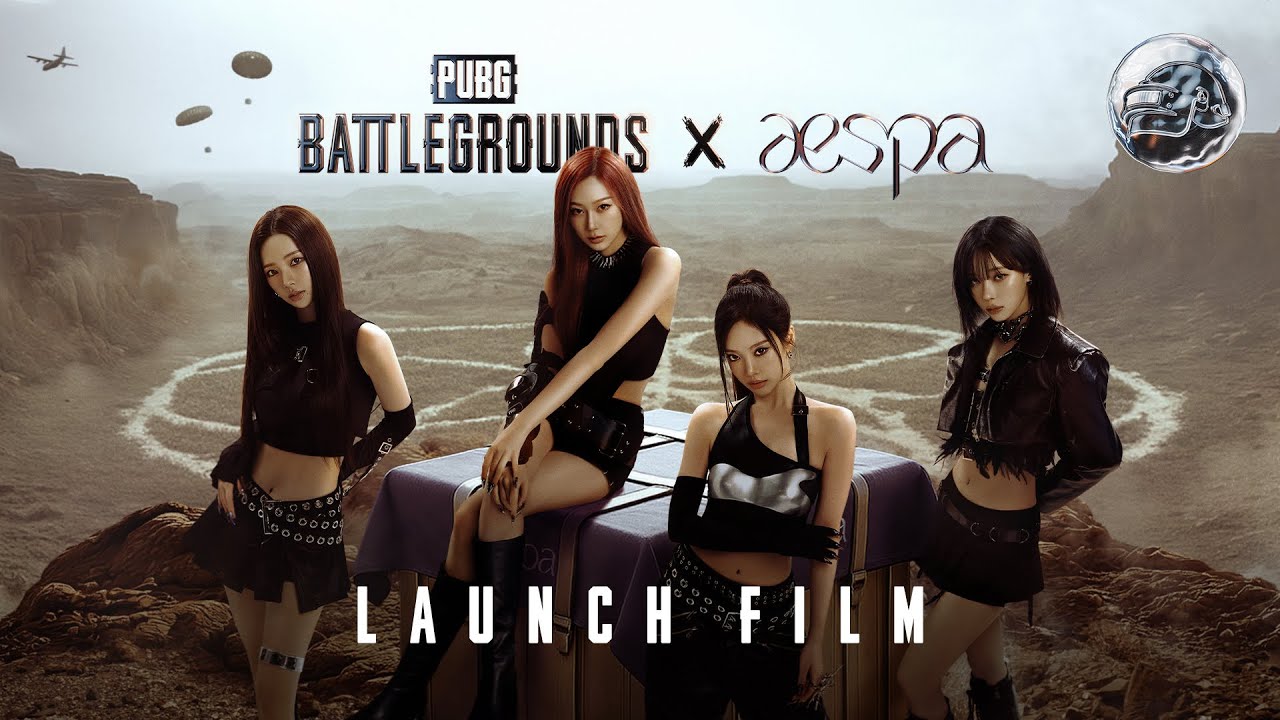
Dark Arts Launch Film: aespa Took Over Miramar Before the Song Arrived
The Dark Arts launch film gives aespa Miramar, weapons, vehicles, and a PUBG collaboration before it gives us the whole song. This is campaign worldbuilding, not an MV, and the distinction matters because branded atmosphere is not musical evidence.
Release file
Released: July 9, 2025
Runtime: 01:55
Artist / channel: aespa / PUBG: BATTLEGROUNDS
Exact-file focus: Official PUBG x aespa Dark Arts launch film.
RAERAE REACTS · aespa x PUBG · LAUNCH FILM
PUBG did not ask aespa to stand beside a branded supply crate and smile. The launch film rewires Miramar around them—stages, symbols, rest stops, care packages and one metallic song fragment sharp enough to make the lobby feel like it joined the comeback schedule.
First reaction: this is an advertisement with actual architecture
Game collaborations often put idol faces on skins, add an emote and wait for fans to call commerce a cultural event. This film at least shows its work. Miramar becomes an aespa space: desert domes, converted gyms, rest stops, screens, murals and crop-field symbols alter how the map is read.
That distinction matters. A logo swap tells players what to buy. Environmental design tells them what has happened to the world. The launch film sells items, absolutely, but it also presents the collaboration as an invasion of ordinary game geography. aespa do not visit PUBG. Their visual language contaminates it.
The fragment understands what a launch film needs
At one minute and fifty-four seconds, this is not the full “Dark Arts” argument. It is the threat before the door opens. The track enters through metallic percussion, compressed vocal attack and words built to survive gunfire, engines and game trailers. “One shot,” “maximum damage” and “attack” are not subtle, but subtlety would drown in the lobby.
The preview does enough to establish texture without spending the full chorus. That restraint protects the July 15 film from feeling like leftovers. A launch film should create appetite, not hand viewers the meal and ask them to return for a different plate.
PUBG fits aespa because both worlds enjoy expensive danger
aespa’s strongest visual identity combines beauty, machinery, digital doubles and the suspicion that every polished surface might become hostile. PUBG provides a world where survival is already the operating system. The collaboration does not need to invent danger or explain why four immaculate women are walking through combat architecture.
The fit can also become lazy. Metallic styling plus weapons is not automatically an aespa concept; it is half the game industry’s advertising language. The film works when Miramar changes around the members, not when they simply look good beside tactical objects.
Karina reads like the squad leader without becoming the only player
Karina has the visual authority to make a still entrance feel like a command. The launch edit uses that efficiently, but it does not let her absorb the entire collaboration. Her center energy establishes the team, then the film moves.
That balance is important in branded material, where the most recognizable member can become the product face and everyone else turns into optional downloadable content. Karina leads the eye; she does not erase the squad.
Giselle gives the English attack language a body
The track’s combat phrases need conversational confidence more than operatic drama. Giselle’s delivery sits naturally inside English-heavy attack language, so the lyrics sound like something a person might actually say before a fight instead of copy written by a marketing department under fluorescent light.
Her cooler performance temperature also suits the desert map. She does not oversell danger. She looks as though Miramar has become inconvenient rather than terrifying, which is more persuasive swagger.
Winter makes precision feel weaponized
Winter’s clean attack works beautifully with trailer editing. A short vocal phrase, direct eye-line or movement cut can land like a mechanical action because she gives the frame a hard edge. The launch film uses her precision as impact rather than asking for emotional development it has no runtime to hold.
She also keeps the group’s musical identity present. Even in fragments, her voice prevents “Dark Arts” from becoming generic esports trailer music with famous people in the thumbnail.
Ningning supplies heat to the metal
Ningning’s voice and expression add warmth inside a concept dominated by steel, desert dust and digital effects. That heat matters because combat trailers can become visually competent and emotionally refrigerated.
Her presence makes the power feel performed by a person rather than rendered by software. When the music opens, her fuller tone suggests the anthem might have somewhere melodic to go after the launch film stops.
Miramar is the fifth visible participant
The official collaboration altered El Pozo, Pecado and Tierra Bronca with concert-like desert domes, converted arenas and rest stops. Starting islands received emote stages, while screens, turntables, crop symbols, balloons, fireworks, planes, care packages and vehicle music carried aespa across normal play.
That list could sound like patch-note soup. The film’s job is to make those changes feel like one event rather than twenty monetization bullets. It mostly succeeds by treating the desert as a stage already waiting to be activated.
The emote stage is clever and slightly dystopian
Players can trigger aespa videos through collaboration emotes on starting-island stages and cheer from below. That turns waiting time before a match into a temporary concert. It is smart use of the game’s social space. It is also a brand-controlled performance where only approved collaboration emotes work and the video stops when the emote ends.
I am not scandalized; PUBG is a commercial platform, not a public park. Still, the mechanic reveals what these crossovers sell: not only clothes or songs, but the ability to make everyone nearby enter your fandom moment for a few seconds.
The launch film and full film are different objects
The July 15 collaboration film gives the song and four members more room. This July 9 launch film introduces the update, previews the anthem and sells the transformed Miramar world. Combining their players would make both reviews vague.
Here, the proper questions are whether the teaser creates a coherent game world, whether the song fragment survives trailer duty and whether the collaboration feels integrated rather than pasted on. The later film can answer how the full track develops and how each member carries longer sequences.
How PUBG music should be filed
PUBG is not a music group, so it should not receive a fake idol profile with “members” named Erangel and Miramar. It is a recurring game property capable of commissioning songs and collaboration films. The archive should connect those works through a PUBG collaboration label/property route while keeping the actual singers under their artist hubs.
That system makes future PUBG tracks findable without corrupting the artist directory. A reader can browse PUBG-related music, then follow this song to aespa, Karina, Giselle, Winter and Ningning. Product relationship and musical authorship remain separate.
Where the film loses me
The launch edit is so efficient that it sometimes feels like a premium patch trailer wearing aespa as proof of scale. I wanted one moment where a member’s action changes the environment, not only a cut showing that both exist in the same campaign.
The song fragment also leans hard on combat nouns. “Dark arts,” force, damage and attack all fit. A stranger lyrical image could have distinguished the anthem from hundreds of game songs built from the same armory. aespa can sell specificity; the copy should trust them with some.
What I kept replaying
- The first Miramar transformation: the map becomes part of the collaboration instead of a neutral backdrop.
- Karina’s squad-establishing entrance: authority without swallowing the other three.
- Giselle’s English attack phrasing: marketing language briefly sounds conversational.
- Winter’s clipped precision: voice and trailer cut behave like one mechanical action.
- Ningning’s warmer tone: human heat survives the metallic mix.
- The emote-stage concept: pre-match waiting becomes a temporary concert and a fascinating little brand-controlled ritual.
- The crop-field symbols: aespa’s arrival changes landscape scale, not only wardrobe.
RaeRae verdict
The “Dark Arts” launch film understands that a real game collaboration needs more than four skins and a hashtag. Miramar becomes an aespa world, the song fragment cuts through combat noise, and each member contributes a different temperature before the full release arrives.
It remains advertising. The difference is that somebody designed the advertisement as a world rather than a shopping receipt. I wanted the members to alter that world more directly, but PUBG gave them enough architecture to make the takeover visible.
Bottom line
aespa took over Miramar before the full song arrived. The “Dark Arts” launch film turns a patch announcement into a compact invasion, then leaves exactly enough ammunition for the July 15 collaboration film to justify its own page.
Sources and official context
- PUBG x aespa — “Dark Arts” exact official launch filmDaily+17Total views222.7K
- PUBG official collaboration file — map features, stages, items and lobby anthem
- CVM Sekai — separate full “Dark Arts” collaboration-film React
- CVM Sekai aespa hub and official-video tracker
What changed every time I replayed it
The first replay tracked the game references. The second watched how the members are integrated rather than pasted over Miramar. The third confirmed the file’s limit: it establishes threat, scale, and collaboration identity, but it cannot substitute for a complete song performance.
Lyrics and meaning
Dark arts functions as power outside respectable rules. The campaign casts aespa as forces capable of rewriting the battlefield, which suits their established lore even when PUBG, not the music, controls the narrative stakes.
Credits and receipts
Use the exact PUBG upload, the aespa hub, and the connected collaboration Reacts documented on the site.