
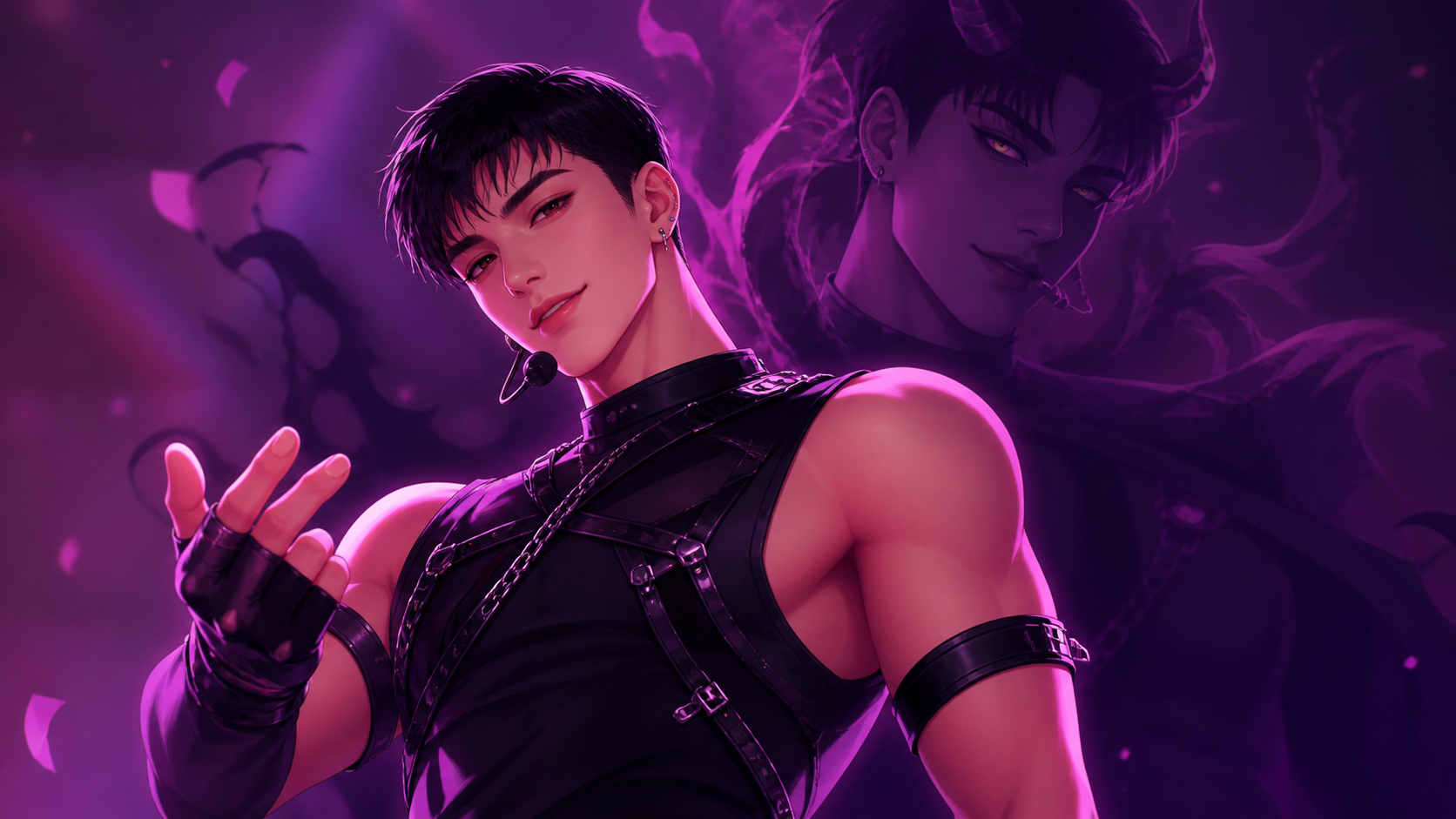
Abby Saja in KPop Demon Hunters
| Character file | Verified details |
|---|---|
| Name | Abby Saja |
| Group | Saja Boys |
| Position | Primary dancer and physical-performance archetype |
| Nature | Centuries-old demon using a human idol disguise |
| Speaking voice | SungWon Cho |
| Singing voice | Neckwav |
| Leader | Jinu |
| Master | Gwi-Ma |
| Main opponent | Mira |
| Public selling point | Muscular body, dancing, and controlled fanservice |
| First appearance | With the Saja Boys in Gwi-Ma's demon realm |
| Final appearance | Defeated by Mira during the final battle |
Abby Saja does not receive a childhood flashback, a private confession, or a dramatic ballad asking us to reconsider his life choices. He gets shoulders, choreography, a floral shirt fighting for its structural integrity, and the confidence of a demon who knows the camera will find his torso. That is not an excuse to write a two-paragraph profile. It is the reason the profile needs to ask what the movie is doing with a character built almost entirely from visual appetite.
He is funny because the exaggeration is funny. HUNTR/X sees him, loses the plot for a second, and the audience understands the joke without explanation. But Abby also belongs to a group engineered to turn desire into access. His body is not a random gag sitting beside the demon scheme. His body is one of the scheme's delivery systems.
The film gives him less interiority than Jinu, so this page will not invent a secret family, a hidden romance, or a redemption arc Netflix forgot to animate. A useful character file separates verified fact from interpretation. Abby is a centuries-old demon, the Saja Boys' primary dancer, voiced in dialogue by SungWon Cho, sung by Neckwav, and defeated by Mira. Everything beyond that has to stay accountable to the scenes we actually have.
The name tells us how the concept works
Abby is named for his abdominal muscles. The joke is blunt enough to function as an instruction: read him through the body first. Each Saja Boy turns one attraction category into a stage identity, and Abby handles the fantasy of visible physical power. He is the member whose concept can be recognized with the sound off.
That instant readability matters because the Saja Boys have no trainee history in the human world. They arrive and need to become desirable before anybody asks where they came from. A body that already fits a familiar idol and fitness fantasy does the promotional work faster than a biography could.
The simplicity also creates a limit. Abby is legible but barely knowable. Fans can identify his function, collect images, choose him as a favorite, and project a personality onto him without the film giving much resistance. That blankness resembles how real promotional systems sometimes sell access to a body while keeping the person behind it safely managed.
A body designed to interrupt thought
Abby's first major human-world impression does not ask viewers to appreciate subtle acting. The shirt opens, the muscles appear, and attention moves. HUNTR/X responds with exaggerated delight, which lets the movie reverse the ordinary direction of an objectifying gag. Women look. A male body performs. The scene knows exactly why it is funny.
Reversing the gaze does not make the gaze disappear. Abby's value inside the Saja Boys remains tied to what his body can make other people do. The group needs fans distracted, emotionally open, and willing to follow. His physical display serves that objective before a lyric needs to explain anything.
The animation pushes beyond realistic anatomy because realism would weaken the joke and the threat. Abby looks sculpted into a category rather than developed through an ordinary training routine. His proportions tell us that the disguise is marketing language made flesh.
Primary dancer means more than standing there shirtless
Netflix identifies Abby as the Saja Boys' primary dancer. That role gives the concept a craft dimension. A muscular body onstage can become visually heavy if the movement does not carry rhythm, control, and clean transitions. Abby has to make size look responsive instead of stiff.
Group choreography uses him as contrast. Jinu leads the eye through center authority. Baby moves through cuteness and surprise. Mystery creates an elusive line. Romance performs direct affection. Abby gives formations weight and a visible physical anchor. His movement helps the five archetypes read as one group rather than unrelated character models.
Calling him only “the abs guy” misses the labor implied by the performance, even in a fictional demon group. The joke starts with the torso. The stage works because animators, choreographers, layout artists, and vocal performers coordinate that torso with timing, camera position, and the other members.
The floral shirt is doing unpaid overtime
Abby's floral shirt softens the physical threat while drawing more attention to it. A plain black tank would announce aggression. The bright print sells vacation ease, playfulness, and the possibility that this enormous man is harmless enough to approach. Then the strained buttons deliver the punch line.
The costume makes appetite feel safe. It frames his body as spectacle offered voluntarily to the crowd rather than force placed near them. That is perfect for the Saja Boys' plan because coercion works better when it arrives dressed as a gift.
The shirt also keeps Abby connected to Soda Pop's bright palette. He belongs inside the sweetness even when his design suggests he could carry three other members out of a burning building. Color prevents the body from breaking the song's innocent surface too early.
Human disguise and demon body
Abby's human form turns exaggerated fitness into aspirational beauty. His demon form exposes the predatory purpose behind that beauty, but the physical scale remains. The movie does not replace a fake attractive body with a true monstrous one. It reveals that attraction and threat were sharing the same design.
That continuity matters. If the human body were only an illusion unrelated to the demon, viewers could treat desire as a trick imposed from outside. Instead, the disguise edits and markets traits already useful to him. The trap is not that audiences saw something with no basis. The trap is that they received a controlled portion of the truth and mistook it for the whole person.
His demon design also makes the muscles less funny. Once the group stops pretending to be harmless, size returns to intimidation. The same shoulders that generated popcorn-spitting comedy can block space during a fight. Context changes what the body communicates.
Abby and Mira are matched through physical confidence
Mira defeats Abby in the final battle, and the pairing makes visual sense. She is HUNTR/X's lead dancer and choreographer, a fighter whose curved blade extends her command of space. Abby is the Saja Boys' primary dancer and physical-display member. Their confrontation pits two forms of body control against each other.
Mira's strength is never limited to being looked at. Her design can carry glamour, but her movement produces decisions. She reads distance, changes direction, and uses choreography as combat knowledge. Abby's public persona is built to stop thought at admiration. Mira's fighting style restores thought through action.
The matchup also lets the film answer the earlier attraction gag without shaming Mira for having eyes. She can notice Abby's body and still destroy the demon using it against people. Attraction does not cancel judgment, competence, or self-possession.
Soda Pop sells the fantasy before the danger
Soda Pop needs Abby because the song promises consumption through pleasure. Its bright surface turns hunger into flirtation and makes the Saja Boys feel immediately familiar. Abby's contribution is visible before most viewers can isolate which singer carries which line. He supplies the body fantasy inside the larger package.
The choreography lets him display strength without reading as openly violent. Flexing, posing, and controlled movement become fanservice. The same physical capacity could threaten, but stage grammar recodes it as entertainment. That recoding is the group's entire strategy in miniature.
The number also shows why audiences inside the film are not foolish. They are watching a professionally constructed debut designed by supernatural beings who understand desire. Responding to craft is normal. Exploiting that response is the moral problem.
Your Idol turns display into domination
Your Idol removes the sunny permission structure. The Saja Boys no longer appear to ask for attention. They command it. Abby's size fits the darker staging because the body no longer needs the floral shirt's harmless framing. Physical presence becomes part of the collective threat surrounding the crowd.
His limited individual dialogue does not remove responsibility. Abby performs in the sequence that prepares fans for Gwi-Ma's soul harvest. He is not an innocent dancer who happened to accept the wrong booking. He is a demon participating in the final stage of the plan.
Keeping that fact visible matters because comedy can make a character feel less dangerous than his actions. Abby is entertaining. He is also part of an attempted mass extraction. Both readings belong in the same profile.
SungWon Cho gives the joke a voice without overplaying it
SungWon Cho provides Abby's speaking voice in the English-language version. Abby receives less dialogue than Jinu and less overt vocal characterization than the group's more talkative archetypes, so efficiency matters. A small amount of performance has to support the physical joke and keep him inside the group rhythm.
The casting also reminds us that character presence is not measured only by line count. Timing, effort sounds, group responses, and brief vocal moments help a large animated body feel inhabited rather than displayed like a poster. The performance supports the joke without demanding that Abby suddenly deliver a monologue the script did not earn.
That restraint fits the concept. Abby communicates most directly through pose and movement. The voice completes the construction rather than competing with it.
Neckwav carries the singing identity
Neckwav is credited among the performers on Soda Pop and Your Idol and serves as Abby's singing voice. The credit belongs beside SungWon Cho's because the character's musical and spoken identities are separate parts of one performance.
The group tracks do not label every voice onscreen for casual viewers. That makes accurate credits even more important. Animated idols can appear self-contained while multiple artists, engineers, songwriters, and animators build the illusion of one singing body.
Neckwav's work contributes to the blend that lets the Saja Boys sound like a credible group rather than five isolated novelty characters. Abby's visual size does not mean his vocal part should overwhelm every arrangement. The music has to keep the ensemble balanced while preserving distinct textures.
Fanservice is the weapon, not a personality flaw
Abby's fanservice should not be treated as evidence that he is vain, stupid, or desperate for approval. The film does not give enough private behavior to support those claims. What it shows is a body deployed with precision inside a coordinated attack.
That distinction keeps analysis from inventing psychology where production design already provides an answer. The Saja Boys sell different fantasies because segmentation widens the audience. Abby serves people drawn to strength, scale, dance, and shameless physical confidence. His concept is strategic even when the movie plays it for laughs.
The weapon is not attraction itself. Attraction is ordinary. The weapon is using attraction to conceal intent, accelerate trust, and redirect collective attention away from the protective group whose fans are being harvested.
The movie reverses objectification and keeps the complication
Mainstream animation has spent decades presenting women in impossible poses while male characters continue the plot. Abby gives the women a chance to stop, stare, and become ridiculous for a beat. That reversal can feel refreshing because female desire gets to be loud, comic, and unserious.
At the same time, Abby remains reduced to the body more aggressively than any other major character. He has almost no personal history, desire, fear, or relationship outside the group. The joke reverses who looks, but the character being looked at still loses interiority.
Both facts can be true. The scene can correct one stale gender habit while reproducing another form of flattening. A sequel could keep the comedy and give Abby one decision that does not originate in Jinu's plan or Gwi-Ma's command.
Muscles are not a substitute for character development
Fandom can fill a blank character with headcanons quickly, especially when the design is memorable. Abby becomes gentle, shy, food-obsessed, gym-disciplined, protective, or secretly intellectual depending on which edit or fan comic appears. Those interpretations can be fun. They are not canon facts.
The official character file openly acknowledges that little is known about him. A responsible profile says the same. Depth does not require pretending the movie supplied information it withheld. Depth can come from analyzing the function of that withholding, the visual archetype, and the industry language the character parodies.
This also protects future storytelling. If another film gives Abby a history, viewers can evaluate that history without discovering a fan-made biography presented as established fact on a reference page.
What his silence does inside the Saja Boys
Jinu speaks for the plan. Romance performs direct affection. Baby gets the memorable rap. Mystery uses concealment as identity. Abby's relative silence pushes more attention toward movement and makes the group feel varied in how it communicates.
Silence can suggest confidence because he does not appear to need explanation. It can also reinforce objectification because the body remains available while the mind stays inaccessible. The film uses that ambiguity without resolving it.
In group scenes, his presence helps Jinu look more verbal and strategic by contrast. Abby can occupy visual space while the leader handles narrative information. That division of labor is common in ensemble design, but it leaves the quiet member dependent on later installments for real development.
Demon consent remains an unanswered problem
The film tells us the Saja Boys serve Gwi-Ma, but it does not provide Abby's contract history. Jinu was once human and made a bargain. We cannot automatically assign the same origin to every member. They may be transformed humans, native demons, constructed servants, or souls bound through different deals.
That uncertainty changes how responsibility should be discussed. Abby clearly participates in harmful acts. We do not know what punishment follows refusal, whether Gwi-Ma controls his memories, or whether he wants freedom. Coercion may exist, but the film has not documented its exact form for him.
A sequel should answer this without copying Jinu's story five times. Different relationships to demon power would give the group internal tension and stop them from functioning as interchangeable extensions of one villain.
The primary dancer deserves an actual dance perspective
If Abby returns, the story should show how he thinks through movement. Does he learn choreography instantly? Does he compete with Mira because both read space at a professional level? Does he enjoy dancing apart from its usefulness in the soul-harvesting plan? None of these questions requires a tragic flashback.
An actual dance perspective could emerge through rehearsal behavior, correction, improvisation, or frustration when another member misses timing. Small choices would reveal standards and temperament while preserving his physical comedy.
The film already establishes a world where music and movement affect supernatural barriers. A primary dancer should have a meaningful relationship to that magic. Abby's body could become more than bait if choreography gives him a way to choose what his strength protects.
Fitness fantasy without a training history
Abby's physique resembles the result of extreme training, diet, recovery, and genetic luck, but he is a demon using a magical disguise. The movie does not claim he earned the body through a human workout program. That gap is part of the joke and part of the fantasy.
Viewers should be careful about turning an impossible animated body into a real-life standard. The design exaggerates because exaggeration communicates quickly. Human performers and fans live in bodies with limits, health needs, and histories that cannot be reduced to visible abdominal definition.
The same entertainment machinery that profits from the fantasy often hides the labor and restriction required to approach it. Abby literalizes the shortcut. He arrives with the marketable body fully installed and no visible cost until the demon truth appears.
Why Mira gets the final answer
Mira's victory over Abby is more than assigning opponents by height or screen position. Her weapon, movement, and refusal to remain distracted answer the entire promise of his human-world introduction. He can control a first look. He cannot control what she understands after looking.
The fight also restores Mira's relationship to performance after the Saja Boys turn the stage against HUNTR/X. Dance was never merely decoration for her. It organizes combat and keeps the trio connected. Defeating the rival primary dancer lets her reclaim that function.
Abby's loss does not mock his body. It proves the body was never sufficient. Strength without a moral purpose, tactical flexibility, or trustworthy group bond becomes another polished asset Gwi-Ma can spend.
Defeat is clear, but death is less useful than the next question
Netflix's official file describes Mira as vanquishing Abby near the end. Onscreen, the Saja Boys are defeated during the collapse of Gwi-Ma's plan. Whether that state allows a supernatural return remains open in a franchise built around souls, barriers, and transformed demons.
A return should not pretend the battle never happened. Abby needs consequences, memory, or a changed relationship to his demon form. Otherwise the film would restore the most popular designs while emptying the first ending of weight.
His limited backstory actually gives writers room. They can develop him without contradicting much, provided they respect the established dancer role, physical concept, service to Gwi-Ma, group relationships, and responsibility for the soul-harvesting performance.
What a sequel owes Abby
First, give him a want that cannot be summarized as helping Jinu or obeying Gwi-Ma. It can be selfish, funny, frightening, or unexpectedly ordinary. A desire creates a basis for choice, and choice creates character.
Second, clarify whether his body is self-expression or assigned branding. Does he enjoy the attention? Did Jinu select the concept? Can the disguise change? What does Abby look like when no human audience is present? The answers would deepen the film's larger interest in performed identity.
Third, let SungWon Cho and Neckwav contribute material identifiable as Abby rather than only group texture. One conversation and one musical phrase could establish more personality than a page of invented trivia.
Abby and the labor of being the body member
Real idol groups often assign members recognizable public positions even when the people themselves contain far more than the label. “Visual,” “main dancer,” “rapper,” or “muscle member” can help audiences learn a group quickly. It can also become a box repeated by hosts, editors, and fans until every appearance demands the same trick.
Abby is a supernatural exaggeration of that box. Nobody asks what he thinks because the body already delivered the content expected from him. The floral shirt opens, the reaction lands, and the promotional identity renews itself.
The satire becomes sharper if we notice how efficient the reduction is. A person does not have to be hated to be dehumanized. Sometimes the audience applauds the one permitted trait so loudly that nothing else can be heard.
Why the character still works with limited dialogue
Abby succeeds as a supporting antagonist because his visual function is immediate, his group role is clear, and his comedy does not interrupt the central emotional arc for too long. The film has a crowded cast and a musical structure. Not every demon needs a full confession inside the first installment.
His design also makes the Saja Boys feel like a deliberately packaged group. Remove the physical-performance archetype and the collection loses one of its most recognizable lanes. He helps the audience understand Jinu's marketing intelligence before the plan is explained in detail.
Limited is not the same as disposable. A strong supporting design can carry thematic information that dialogue would overstate. Abby tells us that the Saja Boys have mapped desire down to the body type.
Fandom can enjoy the abs and keep its brain online
There is no prize for pretending Abby is unattractive. The movie designed the reaction, animated the reaction, and wrote characters having the reaction. Enjoying the joke does not mean surrendering analysis.
The useful move is to separate desire from trust. Somebody can look good and remain dangerous. Somebody can perform confidence and still possess no relationship to you beyond the one the stage manufactured. Somebody can provide real entertainment inside a system built for extraction.
KPop Demon Hunters makes those lessons literal because subtlety would be less fun. The man with impossible abs is a demon. The audience still screams. Then the story asks what happens after the scream becomes a resource.
RaeRae's verdict
Abby is shallow on purpose, but the purpose is not nothing. He is the body-member archetype pushed until the marketing label walks around in a floral shirt. His dancing, scale, and fanservice help the Saja Boys become instantly legible, while his lack of interiority shows how little a promotional fantasy needs to reveal before people start supplying the rest themselves.
I do not need a tragic childhood pasted onto him just to justify a long profile. I need the page to be honest about what we know, what the design accomplishes, and why Mira defeating him feels like the correct visual answer. Pretty packaging can be intelligent craft and dangerous strategy at the same time.
If he returns, give me one choice that belongs to Abby. Let him decide whether the body is his, whether dancing means anything without an audience, and whether Gwi-Ma's command is the only group identity he understands. Until then, enjoy the shirt buttons. They gave more effort than half the fictional managers in idol dramas.
The difference between being visible and being known
Abby may be the easiest Saja Boy to notice and the hardest one to describe without mentioning his body. That gap is not an accident. Visibility can create the sensation of familiarity before a person has revealed anything meaningful. The audience recognizes the shirt, proportions, pose, and dance position, then the brain begins converting repeated images into a relationship that the story never actually supplied.
Idol promotion regularly works through controlled repetition. A member receives a memorable label, editors return to the same reaction shot, and interviews invite the same small behavior until it becomes public identity. Abby compresses that process into a supernatural debut. One scene establishes the label, and every later appearance benefits from recognition already attached to it.
Being known would require information that changes how we understand his choices. What does he fear? What does he want from Jinu? Does he remember a human life? Does he resent being reduced to one physical trick, or is the performance the first role he has ever enjoyed? The film leaves those spaces empty. Fans are free to imagine answers, but the profile must keep the border between imagination and evidence visible.
That border is not meant to kill fun. It protects the character from becoming whatever stereotype happens to fit the body. A muscular man does not automatically have a gentle personality, a simple mind, a gym obsession, or a protective instinct. Those are familiar fan-fiction routes, not facts produced by abdominal definition.
The cleanest sequel development would let Abby surprise the label without discarding it. He can remain physically funny, continue dancing, and still reveal an opinion nobody assigned him. One unexpected refusal, intelligent observation, or private frustration could turn visibility into the beginning of knowledge. Until then, the honest answer is that the audience has seen a great deal of Abby and learned very little about him.
Official production sources
Netflix Tudum's official Abby Saja character file confirms his name, primary dancer role, centuries-old demon status, physical concept, speaking credit for SungWon Cho, singing credit for Neckwav, first appearance with the Saja Boys, and defeat by Mira. Netflix's soundtrack feature identifies Neckwav among the performers of Soda Pop and Your Idol and explains the creative plan to hide demonic consumption inside bright boy-group appeal.
Netflix's cast and franchise coverage establishes the film's directors, writers, principal voice ensemble, Sony Pictures Animation partnership, and broader Saja Boys function as a rival group created to threaten HUNTR/X and their fans.
Those sources establish production facts. The analysis of the gaze, body marketing, dance labor, objectification, group positioning, coercion, fitness fantasy, and sequel possibilities is RaeRae editorial interpretation of the completed film.