
Good Thing: i-dle Found a Great Beat and Forgot to Hire an English Editor
Release file
Released: May 19, 2025
Runtime: 02:55
Label / channel trail: i-dle (아이들)
Sound: RaeRae's verdict: “Good Thing” is i-dle laughing at an ex over arcade noises while the music video lets all five members beat one another through several television genres. The English is crooked, the song is 2:34, and the post-chorus says “holy moly”…
Sources:  Exact official playlist uploadDaily+16.7KTotal views79.3M.
RaeRae’s verdict: “Good Thing” is i-dle laughing at an ex over arcade noises while the music video lets all five members beat one another through several television genres. The English is crooked, the song is 2:34, and the post-chorus says “holy moly” like somebody’s aunt wandered into the diss track. It still works because Soyeon understands that contempt sounds better when everyone can sing along.
Release File
- Artist: i-dle
- Members: Miyeon, Minnie, Soyeon, Yuqi, and Shuhua
- Song: “Good Thing”
- Released: May 19, 2025
- Album: We are, i-dle’s eighth Korean mini album
- Lyrics: Soyeon
- Composition: Soyeon, Pop Time, Daily, and Likey
- Arrangement: Pop Time, Daily, Likey, and Soyeon
- Length: 2:34
- MV director: Ha Jung-hoon of Hattrick
The Good Thing Belongs to Somebody Else Now
The lyric addresses a former boyfriend who has found a new woman. Instead of begging, the narrator congratulates him with enough sarcasm to damage the wrapping paper. His new “good thing” can have him. The real pleasure is knowing what he lost.
Soyeon fills the verses with wealth and speed: an expensive watch, luxury-car keys, and driving at 200 kilometers per hour. Those details make the narrator sound busy, rich, and far beyond the relationship. The flex is cartoonish on purpose.
Then the song calls the couple dumb and dumber, kicks them out, and kisses goodbye. Mature closure was not invited. I respect the honesty.
The English Needed One More Person in the Room
“Baby I heard your good thing” is understandable as slang, but several connecting lines are less cooperative. The official lyrics move between awkward English constructions and Korean phrases that land much more cleanly.
i-dle have used imperfect English as part of their texture before. “TOMBOY” survived lines people still debate because the attitude carried them. “Good Thing” repeats its English too often for every problem to disappear inside delivery.
The issue is not an accent. It is editing. Soyeon’s ideas deserve the final pass that turns intended meaning into sharp language. One fluent check would not erase her voice. It would stop listeners from diagramming sentences while the bass is trying to move them.
Retro Instruments and 8-Bit Sounds Make the Insult Bounce
Pop Time, Daily, Likey, and Soyeon build the track from chunky retro synths, game-like electronic bits, hard percussion, and a bass line that keeps the short runtime moving. The sound has second-generation K-pop bluntness without becoming a costume copy.
The 8-bit details make the relationship feel like a level already cleared. Bright noises answer the vocals while the low end keeps the song from becoming novelty music.
The arrangement is compact and hook-heavy. It reaches the chorus quickly, adds a chant, returns to another verse, and leaves before any idea develops into a bridge. Efficient, yes. Satisfying, almost.
Five Voices Turn Repetition Into Personality
Minnie brings a hazier tone that makes the opening sound amused rather than angry. Miyeon’s clear voice gives the chorus a polished sweetness, which makes the insult meaner. Yuqi attacks the rhythmic lines with low, comic authority. Shuhua’s dry delivery fits the dismissal. Soyeon handles the most exaggerated language like she is directing traffic through her own joke.
The chorus repeats “really” and a nonsense-like sing-song phrase, but the members do not flatten into one chant voice. Their tones remain distinct enough that every handoff adds a different shade of contempt.
That is i-dle’s durable advantage. A simple melody becomes character writing when five recognizable people pass it around.
Holy Moly Is Either Terrible or the Entire Point
The post-chorus pairs “good thing, goody” with “holy moly” and a censored curse. On paper, it looks like three generations arguing over how to insult somebody.
In the song, the absurdity becomes sticky. The rhythm is designed for a point move and a crowd response. The members lean into it with enough facial attitude that the phrase stops requesting dignity.
I would not defend this lyric in court. I would absolutely hear it once and repeat it while unloading groceries. Pop music has its own legal system.
The MV Changes Channels Instead of Explaining the Song
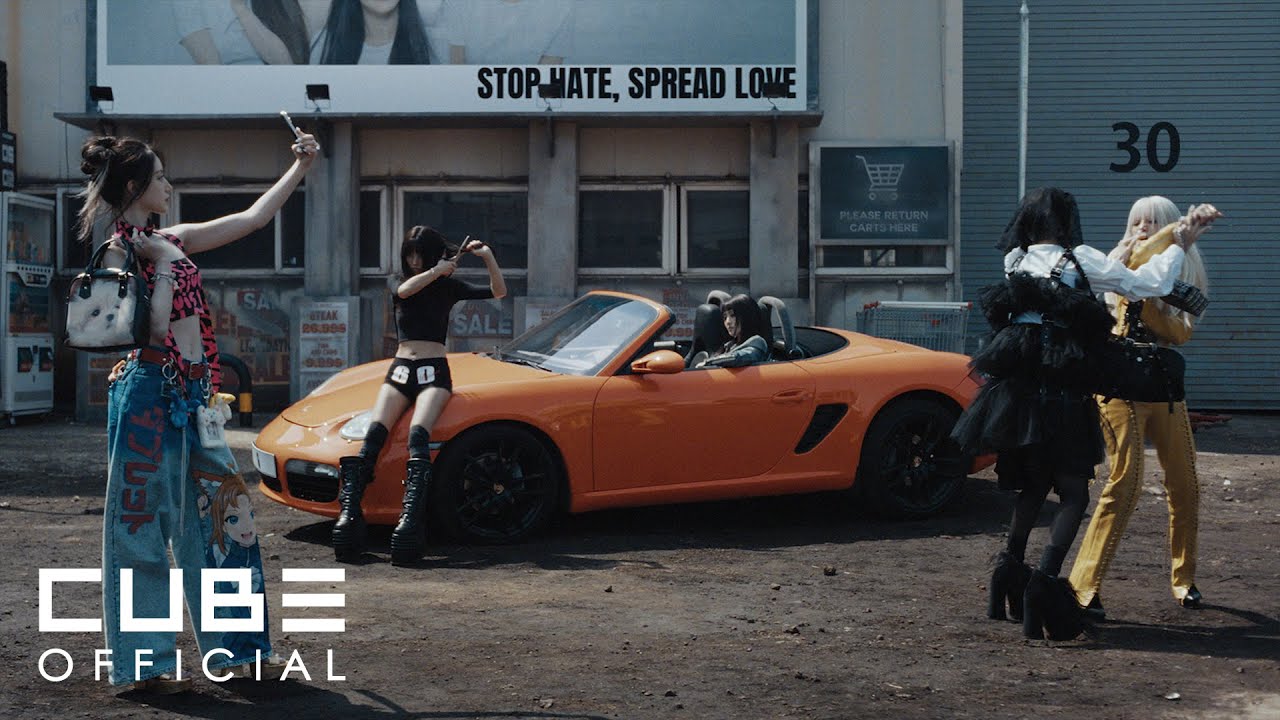
Ha Jung-hoon’s video does not illustrate the ex, the new girlfriend, or the luxury flex in a literal story. It turns i-dle into competing stars moving through television formats, action scenes, stylized sets, and magical transformation logic.
The “Line 1” and “On-air” teasers prepared that broadcast frame. In the full video, screens and genre shifts make the members look like five programs fighting for the remote. They attack one another, reset, pose, and move into the next visual rule.
The song and MV are therefore having separate arguments. The audio dismisses a man. The video stages a five-way battle over image, attention, and control. The shared idea is confidence after destruction.
Letting the Members Fight Is Better Than Inventing Another Man
An obvious MV would cast a handsome idiot, show the breakup, and let all five women laugh at him. i-dle had already made “Girlfriend” about responding to a bad ex ten days earlier.
“Good Thing” chooses internal chaos instead. Miyeon, Minnie, Soyeon, Yuqi, and Shuhua become rivals, heroines, villains, and targets depending on the channel. Their conflict is playful enough to preserve group chemistry.
The result also gives each member an individual visual world. A five-member group that renewed together can afford to joke about trying to eliminate one another. The contract already answered the serious question.
The Rebrand Needed a Title Track With a Name Tag
We are was the group’s first mini album after all five renewed their Cube contracts and the name shifted from (G)I-DLE to i-dle. Every member participated in writing or composing somewhere on the six-track record.
“Good Thing” does not explain the name change. It demonstrates continuity. Soyeon still writes the title, the members still sound unmistakable, and the concept still enjoys turning female anger into a joke nobody else could deliver the same way.
The rebrand removed punctuation. It did not sand down the group.
The Song Leaves Before the Best Fight
At 2:34, there is no real bridge and no final vocal escalation. The post-chorus repeats, the last line lands, and the track exits. The MV supplies additional climax through spectacle, but the audio feels one section short.
A bridge could have stripped away the 8-bit noise, let Miyeon and Minnie sing against Yuqi’s low register, then returned to Soyeon’s chant with new force. The group has the voices. The runtime chooses streaming efficiency over using them.
The good thing needed another thirty seconds. Apparently that relationship ended too.
What Worked
- The retro synth and 8-bit production makes the breakup mockery bounce.
- All five members turn a repetitive hook into distinct character work.
- The ridiculous post-chorus is genuinely difficult to forget.
- The MV avoids repeating the bad-ex plot from “Girlfriend.”
- The television battle gives every member an individual visual identity.
What Was Merely a Thing
The English needs editing, and the song needs a bridge. Neither problem is subtle. A title track should not require fans to rewrite lines or imagine the missing climax themselves.
The MV’s genre changes are fun but loosely connected. Stronger rules for how one channel defeats another could have turned visual chaos into a real story.
RaeRae verdict
“Good Thing” is i-dle making a bad sentence, a good beat, and a ridiculous chant fight for custody of the same song. The beat wins. The members turn sarcasm into five vocal colors, while the MV lets them destroy one another across television worlds instead of wasting another actor on the ex.
It is a good thing. It could have used a good editor.
Sources
- i-dle official music video, credits, and lyricsDaily+16.7KTotal views79.3M
- Bugs Korean track file, runtime, credits, and lyrics
- Bugs Korean We are album file
- Soompi release report and production description
- Maeil Business Korean teaser report
- NME album and rebrand context
What changed every time I replayed it
Replay the official video once for the arrangement, once for the visual direction, and once for the member choices happening outside the center of the frame.
Bottom line
Verdict: This release earns its React because the performance and visual choices keep revealing more than the hook alone can explain.