
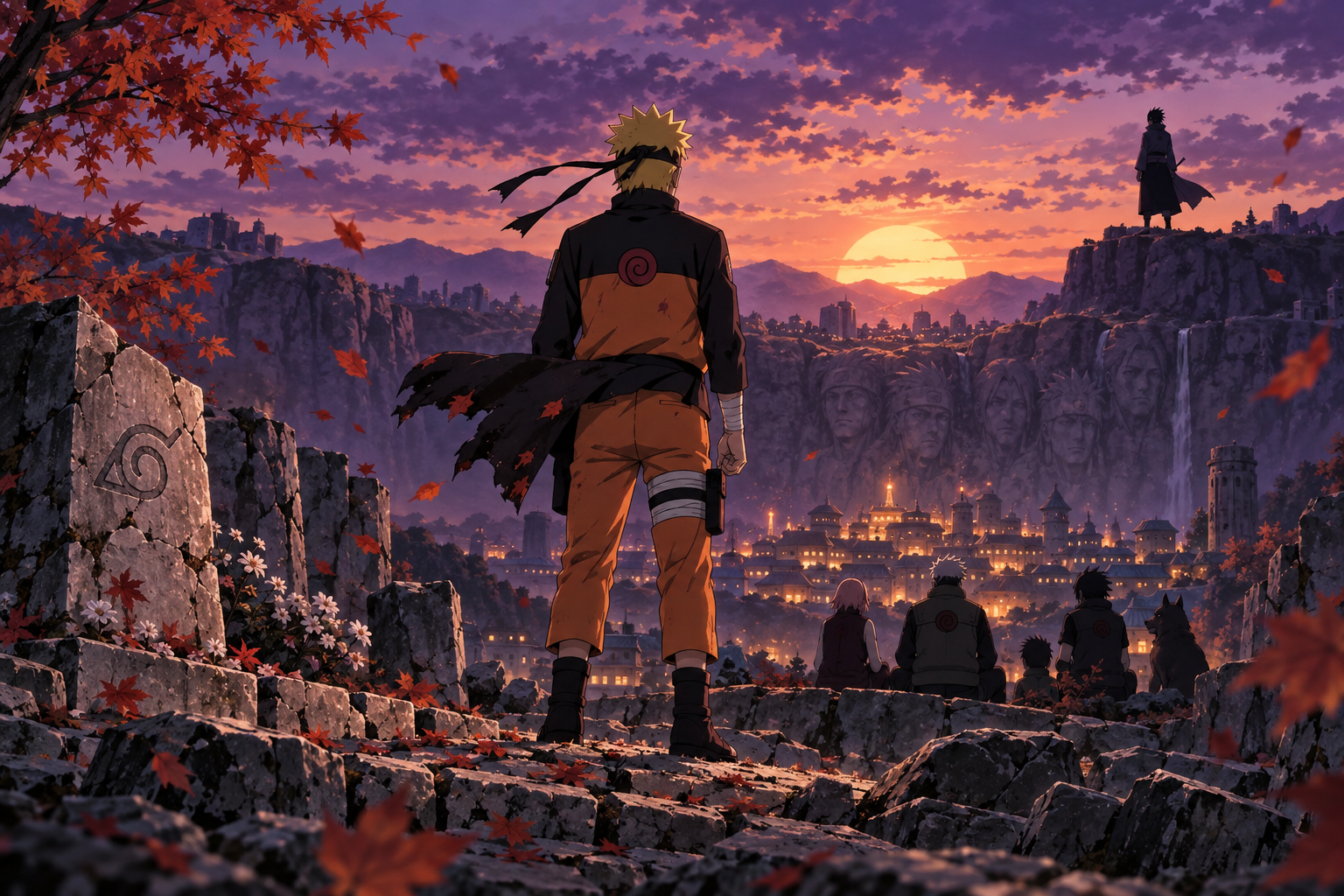
RaeRae Reviews · Animated Series
Naruto Shippuden: Complete Series Review
Shippuden grows Naruto from a lonely boy demanding recognition into the emotional center of a world war. The scale gets bigger, the grief gets older, and the series keeps asking whether inherited violence can be interrupted by people raised inside it. The answer is powerful, messy, and never as simple as one speech.
The bottom line
A childhood wound becomes national policy
My bottom line is 8.5 out of 10. At its best, Naruto Shippuden turns grief into political analysis without losing the pulse of a fight scene. At its worst, the anime interrupts its own emergencies so often that urgency becomes a suggestion. Both truths live in the same 500 episodes.
Naruto’s gift is not magical forgiveness. He recognizes the person inside a role. Jinchūriki, terrorist, prodigy, traitor, weapon, Hokage: every label can become a hiding place for institutions that do not want to account for what they did to a human being. Naruto keeps dragging the person back into view.
That does not erase accountability. Gaara can lead the village that damaged him. Nagato can understand Naruto and remain responsible for mass death. Sasuke can be exploited by adults and still make choices that hurt people. The story weakens whenever empathy is treated like a receipt marked paid in full.
Akatsuki gives grief an organization chart
Akatsuki works because its members are not one ideology wearing different outfits. Sasori preserves bodies because loss made permanence seductive. Deidara wants art to exist in the instant before control returns. Hidan turns faith into permission. Kakuzu makes money the only relationship he trusts. Itachi performs cruelty inside a state crime revealed in layers. Pain turns devastation into a theory of international order.
The group exposes the villages’ hypocrisy. Nations condemn missing-nin while hiring violence, training children, and treating jinchūriki as deterrence systems. Akatsuki is not outside the shinobi world. The organization is assembled from its discarded expertise.
Pain is the series at full power
Konoha celebrates its suffering while forgetting what the great villages did to smaller nations. Nagato’s answer is terror distributed so evenly that nobody can pretend violence belongs somewhere else. Naruto’s answer is not a complete peace program. He refuses to inherit Nagato’s conclusion before he has a system capable of replacing it.
Hinata acts without any promise of victory. Naruto’s transformation shows grief threatening to turn his body into the weapon the village always feared. Minato’s appearance is tender and infuriating: Naruto receives a father while Konoha burns, and that father must explain why he sealed national danger into his newborn son.
Naruto wins the emotional argument because he does not pretend he is untouched by rage. Rage simply does not get the final vote.
Sasuke is not a side quest Naruto can clear through loyalty
Every answer about Sasuke’s family was curated by somebody with power. Orochimaru wants his body. Itachi controls the story of his sacrifice. Tobi redirects his grief. Konoha buries the massacre beneath stability. Even Naruto often wants Sasuke restored to a version of their bond that protects Naruto from loss.
The Five Kage Summit makes Sasuke frightening because pain narrows his field of vision until everybody becomes material between him and revenge. His anger is not irrational. Konoha authorized a massacre and let a child carry the public blame. The tragedy is that truth reaches Sasuke through people invested in weaponizing it.
The final fight works because neither boy simply defeats the other’s philosophy. Reconciliation is earned through exhaustion, memory, failure, and the acceptance that neither can build a future by amputating the other.
The war arc wins and loses at scale
The Fourth Shinobi World War delivers reunions, payoffs, impossible team-ups, and exhilarating animation. It also becomes a warehouse of explanations. Dead characters return. Hidden histories stack. Villains stand behind villains until causality resembles a line of adults insisting somebody else planned the disaster.
Obito is the emotional center because he is Naruto’s possible future with different timing. Madara is the spectacle center because he makes armies look administratively inconvenient. Kaguya arrives with cosmic importance but less accumulated human pressure than the men she replaces.
Still, villages that built identity through rivalry share information, medicine, command, and grief. The world linking chakra against isolation completes an argument the series began with one lonely child making shadow clones.
The giant machine stays human through craft and performance
Five hundred weekly episodes cannot look uniform. Shippuden contains flat stretches, repeated flashbacks, and fights padded past their emotional shape. It also knows when a body should feel weightless, monstrous, exhausted, or suddenly young. Naruto versus Pain is controversial frame by frame and unforgettable in motion. Kakashi versus Obito strips away spectacle until choreography becomes shared biography.
Yasuharu Takanashi’s score gives the sequel a heavier ritual language. Junko Takeuchi lets Naruto age without sanding away the wounded child. Noriaki Sugiyama turns Sasuke’s restraint into pressure. Chie Nakamura gives Sakura’s competence, anger, shame, and resolve distinct edges.
Sakura becomes a medical leader and keeps people alive across a battlefield, yet the story repeatedly returns her emotional framing to Sasuke. Hinata’s courage matters, but too much of her interior life remains organized around Naruto. The problem is not that these women are useless. The problem is narrative allocation.
Final verdict
The ending earns the bond and leaves the institution unfinished
Shippuden completes Naruto and Sasuke’s emotional story more convincingly than its politics. The boys understand the shape of each other’s loneliness. The villages survive. Yet many structures that created the suffering remain available for nicer leaders to manage.
The series is too long, too repetitive, too devoted to flashback, and too willing to explain one conspiracy with a larger conspiracy. It is also emotionally brave, visually iconic, and capable of making a rivalry carry a generation’s argument about love, power, and belonging.
Watch with an episode guide nearby. Let the great arcs breathe. Skip repetition when the broadcast calendar starts arguing with the drama. Naruto’s achievement is not merely that he never gives up. He learns that connection without accountability becomes another way to avoid the truth.
Connected Naruto reading
Official records