
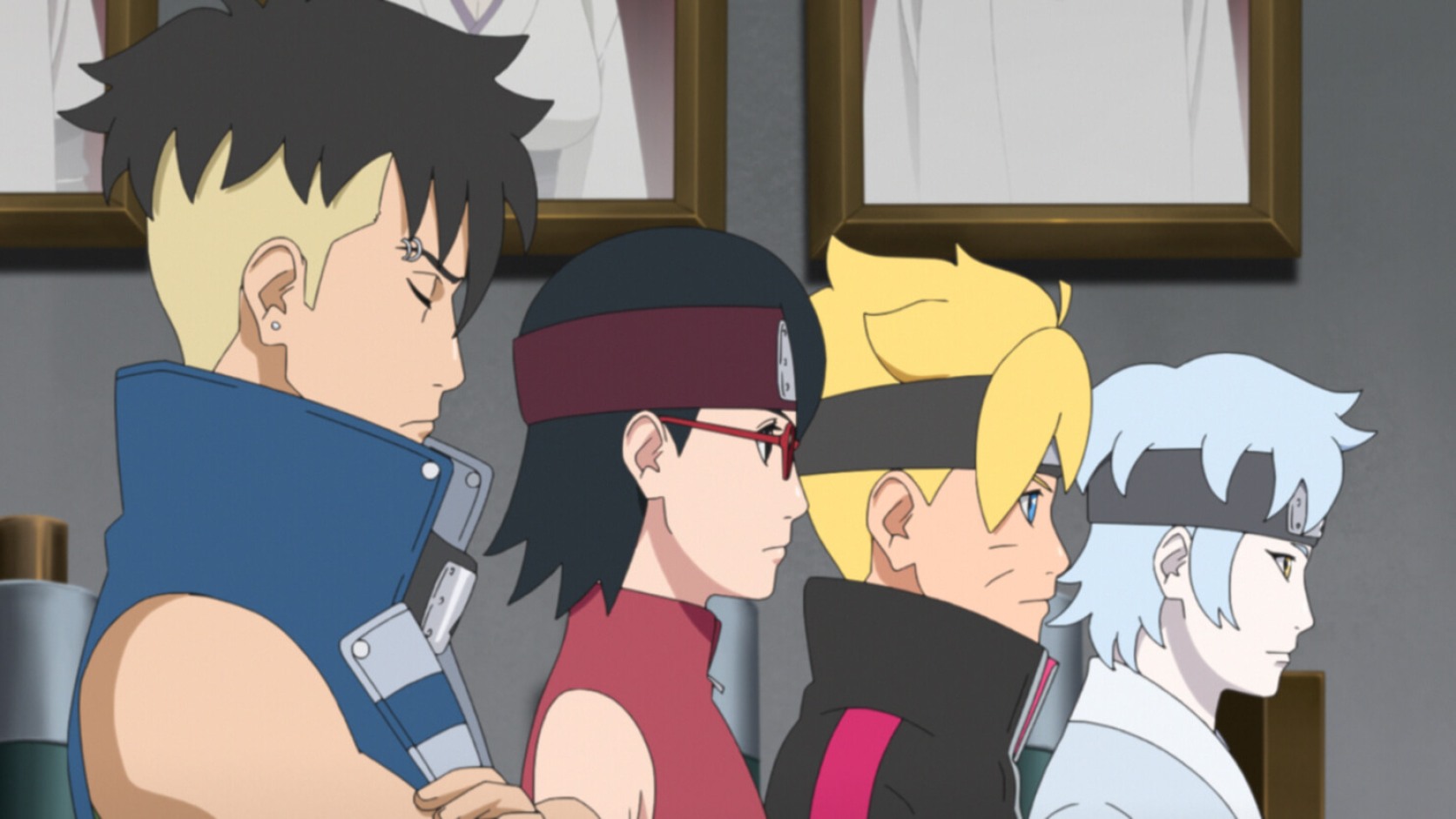
The New Team 7 Jumps Into Action
Kawaki’s headband and Sarada’s command should bring support, rights, and preparation; a known attack threat is not permission for adults to make a new youth team prove itself through catastrophe.
Series: Boruto: Naruto Next Generations
Episode: 233 · The New Team 7 Jumps Into Action
Arc: Great Sea Battle of the Hidden Mist Village
Release: January 23, 2022
Previous: Episode 232 · Captain Denki’s First Mission
Directory: All 293 Boruto episodes
Bottom line
Boruto Episode 233 puts Kawaki in a Leaf headband, places Sarada in command, and sends the expanded Team 7 to the Land of Water as security for Katasuke and the Shinonome power-system ceremony. The mission looks like a victory lap for new beginnings until the Funato movement turns a public infrastructure event into a target.
Kawaki joining Team 7 should give him training, protection, responsibility, and peers. Membership cannot become a reward he loses whenever trauma makes him difficult. Sarada's promotion should give her real authority, adult backup, and clear intelligence. The village cannot hand teenagers impressive titles and then call danger a leadership exercise when warnings about an attack already exist.
The episode at a glance
- Series: Boruto: Naruto Next Generations
- Episode: 233
- Title: The New Team 7 Jumps Into Action
- Arc: Great Sea Battle of the Hidden Mist Village
- Original release: January 23, 2022
- RaeRae rating: Four bowls of ramen out of five
- Core question: Will Team 7 become a safe place for Kawaki and Sarada, or another institution that demands proof through danger?
A headband is not a cure
Kawaki receives official recognition as a Leaf shinobi. The headband gives him a role, shared expectations, and access to a community he chose. That matters after Kara treated his body as property and Jigen treated obedience as survival.
The symbol cannot erase abuse, grief, fear, or his habit of handling danger alone. Adults should explain rights, discipline, pay, medical care, complaint routes, mission limits, and how he can leave or request reassignment. Belonging becomes real through procedures as well as affection.
Team membership must be unconditional at home
Kawaki's position on Team 7 may change if duties, safety, or relationships require another arrangement. His place in Naruto's family should never depend on performance. A failed mission cannot become evidence that he no longer deserves a home.
Naruto needs to say that boundary clearly before deployment. Kawaki has spent too much of his life learning that usefulness buys temporary safety. Family and employment must remain separate enough that correction does not feel like abandonment.
Sarada earned command
Sarada becomes the captain because she demonstrated judgment, leadership, and competence. The role should not be framed as a ceremonial promotion while adults reserve every meaningful decision. She needs access to the mission brief, threat information, resources, and authority to change plans.
Command also requires support. Sarada is still young. A village that promotes her owes mentorship, review, and an escalation route. Respecting her rank does not mean pretending she has adult experience she has not had time to acquire.
The new team needs a real orientation
Adding Kawaki changes communication, tactics, trust, and emergency response. Team 7 should discuss strengths, limits, triggers, medical needs, equipment, formation, and withdrawal signals before international travel. A quick announcement cannot replace that work.
Sarada needs private conversations with every member and a group rehearsal. Kawaki should know how commands work and when he may challenge one. Boruto and Mitsuki should know that friendship does not grant authority over his body or history.
Four people do not become one overnight
The title celebrates a new Team 7, but a shared number cannot manufacture trust. Boruto and Kawaki carry a brotherly bond full of loyalty and conflict. Sarada and Mitsuki already have established rhythms with Boruto. Kawaki enters a system built before him.
Good integration makes those existing relationships visible. The team should not demand instant intimacy from Kawaki or ask everyone else to ignore discomfort. Predictable work, honest boundaries, and repeated repair will build something stronger than a welcome speech.
Sarada should not become Kawaki's manager
Command does not make Sarada responsible for treating Kawaki's trauma, controlling every reaction, or translating his feelings for adults. She can set mission boundaries and support a teammate. Clinical care and family support belong elsewhere.
Girls in leadership often receive the emotional work nobody assigns to boys. Sarada deserves to lead operations without becoming the team's unpaid therapist. Naruto and Konohamaru need to carry adult responsibility for Kawaki's transition.
Kawaki deserves informed assignment
Officials place him on a mission involving international travel, sea transport, a public ceremony, new technology, and a possible attack. He needs full information about known risks before departure. A new genin should not discover the real threat only after leaving home.
Informed participation includes the right to ask about Karma, medical care, communication with Naruto, and what happens if he cannot continue. Consent inside a military structure has limits, which makes transparent briefing more important.
Escort duty is not background work
Team 7 must protect Katasuke while respecting his autonomy. The scientist is a client and technical expert, not cargo. He should understand routes, emergency signals, secure areas, and why shinobi may restrict movement during a threat.
The team also needs to know his schedule, contacts, equipment, and any sensitive information he carries. Protection fails when the client and security team operate from different plans. Katasuke should not wander away because nobody included him in the briefing.
The terrorism warning changes everything
Rumors or intelligence about an attack make the mission more than ceremonial escort. Officials should assess source reliability, likely targets, methods, timing, and political context. Vague warning language can create anxiety without guiding action.
Sarada needs specific decision thresholds. When should the team move Katasuke, cancel attendance, alert local security, or request reinforcement? A warning kept too secret to use becomes institutional theater rather than protection.
Konoha and the Mist need one command map
International security fails when agencies assume someone else controls the scene. Team 7 should know who leads at the port, ceremony, prison, power facility, and evacuation points. Local officials need the same clarity.
Shared radio channels, named contacts, fallback meeting places, and custody procedures matter more than formal greetings. Sarada cannot coordinate people she cannot reach. Mist security should respect her role without surrendering local authority.
The ocean gives Kawaki wonder before sickness
Kawaki sees the sea with fresh fascination and then becomes seasick. That small sequence matters. His life contains experiences unrelated to Karma, abuse, or combat. Wonder gives him a future larger than survival.
Motion sickness does not make him weak. The team should offer hydration, rest, fresh air where safe, and medication if appropriate. Mocking discomfort teaches people to hide symptoms. Hidden symptoms can become operational risk during an emergency.
Travel accessibility belongs in planning
Mission planners know the route includes sea travel. They should ask about prior experience, medical needs, food, sleep, and emergency evacuation. Kawaki cannot report a history he has never had, so the plan needs flexibility.
Sarada should adjust duties without framing accommodation as failure. A teammate resting during transit can still contribute later. Leadership protects capacity across the whole mission rather than demanding identical performance every hour.
Boruto's excitement needs boundaries
Boruto wants to see Kagura again. That desire is understandable after their earlier connection in the Mist. A personal reunion still sits inside an escort and security mission.
Sarada can approve a visit only after confirming timing, route, communication, and return conditions. Boruto should not treat friendship as automatic permission to leave the assigned group. His history with Kagura may also create useful intelligence, which needs to be shared rather than kept as a private adventure.
Kagura chose difficult public service
Kagura now serves as warden of a high-security prison. The role places him inside a system where safety, punishment, rehabilitation, staff culture, and political pressure collide. His past gives him insight into violence and manipulation, but personal experience alone cannot guarantee humane leadership.
He needs policies that protect prisoners and staff, independent oversight, medical care, complaint routes, and clear use-of-force limits. A good person inside a harmful structure requires more than good intentions.
A modern prison can still cause old harm
The facility looks advanced, with controlled cells and clean technology. Modern design does not prove justice. Surveillance, isolation, restricted contact, and automated control can hide abuse behind polished surfaces.
Kagura should know who reviews confinement decisions, how prisoners appeal treatment, and what support exists after release. Security matters because dangerous people are held there. Human rights matter because state power operates with limited public visibility.
Shizuma's escape demands accountability
Kagura explains that Shizuma escaped after killing the previous warden. That failure should trigger an independent review of staffing, intelligence, access, emergency response, and warning signs. Blaming one dead official would protect the institution from learning.
The prison also needs to communicate risk to communities without creating panic. Families of staff and prisoners deserve accurate information. Kagura inherits responsibility for fixing systems he did not design, and leaders above him must provide resources.
Araumi Funato is more than a dangerous prisoner
Araumi leads a clan associated with piracy and violent resistance. His custody may be necessary for public safety. Officials still need to preserve legal rights, medical care, family-contact rules, and protection from revenge.
Boruto's curiosity should not turn the prisoner into a spectacle. Kagura must explain boundaries before any tour reaches sensitive cells. Security information, identities, and procedures should never be shared merely because a visitor knows the warden.
Prison tours require consent and purpose
Boruto enters a high-security setting during an active threat period. That choice raises obvious questions. Who authorized the visit? What purpose justifies access? What information could an observer carry outside, even accidentally?
Kagura should limit the route, protect prisoner privacy, and ensure staff know a visitor is present. Friendship cannot replace procedure. A secure institution becomes vulnerable when personal relationships create informal exceptions.
The Funato grievance needs history
The approaching fleet carries anger tied to the Land of Water's direction and the Funato clan's loss of power. Calling them terrorists may describe tactics without explaining the conflict. Political violence grows from history, material interests, ideology, leadership, and communities affected by state policy.
Understanding grievance does not excuse attacks on civilians. Accurate context helps separate legitimate concerns from hostage-taking, sabotage, and murder. Governments that refuse context often repeat the conditions feeding recruitment.
Pirates are not a single moral category
The Funato label can flatten leaders, fighters, coerced participants, families, coastal communities, and opportunists into one enemy image. Security agencies need distinctions. Individual conduct should determine accountability.
Some people may support resistance to environmental or economic policy without supporting violence. Collective punishment would deepen harm and create new grievances. Investigators should document who planned, ordered, enabled, and carried out each act.
The ceremony is a public promise
The Shinonome power system represents modernization and expanded energy access. A public ceremony tells residents that leaders can deliver progress. That promise needs evidence about who benefits, who pays, and which communities bear environmental or security costs.
Katasuke's presence lends technical legitimacy. He should not endorse claims beyond his knowledge. Engineers have an obligation to explain limits, risks, maintenance needs, and unresolved questions even when officials want celebration.
Infrastructure is political
Power systems shape homes, hospitals, businesses, communication, transportation, and military capacity. Decisions about placement and control distribute opportunity. The Shinonome project cannot be treated as neutral machinery.
Residents need meaningful consultation, accessible information, and routes to challenge harm. Coastal workers and communities may experience development differently from officials at a ceremony. Progress measured only through output can hide displacement, ecological damage, or unequal access.
Security cannot silence dissent
A credible attack warning may justify screening, protected routes, and emergency planning. Officials must distinguish violent planning from protest, criticism, or refusal. Treating every dissenter as a Funato operative would abuse the threat.
Clear rules, documented searches, complaint routes, and independent review can limit overreach. Public safety grows stronger when residents trust that reporting suspicious conduct will not expose ordinary political speech to punishment.
Katasuke carries institutional baggage
Katasuke's technology work has supported valuable tools and serious mistakes. His earlier vulnerability to manipulation and the Chunin Exams scandal should inform security planning without becoming permanent humiliation.
He deserves protection and clear responsibilities. He also owes transparency about the systems presented in the Land of Water. Rehabilitation after failure means restored work with oversight, not pretending the earlier breach never happened.
Scientific collaboration needs safeguards
International technical exchange can improve lives, but shared projects may involve intellectual property, military applications, data, and unequal bargaining power. Konoha and the Land of Water need written boundaries around use and transfer.
Civilian infrastructure should not quietly become a weapons platform. Researchers should identify dual-use risks and who can authorize changes. Public oversight matters because the consequences extend beyond one laboratory or village leadership circle.
The blimp creates a concentrated risk
Moving officials and guests by blimp may offer convenience and ceremony. A known threat makes concentrated transport an obvious target. Security planners should assess passenger lists, screening, routes, weather, redundant aircraft, emergency landing, and medical response.
Sarada cannot protect every vehicle from one position. The plan should distribute capable security and avoid placing all essential personnel together. Ceremony should never outrank evacuation readiness.
Boruto's absence affects the team
Sarada allows Boruto to visit Kagura, then worries whether he will return in time. That concern shows the operational cost of a personal detour. If the threat becomes active, Team 7 has reduced strength and incomplete communication.
Boruto needs a check-in schedule and a direct return order. Sarada should know his location. Approval does not remove his responsibility to monitor the mission channel. Personal trust works better when paired with clear procedure.
Mitsuki should not disappear into calm support
Mitsuki often notices tension and adapts quietly. His composure can make adults assume he needs little guidance. He still deserves an explicit role in the escort and emergency plan.
Sarada can use his observation and flexibility without making him responsible for compensating whenever Boruto or Kawaki ignores structure. Reliable teammates often receive more invisible work because they rarely complain. Leadership should name and distribute that burden.
Kawaki needs a role beyond extra muscle
Placing Kawaki on Team 7 because he can fight would repeat Kara's treatment of his body as a weapon. Sarada should give him tasks involving observation, communication, client protection, and decision-making as well as combat.
He needs chances to learn mission procedure without public shame. Questions should be welcomed. A newcomer cannot follow rules nobody explained. Accountability becomes fair only after the institution provides usable expectations.
Sarada's authority needs adult respect
Katasuke, local officials, and older security personnel may see Sarada as a child despite her rank. They should be able to question plans through established channels, not ignore her until a man repeats the same instruction.
Konoha should introduce her authority clearly before arrival. If adults undermine the captain in front of the team, confusion will grow during crisis. Respect includes listening and providing information, not ceremonial praise after success.
The attack kills before the arc fully begins
One blimp crashes, killing the Shinonome inventor's son. The death should not function only as proof that the villains are serious. A person, family, technical community, and public project absorb the loss.
Emergency response must prioritize rescue, fire control, medical triage, site safety, and identification. Investigators should preserve evidence without delaying care. Public officials need to communicate verified facts and avoid using grief to justify unchecked retaliation.
The inventor's family deserves privacy
Families often learn about public deaths through rumor or media. Authorities should provide direct notice through trained personnel before releasing names. Personal belongings, remains, and medical information require respectful handling.
The ceremony organizers also owe practical support for travel, accommodation, counseling, and legal questions. Public condolences cannot replace sustained care. The family's grief should not become political decoration for speeches about resolve.
A crash requires independent investigation
Officials must determine whether sabotage, security failure, mechanical defect, pilot error, weather, or multiple factors caused the crash. Political pressure may encourage a quick Funato accusation. Evidence should lead the conclusion.
Investigators need flight records, maintenance history, passenger manifests, communications, wreckage documentation, witness accounts, and security footage. Independence protects the public from both cover-up and convenient blame.
The power project needs continuity planning
The inventor's son's death may affect technical knowledge, leadership, or public confidence. Project managers need succession plans and documentation so infrastructure does not depend on one person's memory.
Continuity should not mean forcing grieving colleagues back to work immediately. Teams need time, mental-health support, and transparent decisions about delay. A ceremony deadline is never more important than safe review after a fatal attack.
Team 7 should not chase before regrouping
When violence begins, the new team faces a temptation to pursue suspects immediately. Their first duties are client safety, head count, communication, and coordination with local authorities. Splitting without a plan could create more victims.
Sarada needs current intelligence and a clear command boundary. Boruto's location at the prison complicates everything. A disciplined pause for information is not cowardice. Pursuit only helps when the team knows whom to pursue and what remains unprotected.
Kagura holds dangerous information
As warden, Kagura knows prisoner identities, facility weaknesses, and the history of Shizuma's escape. During an attack, that knowledge makes him an asset and a target. Communication with Mist command should follow secure channels.
Boruto must avoid broadcasting sensitive details to Team 7 over an unsecured route. Friendship can support quick cooperation, but formal coordination remains necessary. One intercepted message could endanger prisoners, staff, and the public.
The prison needs emergency safeguards
An external attack can trigger lockdown, evacuation, medical emergencies, power loss, or attempts to free high-risk prisoners. Plans should distinguish threats inside and outside the facility. A blanket lockdown may trap vulnerable people during fire or structural damage.
Backup power, manual release controls, protected staff communication, medical access, and independent incident logging all matter. Modern doors become dangerous when nobody can operate them after system failure.
New leadership should allow mistakes
Sarada and Kawaki will make errors. Denki will too. Promotion and membership should create structured opportunities for correction rather than a demand for perfection. Fear of losing status encourages concealment.
Adults should distinguish deliberate misconduct, skill gaps, trauma responses, and ordinary learning. Consequences can protect safety without threatening identity or belonging. A team grows through repair because no mission history remains flawless.
Naruto cannot outsource parenting to Team 7
Assigning Kawaki peers may help him build relationships. The team cannot replace Naruto's responsibility as guardian. Boruto should not become his brother's permanent monitor, and Sarada should not carry the burden through rank.
Naruto needs regular private check-ins that do not feel like interrogation. Medical and counseling support should remain available outside the Hokage's office. Kawaki deserves adults whose care does not depend on mission success.
Konohamaru still matters
Sarada may serve as captain during the mission, but Konohamaru remains an experienced mentor connected to Team 7. The village should clarify his role rather than making adult leadership vanish after promotion.
He can review plans, help integrate Kawaki, and support Sarada without undermining her authority. Mentorship works when the learner owns decisions appropriate to her rank and the mentor remains available before disaster.
The Land of Water has changed unevenly
Boruto remembers the Mist from an Academy trip. New infrastructure and ceremonies suggest rapid modernization. A gleaming power system does not prove every island, fishing community, worker, or family benefits equally.
The Funato conflict may exploit real resentment while using unacceptable violence. Officials should investigate distribution, displacement, environmental impact, and political exclusion instead of treating every grievance as propaganda. Security and reform can proceed together.
Development should include coastal communities
People whose livelihoods depend on the sea may face changes in access, pollution, shipping, energy projects, and regulation. Consultation after decisions are final is not participation. Communities need information early enough to influence outcomes.
Compensation should address documented loss without buying silence. Local knowledge can improve project design. Ignoring that knowledge creates avoidable opposition and may give violent leaders room to claim they represent everyone.
The Funato do not own every grievance
Armed groups often present themselves as the only authentic voice of harmed communities. Residents may oppose government policy and reject Funato violence. Officials should protect that distinction.
Peaceful organizers, journalists, workers, and families need safe routes to criticize both sides. Collective labels erase agency and make civilians easier to punish. Team 7 should seek specific evidence before deciding who counts as a threat.
Episode 233 works as a beginning
The episode reconnects Boruto with Kagura, places Kawaki inside Team 7, recognizes Sarada's leadership, introduces major infrastructure, and reveals an organized maritime threat. Those strands create more than a travel setup.
The strongest promise lies in the collision between personal reunion and public systems. Friendship, prison reform, energy policy, terrorism, and village cooperation now occupy the same arc. The story has room to ask who modernization protects and who pays.
The episode needs more preparation time
Team 7's new structure moves rapidly from announcement to international deployment. Viewers see excitement and some discomfort, but little practical orientation. That missing work matters because the coming danger will test relationships that adults barely helped establish.
A few scenes of Sarada setting expectations, Kawaki asking procedural questions, and Konoha sharing threat intelligence would strengthen the arc. Preparation can reveal character without slowing momentum.
RaeRae verdict
Boruto Episode 233 earns four bowls of ramen out of five. Sarada's captaincy feels earned, Kawaki's headband carries emotional weight, and Kagura's new role opens questions bigger than a reunion. The Land of Water looks modern while old political wounds move beneath the ceremony.
Konoha still sends a newly assembled youth team into a known threat environment with too little visible preparation. Team 7 can protect Katasuke and support the Mist. Adults must stop treating young competence as permission to withdraw support. The blimp crash proves the danger was never theoretical.
Before the next episode
Episode 234, “The Unleashed Villain,” turns the attack into an emergency around the prison and Araumi Funato. Watch how officials balance evacuation, custody, medical care, evidence, and public safety when infrastructure begins failing.
Also watch who gets blamed first. A crisis can reveal guilt, but panic can also create convenient suspects and collective punishment. Sarada needs facts before force.
Sources and lawful viewing
The official Naruto site provides the Episode 233 synopsis and gallery. Crunchyroll carries “The New Team 7 Jumps Into Action” where regional availability permits. Release and streaming details can vary by country.
Official episode reference: Naruto Official episode guide
Licensed episode route: Crunchyroll licensed series page
After watching, ask whether Kawaki received a team or another place where usefulness determines belonging. Then ask whether Sarada received command or merely responsibility without enough adult power behind her.