
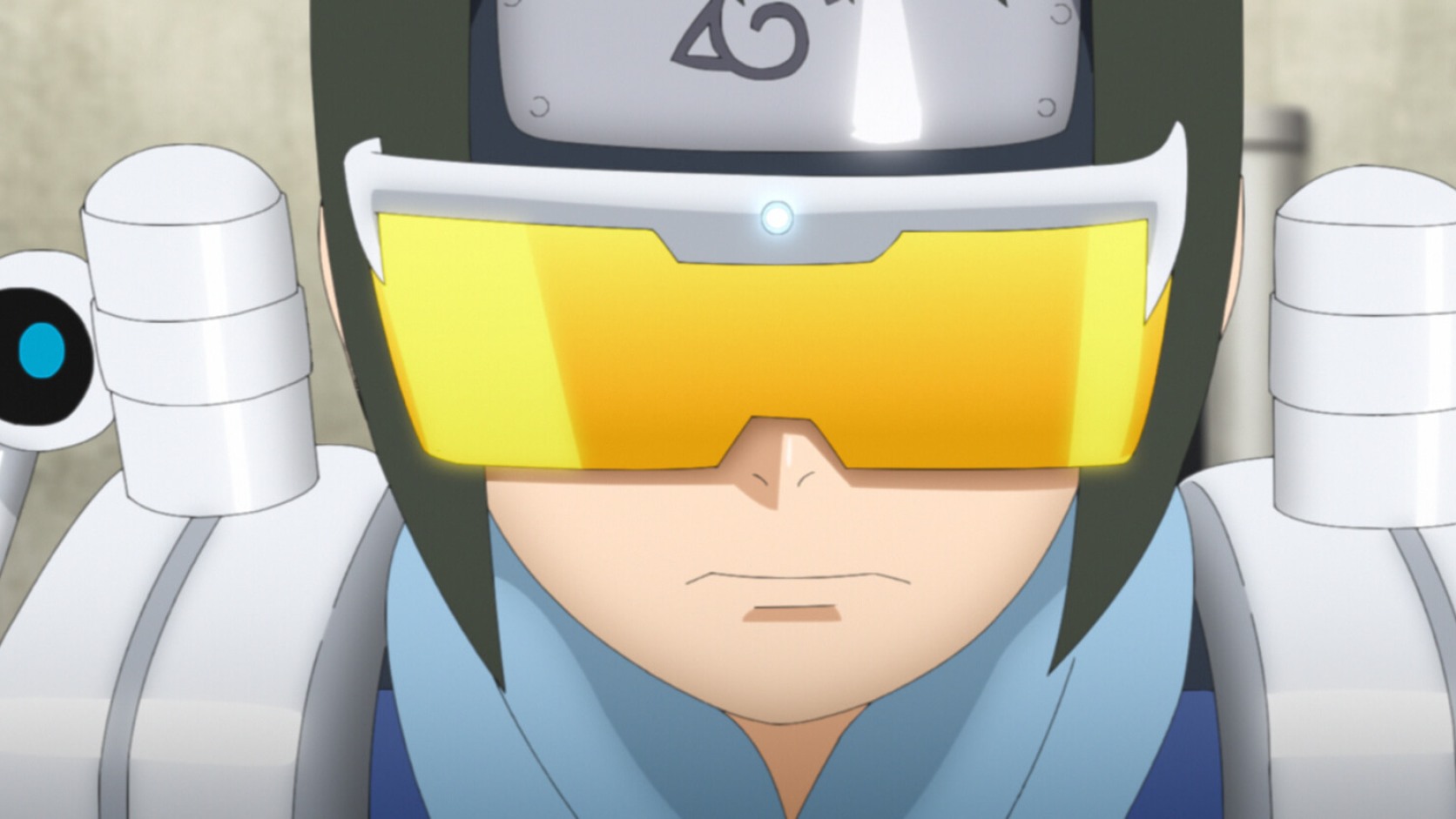
Samurai vs. Science
Denki and Tsubaki prove that neither innovation nor tradition guarantees wisdom; skill becomes meaningful through disclosure, access, preparation, safety, and judgment.
Series: Boruto: Naruto Next Generations
Episode: 226 · Samurai vs. Science
Arc: Chunin Re-Examination
Release: November 28, 2021
Previous: Episode 225 · Showdown Between Best Friends
Directory: All 293 Boruto episodes
Bottom line
Boruto Episode 226 disqualifies Boruto and Mitsuki for arriving late, then places Denki's scientific tools against Tsubaki's samurai training. The title advertises a clash between tradition and technology. The match itself offers a better answer: neither category makes a person worthy. Judgment, preparation, access, safety, and accountability decide whether a tool serves the user or consumes the moment.
Denki finally competes in a field where his engineering belongs inside the definition of shinobi skill. Tsubaki refuses to treat innovation as a shortcut. Both deserve an exam that evaluates what they understand, not whether the village finds a sword more romantic than a machine.
The episode at a glance
- Series: Boruto: Naruto Next Generations
- Episode: 226
- Title: Samurai vs. Science
- Arc: Chunin Re-Examination
- Original release: November 28, 2021
- RaeRae rating: Four bowls of ramen out of five
- Core question: Can Konoha judge tools by transparent use and demonstrated mastery instead of nostalgia?
Boruto and Mitsuki are disqualified
They miss the required arrival time, so officials remove their match from the bracket. The consequence follows the announced structure. That does not make the process automatically fair.
The boys were responding to suspicious activity, but they failed to use a reliable reporting route. Good motives cannot erase unsafe procedure. A village serious about public safety should teach candidates exactly whom to contact when an emergency conflicts with the exam.
Disqualification can remain while adults review why two genin believed direct pursuit was the only responsible option.
Rules need an emergency pathway
Punctuality matters because opponents, judges, medical staff, and spectators organize around a schedule. A rigid clock also creates perverse incentives when candidates encounter danger.
Konoha needs documented exceptions, an immediate contact channel, and a neutral appeal process. Candidates should preserve evidence, report quickly, and follow instructions whenever possible.
An exception process should apply equally to famous and unknown genin. Fairness cannot depend on whether Naruto recognizes the late arrival.
Boruto does not need public humiliation
The earlier Chunin Exam already turned Boruto's wrongdoing into spectacle. This time he accepts a consequence connected to lateness rather than fraud.
Officials should explain the result without replaying his old shame for entertainment. Accountability works when the consequence is specific, proportionate, and paired with guidance.
He needs a review of the decision chain: what he observed, why he followed, when he could have reported, and how he would respond next time.
Mitsuki made his own choice
Mitsuki cannot be treated as a passenger carried by Boruto's impulse. He agreed to investigate and accepted the risk to his exam.
His growth requires independent judgment, including the ability to challenge a friend. Loyalty does not mean automatic agreement.
A debrief should ask Mitsuki what information changed his decision and whether he considered backup. That respects him as a person rather than an extension of Boruto.
Denki finally enters on his own terms
Denki has spent much of the series in a culture that treats physical combat as the clearest proof of competence. Engineering becomes his route to participation rather than an apology for not resembling louder fighters.
The scientific equipment matters because he understands the system. Pressing a button on somebody else's hidden solution would repeat the deception problem from Boruto's first exam. Designing, testing, disclosing, and operating a tool demonstrates knowledge.
His skill should count without requiring him to pretend technology is separate from shinobi history.
Tsubaki represents a living tradition
Tsubaki's sword practice is not a museum exhibit. Samurai technique contains accumulated knowledge about posture, timing, discipline, distance, and responsibility.
Tradition deserves respect because practitioners keep testing and transmitting that knowledge, not because old automatically means pure.
She should be evaluated on judgment and control just as Denki is. A blade can be misused. A machine can be used responsibly. Age does not settle ethics.
The title creates a false binary
“Samurai vs. Science” sounds clean, but Tsubaki's sword is also technology. Metalworking, design, maintenance, clothing, and training systems all reflect human invention.
Denki's equipment also depends on discipline, practiced movement, and inherited technical knowledge. He is not fighting without tradition.
The useful distinction is not old versus new. The useful questions are who built the tool, who understands the limits, who carries the risk, and who receives access.
Disclosure separates support from fraud
Scientific tools can belong in an exam when rules permit them and candidates explain their function. Hidden assistance corrupts the evidence because judges think they are observing a different capability.
Denki should disclose components, automation, data inputs, and known failure modes. Officials need enough technical expertise to inspect claims rather than merely admiring the device.
Transparency also protects him from accusations that every success came from cheating.
Access determines whether innovation is fair
Building equipment requires materials, workspace, time, instruction, and money. A rule allowing personal tools may favor students whose families can provide those resources.
Konoha should offer shared workshops, standard components, safety training, and mentors to all candidates. Accessibility accommodations should not be treated as suspicious advantages.
Innovation becomes meaningful when more than the already privileged can participate.
Denki needs safety certification
Wearable equipment can overheat, restrict movement, misread data, or fail under impact. Testing should include ordinary use, emergency shutdown, electrical safety, and recovery after damage.
The arena also needs technicians who can recognize a dangerous malfunction. Medical staff should understand how equipment interacts with the body.
Enthusiasm for invention cannot transfer every risk onto a child user.
Data collection needs privacy rules
Denki's system may gather movement, biometric, or performance data. Candidates and spectators deserve to know what is recorded, how long records remain, and who can access them.
An exam should not quietly become a surveillance program. Opponent data used during a match must follow disclosed rules.
Sensitive information should never become a village asset merely because a teenager built a clever device.
Automation must leave judgment visible
If equipment selects targets, recommends movement, or corrects balance, judges need to know which decisions belong to Denki. Assistance does not invalidate skill, but assessment must remain honest.
He should be able to explain when he followed a recommendation, when he overrode one, and why.
The ability to question a machine is more valuable than blind obedience to output.
Tsubaki should not romanticize hardship
Traditional training often celebrates endurance, repetition, and sacrifice. Those practices can build discipline and can also normalize preventable injury.
Rejecting a useful safety tool because ancestors trained without one would not honor tradition. Living traditions adapt when knowledge improves.
Tsubaki's confidence is strongest when she can evaluate innovation without feeling that curiosity betrays her identity.
Denki should not mock tradition
Engineering does not make older practice obsolete. Tsubaki's embodied knowledge contains information a sensor may fail to capture.
A machine can model movement while missing intent, context, or a skilled opponent's deliberate deception.
Denki grows when he treats her expertise as data worthy of respect rather than an outdated obstacle waiting for replacement.
The match tests preparation
Both candidates arrive with systems built over time. Tsubaki has trained her body and sword. Denki has designed equipment and practiced operation.
The visible minutes in the arena rest on invisible labor. Judges should notice preparation without assuming resources were equal.
A result shows what happened today, not whose entire path was more legitimate.
Failure modes reveal character
Tools become most informative when plans break. Denki's response to a malfunction may show more leadership than perfect performance.
Tsubaki also faces failure when an expected technique or timing does not work. Adaptation belongs to tradition as much as engineering.
The candidate who can pause, reassess, and protect others demonstrates readiness beyond raw output.
Winning does not prove a worldview
If Denki wins, science has not defeated tradition. If Tsubaki wins, tradition has not exposed technology as fake.
One match reflects individual choices, preparation, conditions, and chance. Turning the outcome into a cultural verdict erases both people.
The exam should promote candidates, not ideologies.
Tsubaki carries cultural pressure
As a samurai training in Konoha, Tsubaki may feel responsible for representing an entire tradition. That burden can make ordinary mistakes feel diplomatic.
Adults should protect her from being treated as a demonstration object. She is a student with her own goals and limits.
Cultural exchange works when participation remains voluntary and the visitor retains full personhood.
Denki carries class expectations
His family's resources may support technical experimentation, while family status can also create pressure to produce measurable success.
The village should acknowledge material advantage without reducing Denki's labor to money. Both access and effort can be true.
Fair policy expands access rather than demanding that one child apologize for every resource available at home.
The crowd may misunderstand the machine
Spectators can see armor and assume automatic victory. That reaction erases design work and creates resentment.
Announcers should explain permitted functionality, safety review, and the candidate's role without revealing proprietary or dangerous details.
Public literacy matters if Konoha wants innovation without panic or worship.
Intellectual property needs boundaries
Denki's design belongs to a young inventor. Participation should not silently grant the village unlimited rights to copy, weaponize, or sell the system.
Any later use requires consent, compensation, safety review, and adult advocacy independent from military procurement.
Children should not lose ownership because an institution provided an arena.
The match should inform training policy
Officials can learn which technical skills genin need, where samurai exchange enriches education, and which safety standards are missing.
That learning should become curriculum rather than remain a one-day novelty. Basic engineering literacy can help every shinobi assess equipment.
Traditional practitioners can also teach attention, maintenance, and embodied discipline across specialties.
Promotion must look beyond the device
Denki's suit may improve speed or power, but chunin leadership requires communication, planning, ethics, and responsibility for teammates.
Judges should assess whether he understands when not to deploy the system and how he protects others during failure.
Tsubaki deserves the same broad assessment beyond sword performance.
The boys' disqualification belongs beside the match
Boruto and Mitsuki miss an official opportunity while Denki and Tsubaki demonstrate preparation inside the rules. The contrast is intentional.
Initiative without coordination can lose trust. Preparation without flexibility can miss an emergency. Chunin judgment requires both.
Konoha needs a system where students do not have to choose blindly between civic concern and procedural compliance.
Sarada's worry should not become her responsibility
Sarada cares that her teammates are missing. She cannot fight, find them, manage officials, and absorb everybody's emotions.
Adults should take over the search and communication. Team bonds do not make a child responsible for solving every peer consequence.
She deserves space to process her own match and promotion path.
The exam needs technical judges
Officials cannot fairly assess equipment they do not understand. Konoha should include qualified engineers alongside combat and command experts.
Technical judges need independence from vendors, families, and departments that may benefit from approving a device.
Clear documentation protects candidates from arbitrary suspicion and protects the public from careless enthusiasm.
What the episode gets right
Episode 226 gives Denki's engineering real dignity and lets Tsubaki's samurai discipline remain formidable. Neither path becomes a joke.
The disqualification also establishes that choices outside the arena carry consequences, even when motives are sympathetic.
Accessibility is not an unfair advantage
Scientific tools can allow candidates with different bodies or sensory needs to participate more fully. The exam must distinguish accommodation from performance enhancement without treating disabled students as suspicious.
An accommodation provides meaningful access to the task. Evaluation should focus on the competency the exam actually intends to measure.
Konoha needs a confidential review process led by medical and accessibility experts, not an arena crowd voting on who looks sufficiently natural.
Standard equipment creates a useful baseline
Personal invention encourages creativity, but shared standard tools can reduce resource gaps. The village could provide tested components, published specifications, and loaner equipment.
Candidates would remain free to build while every student gains a safe starting point. Standardization also helps judges compare disclosed functions.
The goal is not identical gear. The goal is preventing family wealth from becoming an invisible score.
Cybersecurity belongs in shinobi training
Connected equipment can be jammed, spoofed, tracked, or remotely controlled. Denki needs to understand that a powerful system may expose his location and data.
Security testing should include loss of connection, corrupted input, and hostile access. Manual shutdown and safe fallback movement are essential.
A village that adopts scientific tools without cybersecurity education creates vulnerabilities faster than capability.
Maintenance is part of mastery
Building a device once does not prove operational readiness. Denki should inspect components, replace worn parts, document changes, and know when equipment is unsafe.
Tsubaki already understands this principle through sword care. Tradition and science meet in maintenance: both demand attention before visible performance.
The exam should value that quiet labor rather than rewarding only the moment a tool produces force.
Tsubaki's blade requires consent and control
A sword carries lethal potential even inside a supervised arena. Tsubaki's discipline includes distance, stopping power, and awareness of vulnerable areas.
Officials should establish protective rules without insulting samurai practice. Respecting tradition means taking the weapon seriously enough to plan for harm.
The same standard applied to Denki's suit creates fairness across different tools.
Cultural exchange should move both directions
Tsubaki has adapted to Konoha's academy and teammates. Konoha should also learn from samurai education rather than treating her presence as one-way assimilation.
Her knowledge of discipline, weapon responsibility, and cultural practice can enrich classmates when sharing remains voluntary.
Exchange becomes exploitation when the visitor provides novelty while the host refuses to change.
Denki deserves credit for intellectual labor
Engineering work is often invisible because the finished device appears to operate instantly. Planning, failed prototypes, measurement, debugging, and revision happen away from the arena.
Judges should recognize that labor while still examining access and automation. Credit becomes accurate when neither effort nor privilege is erased.
Denki's success belongs to practiced knowledge, not magic metal.
A prototype should not become mandatory gear
One strong performance may tempt Konoha to equip every team with a version of Denki's system. Scaling changes risk.
A prototype tested by its inventor under controlled conditions is not automatically safe for mass deployment. Different bodies, missions, maintenance skills, and environments require new trials.
Procurement should move slowly and include independent review, user feedback, and the right to refuse unsafe equipment.
Failure should be documented without shame
When Denki's system struggles, he needs a record of conditions and symptoms rather than ridicule. Honest failure reports improve engineering.
Punishing disclosure teaches inventors to hide defects until somebody is hurt. Konoha should protect candidates who report safety problems in good faith.
Tsubaki's tactical errors deserve the same learning-focused review rather than character judgment.
The match needs environmental accounting
Electrical systems, metal weapons, debris, weather, and arena surfaces can interact unpredictably. Safety planning must consider the whole environment.
Candidates should learn how tools affect civilians and infrastructure beyond direct targets. A technique suitable for an empty arena may be unacceptable near a hospital or water system.
Leadership means carrying consequences past the edge of the frame.
Scientific literacy helps opponents too
Tsubaki should understand enough about technology to recognize hazards and avoid myths. She does not need to become an engineer.
Basic literacy allows informed tactical choices and reduces fear-based rejection. Denki likewise benefits from understanding samurai principles without copying Tsubaki's specialization.
Cross-training builds respect because each can ask better questions about the other's expertise.
Teachers should not choose a favorite future
Adults may describe technology as progress and tradition as outdated, or treat tradition as honorable while machines feel impure. Both biases distort education.
Teachers should help students evaluate evidence, ethics, safety, and purpose. The village needs multiple forms of expertise.
Denki and Tsubaki deserve mentorship that expands options instead of recruiting them into an adult culture war.
The winner needs limits after promotion
A chunin title may bring more dangerous missions, supervision duties, and expectations. Neither candidate becomes fully trained because one match ended.
First leadership assignments should include adult backup and structured review. Equipment use and weapon authority need mission-specific boundaries.
Promotion should increase support along with responsibility.
The loser needs a real next step
Officials should provide concrete feedback, access to training, and a timeline for future evaluation. “Try again” without resources only postpones inequity.
The losing candidate also deserves recognition for demonstrated strengths. A result can identify a development need without erasing competence.
Exams become educational when every participant leaves with usable information.
Naruto should review the system he represents
As Hokage, Naruto cannot treat Boruto and Mitsuki's absence as only a family matter. The incident tests village policy.
He should separate parental emotion from official review, involve neutral decision-makers, and ask whether reporting channels were clear.
Accountability includes examining the institution rather than locating every failure inside a child.
Progress needs a public definition
Konoha will keep adopting new tools because shinobi work already depends on communication systems, medicine, transportation, and engineered equipment. The village should define progress by improved safety, access, effectiveness, and human well-being rather than novelty alone.
Traditional practice belongs in that evaluation. A method preserved for generations may remain valuable because experienced people understand the risks and limits. A new device may solve a problem while creating another nobody measured.
Denki and Tsubaki give officials a chance to model evidence-based respect. Ask what each method does, who benefits, who carries harm, and how users remain accountable. That framework will serve Konoha longer than declaring a winner in an argument neither teenager created.
Where the episode needs care
The exam still lacks a visible emergency-reporting process, leaving Boruto and Mitsuki's situation trapped between heroism and lateness.
Scientific tools also require access, privacy, ownership, and safety policies. Permission alone is not a complete ethical framework.
RaeRae verdict
Boruto Episode 226 earns four bowls of ramen out of five. Denki and Tsubaki do not prove whether science or samurai tradition is better. They prove that skill becomes meaningful through understanding, preparation, restraint, and the courage to adapt.
Boruto and Mitsuki deserve the consequence attached to missing the match, plus an adult system honest enough to review why they missed the match. Konoha cannot praise initiative in speeches and punish every unscheduled judgment without offering a safe reporting route.
Before the next episode
Episode 227, “Team 7's Last Mission?!,” follows the consequences of Sarada's promotion and the changing shape of leadership inside the team.
Watch whether a new title brings support and clear boundaries or simply transfers more labor onto a teenager.
Sources and lawful viewing
The official Naruto site provides the Episode 226 synopsis and gallery. Crunchyroll carries “Samurai vs. Science” where regional availability permits. Release and streaming details can vary by country.
Official episode reference: Naruto Official episode guide
Licensed episode route: Crunchyroll licensed series page
After watching, ask which parts of Denki's performance came from design, practice, automation, and access. Fair assessment begins by naming every layer.