
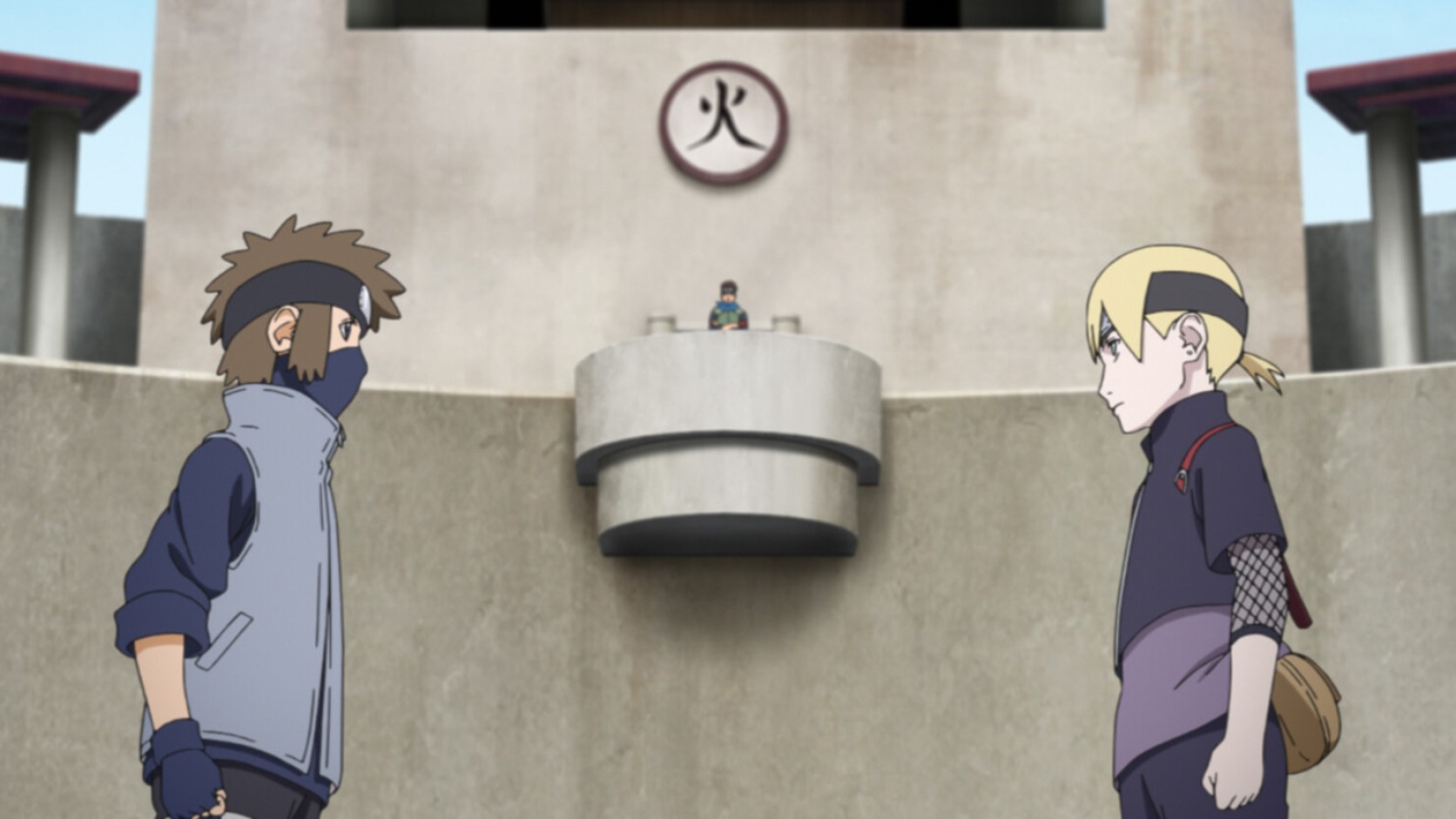
Inojin vs. Houki
Houki brings classified field experience into the first final-round match while Boruto and Mitsuki discover that judgment outside the arena can carry its own consequences.
Series: Boruto: Naruto Next Generations
Episode: 223 · Inojin vs. Houki
Arc: Chunin Re-Examination
Release: November 7, 2021
Previous: Episode 222 · The Night Before the Final Round
Directory: All 293 Boruto episodes
Bottom line
Boruto Episode 223 begins the Chunin Exam finals with Inojin against Houki, then refuses to let the arena become the only place where judgment matters. Houki enters with ANBU field experience that his classmates cannot easily measure. Inojin enters with famous parents, recognizable techniques, and the dangerous assumption that familiarity equals readiness. Meanwhile, Boruto and Mitsuki see suspicious men in the village and choose investigation over punctuality.
That split makes the episode stronger than a simple tournament installment. One pair performs inside an official structure while another faces a decision nobody scheduled. Konoha can score the match. Konoha also needs to ask why two genin believe they must handle a suspicious situation alone instead of alerting an adult and reaching the arena safely.
The episode at a glance
- Series: Boruto: Naruto Next Generations
- Episode: 223
- Title: Inojin vs. Houki
- Arc: Chunin Re-Examination
- Original release: November 7, 2021
- RaeRae rating: Four bowls of ramen out of five
- Core question: Does the exam reward leadership, or only the judgment officials happen to witness?
Houki arrives with work nobody saw
Houki's team has participated in ANBU missions, so the other candidates cannot build an easy scouting report. That uncertainty matters. School rivalries usually create a shared language: classmates know habits, signature techniques, emotional tells, and old weaknesses. Classified work removes that comfort.
The episode wisely treats Houki's quiet confidence as earned without pretending secrecy makes him magical. Experience can sharpen observation and discipline. Experience can also hide strain. If children are participating in ANBU operations, the village owes them supervision, mental-health support, and protection from assignments that exceed their development.
Inojin has to fight the opponent in front of him
Inojin carries techniques associated with both the Yamanaka and his father's ink-based art. That inheritance offers options, but a broad toolbox can become a trap when a candidate reaches for identity instead of strategy. He cannot win by proving that his family taught him well. He has to read Houki.
This is where the match becomes a leadership test. Inojin must notice what is changing, accept when an approach fails, and make a new decision without turning frustration into panic. Adaptation matters more than maintaining the appearance of control.
The arena rewards visible evidence
Spectators see attacks, counters, and a result. Judges can observe composure and tactical choices. Yet no single match can reveal every quality required of a chunin. Command happens across hours and days, often without applause.
Konoha should treat the final as one piece of evidence. Mission reports, teamwork, rescue judgment, communication, risk assessment, and the ability to accept correction belong beside combat performance. A spectacular win should not erase a history of reckless choices, and a thoughtful loss should not erase demonstrated leadership.
Classified experience creates an uneven contest
Houki is not wrong for using skills gained through assigned work. The institution still has to acknowledge the advantage. ANBU exposure may provide training, information discipline, and practical experience unavailable to ordinary genin.
Fairness does not require stripping that growth away. Fairness requires honest criteria. If prior mission experience counts, judges should say how. If the exam measures current capacity regardless of access, the village should expand meaningful training opportunities before the next cycle.
Children should not become security infrastructure
Boruto and Mitsuki notice suspicious men on the way to the venue. Their concern may be justified, but Konoha has police, sensory teams, gate records, and adult shinobi. A healthy response is to observe safely, report quickly, and preserve enough information for trained personnel.
Following strangers alone creates risks the boys cannot fully calculate. They could be lured away, identified, injured, or made responsible for evidence they do not know how to preserve. The village should not praise the outcome while ignoring the missing protocol.
Missing the exam is still a real consequence
The choice places Boruto and Mitsuki's promotion opportunity at risk. That consequence should not be waved away simply because their instinct was protective. Good motives do not guarantee a good process.
At the same time, rigid punctuality cannot be the only standard. If a candidate encounters a credible threat, officials need a documented reporting route and an appeal process. Otherwise the exam teaches young shinobi to ignore public safety whenever a clock is running.
Reporting is part of courage
Anime often frames immediate pursuit as bravery and asking for help as delay. Shinobi work should reject that fantasy. Reporting gives the village a chance to coordinate, protect civilians, check intelligence, and keep the young witnesses from becoming isolated targets.
Boruto and Mitsuki are capable. Capability does not make backup unnecessary. Their growth should include knowing when another set of eyes improves the decision.
Inojin's loss cannot become a character verdict
A tournament bracket converts a complicated performance into one advancing name. Fandom can do the same thing to a character. Inojin deserves analysis beyond whether he wins.
His willingness to engage an unfamiliar opponent, adjust under pressure, and confront the limits of his preparation tells us more than a final scoreboard. Development is not canceled when somebody else performs better on one day.
Houki deserves recognition without militarized worship
Houki's competence is compelling because he has built discipline and observation. The story should celebrate those qualities without treating ANBU proximity as automatic maturity.
Secret missions do not make a child less deserving of care. If anything, specialized work increases the village's duty to monitor workload, trauma exposure, consent, and the power imbalance between young operatives and commanding adults.
The finalists need transparent scoring
Judges should distinguish tactical skill, restraint, adaptability, situational awareness, and command judgment. Candidates deserve to know the categories before competing and to receive meaningful feedback afterward.
Transparency protects the students and the institution. A promotion should never depend on a vague impression that a teenager looked sufficiently leader-like from the stands.
Houki turns uncertainty into terrain
Houki understands that an opponent does not need to know everything to become dangerous. Inojin has inherited techniques with recognizable strengths, so Houki's first advantage comes from refusing to provide an easy pattern. He changes the problem from “Which move will Inojin use?” to “How long can Inojin keep thinking clearly when his expectations stop helping?”
That is not flashy, but leadership rarely is. The person who controls information, pace, and position can shape a conflict before a finishing technique appears. Houki's ANBU experience shows in that patience. He does not need the crowd to understand every choice while he is making the choice.
The risk is that viewers may confuse emotional restraint with moral superiority. Quiet people are not automatically wiser, and expressive people are not automatically careless. Houki succeeds because his observation serves a plan, not because a covered face makes him look serious.
Inojin's imagination is a real combat skill
Inojin's art-based techniques are easy to reduce to aesthetics, especially beside jutsu that look heavier or more destructive. That would miss the tactical value of creation. Drawing requires him to visualize a tool, translate that image into motion, and decide what kind of creature or form fits the moment.
The exam should reward that kind of flexible thinking. A shinobi who can create options may solve problems without escalating force. Inojin's challenge is not lack of talent. He needs enough calm to use imagination responsively instead of repeating what once worked.
His art also belongs to him even when the technique began with Sai. Inherited knowledge is not counterfeit identity. Young people become themselves through what they receive, reject, revise, and combine. The match can expose where Inojin still imitates, but imitation is a stage of learning rather than a permanent accusation.
Famous parents make every result louder
Inojin cannot enter an exam as an anonymous genin. Sai and Ino are respected shinobi with distinctive abilities, and spectators already know the family story they expect him to continue. A victory can be credited to bloodline or training. A loss can be treated as failure to deserve inheritance.
Both readings steal his personhood. Children of accomplished adults deserve ordinary room to be unfinished. They should be allowed to prefer one skill, struggle with another, change direction, and learn without every mistake becoming public evidence about the family.
Parents and teachers can protect that room by discussing process after the match. What did Inojin notice? Where did he hesitate? Which preparation helped? Which assumption failed? Those questions build capacity. “You embarrassed us” and “you should have won” only build fear.
ANBU experience needs an ethical accounting
The episode uses Houki's classified work as a compelling mystery. The village should still account for what that work asks of a child. Secrecy can prevent classmates, families, and even ordinary instructors from seeing signs of overload. An assignment can be technically successful while the young shinobi carrying the memory is not fine.
Konoha needs confidential mental-health care that does not punish disclosure, routine decompression after dangerous missions, and adults empowered to remove a child from unsuitable work. “ANBU” cannot become a magic word that ends oversight. Greater secrecy requires stronger safeguards, not weaker ones.
There is also a consent problem. A genin may say yes because a respected adult selected them, because refusal feels disloyal, or because elite work promises status. Real consent requires an understandable explanation of risk and a meaningful ability to decline without losing ordinary opportunities.
The exam audience changes behavior
Public competition invites candidates to perform confidence even when they need help. A teenager may hide pain because withdrawing looks humiliating. Another may escalate a technique because a cautious choice feels unimpressive. Spectators do not merely watch the exam. Their reactions become part of the pressure inside the arena.
Officials should design for that reality. Medical staff need independent authority to pause a match. Judges should reward restraint openly. Commentators should explain smart disengagement with the same energy they give dramatic attacks. If the crowd only celebrates damage, the institution cannot act surprised when children chase applause.
The audience also needs boundaries around privacy. Candidates should know what information will be announced, recorded, and preserved. Medical details, classified assignments, family history, and private evaluations should not become entertainment because a student entered a public exam.
A delayed candidate needs due process
Boruto and Mitsuki may have a credible explanation for reaching the arena late, but goodwill is not a policy. The exam needs a written procedure for emergencies: whom to contact, what evidence to preserve, who decides whether a delay is excused, and whether a rescheduled match remains possible.
Due process protects everyone. Without clear rules, a famous candidate may receive flexibility that an unknown genin would never receive. A strict official may also disqualify someone who stopped to protect a civilian, teaching every future student that appearances matter more than public duty.
An appeal does not guarantee forgiveness. Boruto and Mitsuki should still explain why they did not report sooner and why direct pursuit seemed necessary. Accountability becomes fair when the same questions and remedies are available to every candidate.
Mitsuki's judgment deserves separate attention
Boruto often becomes the center of any shared choice, but Mitsuki is not luggage following the protagonist. He observes the suspicious men, agrees to investigate, and accepts the same risk to his exam. His reasoning deserves examination on its own.
Mitsuki's history makes self-directed choice especially important. He has spent much of his life orienting himself around Boruto. Growth cannot mean automatically joining whatever Boruto decides. A healthy friendship allows one person to say, “We need backup,” without being less loyal.
The village should encourage that independence. Teamwork is not obedience to the loudest friend. Teamwork includes challenge, verification, and the willingness to slow a group down when the plan has avoidable holes.
Boruto still carries the first exam
Returning to a Chunin final means Boruto cannot escape the memory of his earlier cheating. The new exam offers a second chance, but second chances are emotionally complicated. He may feel pressure to prove that every previous doubt was wrong in one perfect performance.
That burden can distort judgment. Chasing suspicious men might feel like a chance to demonstrate authentic heroism outside the arena. The choice can be sincere and still carry a private need for redemption. Adults should help him separate public safety from self-punishment.
Boruto does not owe the village a flawless story. He owes honesty, safer decisions, and repair where his choices cause harm. Missing or delaying a match should not erase his growth, just as good intentions should not erase the need to review the decision.
Shikadai's position matters even off the bracket
Friends watching from the sidelines can provide emotional grounding, but they also occupy a difficult space. They may recognize a candidate's mistake without having authority to intervene. They may feel proud, jealous, worried, or relieved all at once.
The academy and team leaders should prepare students for that role. Support does not require pretending every performance was excellent. A good friend can celebrate effort, name concern privately, and refuse to turn one loss into gossip.
This matters for Inojin. He will leave the arena with a public result and a private emotional response. The people closest to him can help make the result information rather than identity.
Sai should understand the cost of unreadable emotion
Sai's own history taught him to suppress feeling and perform usefulness. That makes him uniquely positioned to recognize when calm is genuine and when a child is hiding distress to remain acceptable.
He can support Inojin by resisting the urge to evaluate only technical execution. Asking what his son experienced creates room for honesty. Offering observations without comparison protects the relationship from becoming another judging platform.
The strongest parental response would make love boringly reliable. Win, lose, adapt badly, recover well: Inojin should not have to calculate whether affection depends on the bracket.
Ino can protect ambition without feeding pressure
Ino understands clan expectations, public competence, and the work of maintaining vital village systems. She can validate Inojin's ambition while reminding him that promotion is responsibility rather than proof of worth.
That distinction matters because talented children often learn to experience every evaluation as a referendum on belonging. A parent can interrupt the pattern by praising preparation, honesty, and recovery instead of demanding a particular outcome.
Inojin is allowed to want the title. He is also allowed to be disappointed. Neither feeling needs to become a family emergency.
Houki needs life outside exceptional service
Competent young characters are often rewarded with more work. Houki's ANBU background risks turning reliability into permanent availability. The better he performs, the easier Konoha may find assigning another dangerous task.
Promotion should come with workload limits, mentorship, and protected time for ordinary development. A child who can handle classified responsibility still needs friendships, rest, education, and room to make mistakes outside a high-stakes operation.
Institutional praise becomes exploitation when every compliment is followed by another burden.
Winning should not end the review
The victor still needs feedback. Success can hide unsafe habits because nobody wants to question a result that looked impressive. Judges should identify what worked, what created unnecessary risk, and what the candidate must improve before leading others.
The losing candidate needs the same specificity. “Train harder” is not useful feedback. A meaningful review explains decision points, acknowledges strengths, and creates a path toward the next opportunity.
Promotion decisions should also be separated from entertainment. The village can celebrate a match without pretending the winner automatically demonstrated every competency of command.
The episode exposes two definitions of duty
Inside the arena, duty means arriving, following the rules, and completing the assigned contest. Outside, Boruto and Mitsuki interpret duty as responding to suspicious behavior. Both definitions have value, and neither can stand alone.
Rules without judgment become rigid. Instinct without coordination becomes reckless. The lesson is not that official responsibility is fake or that spontaneous heroism is pure. Mature duty connects observation to a safe, accountable response.
Konoha should build systems that let young shinobi do both: report a threat immediately, receive instructions, preserve their exam status when appropriate, and accept review afterward.
What the episode gets right
Episode 223 gives Houki competence without manufacturing cruelty and lets Inojin face an opponent whose strengths require real adaptation. The match has tactical meaning because information itself becomes part of the contest.
The parallel street story also challenges the exam's ability to capture leadership. Boruto and Mitsuki encounter a choice more complicated than a scheduled duel, reminding us that judgment cannot be reduced to an arena result.
Where the episode needs care
Houki's ANBU work should not pass as harmless proof of maturity. Konoha owes young operatives serious safeguards. Boruto and Mitsuki's pursuit also needs scrutiny rather than automatic praise because the suspicious men happened to matter.
Outcome bias is dangerous. A choice does not become wise only because the story avoids the worst consequence. The village should examine the information available when the boys decided, the safer alternatives they had, and the reporting systems they were taught to use.
The next exam should learn from this one
Every Chunin Exam produces more than winners. Officials receive evidence about training gaps, confusing rules, medical risks, unequal access, and moments when students did not know whom to call. That information should shape the next cycle.
Konoha could publish a plain-language candidate guide, establish an emergency contact channel, require post-match feedback, and review whether specialized mission assignments create hidden advantages. None of those changes would make the exam easy. They would make the institution more honest about the abilities under evaluation.
The village should also ask finalists what support they lacked. Students often see practical barriers that senior officials overlook: unclear arrival procedures, inaccessible training spaces, missing recovery time, equipment costs, or fear that reporting pain will look weak. Listening after the event is part of responsible leadership.
A result should open a conversation
When the match ends, adults should not rush Inojin or Houki into a polished lesson for the audience. Each boy deserves time to recover and interpret the experience before public praise, criticism, or promotion language takes over.
The best review would preserve complexity. Houki can be prepared and still need protection from excessive responsibility. Inojin can lose and still demonstrate valuable judgment. Boruto and Mitsuki can recognize danger and still choose a needlessly risky response. Growth begins when the village can hold those truths together instead of flattening every child into winner, loser, hero, or problem.
RaeRae verdict
Boruto Episode 223 earns four bowls of ramen out of five. Inojin and Houki give the final round a match grounded in observation rather than empty spectacle, and Houki's unknown ANBU experience creates tension without requiring a manufactured grudge.
The sharper story sits between the arena and the village street. Boruto and Mitsuki notice a possible danger, but the adults have not given them a clear way to protect people without sacrificing their own future or chasing strangers alone. Leadership is not just running toward trouble. Leadership is knowing how to bring the right people with you.
Before the next episode
Episode 224, “The Legend of the Monster Cat,” turns to Iwabe and Wasabi. Watch how pride, family expectation, and public performance shape two students who both hate losing.
The next match should measure judgment without turning one emotional day into a permanent label.
Sources and lawful viewing
The official Naruto site provides the Episode 223 synopsis and gallery. Crunchyroll carries “Inojin vs. Houki” where regional availability permits. Release and streaming details can vary by country.
Official episode reference: Naruto Official episode guide
Licensed episode route: Crunchyroll licensed series page
After watching, ask whether Konoha gave Boruto and Mitsuki a safe reporting path. A village cannot demand initiative from children and then leave them alone with every consequence.