
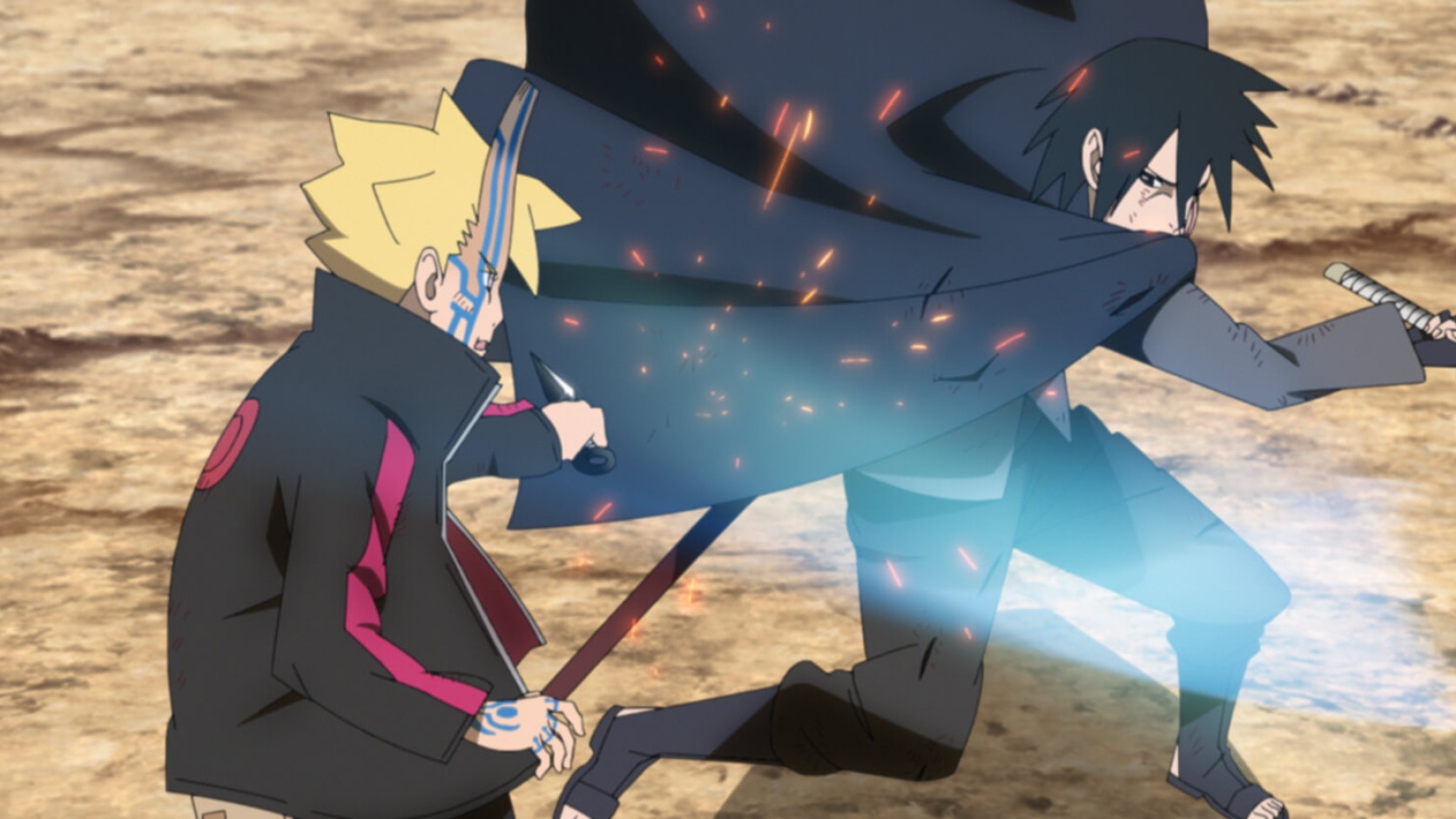
Partner
Kawaki denies Isshiki with a shadow clone, Momoshiki turns Boruto against Sasuke, and Kurama’s final truth makes partnership the episode’s deepest wound.
Series: Boruto: Naruto Next Generations
Episode: 218 · Partner
Arc: Kawaki: Otsutsuki Awakening
Release: October 3, 2021
Previous: Episode 217 · Decision
Directory: All 293 Boruto episodes
Bottom line
Boruto Episode 218 ends one invasion and refuses to let anybody breathe. Kawaki faces Isshiki with seconds left on the enemy’s life, uses a shadow clone to deny the new Karma, and watches the man who treated him as property crumble into dust. Then Momoshiki takes Boruto’s body, destroys Sasuke’s Rinnegan, and turns the exhausted survivors against someone they love. Victory arrives with another emergency already standing inside the family.
“Partner” belongs to more than one relationship. Sasuke and Kawaki cooperate to bring Boruto back. Kawaki risks his body because he refuses to lose the brother who protected him. Naruto and Kurama share the quietest goodbye after a lifetime that began with imprisonment and ended in chosen companionship. Kurama reveals that Baryon Mode consumed his life, not Naruto’s. That lie saved Naruto’s resolve and stole Naruto’s chance to consent to the real farewell.
The title has several owners
Partner can mean teammate, mentor, brother, host, or equal. Episode 218 tests every version.
Real partnership depends on mutual recognition. Shared power alone does not create equality.
Kawaki stands in front of Isshiki
The child who spent years under Jigen’s control now faces the abuser in his true form. Isshiki expects fear and conditioning to deliver obedience.
Kawaki remains afraid. Resistance does not require fear to disappear.
Isshiki still speaks ownership
He treats Kawaki as the vessel needed to continue his own life. The child’s refusal sounds irrational only inside that worldview.
Nobody owes an abuser access because the abuser will die without control.
Mortality does not create entitlement
Isshiki has seconds left and one route toward survival. Desperation explains the violence.
Desperation never creates a right to place Karma on another person.
Kawaki uses the lesson Naruto gave him
The shadow clone carries more than tactical cleverness. Naruto taught Kawaki a technique rooted in dividing presence, sharing work, and confusing an enemy who believes one body tells the whole truth.
Kawaki turns care into resistance without surrendering the care itself.
A clone defeats the vessel system
Isshiki’s plan depends on marking the correct biological body before time expires. Kawaki offers a copy that cannot preserve Karma.
The victory attacks the assumption beneath possession: that a powerful man can always identify, claim, and use the body he wants.
The trick gives Kawaki agency
Naruto and Sasuke weaken Isshiki, Boruto relocates the battle, and Kurama’s power drains the clock. Kawaki delivers the final denial through his own judgment.
He is protected and still active. Those conditions can coexist.
Kawaki does not defeat abuse alone
His shadow clone works because many people created the opening. Collective protection matters.
Celebrating his courage should not turn survival into proof that traumatized children can rescue themselves.
Isshiki dies without obtaining consent
The enemy’s body fails before Kawaki becomes a vessel again. That ending is satisfying because the child’s no remains final.
Power does not get the last word. Time and refusal do.
Relief lasts one breath
Naruto, Sasuke, Boruto, and Kawaki have barely survived. The story denies them a clean victory pose.
Momoshiki takes Boruto’s consciousness and attacks Sasuke before the group can reorganize.
Possession weaponizes familiarity
Boruto’s face, body, voice, and techniques remain visible while another consciousness acts. Friends must respond to an attacker wearing someone they love.
The cruelty comes from forcing protection and defense into the same movement.
Boruto is not the attacker
Momoshiki uses his body. Language should preserve responsibility.
Calling Boruto evil, disloyal, or dangerous without naming possession would blame the victim for the invader’s decisions.
Sasuke loses his Rinnegan in an ambush
Exhaustion and relief create an opening. Momoshiki strikes the eye that gave Sasuke dimensional access and rare strategic power.
The loss changes more than combat strength. The group’s route home and future defense both become less certain.
Injury is not moral failure
Sasuke does not deserve blame for failing to anticipate an attack from Boruto’s body one second after Isshiki dies.
Hypervigilance cannot become the standard for survivors. Nobody can remain ready for every betrayal-shaped emergency forever.
The eye was part of Sasuke’s body
Power discussions may reduce the Rinnegan to abilities, portals, and battle rankings. Sasuke experiences physical injury and permanent change.
Medical care, pain, disability, and adaptation belong beside tactical consequences.
Momoshiki targets infrastructure inside a person
Destroying Sasuke’s eye removes travel, intelligence, and combat options concentrated in one body. The attack reveals how fragile heroic systems become when a community stores essential capacity in individuals.
Konoha needs redundancy without treating Sasuke as equipment.
Kawaki calls for Boruto
He tries to reach the person beneath Momoshiki’s control. The call comes from belief that Boruto remains present.
That faith resists the Otsutsuki claim that extraction has already turned a person into property.
Love alone cannot break possession
Boruto does not immediately return because someone says his name. Emotional connection matters, but trauma and biological invasion do not vanish through one speech.
The episode respects the need for strategy alongside care.
Sasuke looks for the mechanism
He remembers that absorbing chakra may help Momoshiki maintain control while Boruto’s own reserves and consciousness interact with Karma.
Understanding the rule gives Kawaki a route to force Boruto forward again.
Kawaki volunteers for danger
He places himself close to Momoshiki because Boruto needs an opening. His choice grows from brotherhood and recent freedom.
Adults should respect the agency while refusing to romanticize another child solving a body-invasion crisis with personal risk.
Fire becomes a rescue tool
Kawaki uses a technique he only recently learned, not simply to attack, but to manipulate Momoshiki’s need to absorb chakra. The plan aims at the possession mechanism.
Skill becomes care when strategy centers the person trapped inside the enemy.
New training carries emotional weight
Kawaki’s jutsu represents time spent learning outside Kara’s torture system. He uses that growth to save family rather than satisfy a handler.
The same body once trained for obedience now chooses solidarity.
Boruto fights from inside
The external plan creates pressure, but Boruto must reclaim consciousness. His return belongs to him.
Friends can build the opening without claiming ownership of the victory.
Recovery does not erase what Momoshiki did
Boruto may regain control and still wake to Sasuke’s injury, his own missing time, and fear of future possession.
Regaining the body begins the aftermath. Regaining the body does not finish the aftermath.
Boruto will need the truth
Adults may want to soften the account to protect him from guilt. Missing facts can make his imagination worse.
Tell him what Momoshiki did, name Momoshiki as responsible, and give Boruto space to grieve without assigning blame.
Sasuke should not reassure through denial
He may minimize his injury to protect Boruto. Compassion can coexist with honesty.
Sasuke can say the attack was not Boruto’s choice while still acknowledging pain, loss, and changed plans.
Kawaki should not become Boruto’s keeper
His insight and bond helped restore Boruto. That success cannot turn him into permanent surveillance or containment staff.
Brothers deserve a relationship beyond managing each other’s threats.
Containment belongs to adults and systems
Konoha needs medical monitoring, consent-based safeguards, emergency signals, and trained responders for another Momoshiki takeover.
No teenager should carry sole responsibility for restraining another teenager.
Naruto lies motionless during the crisis
Baryon Mode leaves him unable to protect Boruto, Sasuke, or Kawaki. The man everyone relies on becomes another person needing care.
Dependency is not humiliation. Heroes remain worthy when they cannot move.
Kurama meets Naruto in quiet
The battle noise gives way to a conversation built from memory. Naruto believes his own life is ending.
The calm hurts because both partners understand how much changed since their first hostile years.
Their relationship began without consent
Adults sealed Kurama into an infant to save Konoha. Naruto inherited isolation and danger before he could choose.
Kurama inherited another cage. Neither child nor beast designed the partnership.
They made something real from coercion
Over time, Naruto recognized Kurama as a person, and Kurama chose trust rather than mere compliance. Shared battles became friendship.
The origin remains unjust even though the relationship became meaningful.
Kurama reveals the actual price
Baryon Mode consumed Kurama’s life. Naruto does not die from the technique as he expected.
The reveal protects Naruto physically while breaking informed consent emotionally.
Kurama lied to secure Naruto’s yes
He believed Naruto might refuse if the truth meant losing Kurama. The motive comes from love and knowledge of Naruto’s loyalty.
Love explains the deception. Love does not make the deception harmless.
Naruto deserved the chance to choose farewell
Knowing the real cost could have changed his words, his decision, or the way he entered the technique. Kurama removed that possibility.
A saved life can still contain a violated choice.
Kurama also owned his sacrifice
He chose to spend his own life against Isshiki. Nobody forced him to become fuel at that moment.
Respecting his agency means honoring the choice and questioning the incomplete disclosure at once.
Partners owe each other hard truths
Equality cannot depend on one person deciding which facts the other deserves. Kurama and Naruto survived enough manipulation from institutions already.
Their final conversation should not require pretending deception became ideal because the outcome saved Naruto.
Kurama knew Naruto’s self-sacrifice pattern
Naruto might have rejected any plan that killed his partner while sparing him. Kurama acted around that predictable refusal.
The problem came from devotion on both sides, not lack of love.
Naruto’s survival is not betrayal
He may feel guilty because Kurama dies while he remains. Survival does not mean he accepted the cost knowingly or valued Kurama less.
Grief should not become a demand for repayment through another sacrifice.
Kurama is more than Naruto’s power set
His death affects a relationship, identity, history, and consciousness. Losing access to chakra is not the primary emotional fact.
Power rankings cannot measure bereavement.
The village will mourn differently
Many residents once feared Kurama as the Nine-Tails that attacked Konoha. Few shared Naruto’s direct relationship with him.
Public history should acknowledge harm, captivity, growth, and sacrifice without flattening Kurama into monster or weapon.
Naruto needs private grief
The Hokage may face immediate questions about strength, security, and leadership capacity. Those questions matter later.
First he needs medical care, family, and room to lose his oldest companion without performing reassurance for everyone else.
Boruto may grieve through guilt
Naruto used Baryon Mode while protecting him and Kawaki. Boruto may connect Kurama’s death to his own presence in the battle.
Adults must reject that ledger. Isshiki created the emergency. Kurama owned his choice.
Kawaki may build the same debt
Isshiki targeted Kawaki, and Kurama died helping prevent a new Karma. Trauma may tell Kawaki that belonging cost the family too much.
Naruto should tell him that protection was never a loan.
Sasuke faces loss without time to process
His eye is destroyed while Momoshiki remains active and the group still needs a route home. Survival requires postponing grief.
Postponed emotion needs a destination later. Duty should not become permanent silence.
Disability changes logistics immediately
Sasuke may need treatment, assistance, revised combat methods, and new dimensional travel plans. Practical adaptation is not pity.
The community should ask what access he wants rather than assuming independence means refusing help.
Boruto needs a medical advocate
Karma research involves Amado, village leadership, security teams, and enormous strategic pressure. Boruto needs someone responsible for his interests as a patient.
Treatment decisions should not begin with how useful he remains against Otsutsuki threats.
Kawaki needs an advocate too
Isshiki’s death removes the immediate abuser, not the effects of modification, trauma, or future interest in his body.
Freedom needs follow-through: healthcare, privacy, education, family, and choices beyond security planning.
Victory does not end the vessel crisis
Kawaki avoids a new Karma, but Boruto’s extraction continues and Momoshiki has demonstrated another takeover.
The system that threatened two boys changes shape rather than disappearing.
Amado’s role grows more complicated
His information helped defeat Isshiki. Konoha may trust him more because predictions proved correct.
Success should increase access to his knowledge and increase scrutiny of what he still withholds.
The Ten-Tails remains outside the frame
Isshiki’s death does not erase the creature, Kara’s infrastructure, or people connected to the plan. The battle closes one route.
Cleanup requires intelligence work beyond celebration.
Code remains an unresolved risk
Kara had more than one loyal operative. Konoha should assume that grief, doctrine, and unfinished orders can motivate retaliation.
Defeating a leader may decentralize danger rather than end danger.
Partnership means shared aftermath
Teams often celebrate shared battle and leave each survivor alone with injuries afterward. Real partnership continues through recovery.
Naruto, Sasuke, Boruto, and Kawaki need more than congratulations and a mission report.
Partnership includes accountability
Kurama’s choice can be loving and deceptive. Kawaki’s rescue can be brave and too dangerous. Sasuke’s plan can work and still depend on a child.
Honest relationships survive moral complexity better than perfect legends.
Isshiki dies believing possession should work
He cannot understand why Kawaki would risk resistance after years designed to break him. Domination trained obedience but never created loyalty.
The shadow clone exposes the failure of ownership as a relationship.
Naruto created what Isshiki could not
He gave Kawaki patience, food, a home, instruction, boundaries, and belief. Kawaki responds through freely chosen care.
Consent produces stronger bonds than terror, even when terror looks more efficient in the short term.
Boruto and Kawaki choose brotherhood
Their relationship includes conflict, jealousy, teasing, protection, and shared Karma fear. Nobody programmed the bond.
Kawaki fighting Momoshiki inside Boruto’s body shows refusal to abandon the person beneath danger.
Sasuke chooses Boruto beyond usefulness
The damaged mentor still looks for a way to restore his student rather than treating possession as proof Boruto should be eliminated.
Containment begins from belief that Boruto remains reachable.
Kurama chooses Naruto beyond survival
He spends his life so Naruto can continue. The choice rejects the old idea that their bond existed only because a seal forced proximity.
The deception hurts precisely because the partnership became real.
Grief should not clean the history
Kurama caused harm under rage and coercion. Konoha imprisoned tailed beasts and used jinchuriki. Naruto and Kurama fought before they trusted.
Love at the end does not require a sanitized beginning.
A full memorial can hold contradiction
Kurama was feared, exploited, angry, funny, stubborn, strategic, protective, and loved. One label cannot contain him.
Personhood means remembering more than the final useful act.
The episode denies a simple ending
Isshiki dies, Boruto returns, and Naruto survives. Each success carries damage: possession, a destroyed eye, Kurama’s death, and trauma that follows everyone home.
That complexity makes the victory feel honest.
Konoha needs a possession protocol before another attack
Momoshiki exploited exhaustion and surprise. The next takeover may happen during training, treatment, sleep, or an ordinary day rather than a sealed battlefield.
Boruto, his family, medical staff, and trusted shinobi need clear signals, safe locations, nonlethal restraint options, and rules for who receives notice. A protocol should reduce panic without turning the child’s entire life into surveillance.
Privacy matters even during containment
Boruto’s condition carries military significance, but that fact does not make every medical detail public property. Rumor could isolate him, frighten classmates, or encourage people to see Momoshiki whenever Boruto shows anger.
Konoha should share operational information narrowly and protect the rest. Community safety and patient dignity do not need to become enemies.
Sasuke needs rehabilitation, not a replacement myth
The village may immediately ask which shinobi or technology can replace his lost Rinnegan functions. Strategic planning matters, especially for dimensional travel.
Sasuke also needs pain management, healing, mobility assessment, adaptation, and authority over how people discuss his body. He is not a damaged tool awaiting an upgrade.
Naruto’s family deserves direct notice
Hinata and Himawari should not learn Kurama’s death, Naruto’s condition, or Boruto’s possession through public reports. Family communication belongs inside emergency planning.
They deserve honest facts, privacy, and time together before the Hokage office asks Naruto to reassure the village. Political duty should not take the first hours of grief.
Kurama’s death changes Naruto’s health
The relationship involved chakra regulation, healing, combat capacity, and constant internal presence. Losing Kurama may affect Naruto physically and psychologically in ways nobody can assume from older jinchuriki cases.
Medical observation should remain collaborative. Naruto needs room to describe unfamiliar sensations without every symptom becoming a security assessment.
Kawaki’s shadow clone deserves more than applause
The technique works because he understands Isshiki’s confidence, watches the clock, and trusts a lesson associated with Naruto. That combination shows tactical intelligence shaped by relationship.
Adults should tell Kawaki exactly what he accomplished while making clear that survival never depended solely on him. Praise should strengthen agency rather than create a new expectation that he always rescue everyone.
Returning Boruto requires patience afterward
One successful intervention does not guarantee immediate emotional stability. Boruto may fear sleep, chakra exhaustion, physical contact, or any gap in memory.
Recovery could include nightmares, shame, anger, and attempts to hide symptoms so nobody restricts him. Support needs trust strong enough for honest reporting without automatic punishment.
What the episode gets right
Episode 218 makes partnership active. Kawaki and Sasuke build a plan around saving Boruto, not defeating his body. Naruto and Kurama’s goodbye honors years of growth.
The shadow clone victory also lets Kawaki deny ownership through a skill learned inside chosen family.
Where the episode needs care
Kurama’s lie should not become proof that loving deception is automatically noble. Naruto lost information central to consent and farewell.
Sasuke’s injury also deserves treatment as disability and grief, not only a reduction in combat abilities.
RaeRae verdict
Boruto Episode 218 earns five bowls of ramen out of five and then steals the bowl while you are still crying into the broth. Kawaki tricks Isshiki with Naruto’s shadow clone lesson, proving that care gave him tools terror never could. Momoshiki immediately turns Boruto’s body against Sasuke, and the family has to save the child without pretending the threat wearing his face is harmless.
Then Kurama says goodbye. His sacrifice belongs to him. His lie does too. Naruto survives because his partner chose a cost Naruto might never have accepted, which makes the love enormous and the consent broken. A real partnership can contain devotion, anger, gratitude, and hurt at the same time. The episode lands because nobody gets a clean victory and nobody worth loving becomes only a weapon.
Before the next episode
Episode 219, “Return,” brings the survivors back to Konoha and forces the village to face what the battle changed. Watch whether public relief leaves room for Boruto’s fear, Sasuke’s injury, Naruto’s grief, and Kawaki’s uncertain freedom.
Homecoming should begin care, not close the file.
Sources and lawful viewing
The official Naruto site provides the Episode 218 synopsis and gallery. Crunchyroll carries “Partner” where regional availability permits. Release and streaming details can vary by country.
Official episode reference: Naruto Official episode guide
Licensed episode route: Crunchyroll licensed series page
After watching, ask what partnership owes when one person controls the truth. Love can motivate sacrifice. Equality still requires the other person’s right to know.