
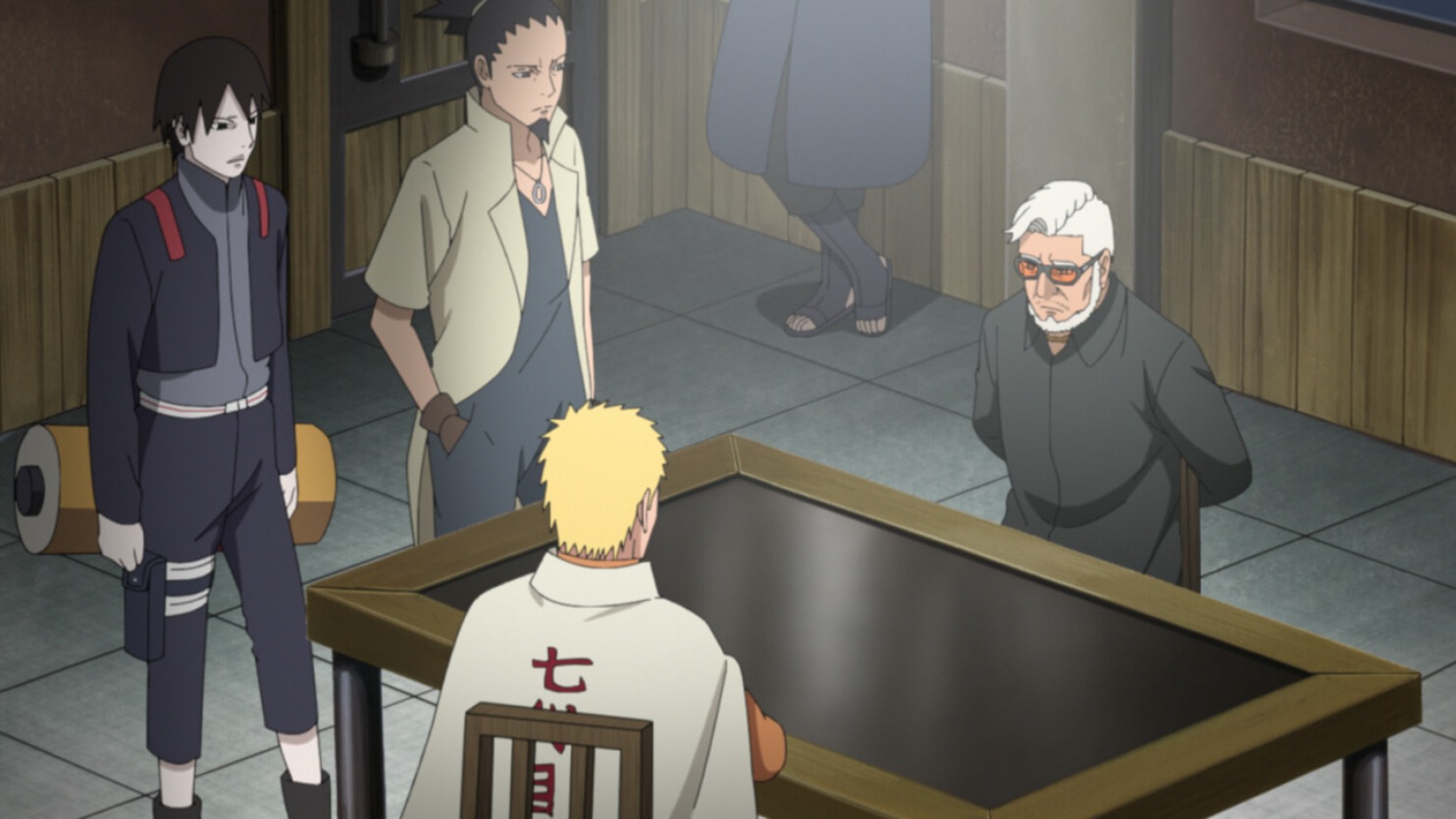
Amado's Defection
Amado brings Konoha the intelligence the village desperately needs, then wraps the offer around Shikadai’s life so nobody can mistake useful information for trustworthy intent.
Series: Boruto: Naruto Next Generations
Episode: 212 · Amado's Defection
Arc: Kawaki: Otsutsuki Awakening
Release: August 22, 2021
Previous: Episode 211 · The Chase
Directory: All 293 Boruto episodes
Bottom line
Boruto Episode 212 brings Kara’s chief scientist into Konoha with a request for asylum, a mountain of intelligence, and an explosive collar around Shikadai’s neck. Amado knows the village cannot trust him, so he does not ask for trust. He creates urgency, takes control of the meeting, and makes Naruto choose between negotiating with a criminal and gambling with a child’s life. That tactic gets Amado into the room. The same tactic proves why every promise he makes needs verification.
The episode’s smartest choice is letting Shikamaru remain angry. A lesser version would praise him for becoming pure strategy while his son stands under threat. Shikamaru thinks strategically and reacts as a father because both truths belong in the room. Amado turns that love into leverage, then offers information about Kara, Jigen, the Ten-Tails, and the Ōtsutsuki as payment for protection. Meanwhile, Koji confronts Jigen, and the glasses on Amado’s face become a live window into Kara’s civil war.
Defection begins with coercion
Amado says he wants asylum, but he arrives after kidnapping Shikadai and fitting the boy with a device he claims can explode. That opening makes the request impossible to treat as a clean appeal for safety.
He wants a legal and political decision while controlling the risk attached to refusal. Konoha may choose asylum, but the hostage means the choice occurs under pressure Amado deliberately created.
A useful witness can still be dangerous
Amado may possess the best intelligence Konoha has ever received about Kara. He also designed or maintained technology connected to the organization’s violence.
Usefulness should secure a hearing, not automatic innocence. The village needs his knowledge while protecting residents from the man delivering that knowledge.
Shikadai becomes leverage because of his father
Amado does not select a random resident. He targets the child of Naruto’s chief adviser, knowing Shikamaru can influence the Hokage and understanding that parental fear will reshape the negotiation.
That choice turns family into an access credential. Amado studies relationships the way other scientists study machines, then presses the connection most likely to open the protected door.
Shikamaru refuses emotional neutrality
He does not pretend that the collar belongs to an abstract hostage. His son could die, and the threat enrages him.
That anger does not make Shikamaru unfit for the room. Pretending a parent has no stake would create a different danger because hidden emotion can distort decisions while everyone acts as though objectivity remains intact.
Naruto cannot make a private promise
As Hokage, Naruto has authority to respond, but asylum affects village security, law, housing, surveillance, and relations with other powers. One frightened agreement can produce years of responsibility.
The collar compresses time without removing those consequences. Naruto must save Shikadai while refusing to treat leadership as a personal favor exchanged across a table.
The Hokage has faced this pattern before
Enemies have used hostages, secrets, family bonds, and impossible deadlines throughout Naruto’s life. His instinct usually moves toward protecting the person first.
Amado depends on that instinct. He knows Naruto’s compassion is genuine and predictable, which means a moral strength can become an operational vulnerability when nobody builds support around the decision.
Sai brings the correct suspicion
Sai understands controlled organizations, false identities, compartmentalized knowledge, and people trained to make cruelty sound necessary. He watches Amado as an intelligence problem rather than a misunderstood visitor.
His presence gives the meeting institutional memory. Root should have taught Konoha what happens when a village excuses hidden methods because one official promises security.
Konoha needs more than an interrogation
Questions can test contradictions, but Amado’s knowledge spans science, Kara hierarchy, Karma, weapons, laboratories, and people the village barely understands. No single interrogator can verify every claim in real time.
The village needs scientific, medical, legal, intelligence, sealing, and diplomatic review. A clever conversation should begin that work rather than replace the work.
Amado controls the sequence
He reveals enough to keep the meeting alive, withholds enough to maintain value, and ties each larger answer to asylum. Information becomes a staircase he owns.
That structure forces Konoha to follow his order instead of the village’s investigative priorities. Control over sequence can matter as much as control over facts because timing decides which fear reaches the room first.
Knowledge becomes currency
Amado offers Kara’s internal structure, Jigen’s secrets, the Ten-Tails, and Ōtsutsuki information. Each subject carries survival-level importance.
He is selling knowledge for protection. The bargain may be necessary, but Konoha should name the exchange plainly and record which guarantees depend on verified cooperation.
Asylum is protection, not absolution
A person may deserve protection from retaliation even while facing investigation for serious harm. Those legal and moral questions can exist together.
Konoha does not need to declare Amado good before preventing Kara from killing him. The village also does not need to erase victims before offering temporary safety.
The hostage contaminates consent
Naruto’s agreement cannot represent fully voluntary consent while Shikadai remains under a claimed death threat. The immediate decision may still be valid as emergency action.
Later review is essential. Once the collar no longer controls the room, Konoha should confirm the terms, examine coercion, and decide which protections remain justified.
Amado performs calm as power
His measured voice and controlled posture make everyone else’s fear look disorderly. That contrast helps him dominate the meeting without raising his volume.
Calm does not equal honesty. A person who designed the crisis has an easier time appearing composed because he already knows the next step.
Shikamaru sees the manipulation clearly
He understands why Amado chose Shikadai, why the scientist needs Naruto, and why each piece of information arrives with a condition. Recognition does not free his son.
That gap makes the scene hurt. Intelligence can identify a trap while love still requires entering the trap carefully.
Shikadai remains a person under the device
The plot could reduce him to a bomb timer attached to Shikamaru’s emotions. Shikadai’s own awareness, fear, and attempts to remain useful resist that reduction.
He deserves care after the crisis that does not depend on whether the device contained a real explosive. A credible threat can create trauma even when the mechanism proves false.
The collar is psychological warfare
Amado controls the room through uncertainty. Konoha does not know the trigger, range, construction, or whether removal will cause detonation.
The threat forces defenders to imagine the worst design. Amado makes their caution perform the same function as an actual blast.
Scientific authority needs independent testing
The scientist who describes the collar also created the conditions preventing inspection. Everyone must rely on his explanation because experimentation could kill Shikadai.
That monopoly shows why technical claims need independent experts whenever time allows. Expertise becomes dangerous when the expert controls both the device and the only accepted account of the device.
A fake bomb would not make the act harmless
If Amado exaggerated or fabricated the explosive, he still kidnapped a child and made parents believe death could arrive instantly. Psychological terror remains harm.
The absence of explosives would change the criminal evidence and physical risk. The absence would not transform coercion into a clever joke.
Konoha should preserve every technical detail
The collar, communications, glasses, tools, residue, and Amado’s own equipment may reveal design habits or links to Kara systems. Evidence collection should begin before the meeting ends.
Preservation matters because Amado can later revise his account. Physical and digital records give investigators something stronger than memory from a frightening conversation.
The glasses are another controlled channel
Amado’s eyewear connects the room to Koji and Jigen. The device looks like proof because viewers can watch events unfold.
A live feed still has an owner. Konoha must ask what the camera cannot see, whether sound can be altered, and why Amado chose this exact moment for transmission.
Live video is evidence with limits
The broadcast may confirm that Koji confronts Jigen and that Kara’s internal alliance has broken. The feed does not automatically prove Amado’s complete explanation of motives.
Visible events support narrow conclusions. Investigators should separate what the room directly observes from what Amado says the scene means.
Koji becomes Amado’s demonstration
Amado does not merely claim that he opposes Jigen. He shows an ally confronting Kara’s leader in real time.
That act gives the defection credibility while placing Koji in extraordinary danger. Amado’s proof is another person’s body entering combat.
Kara’s civil war reaches Konoha
The organization no longer appears as one coordinated enemy. Amado and Koji have planned against Jigen while Delta remains disabled and other Inners lack the full picture.
Internal fracture creates opportunity and risk. Defectors may expose secrets, sabotage one another, destroy evidence, or bring private battles into the village granting protection.
Jigen expects obedience
His authority rests on fear, power, secrecy, and the assumption that every Inner ultimately serves his purpose. Koji’s refusal attacks that assumption directly.
A hierarchy can look stable until one member believes the leader is weak enough to challenge. Jigen’s damaged condition after fighting Naruto and Sasuke creates the opening Amado planned to use.
Amado planned around Jigen’s recovery
The timing is not accidental. Jigen consumed enormous power during the earlier battle and has not fully recovered.
Amado turns medical and scientific knowledge into strategy. He knows the body behind the authority has limits, and he schedules betrayal for the period when those limits matter most.
The scientist treats bodies as systems
Amado observes energy, modifications, recovery, Karma, and failure states with frightening precision. That knowledge can save lives or make people easier to exploit.
Konoha should not confuse technical brilliance with ethical reliability. A person can understand every mechanism inside a body while ignoring the person living inside that body.
Kawaki has reasons to fear the offer
Amado knows more about Kawaki’s modifications and Karma than anyone in Konoha. That knowledge may help protect him.
The same scientist participated in the system that turned Kawaki into a vessel candidate. Access to treatment should not require Kawaki to forgive, cooperate, or accept Amado’s preferred version of their history.
Boruto’s body enters the bargain
Information about Karma affects Boruto directly. Adults may discuss his survival, transformation, and risk while he sits outside the central legal decision.
Urgency does not erase his right to understand what officials learn. Medical disclosure, security planning, and personal agency must remain connected.
Children should not pay for adult intelligence
Shikadai becomes a hostage. Kawaki and Boruto become subjects of technical knowledge. Koji becomes a weapon created for a larger plan.
The episode keeps returning to adults who convert younger bodies into leverage. Konoha’s response should reject that logic even when doing so slows access to valuable information.
The village needs a victim-centered ledger
Every Amado disclosure should prompt two questions: which fact helps stop Kara, and which people were harmed by the work that produced the fact?
Without that ledger, officials may celebrate intelligence while victims disappear behind technical success. Accountability begins by naming the human route behind each capability.
Defectors often arrive with mixed motives
Fear of Jigen, desire for revenge, personal survival, guilt, scientific ambition, and a hidden objective could all shape Amado’s decision. One motive does not need to cancel the others.
Konoha should avoid demanding a clean redemption story. Mixed motives are expected, and verification matters more than a beautiful confession.
Truth can come from an untrustworthy person
Amado’s coercion gives Konoha strong reasons to distrust him. That distrust does not make every statement false.
Officials need corroboration rather than reflexive belief or reflexive rejection. Evidence should rise or fall through sources, mechanics, prediction, and independent observation.
False information may contain real details
An experienced insider can build a lie from mostly accurate facts, leaving one critical conclusion distorted. The surrounding truth makes the planted conclusion harder to notice.
Investigators should test chains of reasoning, not only isolated claims. A correct date and real laboratory do not prove the motive Amado attaches to them.
Naruto must protect the village from urgency
The immediate threat to Shikadai can consume every decision. Amado also brings possible dangers involving Kara access, tracking, sabotage, biological material, and technology nobody has inspected.
Emergency compassion needs a security perimeter. Naruto can refuse cruelty toward Amado while authorizing careful containment.
Containment should not become torture
Konoha has a history of secret detention and interrogation practices. Fear of Kara could reopen those habits quickly.
The village should secure Amado, limit access, document questioning, provide basic care, and prohibit coercive abuse. Rights do not depend on likability.
A written agreement matters
Oral promises made during a hostage crisis invite later dispute. Terms should identify temporary protection, disclosure duties, security restrictions, review dates, and consequences for deception.
Writing cannot make the coercion disappear. A record can prevent every powerful participant from remembering the bargain differently once the immediate danger passes.
Independent counsel would protect the process
Amado should understand the agreement and its limits. Konoha also needs advisers who do not report solely to the intelligence branch or Hokage.
A process with review looks slower than a dramatic handshake. The slower structure protects the village and the applicant from secret conditions nobody can challenge.
Shikamaru should not lead every later review
His expertise is essential, but his son’s targeting gives him a direct conflict. That conflict does not imply dishonesty.
Sharing authority protects Shikamaru from carrying an impossible burden and protects later decisions from claims that parental fear controlled the outcome.
Temari belongs in the consequence
Shikadai has two parents. The hostage plot focuses on Shikamaru because he sits beside Naruto, but Temari also deserves immediate information, access, and a voice in her son’s care.
Leaving mothers outside security stories can make political proximity look like the only family bond that counts. The aftermath should not repeat that omission.
Ino’s communication network carries risk
Konoha depends on mental communication for fast coordination. A crisis involving Kara technology raises questions about interception, overload, false messages, and who can hear sensitive details.
The network needs clear channels and confirmation procedures. Speed should not make one gifted person responsible for every secure conversation in the village.
Sai should map Amado’s access
The scientist knows names, abilities, family relationships, procedures, and locations. Konoha needs to identify how he learned each fact.
That map could expose Koji’s reconnaissance, stolen records, compromised systems, or other sources still active inside the village. Amado’s knowledge is evidence about the breach as well as intelligence about Kara.
The archive theft now has a purpose
Episode 211 showed Koji taking older records. Episode 212 shows Amado arriving prepared to manipulate specific people and institutions.
The connection does not explain every file, but the timing confirms that the theft supported a larger operation. Konoha should review whether stolen information shaped the hostage choice or negotiation script.
Amado turns preparation into inevitability
He presents the meeting as though Konoha has only one rational response. Hostage danger, Kara intelligence, and Koji’s live confrontation all point toward agreement.
That feeling of inevitability is part of the pressure. Leaders should pause long enough to identify choices Amado would prefer them not to see.
One alternative is provisional protection
Konoha can offer immediate safety and defer permanent status until the collar is removed and core claims receive initial verification. That path reduces the false choice between full asylum and immediate rejection.
Provisional terms still require clear limits. Temporary should not become indefinite detention or a promise the village quietly refuses to honor.
Another alternative is staged disclosure
Amado can provide a testable fact first, followed by broader access as verification succeeds. Staging reduces the village’s dependence on one enormous story.
He already stages information for his own advantage. Konoha should design a transparent sequence that serves public safety rather than merely accepting his sequence.
The Ten-Tails changes the scale
Amado’s offer reaches beyond one organization or village. Knowledge about a Ten-Tails and Ōtsutsuki plans concerns mass casualty risk.
That scale strengthens the case for hearing him and strengthens the case for verification. Catastrophic claims can pressure leaders into skipping safeguards precisely when safeguards matter most.
International responsibility follows the intelligence
If Amado’s information confirms a threat beyond the Land of Fire, Konoha may need to coordinate with allied villages. Hoarding the intelligence could recreate the secrecy that allowed Kara to operate.
Sharing should protect sources and avoid spreading dangerous technical details. Cooperation needs rules, not another private circle of powerful men deciding who deserves to know.
Scientific knowledge needs ethical limits
Konoha may want Amado to reproduce tools, treatments, or countermeasures. Technical possibility does not settle whether a project should continue.
Research involving bodies needs consent, oversight, stopping rules, and independent review. Kara’s results cannot become a free research program because the scientist changed employers.
Victims deserve access to relevant findings
People modified, experimented on, recruited, or injured by Kara may need information Amado holds about their bodies and risks. Konoha should not reserve every answer for military planning.
Medical benefit should not depend on testimony or cooperation. A victim’s health is not payment for helping the investigation.
Amado’s records need authentication
Files, formulas, diagrams, and samples can be accurate, incomplete, altered, or designed to work only under conditions he controls. Specialists must reproduce safe claims independently.
Authentication also means tracing origin. Knowledge taken from unwilling subjects carries obligations that ordinary technical review can miss.
Koji bears the physical cost
Amado reaches a guarded room while Koji faces Jigen. The plan divides risk sharply between the strategist seeking protection and the fighter confronting the target.
That imbalance raises questions about partnership. Koji may have agreed, but consent inside a plan designed around another person’s sacrifice deserves scrutiny.
Jigen’s weakness does not make him harmless
Reduced power can encourage overconfidence. Koji and Amado chose the strongest available window, yet Jigen remains Kara’s leader for reasons beyond reputation.
The live feed gives Konoha useful evidence and a warning. A wounded authoritarian can become more dangerous when survival and control collapse into the same objective.
Delta’s shutdown exposes centralized control
Amado can disable or manage technology embedded in Kara’s members. That capability gives him leverage over former allies and possible power over anyone carrying his work.
Konoha should ask which remote commands remain active, who can trigger them, and whether Kawaki contains systems Amado has not disclosed.
A backdoor is not safe under a trusted operator
Remote control can stop an immediate threat. The same feature can remove bodily autonomy and create a permanent hidden weapon.
Konoha should identify, document, and remove unauthorized control paths where possible. Trusting Amado forever is not a security design.
The episode understands bureaucratic tension
The central conflict happens across a table, through communication links, and around conditions nobody can treat casually. Physical combat exists elsewhere, but words control Shikadai’s survival in Konoha.
That structure gives the arc needed weight. Governments fail through agreements and information management as easily as they fail through lost battles.
Naruto’s compassion needs institutional support
His willingness to hear Amado reflects the best part of Naruto’s leadership. He believes people can leave harmful systems and that protection can interrupt cycles of violence.
Compassion becomes durable when law, oversight, evidence, and care support the promise. Otherwise every outcome depends on one good man remaining correct and available.
Shikamaru’s anger protects a truth
Amado wants the room to discuss strategy, but Shikamaru keeps the human cost visible. His son is not a procedural inconvenience attached to valuable intelligence.
Anger can name what polished negotiation language hides. The task is directing that anger toward protection and accountability rather than revenge.
Shikadai will need more than praise
Adults may call him brave, capable, or calm after the collar comes off. Those labels can become another way to skip care.
He needs medical assessment, truthful explanation, time with family, and permission to react after the mission pressure ends. Competence does not cancel fear.
Public communication should avoid panic
Konoha residents may learn that a Kara scientist entered the village and took a child hostage. Silence invites rumor, while excessive detail can expose security procedures.
Officials should state the confirmed threat, immediate safety measures, and where residents can report concerns. Public trust grows through accurate boundaries rather than fake certainty.
The village cannot hide Amado forever
A secret asylum arrangement would tempt leaders because Kara may retaliate and the public may object. Secrecy could also remove oversight and make future abuse easier.
Some operational details require protection. The existence and legal basis of long-term custody should eventually face accountable review.
What the episode gets right
“Amado’s Defection” lets intelligence, family, law, science, and fear occupy the same room. Nobody receives a clean choice, and Amado’s composure never erases the violence of his entrance.
The live link to Koji and Jigen connects negotiation to action without reducing either side to filler. Kara’s fracture becomes evidence Konoha can watch while still questioning the person controlling the camera.
Where the episode needs care
Shikadai’s collar drives the scene so efficiently that his own experience risks becoming secondary to adult strategy. Temari’s absence from the immediate emotional frame also narrows the family consequence.
The village needs a fuller legal and scientific process than one tense meeting can show. Later episodes should treat asylum, victim accountability, technical oversight, and Kawaki’s consent as continuing responsibilities.
RaeRae verdict
Boruto Episode 212 earns four and a half bowls of ramen out of five. Amado walks into Konoha carrying the kind of information every intelligence service dreams about, then makes sure nobody can receive the gift without remembering the threat around Shikadai’s neck.
That contradiction is the episode. Amado may help save Boruto, Kawaki, Konoha, and far more people than the village can count. He may also be lying, withholding, manipulating, and using Koji as expendable proof. Naruto is right to hear him. Shikamaru is right to hate the terms. Konoha’s real test begins after the collar comes off, when urgency can no longer excuse every compromise made in the room.
Before the next episode
Episode 213, “True Identity,” continues Amado’s explanation while Koji’s battle with Jigen exposes the person and purpose hidden beneath Kara’s leader.
Watch which statements the live feed confirms, which claims still depend on Amado alone, and how information about Karma changes the way Konoha understands Boruto and Kawaki’s bodies.
Sources and lawful viewing
The official Naruto site provides the Episode 212 synopsis and gallery. Crunchyroll carries “Amado’s Defection” where regional availability permits. Release and streaming details can vary by country.
Official episode reference: Naruto Official episode guide
Licensed episode route: Crunchyroll licensed series page
After watching, ask whether Konoha granted asylum because Amado proved his case or because he designed a room where refusal felt impossible. The answer determines how much independent review the agreement needs once Shikadai is safe.