
The New Team Seven
A team becomes real when leadership, medicine, lived intelligence, pressure, and correction move among four people without reducing anyone to a tool.
Series: Boruto: Naruto Next Generations
Episode: 206 · The New Team Seven
Arc: Kawaki: Kara Clash
Release: July 4, 2021
Previous: Episode 205 · Proof
Directory: All 293 Boruto episodes
Bottom line
Boruto Episode 206 earns its title by making membership a practice instead of a label. Boruto, Sarada, Mitsuki, and Kawaki enter the dimension to recover Naruto, then meet Boro waiting beside the sealed Hokage. Kawaki knows the enemy and terrain. Sarada takes command. Mitsuki turns careful observation into a medical breakthrough. Boruto supplies speed, pressure, and trust. Nobody becomes less important so another person can lead. Their first plan fails because Boro’s black mist carries a virus, and their next plan forms because each teammate shares what only they can know. “The New Team Seven” is not four talented children standing near each other. The team begins when information, risk, and authority start moving among them.
The title announces a relationship under pressure
Calling this group the new Team Seven could have been empty fan service. The original name carries history large enough to overwhelm younger characters.
The episode makes the title conditional. They must communicate, accept leadership, revise a failed plan, and protect one another before the name means anything.
The portal turns argument into commitment
Episode 205 ended with questions about Kawaki’s trustworthiness. Crossing dimensions changes the terms. He is no longer explaining what he might do. He moves toward Boro and Naruto despite every reason to fear Kara.
Action does not purchase his personhood. Action does show a chosen commitment that belongs to Kawaki rather than Jigen.
Kawaki returns to Kara territory by choice
The dimension carries the architecture of the organization that abused him. Entering can reactivate memory, bodily fear, and conditioned responses.
Courage does not require emotional calm. Kawaki acts while danger remains recognizable, which makes choice more meaningful rather than less.
Naruto's sealed body becomes the mission center
Boro guards the vessel containing Naruto as both hostage and leverage. The children can see the person they came to rescue without reaching him.
Visible captivity intensifies urgency. A disciplined team must resist letting urgency dictate every move, because Boro benefits when emotion replaces observation.
Boro expects grief to make them careless
He knows Naruto matters to Kawaki and Boruto. He can provoke, delay, and force rushed attacks while his virus spreads invisibly.
Manipulation works best when the emotion is real. The answer is not suppressing care. The answer is building enough communication that care can guide strategy instead of becoming a handle for the enemy.
Sarada becomes captain because someone must coordinate
Four strong fighters without shared direction can interfere with one another. Sarada accepts responsibility for timing, roles, and changing conditions.
Leadership here is not a reward for being the loudest. Leadership is work: receiving information, making a decision before certainty arrives, and remaining accountable when the first plan fails.
Boruto accepts her authority
The Hokage’s son could assume the rescue belongs to him. Instead, he participates within Sarada’s plan.
Following well is a team skill. Trusting another person’s command does not erase initiative. Boruto keeps his judgment while allowing coordination to matter.
Mitsuki turns observation into protection
Mitsuki notices symptoms, gathers samples, and investigates the black mist. His scientific and medical awareness becomes as important as combat strength.
The episode values a teammate who can slow down enough to identify the real threat. Without that work, every attack would repeat the same failure.
Kawaki brings lived intelligence
He knows Boro’s position within Kara, the organization’s habits, and the danger of underestimating an Inner. That knowledge did not come from safe training.
Using lived experience can be empowering and painful. The team should value the information without treating Kawaki’s trauma as a convenient database.
Expertise remains distributed
Sarada leads, but she does not possess every answer. Kawaki knows Kara. Mitsuki understands the virus. Boruto recognizes Kāma resonance and combat openings.
Good leadership creates routes for expertise to reach the decision. A captain who needs to look omniscient will miss what teammates can see.
The black mist punishes visual confidence
Boro’s attack appears as environmental haze rather than a blade. The children may believe distance or speed will protect them until their bodies begin failing.
Invisible danger changes combat ethics. Observation, testing, and honest symptom reporting become survival skills.
Paralysis feels like betrayal by the body
Muscles stop responding while awareness remains. For Kawaki, loss of bodily control can echo Kara’s procedures and Jigen’s ownership.
The reaction deserves more than tactical attention. A teammate can need medical help and grounding at the same time.
Boro weaponizes uncertainty
Nobody initially knows whether the mist is poison, chakra, technology, or ninjutsu. Each possibility suggests a different defense.
Uncertainty gives Boro time. Naming uncertainty aloud prevents false confidence and lets Mitsuki organize the next question.
A virus changes the fight
Once Mitsuki identifies a biological agent, the team can stop treating the mist as a conventional technique. Knowledge transforms paralysis from mysterious inevitability into a problem with mechanisms.
Diagnosis does not guarantee victory. Diagnosis restores choices.
Mitsuki's body becomes part of the solution
His unusual physiology and snakes allow him to collect evidence and develop antibodies. A body created through experimentation now supports teammates through chosen care.
That reversal matters, but usefulness should never define his value. Mitsuki belongs before the antidote succeeds.
Antibodies make support physical
Teamwork often appears as coordinated attacks. Here, protection moves through medicine. Mitsuki’s analysis allows everyone else to regain agency.
Care is not a pause between important scenes. Care changes who can participate in the fight.
Consent still matters during treatment
Time is short, and paralysis threatens everyone. Emergency care may require quick decisions, yet explanation can remain concise and honest.
“This is what I found, this is what may help, and these are the risks” preserves personhood even when nobody has leisurely choices.
The first plan failing does not disqualify Sarada
Leaders often inherit impossible expectations: predict every hidden ability or surrender authority. Boro’s virus was unknown.
Sarada’s real test begins after failure. She accepts new evidence and changes the plan rather than defending her first decision.
Revision is leadership
A fragile leader treats correction as humiliation. Sarada treats correction as information.
Teams become safer when members can report problems without threatening the captain’s identity. Adaptation matters more than the performance of certainty.
Kawaki tests the boundaries of membership
He is not officially shaped by Team Seven’s history, training, or rituals. The mission asks whether membership can expand around shared purpose and mutual responsibility.
A healthy team can change without making longtime members disposable. Inclusion adds relationships rather than replacing them.
New does not mean improved in every way
Four members create more capability and more coordination demands. Kawaki’s knowledge helps while his history with Boro may intensify risk.
Calling the team new should invite evaluation, not automatic celebration. The episode earns optimism through behavior.
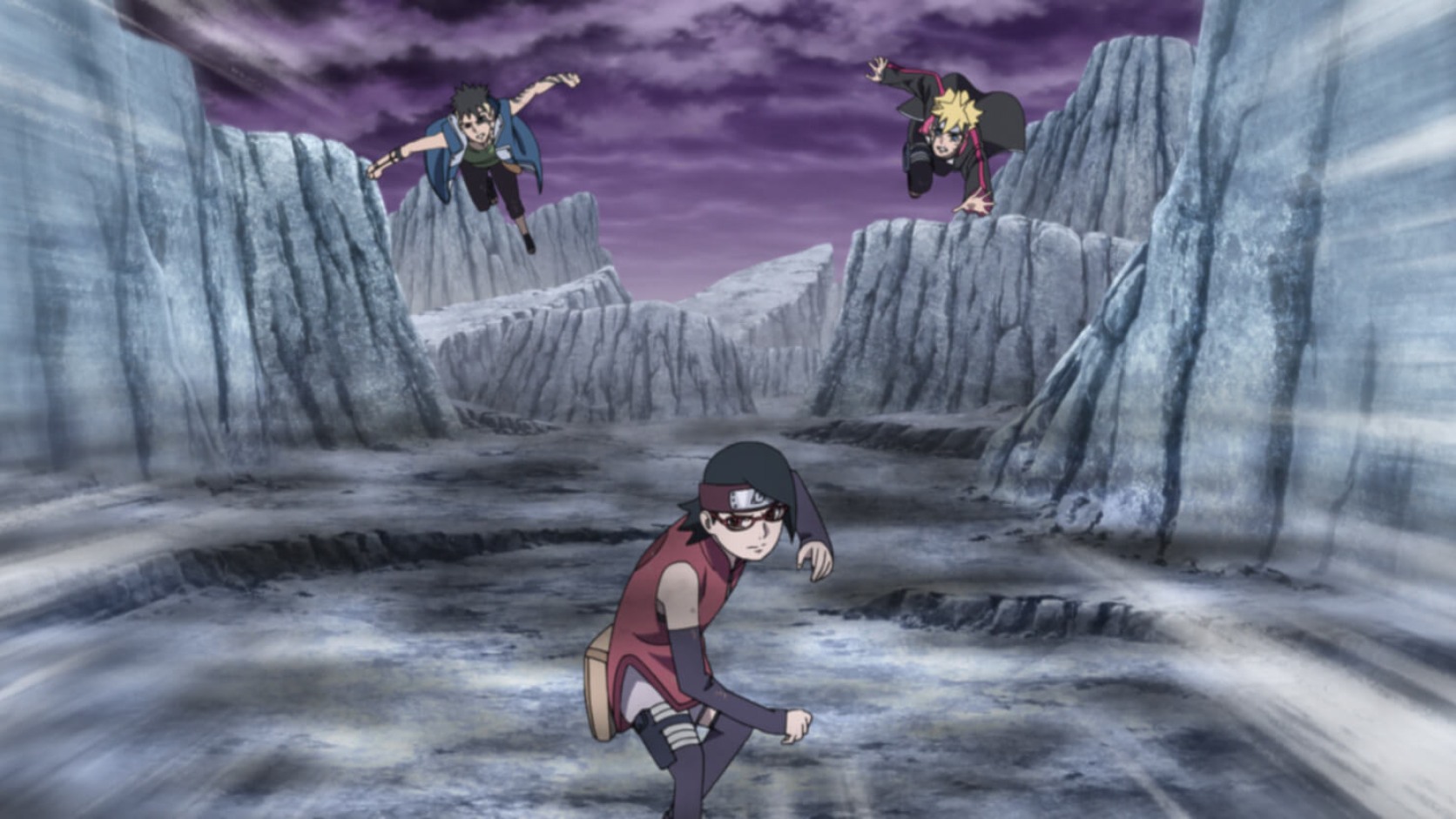
Sarada leads from the foreground
The battle composition places her reading movement while Boruto and Kawaki attack from opposite sides. Leadership becomes spatially visible.
She does not need the largest technique to shape the encounter. Position, timing, and information can carry command.
Boruto and Kawaki mirror without becoming copies
Both boys carry Kāma, move aggressively, and care about Naruto. Their instincts and histories remain different.
Parallel movement shows emerging partnership. Distinct choices prevent partnership from becoming identity erasure.
Competition must become coordination
Boruto and Kawaki often measure themselves against one another. Against Boro, unmanaged competition would expose the whole team.
The episode asks both boys to use rivalry as energy while accepting a shared plan. Winning against each other cannot matter more than bringing Naruto home.
Boro's regeneration changes the objective
Damage that should end the fight disappears. Repeating stronger attacks will not solve a system built to repair itself.
The team needs to discover limits, costs, or dependencies. Combat becomes another investigation.
Regeneration can hide vulnerability
Rapid healing creates the impression that Boro has no meaningful weakness. Every regenerative system still requires information, energy, structure, or time.
Sarada’s task is to find the hidden dependency rather than surrender to appearance.
Scientific ninja technology complicates morality
Boro’s body uses advanced modification for domination. Mitsuki uses biological knowledge for healing. Kawaki’s altered body helps open a rescue path.
Technology has no single moral direction. Consent, control, purpose, and distribution determine whether capability widens freedom or consumes someone.
Boro treats his body as a weapon system
His techniques combine virus, regeneration, size, and physical force. The body appears designed around controlling the field.
Kara celebrates such optimization while ignoring what bodies mean to the people living inside them. Kawaki knows the cost of that philosophy.
Team Seven treats bodies as people
When paralysis strikes, teammates do not discard whoever cannot fight. They diagnose, protect, and restore.
That response creates the clearest contrast with Kara. A person remains part of the team during incapacity.
Rescue work includes managing fear
Naruto remains sealed nearby. Every delay can feel intolerable, especially to Boruto and Kawaki.
Sarada must respect fear without letting fear set the entire tempo. Emotional regulation becomes collective rather than an individual demand.
Nobody should carry Naruto's fate alone
Kawaki may believe the attack happened because of him. Boruto may believe a son should save his father. Sarada may believe a captain must guarantee success.
The team distributes responsibility so no child becomes the single explanation for what happens next.
Sarada's Sharingan supports analysis
Her visual ability helps track attacks and identify patterns, but eyes alone do not create judgment. She needs teammates’ reports and her own willingness to revise.
Power becomes leadership only when information serves the group.
Mitsuki refuses the glory hierarchy
Developing antibodies may appear less spectacular than landing a decisive blow. The mission would end without his work.
Teams fail when visible offense receives all recognition. Maintenance, medicine, and analysis deserve equal memory.
Kawaki learns that disclosure can help
Kara taught him to hide weakness because information invited punishment. Team Seven needs him to share what he knows about Boro.
When disclosure leads to coordination rather than exploitation, trust gains evidence. One successful exchange cannot erase conditioning, but the pattern can begin.
Boruto learns that urgency needs structure
His impulse to reach Naruto immediately is loving and dangerous. Sarada’s command creates a route for that love to become effective action.
Structure should channel urgency rather than shame the emotion producing urgency.
The team name carries inherited pressure
Naruto, Sasuke, and Sakura made Team Seven legendary. Their children and Mitsuki can easily become comparisons before becoming people.
The new team honors history by building its own division of labor. Copying famous roles would turn legacy into a cage.
Sarada is not simply the new Sasuke
She carries the Uchiha name and Sharingan, but her leadership, ambitions, and relationships differ from her father’s path.
The captain role lets her define authority through communication rather than isolation.
Boruto is not simply the new Naruto
He loves his father, carries different privilege, and faces an Otsutsuki mark Naruto never carried. Similar energy does not produce identical development.
His willingness to follow Sarada already separates this team from a recycled origin story.
Mitsuki is not simply the new Sakura
Medical contribution may invite a shallow team-role comparison. Mitsuki’s biology, observation, and personal search for chosen identity create a different function.
Reducing support to an inherited slot would miss the new team’s actual chemistry.
Kawaki is not an extra Naruto
His loneliness parallels Naruto’s childhood, yet direct abuse, sale, experimentation, and Kāma define distinct wounds.
Membership should not depend on fitting a familiar archetype. Kawaki belongs as himself.
Four members change accountability
More people mean more witnesses to decisions and more chances to catch errors. More people also create diffusion, where everyone assumes someone else will act.
Sarada’s explicit assignments prevent responsibility from evaporating.
Trust becomes observable
The team does not announce perfect faith. They exchange information, administer treatment, cover positions, and follow commands.
Trust grows through specific behaviors that can be repeated after the mission.
Boro attacks belonging psychologically
He can frame Kawaki as Kara property and the others as naïve outsiders. The goal is to isolate him inside the group.
Every teammate who keeps treating Kawaki as a participant interrupts that narrative.
Belonging must survive disagreement
Kawaki may challenge Sarada’s plan because he knows Boro. Sarada may reject his preferred attack because she sees a larger pattern.
A real team can disagree without turning disagreement into expulsion or domination.
The mission is bigger than defeating Boro
Victory requires recovering Naruto, escaping the dimension, and preserving the children’s ability to continue. A dramatic knockout without extraction would fail.
Clear objectives protect the team from Boro controlling attention.
Return planning should begin before victory
The portal relied on Boruto and Kawaki’s resonance. Injury or separation could remove the route home.
Teams should protect extraction capacity instead of assuming success will solve logistics. Heroic arrival is only half a rescue.
The sealed Hokage is still a person
Naruto can become mission cargo when trapped inside a vessel. The children remember relationship: father, mentor, protector, Hokage.
Rescue should restore his agency rather than only recover strategic power.
The dimension strips away adult supervision
No jonin captain crossed the portal with them. Sarada leads peers while consequences normally assigned to adults arrive without warning. Her authority is real, and the absence of adult support remains a failure of circumstance rather than proof that children should manage every crisis alone.
The episode can celebrate their competence while preserving anger about the burden. Admiration should never become permission for institutions to depend on exceptional children.
Command needs emotional honesty
Sarada cares about Naruto and knows Boruto is terrified for his father. Pretending personal feeling has vanished would not make her more objective. Unnamed emotion can influence decisions without scrutiny.
She leads more responsibly by recognizing urgency, then creating roles that prevent urgency from scattering the team. Emotional honesty supports judgment when nobody confuses honesty with surrender.
Kawaki needs a team that can question him safely
His Kara knowledge is invaluable, but trauma can shape assumptions about what Boro will do and what survival requires. Teammates should listen closely without treating every prediction as unquestionable.
Safe questioning differs from disbelief. Questions seek detail, compare observations, and leave dignity intact. Dismissal tells Kawaki that disclosure was a mistake.
Sarada needs teammates who can correct her safely
A captain cannot observe every angle. Mitsuki’s diagnosis and Kawaki’s intelligence must be able to alter her plan without a contest for status.
The strongest command culture rewards timely correction. Authority remains clear, but truth does not need permission from rank before reaching the group.
Antidote distribution reveals priorities
Once Mitsuki develops protection, the team must decide order, timing, and coverage. Those decisions can expose hidden hierarchies under pressure.
Care should follow medical need and mission survival rather than popularity. Nobody becomes less deserving because another teammate produces more visible offense. The episode’s teamwork works because restored bodies return as participants, not tools.
Boro underestimates collective intelligence
His mist depends on secrecy and repeated exposure. He expects young opponents to panic, attack, and collapse before understanding the mechanism.
The team defeats that expectation by combining observation. No single clue solves the virus. Symptoms, timing, samples, Kara history, and medical knowledge become useful only after communication brings them together.
Information sharing is an act of trust
Kawaki reveals knowledge connected to abuse. Mitsuki reveals a diagnosis before every uncertainty disappears. Sarada reveals enough of her plan for others to coordinate. Boruto reveals fear through urgency rather than pretending detachment.
Each disclosure creates vulnerability. The team answers by using information for shared safety instead of leverage, which teaches everyone that honesty can produce protection.
A new team needs rituals after survival
If they return, the group will need more than a name. Debriefing, medical care, acknowledgment of mistakes, and room for each person’s account can turn one emergency alliance into durable trust.
Teams are built after missions too. Who receives credit, whose pain gets noticed, and whether leaders invite correction will determine whether “new Team Seven” remains true outside battle.
They will also need space to decide whether Kawaki wants the name after the emergency ends. Membership offered during crisis becomes meaningful only when refusal remains possible. A team chosen freely can hold loyalty without turning gratitude into another obligation.
What the episode gets right
“The New Team Seven” makes cooperation concrete. Sarada leads, Mitsuki diagnoses, Kawaki informs, and Boruto commits. Nobody’s contribution is decorative.
The virus forces adaptation and prevents the battle from becoming four children attacking harder until a villain falls.
Where the episode needs care
Kawaki’s inclusion can become conditional if the team values him only for Kāma and Kara intelligence. Later episodes must preserve belonging outside usefulness.
Sarada’s captaincy also deserves continuity. Leadership should not disappear once a larger attack begins.
RaeRae verdict
Boruto Episode 206 earns four and three-quarter bowls of ramen out of five. Sarada standing in front while Boruto and Kawaki converge says everything the title needs to prove. Leadership has a shape, teamwork has a cost, and the newest member is neither mascot nor key.
The best part is Mitsuki’s antibody work. A team becomes real when keeping people alive matters as much as looking powerful. Team Seven does not win this stage through one inherited legend. They survive by sharing what each person knows.
Before the next episode
Episode 207, “Regeneration,” forces the team to solve Boro’s modified body and gives Sarada a decisive opening. The virus is understood, but the enemy still repairs damage faster than ordinary attacks can matter.
Watch who identifies the hidden dependency, who creates the opening, and whether command remains collaborative when the fight becomes desperate.
Sources and lawful viewing
The official Naruto site provides the Episode 206 synopsis and gallery. Crunchyroll carries “The New Team Seven” where regional availability permits. Release and streaming details can vary by country.
Official episode reference: Naruto Official episode guide
Licensed episode route: Crunchyroll licensed series page
After watching, name each teammate’s contribution without ranking them. If one role disappears from the explanation, the episode’s definition of a team has probably been replaced by a highlight reel.