
Karma
Kāma saves Konohamaru before anyone understands what the imposed mark wants from Boruto, making rescue the first reason everyone may trust a dangerous power.
Series: Boruto: Naruto Next Generations
Episode: 187 · Karma
Arc: Vessel
Release: February 21, 2021
Previous: Episode 186 · How You Use It
Directory: All 293 Boruto episodes
Bottom line
Boruto Episode 187 turns Kāma from a private warning into a public rescue. Kashin Koji kills Ao after the former Outer protects Boruto, traps Team 7, mirrors Konohamaru’s Rasengan, and surrounds the young jōnin with flames that ordinary ninjutsu cannot extinguish. Boruto’s mark spreads across his arm and absorbs the fire before anyone understands why. Saving Konohamaru makes the power emotionally persuasive, which also makes the danger harder to question. A force connected to Momoshiki and Kara has just behaved like a hero. Gratitude cannot replace consent, medical investigation, or a plan for Boruto’s body.
Ao chooses one last protective action
Episode 186 ended with Boruto refusing to execute Ao. Kashin Koji answers that mercy by summoning a massive toad above the battlefield and dropping the creature toward the boy. Ao sees the attack first and pushes Boruto away.
The man who called himself a disposable tool uses his damaged body to protect someone else. That choice does not erase Mugino’s death, the stolen technology, or the violence Ao committed. One courageous act cannot purchase absolution. The choice still proves that Kara never owned every part of him.
Boruto’s mercy created room for Ao to choose
Boruto could not know Ao would save him. Mercy was not a transaction offered in exchange for future protection. Boruto lowered the screwdriver because a defeated person remained human and because custody offered a path toward accountability beyond another battlefield death.
Ao uses that surviving moment to make a choice Kara did not authorize. The result matters because humane restraint preserves agency. Execution would have ended every possible future action, including testimony, repair, remorse, and resistance against the organization that recruited him.
Koji treats Ao exactly like a failed component
Kashin Koji does not ask why Ao lost, whether the mission exposed weaknesses in Kara’s equipment, or whether an injured operative needs extraction. He eliminates the Outer because failure has removed Ao’s usefulness.
Kara’s philosophy becomes visible without a speech. The organization offers wounded people purpose while function remains profitable, then destroys those same people when output stops. Ao believed machinery gave him a new existence. Koji reveals that Kara only rented him a role.
The toad summons carry disturbing familiarity
Konohamaru recognizes a technique associated with shinobi traditions much closer to Konoha than Kara should possess. Koji’s summoning contract and later Rasengan make the stranger feel less like an external invader and more like a stolen reflection.
Familiar technique creates a different kind of fear. Team 7 knows how to respond to unknown weapons by observing function. Koji makes known symbols unreliable. A Rasengan no longer guarantees shared lineage, loyalty, or moral purpose.
Team 7 is exhausted before the new fight begins
Boruto, Sarada, Mitsuki, Konohamaru, and Katasuke have survived Ao’s drones, absorption technology, close combat, explosions, and repeated tactical changes. Konohamaru was already injured protecting Boruto during the previous battle.
Koji arrives with fresh chakra and control while the group carries physical depletion and shock. The imbalance matters. Heroic stories often treat one victory as renewed strength, but bodies do not reset when a new enemy steps onto the same ground.
Koji controls the battlefield through containment
Rather than testing every fighter separately, Koji uses sealing techniques to restrict the group. Confinement turns the team’s exhaustion into helplessness and isolates Konohamaru as the only person able to break free.
The method matches Kara’s wider politics. Control comes before persuasion. People become vessels, Outers, research subjects, targets, and assets according to who can contain whom. Team 7 encounters that worldview as a physical boundary around their bodies.
Konohamaru takes responsibility for the confrontation
Konohamaru frees himself and faces Koji so the younger shinobi and Katasuke have a chance to survive. His decision grows from command responsibility, not a desire to prove adult superiority.
Leadership requires someone to enter danger first when subordinates cannot move. Leadership also requires a plan that does not leave one person permanently expendable. Konohamaru’s stand buys time, but Konoha cannot normalize captains burning alone while children watch.
Koji studies Konohamaru instead of rushing
Koji has enough information to recognize techniques and enough confidence to let Konohamaru reveal his approach. The masked man does not fight like a stranger improvising around Konoha methods.
Every measured response increases the suspicion surrounding his origin. Knowledge can be stolen, observed, taught, or built into a body. The episode makes viewers ask who had access, who authorized the creation, and which institution buried the answer.
Konohamaru’s Rasengan carries family history
Konohamaru learned Rasengan through Naruto, who learned from Jiraiya and carried Minato’s technique forward. The attack therefore contains mentorship, aspiration, and a relationship between two boys who once demanded acknowledgment in different ways.
Using Rasengan against Kara should feel like bringing Konoha’s inherited strength into the fight. Koji answers with the same technique, turning reassurance into alarm. Family resemblance becomes evidence without becoming a complete explanation.
The Rasengan clash refuses an easy hierarchy
Koji does not merely recognize Konohamaru’s attack. He produces his own Rasengan and meets the technique directly. The clash tells Konohamaru that skill and lineage cannot guarantee moral alignment.
Naruto once used Rasengan as a visible sign of learning from people who cared for him. Koji uses the same form while hiding identity and serving an organization built around possession. Technique records transmission, but transmission alone cannot tell viewers what the learner chose afterward.
Konohamaru cannot solve the mystery during combat
The sight of Koji’s Rasengan demands an explanation, yet stopping to interrogate the connection would leave everyone exposed. Konohamaru must respond to the immediate threat while carrying a question that could reshape Konoha’s understanding of Kara.
That tension resembles responsible crisis work. Urgency determines which question comes first, not which question matters forever. Survival comes now. Investigation, records, testimony, and institutional accountability must follow.
Koji’s fire changes the rules of the duel
After matching Rasengan, Koji uses flames that cling to Konohamaru and resist ordinary suppression. The attack turns a contest of technique into an execution unfolding in front of trapped students.
Fire removes distance. Konohamaru cannot simply dodge once the flames take hold, and Team 7 cannot pretend their commander remains in control. The danger forces Boruto’s body toward an answer before Boruto’s mind can make an informed choice.
Watching an adult burn becomes its own coercion
Boruto sees Konohamaru in immediate mortal danger. Any power capable of saving him will feel impossible to refuse. That emotional reality matters when judging what happens next.
Consent under crisis has limits. Boruto does not receive an explanation of Kāma’s mechanism, risks, ownership, or long-term consequences. His body activates because someone he loves may die. Rescue remains necessary, while the conditions remain coercive.
Kāma responds before Boruto understands the command
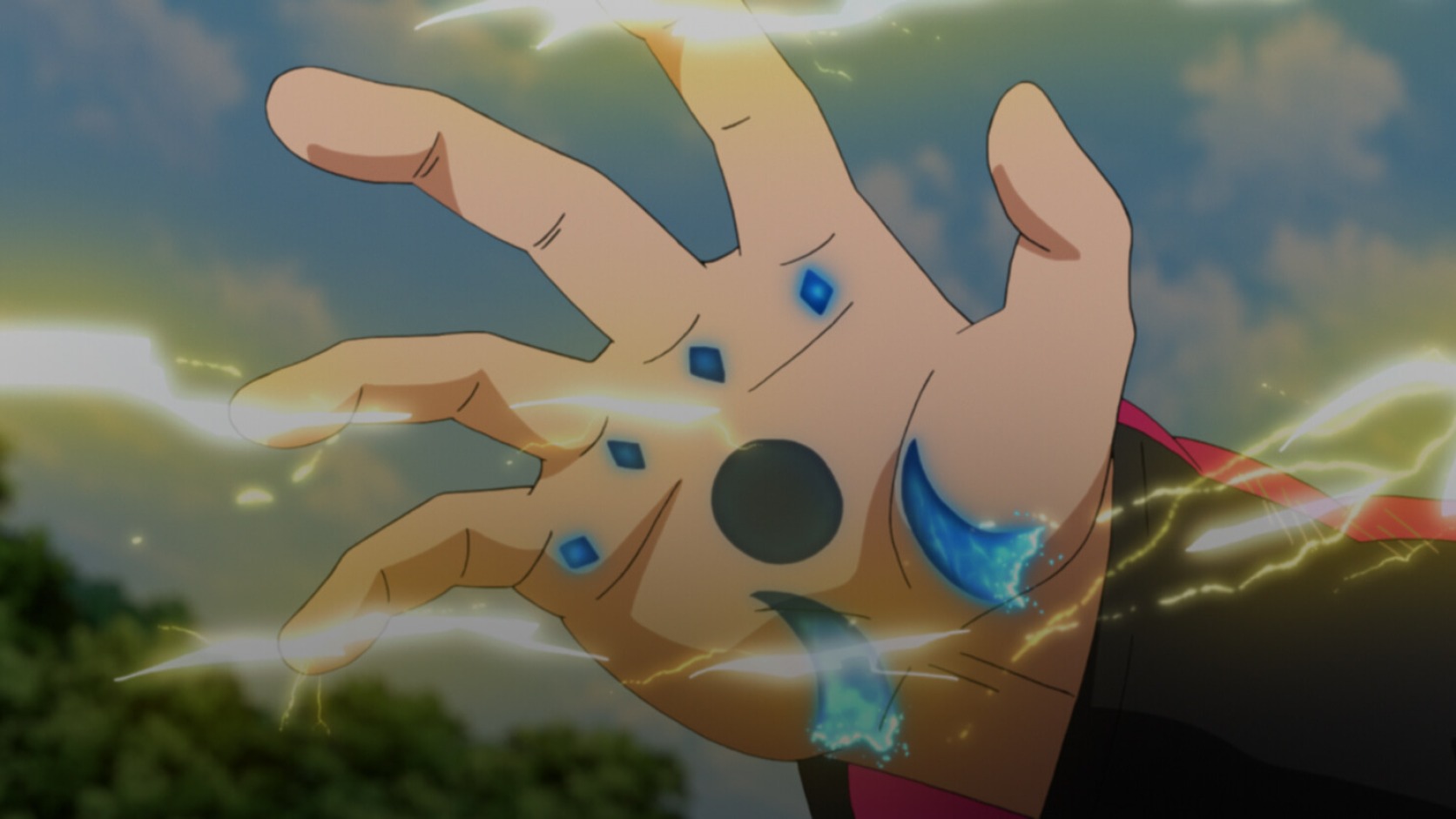
The mark spreads across Boruto’s palm and arm, changing shape and scale. His earlier experience with Momoshiki gave no usable manual. Nobody around him can tell whether the activation comes from intention, instinct, external programming, or another presence.
Boruto directs the result toward Konohamaru’s flames, but control remains incomplete. A power can answer a desire without belonging fully to the person whose skin carries the mechanism.
The canonical image centers the body carrying the cost
The close view of Boruto’s hand matters because the episode’s central spectacle is not simply a larger attack. The pattern moves across a child’s body while energy gathers around his palm.
Kāma looks powerful and visually beautiful. The same image should create unease. Boruto’s skin has become an interface for a system placed there through Momoshiki’s final act, without permission and without aftercare.
Absorption saves Konohamaru
Boruto reaches toward the flames and Kāma draws them away. Konohamaru survives because the mark can absorb chakra-based techniques on a scale Boruto has never demonstrated alone.
The rescue deserves relief. Konohamaru is a mentor, teammate, village officer, and person whose life matters beyond his usefulness to Boruto’s development. Saving him is good. The good outcome does not make the mechanism safe.
Heroic use gives dangerous power emotional permission
Kāma’s first undeniable public intervention looks compassionate. The mark does not hurt a friend in this moment. The mark prevents a death. Everyone present now has a reason to associate activation with protection.
That association can silence necessary questions. Dangerous systems often become harder to regulate after producing one beloved result. Gratitude encourages trust before evidence exists, especially when refusal seems equivalent to letting someone die next time.
Boruto deserves medical attention after the rescue
The episode moves quickly because Koji remains nearby, but Konoha must treat Kāma as a bodily event rather than a new combat feature. Boruto needs examination, imaging, chakra monitoring, symptom records, and honest discussion of every known Momoshiki connection.
Medical care must serve Boruto before intelligence collection serves the village. His body is not public property simply because the mark may threaten public safety. Protection and investigation require his participation, privacy, and age-appropriate consent.
Katasuke has expertise without complete authority
Katasuke understands scientific ninja tools and has already fitted Boruto with an absorption arm. Kāma resembles some tool functions while exceeding the category of ordinary equipment.
His knowledge can help measure effects, compare absorption patterns, and design noninvasive monitoring. Technical expertise does not grant ownership over Boruto’s body. Katasuke should explain uncertainty plainly and work beside medical specialists, seal experts, and the family.
Sarada witnesses a teammate changing
Sarada cannot intervene physically while the sealing technique holds her. She watches Boruto’s mark spread and sees a power nobody discussed become the only available rescue.
Future leadership begins with remembering that helplessness. Sarada should not reduce Kāma to Boruto’s secret or Naruto’s administrative problem. A captain must ask what support allows a teammate to speak honestly without fearing removal from the team.
Mitsuki recognizes bodily uncertainty from experience
Mitsuki knows what living inside someone else’s design can feel like. Orochimaru shaped his body, prepared choices, and arranged environments meant to produce a particular identity.
That history could make Mitsuki an important listener for Boruto, provided the story does not turn him into unpaid therapy. Shared experience offers understanding. Adults and institutions still owe both children professional care and transparent boundaries.
Koji recognizes Kāma immediately
Team 7 lacks a name, but Kashin Koji understands the pattern and changes his behavior. Recognition proves Kara has information about Boruto’s body that Konoha does not.
The knowledge imbalance is a security crisis and a consent crisis. An enemy organization can identify a mechanism inside a child while the child cannot. Konoha’s first duty should be closing that gap without treating Boruto as captured equipment.
Koji’s retreat is strategic, not merciful
Once Kāma activates, Koji no longer needs to eliminate everyone immediately. Boruto has become evidence connected to Kara’s Vessel project and to a process Koji wants to observe.
Leaving Team 7 alive does not transform Koji into a protector. He withdraws because information has changed the value of the targets. Kara’s violence pauses when surveillance promises greater benefit.
The word Karma invites moral shortcuts
English viewers hear “karma” and may reach for cosmic reward or punishment. The mark should not be read as Boruto receiving consequences for cheating in the Chūnin Exams or inheriting Naruto’s past through moral fate.
Momoshiki imposed Kāma during defeat. Boruto did not earn bodily occupation. Consequence can travel through history without becoming deserved punishment. Adults must resist narratives that blame a child for carrying danger another person placed inside him.
The Japanese term signals a seal and a burden
Kāma functions as a branded mark connected to the Ōtsutsuki, absorption, and future transformation. The visual language resembles a seal while the story withholds the full biological process.
Names help people discuss a threat, but a name can also create false confidence. Learning “Kāma” does not mean Team 7 understands activation, progression, transmission, or the person whose will may travel through the mark.
Konohamaru survives but remains a patient
Absorbing the flames ends immediate combustion. Konohamaru still carries injuries, chakra depletion, smoke exposure, shock, and damage from the earlier drone strike.
Shinobi narratives frequently move rescued adults back into command before recovery. Team 7 needs extraction and medical care, not another speech about endurance. Survival begins a care process rather than completing one.
Ao’s body should not become abandoned evidence
Koji’s attack appears fatal, but Ao remains a person and a major source of information. Konoha should recover his body, document Kara’s modifications, contact appropriate Kirigakure authorities, and preserve dignity during examination.
Accountability includes the dead. Ao’s final protective act should not erase his crimes, and his crimes should not authorize treating his remains as equipment. Both truths belong in the record.
Kara has demonstrated witness elimination
Koji’s treatment of Ao tells Team 7 what Kara will do to compromised members and anyone carrying dangerous knowledge. Future custody plans must account for assassination attempts, remote technology, infiltration, and surveillance.
Bringing a witness into Konoha without layered protection could endanger patients, staff, and civilians. Humane custody requires more infrastructure, not less. Mercy creates work because protecting life is an ongoing responsibility.
The destroyed puppets widen the mystery
After Koji leaves, Team 7 follows the route connected to the missing Vessel and finds automated puppets torn apart. The damage shows that another powerful person moved through the area before them.
The battlefield becomes evidence of captivity and resistance. Someone survived the crashed transport, encountered Kara’s machines, and possessed enough strength to destroy them. Team 7 approaches without knowing whether the survivor is victim, weapon, enemy, or several truths at once.
Kawaki appears first as an unconscious body
The boy at the center of Kara’s plans is not introduced through a title card explaining his moral role. Team 7 finds a wounded young person lying amid wreckage.
That order matters. Before Kawaki becomes “the Vessel,” a threat assessment, or a source of intelligence, he is a child requiring medical evaluation and safety. Language will determine whether Konoha remembers that priority.
The matching mark connects Boruto and Kawaki
Boruto’s Kāma and the mark on Kawaki create an immediate visual relationship. Shared bodily alteration offers evidence, not consent to compare every response or demand instant trust.
Two children can carry the same system and experience different pain, knowledge, coping strategies, and loyalties. Konoha should avoid treating Boruto as an interpreter for Kawaki merely because their bodies display related signs.
Vessel is a word designed to erase personhood
Kara calls Kawaki a Vessel because the organization values what his body can contain. The term reduces childhood, preference, fear, and survival to capacity for someone else’s plan.
Konoha must not repeat that violence through friendlier vocabulary. “Asset,” “key,” “host,” and “evidence” can perform the same erasure when institutions discuss a child primarily through strategic value.
Boruto’s family needs truthful disclosure
Naruto and Hinata cannot support Boruto if officials classify every detail surrounding Kāma. Himawari also lives in the household and deserves safety planning appropriate to her age without being burdened with adult responsibility.
Disclosure must avoid making Boruto feel like danger has revoked his place at home. The family needs facts, emergency procedures, medical contacts, privacy boundaries, and room for fear without turning fear against the child.
Naruto cannot answer only as Hokage
Kara presents a village threat, and Kāma may create national-security consequences. Naruto still owes Boruto a parent’s presence before an officeholder’s assessment.
The boy has spent years asking whether Hokage responsibilities leave room for family. Responding to Kāma through committees while withholding emotional availability would repeat the wound under more serious circumstances. Public duty and parental duty must be coordinated rather than ranked.
Sasuke’s Ōtsutsuki knowledge becomes essential
Sasuke witnessed Momoshiki’s final interaction with Boruto and understands space-time threats better than most Konoha officials. His investigation may connect Kāma to Ōtsutsuki survival mechanisms.
Expertise should come with communication. Boruto does not need another adult silently studying danger around him and revealing conclusions only when a battle forces disclosure. Knowledge held for strategic timing can become harm inside a family.
Konoha needs a consent boundary for Kāma research
Researchers will want blood, chakra readings, activation tests, tissue scans, and controlled exposure to ninjutsu. Some requests may be medically justified. Curiosity and military advantage are not sufficient reasons.
Boruto needs an advocate separate from command, clear explanations, the right to pause nonemergency procedures, and records of who accesses results. A child carrying rare power is still a patient, not an open laboratory.
Controlled activation would carry serious risk
The rescue may tempt officials to ask Boruto to reproduce absorption under supervision. Nobody yet knows whether each activation advances a hidden process, invites Momoshiki’s influence, damages tissue, or changes behavior.
Testing without a theory of cumulative harm would use Boruto’s body to answer institutional curiosity. Monitoring natural events may be safer until evidence supports a deliberate protocol.
Team 7 needs a field plan before the next activation
Sarada, Mitsuki, and Konohamaru should know warning signs, safe distances, communication phrases, and extraction priorities. A plan can reduce panic without making teammates responsible for containing Boruto alone.
Adults must provide backup capable of responding without lethal assumptions. Friendship can support Boruto. Friendship cannot substitute for medical teams, sealing expertise, and accountable command decisions.
The episode makes rescue and danger true together
Kāma saves Konohamaru. Kāma also comes from Momoshiki, draws Koji’s interest, links Boruto to Kara’s missing Vessel, and changes his body without informed permission.
Fandom does not need to choose one truth. Calling the rescue heroic should not require celebrating the mechanism. Calling the mechanism dangerous should not erase Boruto’s courage when he reaches for his mentor.
Power does not become good through one good outcome
Boruto’s intention matters. He sees suffering and acts. The mark’s origin and future purpose remain separate questions.
A weapon can save someone. A harmful institution can provide useful technology. An imposed ability can produce relief. Ethical judgment requires examining design, control, access, consequence, and who carries the cost after applause ends.
Koji’s familiar techniques demand institutional memory
Konoha has records concerning Rasengan users, summoning contracts, genetic research, wartime bodies, and missing personnel. Investigators should compare Koji’s techniques without leaking sensitive files or jumping from resemblance to certainty.
Institutional memory can protect people when records remain accurate and accessible to accountable officials. Secrecy without indexing produces archives nobody can use until harm has already arrived.
Episode 187 shifts the Vessel arc toward bodies
The airship, autonomous puppets, absorption arms, chakra blades, and drones made technology central. Kāma and Kawaki change the question from equipment someone holds to systems written into flesh.
Ownership becomes more urgent when removal may not be possible. Kara does not merely distribute tools. Kara engineers people around functions and names the result purpose.
What I am watching next
Team 7 has found Kawaki unconscious beside destroyed puppets, and Boruto now knows another person carries a related mark. Koji has seen Kāma activate and can report that the Hokage’s son belongs inside Kara’s problem.
Episode 188 must show how Konoha approaches a wounded child trained to expect ownership. Every restraint, medical decision, label, and question will tell Kawaki whether rescue means safety or merely a new institution claiming his body.
RaeRae’s verdict
“Karma” makes Boruto’s rescue emotionally undeniable and ethically unsettling. Ao spends his final choice protecting the boy who spared him, proving Kara never reduced him completely to a failed component. Koji answers with the organization’s real policy: eliminate the witness, contain the survivors, and use familiar Konoha techniques without offering identity or explanation. Konohamaru stands between that threat and his students until Koji’s flames overwhelm him.
Boruto reaches for his mentor, and Kāma answers. The mark absorbs the fire, saves a life, and gives everyone present a reason to welcome the power before understanding what the power wants. That is the episode’s sharpest danger. A heroic outcome can make bodily violation feel acceptable. Boruto deserves relief, praise for his courage, urgent care, honest information, family support, and a consent boundary around every future examination. None of those needs cancel the others.
The final image of Kawaki makes the warning impossible to avoid. Kara calls children vessels because bodies matter only as containers for someone else’s future. Konoha’s test begins before Kawaki wakes. The village must see an injured person first, then build protection and accountability around that truth.
Sources and lawful viewing
Official episode reference: Naruto Official episode guide
Licensed episode route: Crunchyroll licensed series page