
Memory, Sorrow, and Thorn · Canonical Character Profile
Baron Devasalles
Baron Devasalles arrives at Naglimund dressed like court gossip and argues like a state prosecutor. The joke is that both performances are deliberate. Leobardis’s emissary makes Josua prove his case in public, carries Nabban’s hidden support in private, and turns ornamental polish into camouflage for one of Book 1’s sharpest diplomatic operations.
At a Glance
The peacock who came carrying a war alliance
- Realm
- Nabban
- Title
- Baron of Drina
- Political office
- Duke Leobardis’s emissary to Prince Josua
- Dynastic tie
- Pledged match of Lady Antippa, Leobardis and Nessalanta’s daughter
- Reputation
- Sharp-minded, conspicuously dressed, and a brave swordsman
- Book scope
- Book 1, The Dragonbone Chair
- Last confirmed status
- Alive at Naglimund; fate during or after the siege is not established in the completed record
The Visual Receipt
Immaculate enough to make soldiers laugh—and smart enough to let them
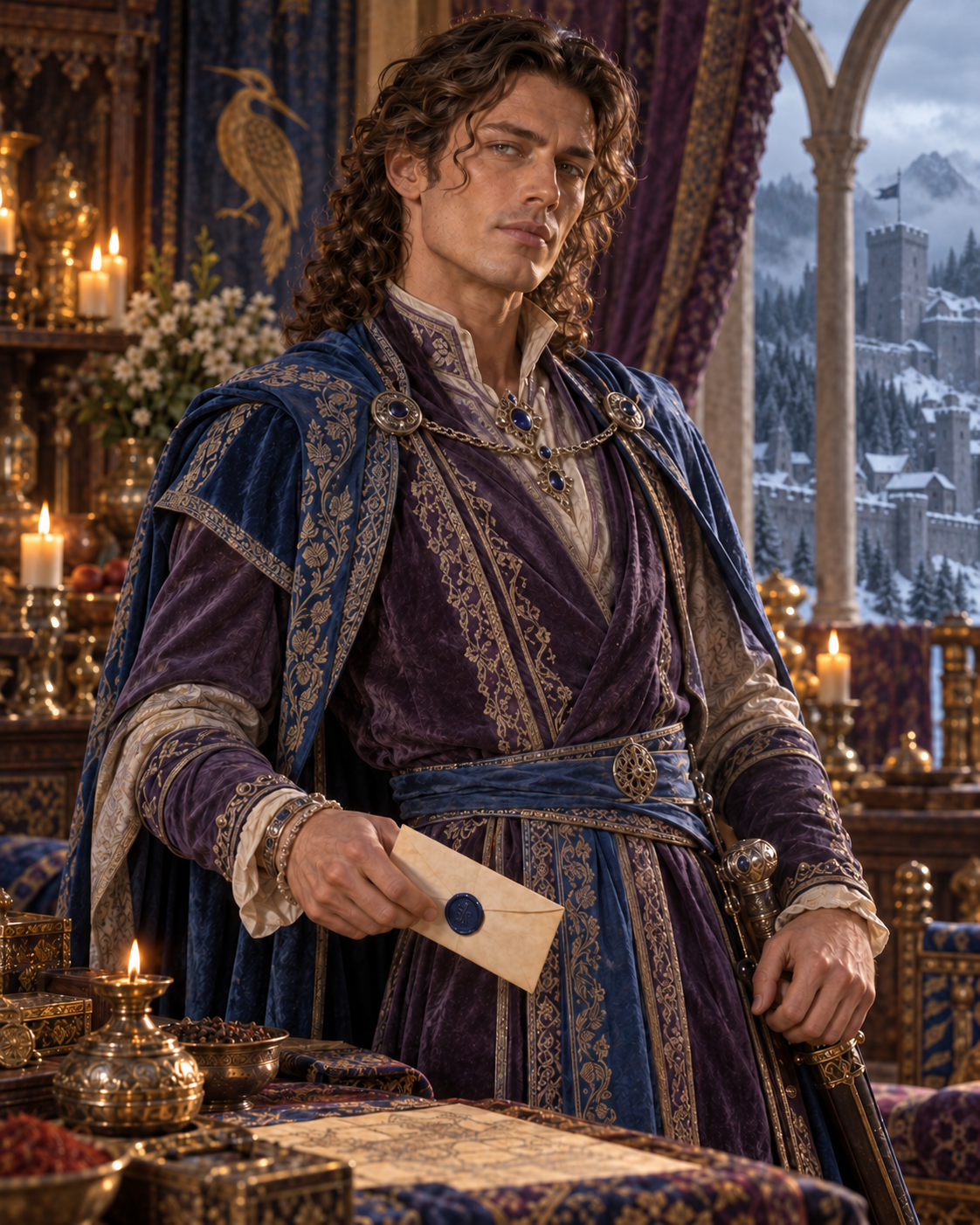
Devasalles appears only a little older than Prince Gwythinn. His hair is carefully curled, and his clothing is arranged in delicate heather and blue tones with such exaggerated polish that Simon thinks even Sangfugol would be impressed. Old soldiers laugh openly at the foppish display. The baron also wears gleaming ornaments at his neck and wrist, and his Naglimund chamber is crowded with bright fabric, candles, oil lamps, and island spices.
None of that cancels his martial reputation. Binabik identifies him as a man with an exceptionally sharp mind and reports that others call him a brave fighter. The contrast is the point: Osten Ard’s soldiers read beauty as unseriousness, while Devasalles uses the room they give him to observe, question, and carry out Leobardis’s policy.
The approved identity makes him a devastatingly handsome Nabbanai noble around thirty-two with a lean trained body, warm golden-olive skin, a narrow heart-shaped face, clever sea-green eyes, clean-shaven jaw, and thick honey-brown hair arranged in deliberate shoulder-length ringlets. Heather-purple and cornflower-blue finery, silver-blue ornaments, a sealed dispatch, and a sheathed narrow sword keep polish, intelligence, and martial credibility in the same frame.
Exact age, body, face, coloring, eyes, hair shade, ringlet pattern, clothing, embroidery, jewelry, sword, message, seal, map, furnishings, spices, lamps, architecture, snow, pose, and light are CVM editorial reconstruction. This exact man governs the embassy, Raed, private reveal, directory, hero, social, and every later scene; no future image may replace him with a new “pretty courtier” face.
Book 1 · The Dragonbone Chair
An embassy built to look less committed than it is
The road to Naglimund
Leobardis needs information—and political cover at home
Before Devasalles reaches Josua, Father Dinivan tells Eolair that the baron is preparing an embassy important to both Dinivan and Duke Leobardis. Its destination and purpose remain guarded. That discretion matters because Nabban is not one unified opinion wearing a crown. Leobardis leans toward resisting Elias, while Duchess Nessalanta and their eldest son Benigaris favor the High King.
Devasalles therefore travels with two jobs. He must assess Josua’s position, but he must also make the assessment look genuinely open so Leobardis’s opponents cannot dismiss the resulting alliance as predetermined. His public skepticism is not merely personality. It is part of the instrument.
The Raed
He refuses to let sympathy masquerade as a war policy
At Josua’s council, Devasalles asks the question every potential ally needs answered: does the prince want accommodation, revenge, or the Dragonbone Chair? Josua says he does not seek kingship, would trade revenge for fair rule, and will not launch a war on rumor. The baron’s pressure forces that position onto the record before the room’s anger can choose for him.
Devasalles continues to test evidence. He initially treats Bukken as southern legend, questions northern testimony, and resists Jarnauga’s supernatural frame. Some of that skepticism slides into the same condescension that makes Binabik absorb insults while translating northern reality for southern men. Yet Devasalles’s evidentiary demand also prevents a coalition from pretending that fear alone equals proof.
When Josua introduces Miriamele as the firsthand witness everyone can recognize, the princess’s entrance changes the political temperature. Devasalles has helped create the standard her testimony must meet. The Raed becomes more than a grievance circle because he insists on knowing what the claimant wants and why anyone should believe him.
The private reveal
The doubtful ambassador has already sent the fastest rider home
Later, Josua summons Devasalles privately and shares the Three Swords evidence because he urgently needs Nabban’s army. The baron reveals that Leobardis has sympathized with Josua for a long time, that Nabbanai troops have been kept alert for weeks, and that his own fastest rider carried the call to Leobardis two nights earlier.
Josua had already received the sealed answer. Deornoth delivered it, but the exhausted prince left it unread beside his bed. The alliance that everyone believes remains uncertain is literally waiting in the room.
Devasalles then names the domestic opposition: Nessalanta and Benigaris favor Elias. His skeptical public posture was designed to reassure Nabban’s hesitant lords and make Leobardis’s eventual choice look earned. He was not waiting to discover whether Josua could speak elegantly about swords. He was building political survivability around a decision already moving toward the battlefield.
That news also reveals the tragedy of timing. Miriamele has already fled Naglimund to secure the Nabbanai support she believes her uncle lacks. Devasalles’s successful secrecy and Josua’s unread message leave her solving a problem that has quietly been solved—while creating a new danger no one can recall.
Connections
The people inside his diplomatic equation
Duke Leobardis
Devasalles serves as his evaluator, messenger, and political shield. The embassy lets Leobardis support Josua without pretending Nabban’s internal opposition does not exist.
Lady Antippa
He is pledged to Leobardis and Nessalanta’s daughter. The intended marriage places his diplomatic service inside the ruling family’s dynastic network, not outside it.
Prince Josua
He makes Josua articulate purpose before offering confidence. In private, he gives the prince the alliance news that turns desperation into a possible continental defense.
Nessalanta and Benigaris
The duchess and heir favor Elias. Devasalles’s public doubt is partly staged for their faction, making performance a weapon against domestic resistance.
Dinivan and Ranessin
Dinivan knows the secret embassy matters before its purpose is disclosed, and later records place Ranessin in conversation with Devasalles before the journey. Church intelligence and Nabbanai policy overlap without becoming identical.
Miriamele
They do not need a major shared scene to alter one another’s path. His hidden success makes her mission obsolete before she leaves; the secrecy that protects the alliance helps place her in Cadrach’s hands.
Binabik
Binabik identifies the intelligence and battlefield courage beneath Devasalles’s peacock display. The baron later participates in a room that still demands northern people translate the impossible for skeptical southerners.
Barony of Drina
Drina establishes Devasalles as a landed political actor, not decorative embassy staff. Later reassignment of the barony suggests his disappearance or death, but the completed trilogy record does not directly verify his fate.
Why He Matters
Pretty clothes are not the opposite of strategic seriousness
Devasalles matters because he makes diplomacy visible as craft. The alliance does not happen when two good men recognize one another’s goodness. It requires intelligence channels, staged uncertainty, sealed messages, household factions, an intended marriage, a fast rider, and someone willing to be laughed at while listening to the room.
He is also useful friction. His skepticism toward northern evidence can be insulting and politically dangerous; the story does not reward us for converting every sharp man into a flawless one. But his questions force Josua’s coalition to distinguish firsthand testimony, rumor, supernatural inference, and political desire. That work becomes essential when the war’s true enemy sounds impossible.
And yes, the visual joke deserves to survive: the men who laugh at his clothes are not wrong that he is extravagantly dressed. They are wrong to think extravagance tells them the limit of his competence.
The Cruel Timing
His mission succeeds before anyone who needs the news behaves as if it has
The embassy is one of the saga’s sharpest demonstrations that information can be true, delivered, and still functionally absent. Devasalles has dispatched the rider. Leobardis has answered. Deornoth has placed the sealed message beside Josua. Yet exhaustion leaves it unopened, public caution disguises the alliance, and Miriamele departs to obtain help that has already been pledged.
No single person owns the entire failure. Devasalles’s secrecy protects Leobardis from Nabban’s Elias faction. Josua’s exhaustion is the cost of maintaining a collapsing refuge. Miriamele’s urgency grows from watching adults delay while the world worsens. The result is still brutal: good decisions made in separate rooms do not automatically become coordinated action. The baron’s success helps explain why the princess’s danger feels tragic rather than foolish.
On the Record
Scope, spoilers, and the missing final receipt
This is Baron Devasalles’s single canonical full-spoiler profile for Book 1 and the franchise directory. It is grounded in the completed owned-edition ledger and the fresh sequential reread through Chapter 35. No duplicate book-specific profile should be created.
The completed record last confirms Devasalles alive at Naglimund. Secondary reference material says he likely perishes there and notes that Drina later passes to Aspitis, but “likely” is not a death scene. His canonical status therefore remains alive at last confirmed appearance, later fate unverified.
The approved identity preserves the canonical careful curls, delicate heather-and-blue clothes, gleaming throat and wrist ornaments, beautiful chamber, sharp-minded bearing, and physical credibility of a brave fighter. Exact age, body, face, coloring, eyes, hair shade, ringlet pattern, costume, jewelry, sword, sealed dispatch, furnishings, spices, architecture, weather, pose, and light remain reconstruction.
One local attachment powers featured image, visible hero, Book 1 and franchise directory cards, and Rank Math social metadata.