
Memory, Sorrow, and Thorn · Canonical Character Profile
Brother Dochais
Brother Dochais survives the massacre at Saint Hoderund’s only long enough to recognize Simon as another person “marked” by the White Foxes. His fractured warning links a black wagon, frozen hearts, stolen souls, and the Storm King before anyone in the traveling party has language sturdy enough to hold the pattern.
At a Glance
The witness whose terror contains evidence without becoming a clean answer
- People
- Hernystirman
- Calling
- Monk and survivor associated with Saint Hoderund’s
- Condition
- Fevered or supernaturally altered despite lacking a clear physical fever
- Core testimony
- White Foxes, a master who freezes hearts, a black wagon, stolen souls, and the mark shared with Simon
- Final words
- “Storm King”
- End status
- Dead and buried in the abbey cemetery
The Visual Receipt
Young, thin, and frightening because the body is still recognizably human
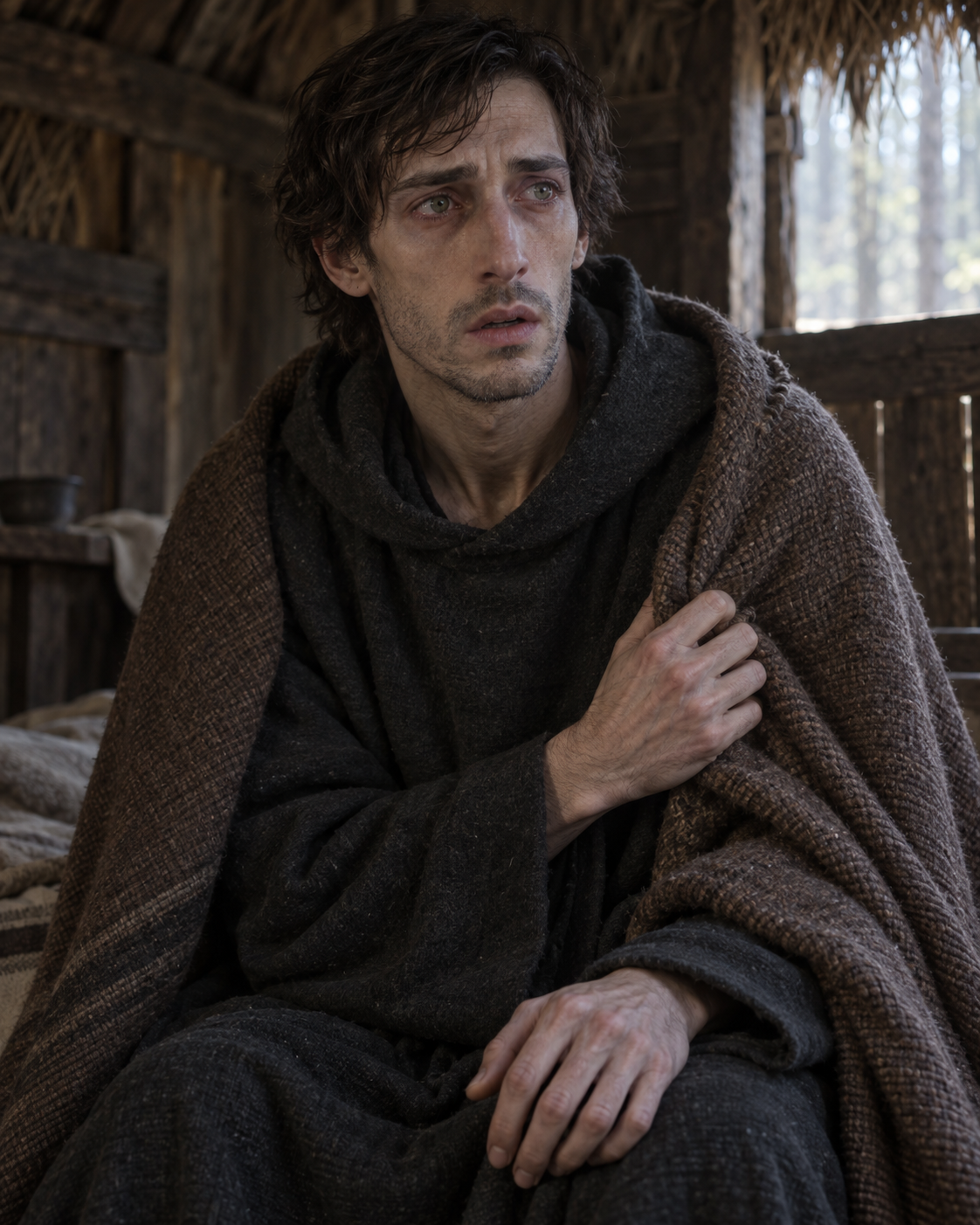
Dochais is a thin young Hernystirman with a long nose, blue chin-stubble, laboring breath, trembling eyelids, and startling grip strength during the seizure in which he grabs Simon. These details should anchor an attractive, age-correct adult face rather than turn illness into ugliness or possession into a creature redesign.
One approved identity must persist across pre-massacre reconstruction, forest shelter, altered warning, refusal of food, convulsion, death, and burial. The blue stubble, long nose, fine build, strained breathing, and human vulnerability remain consistent. Do not make his eyes glow or invent lesions, ritual markings, or demonic anatomy the ledger never supplies.
Book 1 · The Dragonbone Chair
The warning arrives before interpretation
After Saint Hoderund’s
Hengfisk gets the body to shelter; nobody can bring the mind fully back
Hengfisk had gone searching for Dochais and returned to find the abbey massacre. He rescues Dochais and the gravely wounded Langrian into a forest shelter. When Simon and Binabik arrive, Dochais appears fevered or mentally altered, although Binabik later finds no clear bodily fever and considers him beyond ordinary help.
Dochais grabs Simon with startling force and recognizes him as another person who has been marked. He names White Foxes and describes their master sending them to freeze hearts and carry souls away on a black wagon. The imagery reconnects Simon’s mark, the procession at the Angel Stones, supernatural cold, and the abbey’s violence.
The testimony remains altered witness, not omniscient exposition. It does not prove who committed every killing, explain how the mark operates, or establish whether Dochais saw the black wagon directly in ordinary waking space. Its value lies in convergence: a terrified survivor independently supplies images already haunting Simon.
Dochais refuses food, convulses, and dies suddenly. His last words name the Storm King. Hengfisk weeps openly. Simon feels horror mixed with guilty relief; Binabik becomes unreadable. Their reactions preserve the emotional mess of watching suffering end when nobody could relieve it.
Binabik agrees to bury Dochais even while refusing Hengfisk’s demand that they remain for days interring every corpse. Dochais receives a grave in the abbey cemetery. The warning continues north with Simon and Binabik, but the man who carried it is not reduced to information.
The People Around Him
Care cannot cure him, but it keeps him from dying entirely alone
Brother Hengfisk
Hengfisk searches for him, moves him to shelter, restrains him during the seizure, mourns him, and demands burial.
Brother Langrian
The two surviving monks occupy different sides of the aftermath: Langrian’s body improves enough to testify; Dochais’s altered state deepens toward death.
Simon
Dochais recognizes a shared mark before Simon understands it. Their contact turns private nightmare imagery into corroborated danger.
Binabik
He assesses the body, rejects false confidence about treatment, and later connects Dochais’s death with Ookequk’s final terror without claiming proof.
Ookequk
The Singing Man’s dream-road seizure resembles Dochais’s condition. The parallel is meaningful and explicitly not a completed diagnosis.
The Storm King
Dochais’s final name gives Simon and Binabik a vocabulary for the larger force accumulating behind winter, dreams, and fear.
Why He Matters
A damaged witness can be both unreliable and indispensable
Dochais matters because the saga does not require testimony to be perfectly interpretable before it deserves attention. His terror alters the form of the message; it does not automatically erase every connection inside it.
The profile must also resist treating him as a prophecy delivery device. Hengfisk’s grief, Simon’s relief, Binabik’s uncertainty, and the burial return personhood to a man whose final scenes are dominated by forces nobody understands.
What the Warning Proves
Convergence is evidence; it is not permission to upgrade every image into literal fact
Dochais’s words matter because Simon has already encountered related imagery. The black wagon, supernatural cold, the Angel Stones procession, White Fox associations, and the mark on Simon form a cluster before the monk names the Storm King. A second person producing connected language makes private nightmare harder to dismiss as ordinary fear.
The convergence still leaves crucial questions open. Dochais does not provide a stable chronology of the massacre. The scene cannot establish whether every image was physically witnessed, dreamt, imposed, remembered, or translated through trauma. “Marked” is recognition, not an operating manual. The White Foxes have a master in his account, but the exact chain between that master, the attackers, the black wagon, and every corpse remains incomplete.
A responsible profile therefore preserves layers of confidence. The monk definitely speaks the warning and recognizes Simon. Simon definitely sees correspondence with his own experience. Dochais definitely dies after naming the Storm King. The larger mechanism becomes more plausible through later events, but later knowledge should not be smuggled backward into the certainty available in the shelter.
This evidence discipline makes the warning stronger, not weaker. Readers can watch the pattern accumulate instead of being told a dying traumatized man secretly delivered a perfect exposition speech nobody understood.
The Mark Between Them
For one terrible instant, Simon is recognized by the person he most fears becoming
Dochais seizes Simon with strength that contradicts his failing body and identifies them both as marked. Simon does not receive comfort from being understood. Recognition collapses distance between a frightened traveler and a survivor whose mind and body appear occupied by terror.
The encounter gives Simon a possible future image: knowledge may not protect him; surviving one event may only carry the pursuing force forward; the mark may mean he is already inside a pattern larger than the royal struggle. Dochais cannot tell him how to remove it. He can only recognize the condition and name fragments around it.
That helpless recognition helps explain Simon’s guilty relief when the monk dies. Relief does not mean Simon wanted him dead. It means witnessing unrelieved convulsion, refusal of food, altered speech, and fear has become unbearable—especially when the suffering seems to reflect something Simon carries too. The chapter permits compassion and relief to coexist without polishing either into a noble reaction.
Care, Limits, and Burial
Nobody cures Dochais; several people still refuse to abandon him
Hengfisk searches for Dochais, carries him from the massacre, shelters him, restrains him during the seizure, weeps at his death, and demands burial. The monk’s prejudice toward Binabik and Qantaqa remains part of his character, but it does not erase the labor he performs for the two survivors.
Binabik examines Dochais, recognizes that the apparent fever lacks an ordinary physical sign, and refuses to pretend his skill can solve the condition. The contrast with Langrian is painful: one patient improves under the same caregiver while the other moves beyond help. Competence does not guarantee equal outcomes.
The burial dispute then widens care from one body to a field of bodies. Hengfisk wants every victim buried. Binabik argues that days of labor will endanger the living and that the dead are spiritually beyond further harm according to the monk’s own belief. Neither position is emotionally cheap. Ritual obligation, immediate survival, prejudice, exhaustion, and grief compete for too few hands.
Dochais receives a grave in the abbey cemetery. The practical compromise cannot honor every corpse equally, but it prevents the named witness from disappearing the moment his final word becomes useful. The site should remember both facts: his warning travels onward, and his body stays behind beneath earth moved by people who could not save him.
On the Record
Scope, spoilers, and identity continuity
This is Brother Dochais’s one canonical full-spoiler Book 1 profile, grounded in the completed owned-edition ledger. His statements remain labeled as altered testimony, and the resemblance to Ookequk’s death remains a comparison rather than proven mechanism. His exact route through the initial massacre remains unknown.
The approved living identity presents a thin, exceptionally attractive Hernystirman around twenty-four with a long narrow face, long straight nose, pale olive-fair skin, gray-green eyes under strained lids, uneven ear-length dark hair, and natural blue-black chin stubble. Youth, thinness, nose, stubble, laboring breath, trembling eyelids, and abnormal grip are canonical; exact age, face beyond those traits, coloring, hair, robe, blanket, shelter, pose, and light are CVM editorial reconstruction. Preserve this same human identity across warning, convulsion, death, burial, hero, card, and social placements without glowing eyes, demonic anatomy, or corpse-first spectacle.