
Memory, Sorrow, and Thorn · Canonical Character Profile
Abbot Quincines
Abbot Quincines appears through the testimony of survivors because his decisive scene ends in murder. He sees armed strangers hiding steel inside a religious refuge, orders them to disarm, and becomes the first body dropped when hospitality stops protecting Saint Hoderund’s.
At a Glance
The authority who tests the concealed weapon and receives the answer in blood
- Office
- Abbot of Saint Hoderund’s
- Community
- The monks and travelers sheltered at the northern abbey
- Core action
- Confronts the pale-eyed leader after a brother reports a hidden sword
- Demand
- Orders the suspicious strangers to disarm as another armed company approaches
- Primary witness
- Brother Langrian, whose wounded account reconstructs the attack
- End status
- Dead; his throat is cut at the beginning of the abbey massacre
The Visual Receipt
No description means no invented abbot template
The completed ledger explicitly records that Quincines is not physically described. Canonical art must not pretend the approved face, age, coloring, body, hair, beard, clothing, keys, pendant, architecture, weather, pose, or light came from the novel.
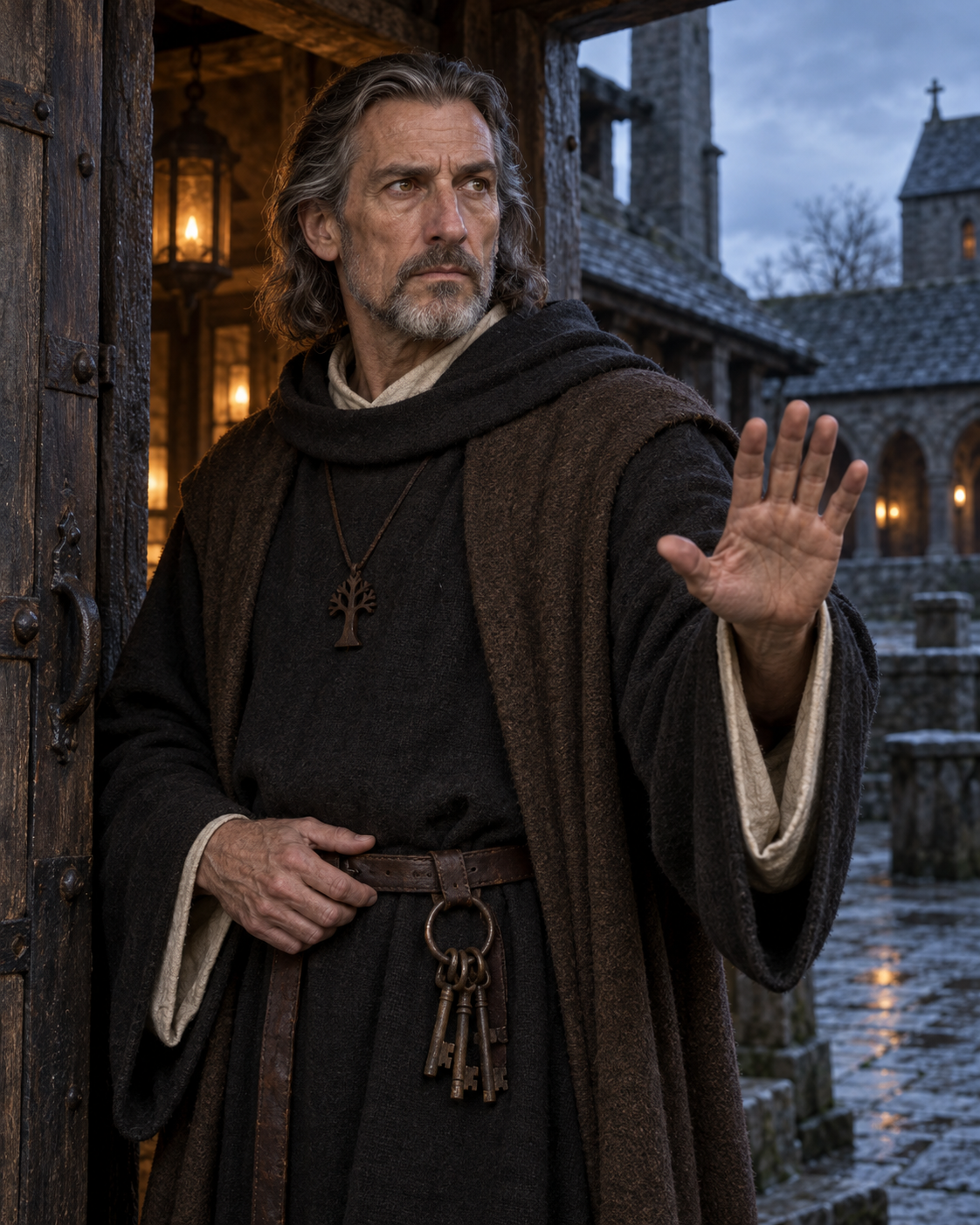
CVM’s reconstruction establishes an exceptionally handsome mature Aedonite abbot around fifty-six: tall and lean-sturdy, with weathered fair-olive skin, a long square face, deep hazel eyes, a slightly bent prominent nose, shoulder-length ash-brown hair substantially streaked with silver, and a short salt-and-pepper beard.
He is grounded in Saint Hoderund’s material setting through practical charcoal and brown wool, a plain wooden Tree, worn keys, and the open Travelers’ Hall threshold. This exact living face and body govern abbey life, confrontation, directory, hero, social, and any later massacre image. The murder scene may show injury; it cannot replace him with a corpse-only identity.
Book 1 · The Dragonbone Chair
The massacre begins when sanctuary attempts to enforce a boundary
Saint Hoderund’s
Hospitality does not require pretending a hidden sword is harmless
Roughly a dozen armed travelers arrive first under a pale-eyed leader and are housed in Travelers’ Hall. A second company approaches from the south. The first leader greets them as though reinforcements may have arrived, but a brother has already glimpsed a concealed sword.
Quincines distrusts the strangers and confronts their leader. He orders them to disarm. The demand is a lawful defensive act inside a refuge full of unarmed residents, not an aggressive challenge staged for glory.
The leader kills him, cutting his throat. Brother Sceneseafa runs to warn the community and is shot. Fighting then engulfs the abbey. Langrian later believes the two armed companies fought one another as well as slaughtering monks, but cannot identify every allegiance. Quincines’s death is one of the few fixed points inside that confusion.
Because the scene comes through testimony, the profile must resist embellishment. The ledger does not preserve a speech, duel, private fear, or final blessing. It preserves an abbot seeing danger, asserting a boundary, and being murdered for it.
The Abbey Around Him
His death survives through the people who reconstruct it
Brother Langrian
The wounded survivor provides the account that makes Quincines’s action legible after the attackers leave.
Brother Sceneseafa
Sceneseafa attempts to carry the warning after Quincines falls and is shot before the abbey can organize.
Brother Hengfisk
The surviving monk later demands burial for the dead, keeping communal obligation alive after institutional authority is destroyed.
The pale-eyed leader
His response to a lawful disarmament order reveals what the concealed weapon already implied: the strangers never accepted the abbey’s protection as reciprocal.
Why He Matters
A short appearance can define the moral shape of an entire location
Quincines matters because the abbey massacre is not weather that happens to anonymous robes. A named authority identifies danger, tries to protect the community, and dies before uncertainty can be resolved.
His profile also establishes an editorial limit. Comprehensive coverage means preserving the person and the verified act; it does not mean manufacturing interiority because a longer page looks more impressive.
Sanctuary Has Rules
Hospitality protects strangers only while strangers accept obligations toward the people sheltering them
Saint Hoderund’s receives travelers into a community whose residents are largely unarmed. Travelers’ Hall exists because the abbey treats movement, weather, danger, and religious duty as reasons to provide refuge. That protection is not a surrender of authority inside the walls.
A concealed sword changes the moral situation. Quincines does not attack merely because armed foreigners look unfamiliar. He acts after a brother reports hidden steel and as a second armed company approaches. Ordering the first strangers to disarm is an attempt to keep uncertain military relationships from turning the abbey into their battlefield.
The pale-eyed leader’s response exposes the original bad faith. He cuts the abbot’s throat rather than submit to the boundary of the house that sheltered him. Violence begins not because hospitality failed, but because one guest treated hospitality as access without reciprocal restraint.
That distinction matters beyond the scene. The books repeatedly ask whether protection permits control, whether guests owe obedience, and when a host’s authority becomes coercion. Quincines’s demand is unusually clear because the concealed weapon and unarmed community make the immediate risk concrete.
A Reconstructed Death
Langrian’s testimony provides fixed points without becoming an overhead view of the massacre
Readers do not accompany Quincines through the confrontation directly. Langrian later reconstructs events while recovering from grave wounds. His account establishes the first group’s approximate size, pale-eyed leader, concealed sword, the approach of another company, Quincines’s challenge, Sceneseafa’s attempted warning, and the violence that follows.
The witness cannot identify every allegiance. He believes the armed groups also fight one another, and he observes that the first band meets harder resistance from the newcomers than from the monks. Those details prevent the event from becoming a simple two-sided raid while leaving the exact relationship between companies unresolved.
Quincines’s murder is one of the firm anchors. The profile can say the leader cuts his throat after the disarmament order. It cannot provide a private exchange, exact wording, combat choreography, final prayer, or knowledge Langrian did not preserve.
This layered evidence is more trustworthy than smooth omniscience. The massacre remains chaotic because it was chaotic. A wounded survivor supplies enough structure to identify moral actions without solving every military question.
Leadership at the Threshold
The abbot’s office becomes visible through one decision made before certainty arrives
Quincines does not have time to gather a council, interrogate both companies, or wait for the hidden sword’s purpose to become undeniable. He must decide while residents and guests share space with armed strangers and more riders close in.
His action is neither prophetic insight nor reckless accusation. Distrust leads to a proportionate boundary: surrender weapons inside the refuge. The order attempts to reduce capacity for immediate harm while preserving the possibility that the newcomers can remain under protection.
The murder demonstrates why leadership under uncertainty cannot always wait for perfect information. If Quincines is wrong about intention, disarmament inconveniences dangerous-looking guests. If he is right, delay exposes the abbey. The pale-eyed leader makes the true stakes visible only after the abbot has already committed.
Quincines dies before the community can organize around his warning. Sceneseafa’s run becomes the next link and is stopped by an arrow. Authority collapses through targeted speed: kill the person setting the boundary, kill the messenger carrying it, then exploit the confusion among everyone else.
The Abbey After Him
Once the attackers leave, the survivors must decide how much care the dead can receive
Hengfisk returns to a destroyed community and rescues Dochais and Langrian. Later he demands burial for every corpse. Binabik refuses to spend days on the task while the living remain endangered, though he agrees to bury Dochais. The disagreement is practical, spiritual, and emotional at once.
Quincines belongs to the field of dead whose individual burials the traveling party cannot complete. That does not make him less individual. Langrian’s testimony carries his name and action forward even when the available labor cannot restore full funerary order.
Simon’s later passage through the heat-worsened bodies forces the same recognition across unnamed victims: every corpse was previously a person rather than scenery. A canonical profile extends that work for the abbot. It does not elevate his death above the others; it preserves the specific evidence the novel gives.
Name and Record
Quincines and Quincienes refer to one abbot, not duplicate characters
The reading record preserves a spelling variant, Quincienes, alongside the canonical display name Quincines. Both belong in alias metadata so search can resolve the same person without creating two profiles or treating a transcription difference as new lore.
The same discipline applies to his role. “Sanctuary defender” summarizes the verified disarmament demand; it does not claim a military office, warrior history, or broader political program. “First named victim” describes narrative position, not proof that no one else was killed moments earlier beyond the witness’s view.
His final status is certain. His appearance is not. His community and office are certain. His age, family, private theology, and earlier tenure are not. The page becomes deep by keeping those categories legible, not by making every field look equally full.
On the Record
Scope, spoilers, and evidence limits
This is Abbot Quincines’s one canonical full-spoiler Book 1 profile, grounded in the completed owned-edition ledger and Langrian’s reconstructed testimony. The franchise and Book 1 directories point to this post rather than duplicate it.
The source explicitly lacks a physical description. The approved living identity is CVM editorial reconstruction: one exceptionally handsome mature, silver-streaked, bearded Aedonite abbot in practical wool at the Travelers’ Hall threshold. Exact age, body, face, coloring, eyes, nose, hair, beard, garments, Tree pendant, keys, architecture, weather, pose, and light are not textual canon.
One local attachment powers the featured image, visible hero, directory cards, and Rank Math social metadata. Future death-scene art must preserve this exact face and make the attacker’s violence—not invented weakness or sainthood—the cause of his changed condition.