
Memory, Sorrow, and Thorn · Canonical Creature Profile
Niku’a
Niku’a is not a winter wolf with better branding. Utuk’ku’s giant white hound is a tracker, rescuer, pack-summoner, and living extension of the Queen’s Hunt—beautiful at a distance, anatomically wrong up close, and patient enough to carry a broken hunter back into the chase.
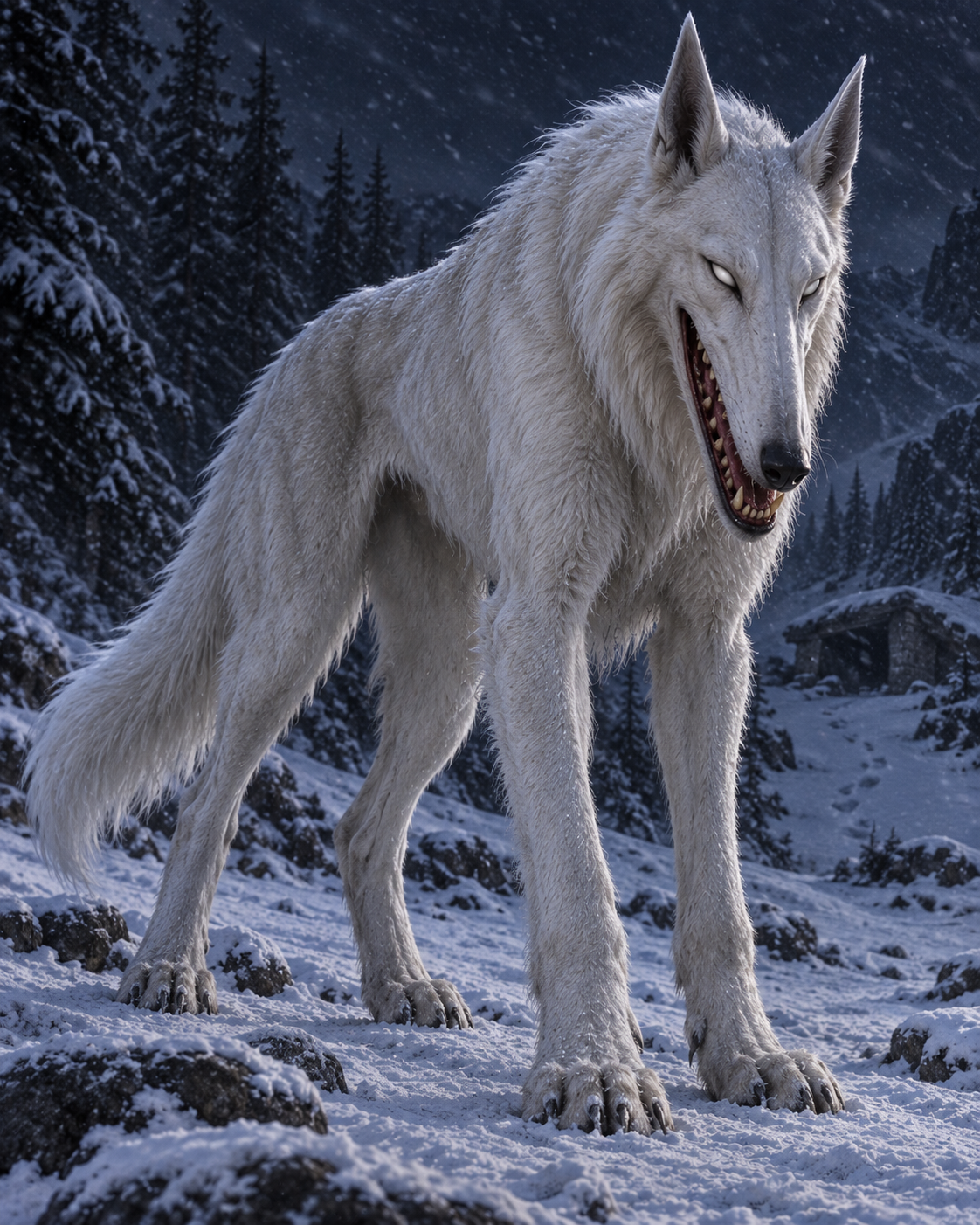
At a Glance
The white hound that turns pursuit into a supernatural office
- Nature
- Giant white hunting hound associated with Stormspike and Utuk’ku
- Handler
- Ingen Jegger, the Queen’s Huntsman
- Primary function
- Tracking quarry across wilderness and summoning the larger white-hound pack
- First confirmed appearance
- Book 1, answering Ingen Jegger’s call on the Stile
- Defining action
- Drags the badly injured Ingen to shelter and later leads the final pursuit toward Sesuad’ra
- End status
- Dead; killed by Shima’onari during the Sesuad’ra confrontation
The Visual Receipt
White enough to look holy until the face turns toward you
Niku’a is enormous, larger than the earlier white hound Qantaqa kills. The coat is shining white, an almost ceremonial purity that belongs to the Hunt’s deception rather than innocence. The face is long and grinning, the eyes reduced to pearl-like slots, and the growl has the depth of a cavern. Future art must preserve that exact contradiction: magnificent winter animal at first glance, manufactured predator when the anatomy resolves.
The approved design must not drift into a normal dire wolf, fluffy pet, polar bear, or random demon dog. Niku’a is a hound with an identifiable muzzle, working body, and purposeful relationship to scent. Scale should remain consistent beside Ingen, his tall horse, Qantaqa, the other hounds, and Shima’onari. Snow may hide the feet; it cannot be used to avoid solving the body.
The Complete Journey
The hunt survives broken bones because the hound carries it forward
Book 1 · The Dragonbone Chair
A name answers from the snow
Ingen Jegger’s earlier pursuit already establishes the white hounds as something outside ordinary animal behavior. They move through murderous cold, attack with coordination, and belong to a widening pattern that includes the White Foxes in Dochais’s warning and the unnatural winter following Simon north.
Niku’a enters after Ingen’s catastrophic fall. The Huntsman’s horse has crushed both legs and several ribs, injuries that should finish any pursuit even when ritual preparation keeps the man alive. Ingen makes a snow-owl call on the Stile. A giant white hound answers. It is larger than the animal Qantaqa killed, with a shining coat, a long grinning face, narrow pearl-slot eyes, and a growl that sounds less like warning than an opening underground.
Ingen names Niku’a and uses the hound to continue tracking the Thorn expedition. More importantly, Niku’a drags the broken hunter into shelter while Ingen splints his legs and converts survival into revenge. The Queen’s Hunt is therefore not simply a man directing animals. Handler and hound keep the institution moving when either body alone should fail.
Book 2 · Stone of Farewell
The tracker calls the pack for the chase it was bred to finish
Utuk’ku restores Ingen from Death’s Country and equips him with weapons and knowledge no ordinary hunter carries. Niku’a remains beside him as the hunt moves south from Stormspike. Ingen feeds the hound a strip of dried flesh with something like a fingernail attached. Niku’a takes the scent, making the supernatural pursuit immediate, physical, and revoltingly intimate.
The hound’s function widens when Niku’a summons the full white pack. Ingen declares that this is the last chase for which the animals were bred. The statement transforms them from conveniently recurring monsters into a purpose-built lineage: bodies cultivated for one long pursuit inside Utuk’ku’s strategy.
At Sesuad’ra, the hunt collides with Simon, Jiriki, and the Sithi defenders. Shima’onari fights Niku’a and kills the giant hound, but receives a mortal wound in the exchange. Jiriki uses Indreju, Simon kills another hound with a rock, and the Sithi eventually break the remaining pack and the Red Hand manifestation.
Niku’a’s death is not just the removal of a boss creature. It costs the defenders an ancient Sitha life and ends the named tracker that carried Ingen from Book 1’s broken-body cliffhanger into Book 2’s final assault. The chase was designed to outlive ordinary limitations. It ends only when several kinds of courage meet it together.
The Body as a Weapon
Rescue does not make the Hunt merciful; it proves how efficiently it preserves its own violence
Niku’a’s first major act is rescue. That verb could soften a lesser monster, especially beside a wounded human calling through the snow. Here it does the opposite. Ingen’s crushed legs and ribs ought to end the pursuit. Niku’a drags him to shelter so the Huntsman can splint himself, survive, and resume tracking the people Utuk’ku has marked. Care exists inside the Hunt, but its purpose is to return the hunter to violence.
That distinction matters beside Qantaqa. Binabik’s wolf is never merely useful equipment. She makes decisions, recognizes danger, defends Simon and Binabik, grieves, and exists within reciprocal attachment. Niku’a also acts intelligently and sustains a bond with Ingen, but every verified function points toward the Queen’s machinery: answering the call, carrying the injured Huntsman, taking the grotesque scent-token, summoning the pack, and pursuing quarry to the final confrontation.
The saga does not tell us whether Niku’a could have chosen another life, and this profile will not invent secret rebellion or secret delight. The more honest horror is structural. Utuk’ku has bred a lineage for a terminal chase and placed a named creature at its center. Individual loyalty and institutional exploitation can occupy the same body. Niku’a may care for Ingen; the Queen still owns the purpose their relationship serves.
At Sesuad’ra, Shima’onari’s fatal exchange with the hound gives that engineered purpose a measurable cost. The king is not killed by an abstract curse viewed safely from a balcony. He must meet the Hunt as muscle, teeth, weight, coordination, and endurance. Killing Niku’a does not undo what was bred into the pack, and victory does not restore the life spent achieving it.
The Hunt Around It
Niku’a belongs to a system, not a pet-and-master sidebar
Ingen Jegger
Ingen gives direction, scent, and ritual purpose. Niku’a gives mobility, rescue, tracking, and access to the pack. Each extends the other’s ability to continue.
Utuk’ku
The Norn Queen is the true owner of the Hunt. Niku’a’s breeding and function belong to her project, whatever attachment exists between hound and Huntsman.
The white-hound pack
Niku’a can call the others, marking the named hound as more than one interchangeable predator inside the group.
Qantaqa
The wolves are visual opposites only if “white monster versus gray companion” is mistaken for the whole story. Qantaqa chooses, protects, mourns, and belongs; Niku’a has been bred into an office.
Shima’onari
The Sitha warrior kills Niku’a and dies from the wounds received. Their exchange gives the hound’s scale and lethality a cost the story refuses to hand-wave.
Simon
Simon is part of the quarry, but the final battle makes him an active defender. His rock-kill of another hound punctures the fantasy that only enchanted weapons can resist the Hunt.
Why It Works
The horror is not that the animal is wild; it is that somebody engineered purpose into it
Niku’a works because the saga does not treat “beast” as shorthand for moral emptiness. Qantaqa has already shown readers an animal relationship built on agency, partnership, and love. Niku’a supplies the nightmare counter-image: a magnificent body bred and organized around somebody else’s endless hunt.
The named identity matters. Once the hound has a name, recognizable anatomy, repeated labor, and a relationship with Ingen, its death carries more weight than clearing another monster encounter. Niku’a is terrible, but not disposable.
Its visual beauty sharpens the trap. Snow-white fur, immense scale, and perfect tracking power could belong to a guardian in another fantasy. The narrow eyes and unnatural grin reveal that majesty has been redirected. Niku’a is not frightening because beauty was fake; it is frightening because beauty and violation have been made to cooperate.
On the Record
Scope, spoilers, and creature consistency
This is Niku’a’s one canonical full-spoiler profile across Books 1 and 2. It is grounded in the completed owned-edition reading ledger and corrects the named hound’s omission from the earlier character registry. Franchise and volume directories must filter this post rather than duplicate it or collapse Niku’a into Ingen Jegger’s profile.
Visual state: approved canonical Stile identity. The design preserves the direct receipt: enormous scale larger than Qantaqa, shining-white coat, long grinning face, narrow pearl-white eyes, tracker anatomy, and a mouth built around the pack’s red-gummed, yellow-toothed wrongness. Exact proportions, fur length, ear shape, tail, paws, tooth arrangement, jaw construction, snow pass, shelter, pose, weather, and light are CVM reconstruction.
This exact head, body, leg count, paws, tail, face, eye treatment, mouth structure, coat, and scale now govern the Stile rescue, Stormspike hunt, pack-summoning, Sesuad’ra combat, directory cards, hero, and social metadata. Later images may change movement or injury state without turning Niku’a into a normal white wolf or an unrelated demon dog.