
Memory, Sorrow, and Thorn · Canonical Character Profile
Younger Mogahib
Younger Mogahib survives the ghant nest long enough to become Village Grove’s last living witness, then dies before he can explain what happened. Tiamak does not rewrite a man he disliked into a saint. He gives him the harder dignity of an honest funeral.
At a Glance
The last known voice from Village Grove never gets to tell the story
- People
- Wrannaman of Village Grove
- Community connection
- Associated with the Mogahib family and the vanished settlement
- Captivity
- Used by coordinated ghants inside their nest before Tiamak’s arrival
- Condition after rescue
- Feverish and repeating visions of ghant conquest
- Funeral witness
- Tiamak, who names one honest goodness despite their dislike
- End status
- Dead on the third night after rescue
The Visual Receipt
The canon supplies suffering and community, not a ready-made face
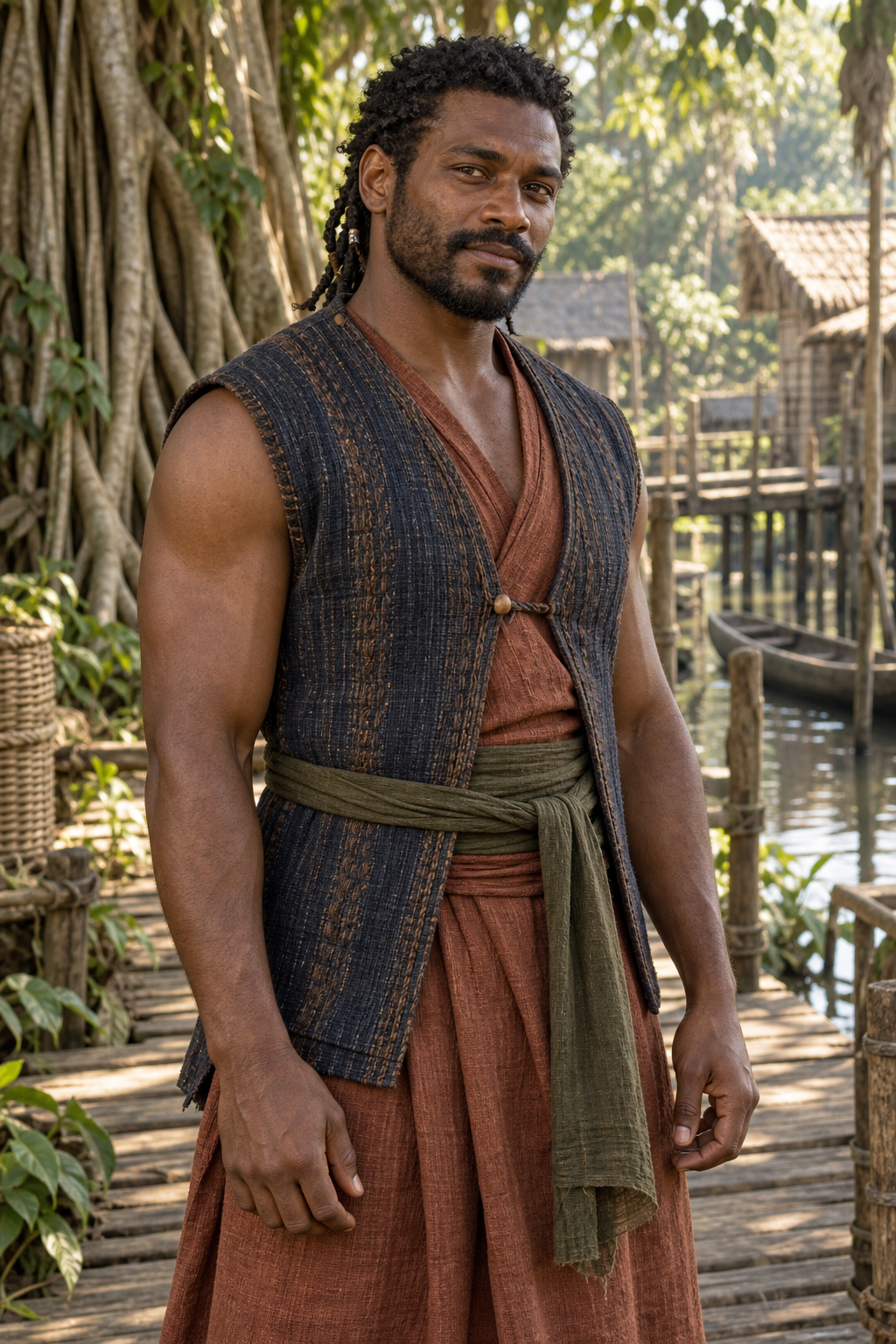
The completed ledger does not provide a defensible inventory of Younger Mogahib’s age, coloring, facial structure, build, clothing, or distinctive marks. Art must not copy Tiamak, turn him into a generic swamp villager, or use the ghant injuries as a substitute for identity.
CVM depicts Younger Mogahib as an exceptionally attractive adult Wrannaman man around thirty-two, with a broad compact athletic build, rich dark-brown skin, deep warm-brown eyes, a strong rounded-square face, short dense black coils with several thin temple braids tied back, and a short neat beard and mustache. His indigo-brown, rust-clay, river-green, palm-fiber, and leather clothing grounds the approved living portrait in Village Grove without inventing rank or ritual costume. Preserve this exact face and body across pre-capture reference, ghant captivity, fevered rescue, death, and funeral imagery. Horror may alter condition; it cannot erase personhood.
Book 3 · To Green Angel Tower, Part I
Rescue returns the body, but not enough time
Village Grove
An empty settlement leaves one survivor inside the enemy’s machinery
Tiamak reaches Village Grove and finds tree houses, stilt houses, boats, market baskets, food, and possessions still present. Communal spears and conflict weapons are gone, proving a hurried collective flight rather than slow abandonment. He searches for Elder Mogahib’s house and does not return.
The ghants capture Tiamak, bind him, move his boat, and carry him conscious into their nest. They had already used Younger Mogahib in the same manner. The captive is forced out to retrieve a carved mirror shard for Tiamak, making one prisoner part of the apparatus controlling another.
After rescue, Tiamak confirms Younger Mogahib also survived the nest. Physical escape does not end the damage. Younger Mogahib develops fever, repeats the same visions of ghant apocalypse, and dies rigid on the third night. He was Tiamak’s last known connection to the people of Village Grove; his death leaves their fate unresolved.
The funeral
Tiamak refuses false praise and refuses abandonment
Tiamak wraps the body in oil-palm fronds and burns it on a raised pyre. He invokes She Who Waits to Take All Back, She Who Birthed Mankind, and They Who Watch and Shape. The rite returns a Wran death to Wran language after the ghants tried to turn human beings into instruments.
Tiamak and Younger Mogahib were not friends. The funeral does not require him to lie. He pauses until he finds honest goodness: the dead man respected his elders and did not stint when his feast was due. Tiamak asks the others to join the response, “Do not let him drift by.” Truth and mercy share the pyre.
The People and Community Around Him
Even a sparse record carries obligations
Tiamak
They were not friends. Tiamak’s honest funeral becomes more meaningful because affection is not required for dignity.
Elder Mogahib
The family name connects Younger Mogahib to Village Grove’s elders and to the community Tiamak expected to find.
Village Grove
He becomes its last confirmed survivor and then its unanswered question. His death prevents easy knowledge of where the others went.
The ghants
They use his body and mind within a coordinated system, then leave him carrying visions that continue after physical rescue.
Why He Matters
The dead deserve accuracy, not instant sainthood
Younger Mogahib matters because the saga gives Tiamak an ethical task after tactical rescue fails. He cannot save the man, recover the village, or honestly praise a friendship that never existed. He can refuse to let the dead drift away unnamed.
The funeral also sets a standard for exhaustive fandom coverage. A character does not need royal blood or a long speech to deserve a canonical place. Named suffering, community connection, and remembered goodness are enough.
The Empty Village
Village Grove disappears through evidence of interrupted life, not a convenient explanatory note
Tree houses and stilt houses remain. Boats, market baskets, food, and possessions remain. The scene does not resemble a settlement dismantled through planned migration. Communal spears and weapons used for conflict are missing, pointing toward hurried collective flight.
Younger Mogahib becomes significant inside that absence. He is not introduced through ordinary village life and then captured in front of the reader. He appears as the last confirmed survivor after the community has become a question. His body carries contact with the force that helped empty the place, but fever and death prevent him from turning that contact into a complete account.
The profile must not answer what the novel leaves unresolved. It cannot claim the villagers reached safety, died, joined another settlement, or were all taken by ghants. The missing weapons support purposeful departure; they do not reveal destination or outcome. Younger Mogahib’s death closes the most immediate human route to that knowledge.
Captivity as a System
The ghants do not merely attack; they coordinate bodies, boats, vines, and visions
Tiamak’s capture supplies the clearest reconstruction. Ghants ambush him, bind him with vines, move his boat, and carry him conscious into the nest. Younger Mogahib has already been used within the same machinery. The creatures force him out to retrieve a carved mirror shard for the newer captive.
That action is more disturbing than an ordinary predator encounter. The ghants preserve enough control over one human being to make him perform a task inside another person’s imprisonment. Younger Mogahib is simultaneously survivor, captive, tool, and warning of what may happen to Tiamak.
Physical removal from the nest does not end the assault. Both men carry ghant-apocalypse visions. Tiamak wakes lucid and physically unwounded, but believes his ka was close to destruction. Younger Mogahib develops fever, repeats the visions, becomes rigid, and dies on the third night.
The shared imagery suggests a connected process without supplying a complete mechanism. This profile does not diagnose poison, possession, psychic transmission, infection, or divine attack as settled fact. It records coordinated captivity, persistent visions, unequal recovery, and death.
Two Mogahibs
A shared name connects community without collapsing elder and younger into one record
The ledger distinguishes Younger Mogahib from the older village elder associated with Tiamak’s communal duty. Older Mogahib participates with Roahog and other elders in sending Tiamak toward Nabban with the Summoning Stick. Younger Mogahib is the captured survivor later found through the ghant nest.
The exact family relationship is not established strongly enough to invent a father-son genealogy. “Associated with the Mogahib family” is the safe canonical statement. Shared name and village connection matter; imagined kinship does not become fact because it would make the story tidier.
Separate canonical profiles protect both identities. The elder belongs to the political decision that turns Tiamak’s drylander education into communal service. The younger belongs to Village Grove’s disappearance, ghant captivity, failed recovery, and funeral. Filtering can place both on the Book 3 shelf without merging their actions or artwork.
The Funeral’s Honesty
Respect becomes more credible when it refuses to counterfeit affection
Tiamak says plainly that he and Younger Mogahib were not friends. The admission does not degrade the dead man; it prevents ritual praise from turning him into a fictional version more convenient for grief. Tiamak waits until he can name goodness he actually remembers.
Younger Mogahib respected his elders and did not stint when his feast was due. These are communal virtues, modest and specific. They suggest obligation honored through behavior rather than a grand hidden nobility discovered only after death.
The raised pyre, oil-palm fronds, invocations, and collective answer return the man to Wran practice after ghants used him as an instrument. “Do not let him drift by” asks witnesses to participate. Tiamak does not perform mourning alone for an audience of outsiders; he teaches the company the response required to hold one life in place long enough to release it.
The ceremony also marks Tiamak’s own survival. He believes another day or hour in the nest might have destroyed his ka. Conducting the funeral means standing beside the outcome he escaped. Gratitude and survivor grief share the fire without requiring him to claim a friendship that never existed.
What Survives
The record retains a person even when the witness cannot deliver exposition
Younger Mogahib never provides the explanatory speech a plot summary might want. His value is not measured by how efficiently he solves Village Grove. The surviving facts establish a community member with obligations, a difficult relationship to Tiamak, captivity, visions, fever, death, and remembered goodness.
His canonical page also prevents the ghant storyline from becoming purely Tiamak’s trauma. Someone else was already inside the nest. Someone else was used to retrieve the mirror shard. Someone else came out and did not recover. Naming him distributes the cost beyond the protagonist who continues.
Art follows the same ethic. Captivity, fever, and death are milestones affecting this one locked Wrannaman identity, not excuses to create anonymous horror imagery. The approved healthy Village Grove portrait is the permanent baseline for every later scene.
On the Record
Scope, spoilers, and evidence limits
This is Younger Mogahib’s one canonical full-spoiler profile for Book 3 and the franchise directory. It is grounded in the completed owned-edition ledger. No duplicate book-specific profile should be created.
Visual state: approved editorial reconstruction. One canonical attachment now powers featured image, hero, directory card, and social metadata. The ledger does not support the reconstructed appearance specifics, so they remain disclosed as CVM choices; later captivity, rescue, death, and funeral art must preserve this exact identity without inventing a father-son relationship to Elder Mogahib or an individual death action.