
Memory, Sorrow, and Thorn · Canonical Character Profile
Chiya
Chiya is a named Sitha member of the hidden party entering Asu’a. The surviving record gives her one decisive fact rather than a manufactured biography: when Likimeya asks others to fight outside as though no secret plan exists, Chiya accepts the danger inside.
At a Glance
A named fighter inside the route the armies must never reveal
- People
- Zida’ya of the Sithi
- Calling
- Member of the hidden Asu’a infiltration party
- Book scope
- Book 4, To Green Angel Tower, Part II
- Command
- Travels under the senior leadership of Likimeya and with Jiriki’s company
- Confirmed action
- Enters Asu’a by the concealed route while the siege holds attention outside
- Last confirmed status
- Alive at the final point where the ledger individually confirms her
The Visual Receipt
Identity must come before decoration
The completed ledger does not provide a defensible description of Chiya’s hair, eyes, face, age beyond adulthood, clothing colors, weapons, or physical distinction. Those blanks will not be filled by borrowing Aditu’s lavender hair, Likimeya’s copper braids, or a generic fantasy-elf template.
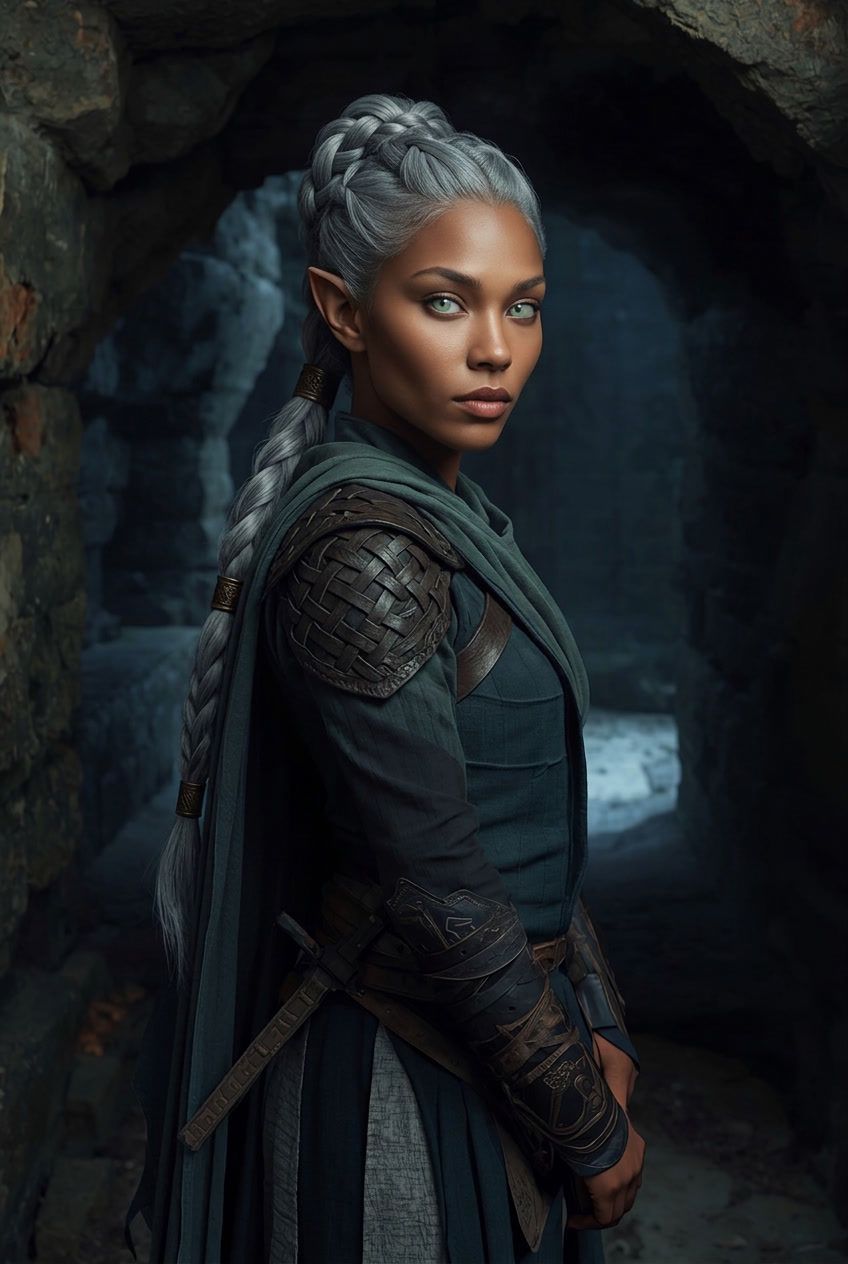
CVM’s approved editorial reconstruction presents Chiya as a breathtakingly beautiful adult Sitha woman with a distinct elongated face, deep mahogany-bronze skin, pale jade eyes, visibly pointed ears, cool silver-gray hair in a crown-to-long-braid structure, and practical midnight-teal infiltration layers. Canon supplies none of those exact visual specifics. This face, body, coloring, braid structure, clothing logic, and equipment are now fixed across every card or scene.
Book 4 · To Green Angel Tower, Part II
The secret plan requires people willing to disappear from the visible battle
The hidden route
Chiya enters the city while thousands fight as deliberate misdirection
Likimeya’s final strategy depends upon two equally dangerous efforts. The armies outside must fight the siege as though no other hope exists. A smaller group must use Sithi hidden ways and Camaris’s knowledge of the cliffs to enter Asu’a while defenders remain focused on the walls.
Chiya is named among that group with Jiriki, Likimeya, Aditu, Kira’athu, Kuroyi, and Tiamak. The company mixes royal leadership, warriors, healing knowledge, Witness knowledge, and mortal scholarship. Her inclusion establishes that the Gardenborn commitment is not symbolic support from a safe distance.
The ledger does not individualize Chiya’s later movements strongly enough to assign her Kuroyi’s death, Aditu’s explanations, Kira’athu’s healing role, or another fighter’s actions. Her profile therefore preserves the earned fact without stealing detail: she chooses the hidden danger and enters the haunted city.
The Infiltration Company
Context without invented intimacy
Likimeya
The Lady of Year-Dancing House proposes the strategy and enters personally, sharing the risk assigned to Chiya and the others.
Jiriki and Aditu
The siblings carry royal, historical, and hidden-road knowledge into Asu’a beside Chiya.
Kira’athu
The healer’s presence confirms that the company expects bodily consequences rather than a clean heroic passage.
Kuroyi
The fellow infiltrator dies holding Utuk’ku at the Pool. His fate establishes the danger Chiya also accepted.
Tiamak
The mortal scholar enters because evidence must be interpreted where it becomes physical. Chiya helps make that fragile presence possible.
The siege force
Everyone outside becomes visible cover for the hidden group. Chiya’s route exists because thousands accept a battle that cannot look like a distraction.
Why She Matters
Exhaustive coverage should preserve limits, not manufacture importance
Chiya matters because named participation is part of how the saga distributes risk. Likimeya, Jiriki, and Aditu do not enter Asu’a alone while anonymous followers vanish into “the Sithi.” Chiya is one of the people inside the collective noun.
A truthful profile also models what a fandom hub should do when the canon is sparse: identify the person, situate the action, connect the relevant stakes, and mark every unsupported detail as unknown. Longer is not automatically better when length comes from theft or invention.
The Mission Architecture
Entering Asu’a is one half of a strategy that depends on everyone outside believing the other half
The hidden party does not replace the siege. It depends upon it. Armies outside must keep fighting with enough commitment and visibility that defenders read the assault as the coalition’s real plan. Every casualty at the walls helps conceal the smaller route climbing toward the place where the swords and Ineluki’s design converge.
Chiya’s participation belongs to that double structure. She is not wandering into Asu’a independently or arriving as a last-minute reinforcement. Her movement is coordinated with senior Sithi leadership, mortal knowledge, Camaris’s remembered access, and the larger force’s deliberate misdirection.
The distinction protects the page from a familiar fantasy shortcut. A “secret team” is not automatically the only group doing meaningful work. Chiya’s party can move because thousands of other people accept danger without receiving the hidden mission’s knowledge or glamour. The inside and outside operations are mutually necessary.
Who Enters
The party’s composition is a compact map of what the final problem requires
Likimeya brings senior political authority and accepts the risk personally. Jiriki and Aditu carry royal lineage, lived relationships with mortals, and knowledge of Sithi ways. Kira’athu brings healing expertise. Kuroyi understands Witnesses and joins as warrior and council voice. Tiamak brings mortal scholarship and a body especially vulnerable inside the violence around him. Chiya is named beside them as a Sitha fighter.
The books do not assign Chiya the others’ specialties. She does not inherit Kira’athu’s diagnosis, Kuroyi’s Witness explanation, Aditu’s diplomacy, or Likimeya’s command merely because she stands in the same group. Her canonical role is participation within a deliberately mixed team.
That restraint lets the roster remain meaningful. The mission needs more than one royal face and a scholar. It needs additional trained bodies willing to protect movement, respond when the route becomes combat, and share danger that cannot be predicted precisely. Chiya’s name marks one of those bodies as a person.
Asu’a as Inherited Danger
For a Sitha fighter, the destination is not merely an enemy castle
Asu’a is the lost seat of Iyu’unigato, the city Ineluki defended, seized, and transformed through Sorrow before Rimmersman conquest scattered the survivors. Likimeya’s generation carries direct political memory of that catastrophe. Later Sithi inherit its absences, laws, grief, and unfinished war.
Chiya’s private relationship to that history is not recorded. The profile cannot claim she remembers the fall, belongs to a particular House, lost a named relative, or feels one precise emotion on entering. It can establish the shared historical field: she walks into a place where Sithi creation, mortal conquest, Norn power, and the Storm King’s return have accumulated.
This distinction matters because “haunted city” can become generic atmosphere. Asu’a’s danger is political and familial as well as supernatural. Chiya enters alongside the ruling branch that escaped its fall and against forces shaped by the same fracture. Her choice takes place inside history even when the books withhold her monologue about it.
Named Inside the Collective
The directory refuses to turn every supporting Sitha into interchangeable background beauty
Epic prose often compresses groups once action accelerates. “The Sithi” move, fight, summon, retreat, or die while a few familiar names carry the emotional focus. A complete fandom record must unpack that collective where the text supplies individuals without pretending every individual receives equal narrative development.
Chiya’s canonical profile is therefore an act of indexing, not inflation. Her name, people, adult status, mission, companions, scope, and last confirmed state are recorded once. The Book 4 directory can surface her through the same canonical post. No duplicate biography is required to make her visible in a volume-specific journey.
This model prevents later art from drifting. Chiya now has one approved identity, so every future group scene, filtered card, hero, and social image must preserve the same face, complexion, jade eyes, pointed ears, silver-gray braid structure, and midnight-teal equipment language.
What the Canon Does Not Say
Unknown is a meaningful status, not an invitation to fill the page with fanon
The completed ledger does not establish Chiya’s family, House, age beyond adulthood, rank, weapon, coloring, first military campaign, friendships, dialogue, wounds, private motive, or final postwar location. It does not individually narrate her death, so the profile cannot mark her deceased. It also does not carry her safely into an epilogue, so “alive at series end” would be too strong.
Her correct status is alive at the last individually confirmed appearance, with later outcome unknown. That phrasing is less dramatic than a fabricated resolution and more useful than vague “presumed alive” language. It tells readers exactly where evidence stops.
Depth here comes from explaining the mission, historical stakes, roster design, canonical identity model, and evidence boundary. None of that requires giving Chiya invented personality traits. A fandom hub becomes trustworthy by knowing when not to decorate silence.
On the Record
Scope, spoilers, and evidence limits
This is Chiya’s one canonical full-spoiler profile for Book 4 and the franchise directory. It is grounded in the completed owned-edition ledger. No duplicated profile should be created for the book-specific view.
Visual state: approved editorial reconstruction. The ledger supports an adult Sitha woman and Asu’a infiltrator but no specific coloring or facial inventory; those invented visual details are disclosed rather than presented as textual canon. The same canonical attachment powers featured image, hero, directory card, and social metadata.