
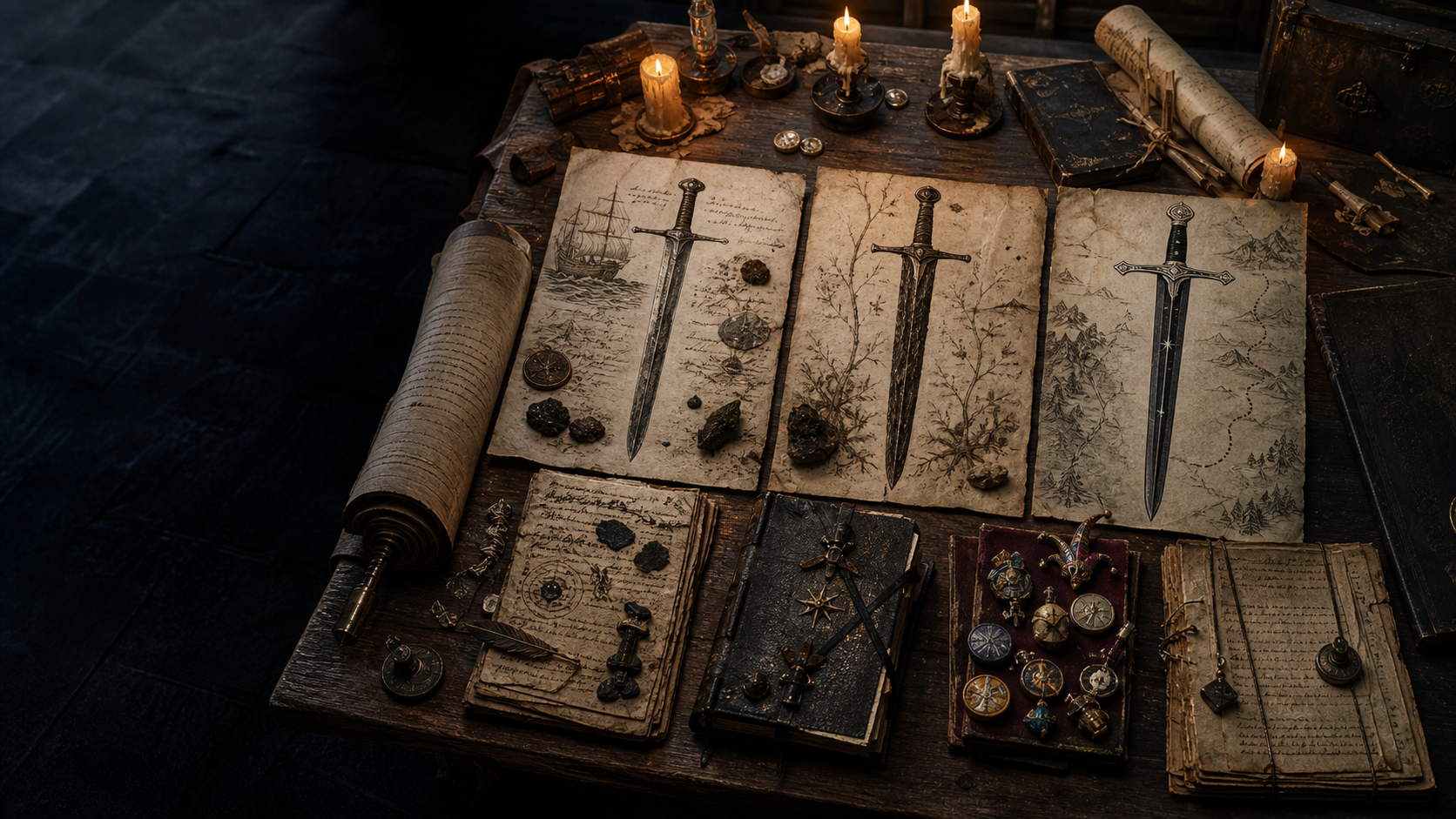
Three Swords, Five Evidence Types
The quest does not begin with one perfect prophecy. It becomes possible when five unequal kinds of evidence are finally allowed to argue with one another.
The objects
Memory, Sorrow, and Thorn are not interchangeable magic keys
Memory—Minneyar—is tied to sea-iron, a murdered smith, royal burial history, and Bright-Nail’s concealed identity. Sorrow—Jingizu—joins iron and witchwood inside Ineluki’s catastrophe and re-enters the present through Pryrates’s covenant. Thorn is black star-metal with a silver hilt, associated with Camaris, Colmund, northern loss, and a search route that must be reconstructed.
The material differences matter because the title is not decorative. Each sword carries a distinct history of making, custody, injury, and misnaming. “Bring the swords together” does not tell the characters what reunion will do, whether the blades can be trusted, or who should hold them.
The five evidence streams
Scripture, heresy, manuscript, memory, and ledger do different jobs
Canonical religious writing supplies one interpretive frame. Heretical counter-reading preserves what official doctrine excludes. League manuscript work connects prophecy to researched history. Towser’s oral memory supplies the human handoff no archive fully recorded. The ledger anchors names, custody, and material clues.
None is complete alone. Treating all five as equally direct would be sloppy; dismissing the weaker-looking forms would make the solution impossible. The breakthrough occurs because the investigators compare contradictions instead of choosing one authoritative voice and forcing every clue beneath it.
The operational result
Knowledge becomes a route only after social memory meets scholarship
Strangyeard, Jarnauga, Josua, Towser, Gutrun’s testimony, Morgenes’s preserved work, and Simon’s supposedly childish store of stories each hold a different piece. The sword quest is collective research under wartime pressure.
That is why Towser matters so much. Urgent men keep trying to hurry the old jester through the memory only he carries. The answer survives not because the institution cataloged every truth, but because somebody considered socially disposable remembered how Camaris entrusted Thorn to Colmund. The archive requires the fool.
On the record
Full-spoiler reading receipt
Return to The Dragonbone Chair hub → · Open every Book 1 Story 101 guides → · Open the series hub →