
What the Raed Actually Decides
Miriamele’s crown detonates the room, but the Raed is still an evidence hearing—not yet a tidy declaration of war.
Who is in the room
The Raed is a coalition meeting before it becomes a war council
The vast horseshoe of tables holds several interests that agree Elias is dangerous without agreeing what Josua should do about him. Bishop Anodis opens with an ill-tempered prayer. Baron Ordmaer, Ethelferth, Gwythinn, Devasalles, other lords and soldiers sit beside witnesses who do not carry noble rank, including Binabik and Simon. Lady Vorzheva is present as Josua’s Thrithings partner, not decorative court furniture.
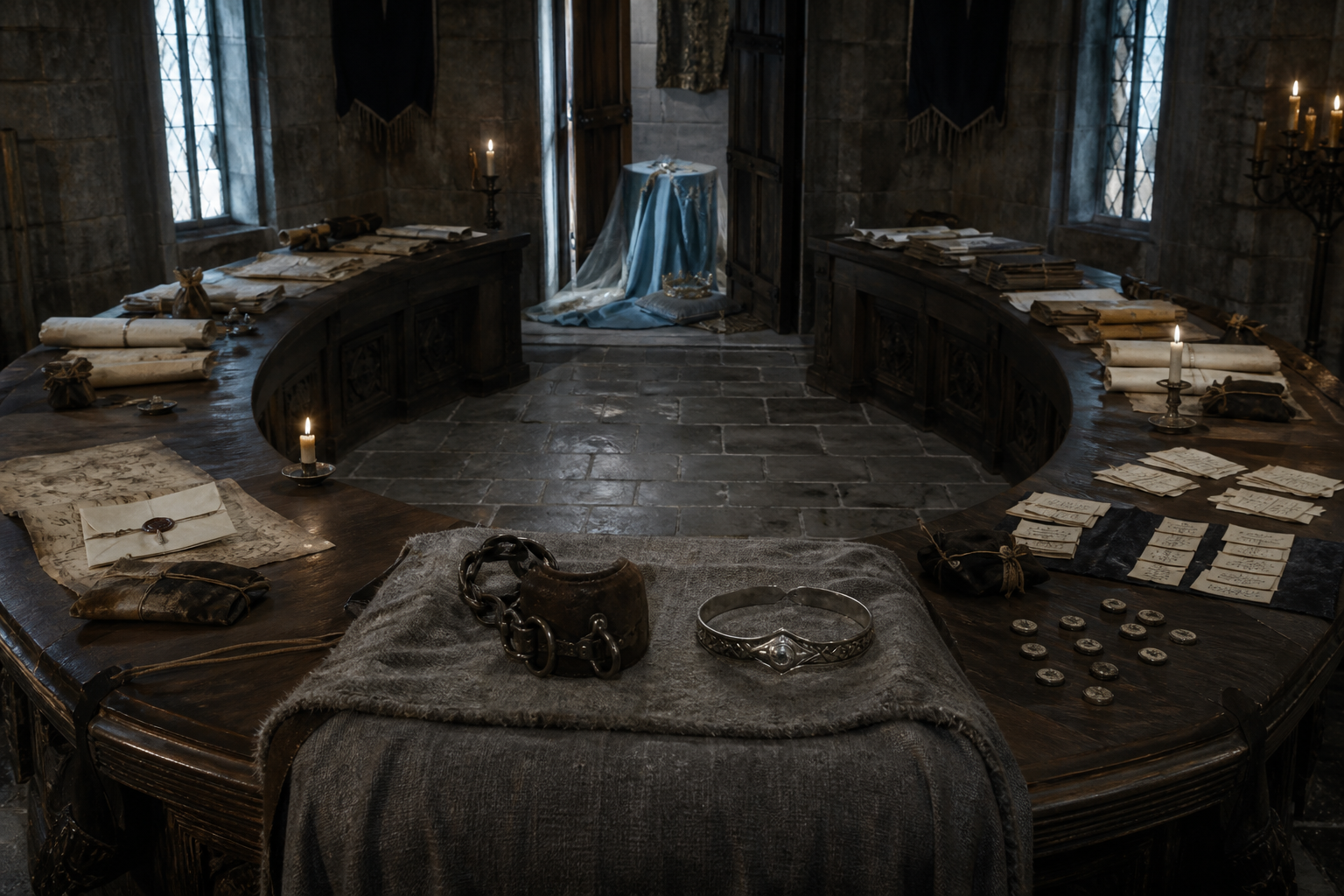
Josua stages his own body as evidence. He wears gray and a restrained silver circlet rather than presenting himself as a rival king, while the leather-capped prison shackle remains visible at his wrist. The shackle says Elias imprisoned him; the circlet says Josua still claims princely standing; neither object constitutes a vote to replace Elias. The room begins with shared alarm and incompatible preferred outcomes.
Claims and evidence
Accommodation, revenge, kingship, and war are questions—not decisions hiding in fancy clothes
Devasalles presses for the actual political objective: accommodation, revenge, or the throne. Gwythinn wants war. Josua answers more narrowly than either camp would like. He says he does not want kingship and would trade revenge for fair rule, but Elias has become dangerous and is sometimes reported mad. Then he draws the line responsible opposition requires: he will not begin a war on rumor alone.
That line determines why Miriamele matters. Josua introduces her as the messenger whose firsthand knowledge can be trusted. Her escape from the Hayholt and direct observation of Elias move claims about the king from tavern report toward admissible testimony. Simon and Binabik matter for the same reason: they have seen people, creatures, routes, and events the assembled lords have not. Rank can authorize a council. It cannot manufacture evidence.
What changes at the reveal
Marya becomes Princess Miriamele; the council does not magically become unanimous
Miriamele enters in sky blue with cropped golden hair beneath veil and crown, removing the dark-haired Marya disguise in the most public way possible. Politically, the reveal identifies Elias’s own daughter as a firsthand witness against the safety of his court. Emotionally, it destroys Simon’s understanding of their journey. He curses, flees in tears, and leaves before the hearing can use his testimony. Her wide, sad stare records the personal cost of Josua’s evidentiary theater.
What has the Raed actually decided at that point? It has decided to hear witnesses, test reports, and treat Elias as a danger serious enough to investigate and prepare against. Josua has stated what he does not seek. Gwythinn has demanded war; Devasalles has demanded clarity; Miriamele has been revealed. The scene has not yet supplied a clean collective declaration, campaign plan, or unanimous succession settlement. A crown enters the room. Consensus does not arrive tucked beneath it.
On the record
Full-spoiler reading receipt
Return to The Dragonbone Chair hub → · Open every Book 1 Story 101 guides → · Open the series hub →