
Drought, Plague, and the Refugees Outside the Hayholt
The crisis is not one curse. It is water, food, displacement, rumor, disease theory, policing, class, and a government choosing whose fear counts.
The material crisis
The drought becomes political through water, food, and labor
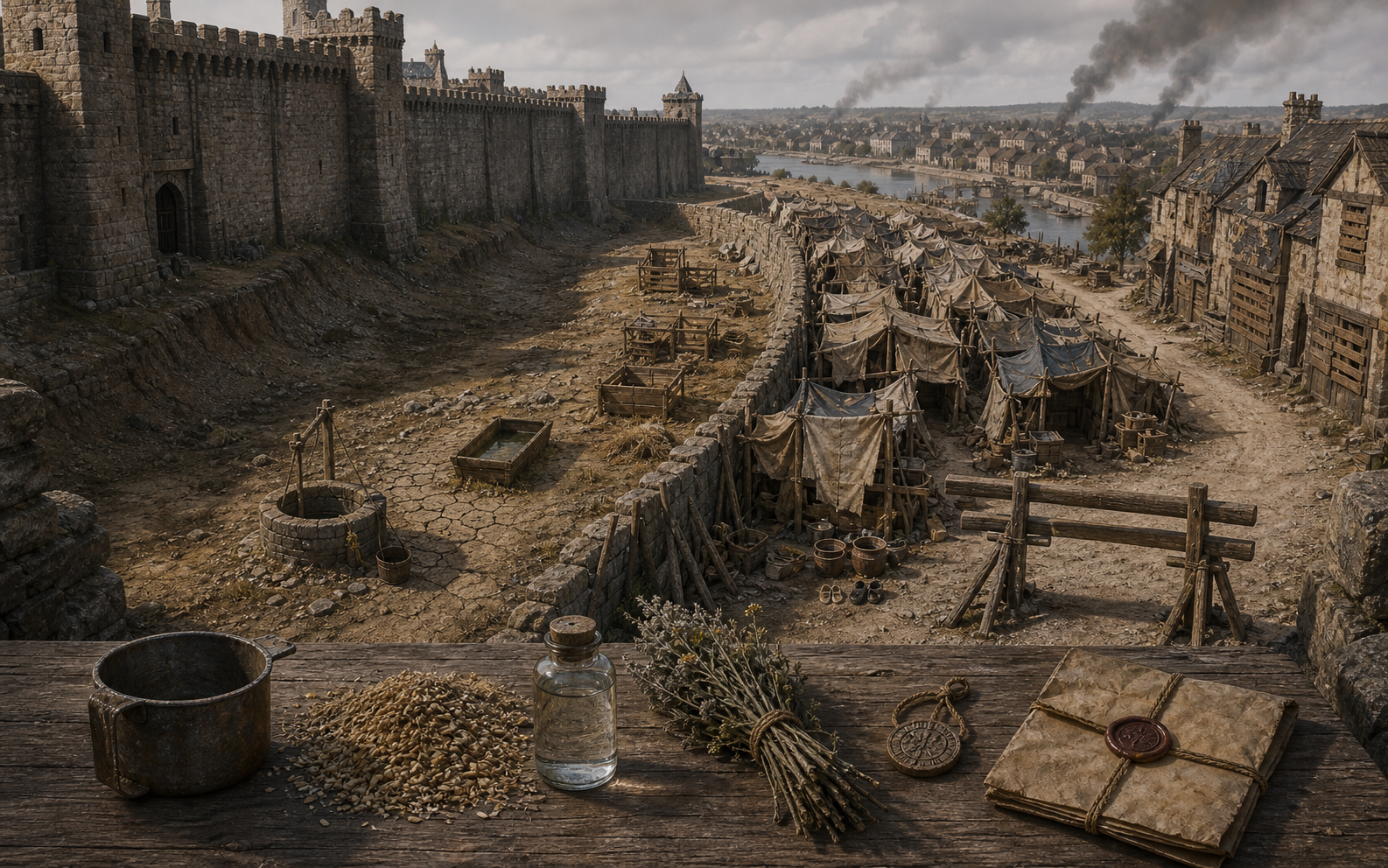
Book 1 establishes the shortage through ordinary receipts before it offers a complete supernatural explanation: no expected rain or snow, a visibly shrinking moat, threatened livestock, unsown crops, stressed wells, and a Kynslagh whose salty water cannot simply replace drinking supplies. Judith reads the crisis from the kitchen because feeding the castle forces weather to become arithmetic.
Scarcity is not evenly distributed. The court can extend celebration while servants calculate stores and people outside the walls lose shelter, water, and children. Drought creates the pressure; class determines who must experience that pressure as immediate emergency and whose inconvenience still gets called policy.
The displacement system
The wall turns protection into a boundary between recognizable and disposable need
Refugees build overlapping huts and tents against the Hayholt’s outwall, many of them women, children, and older men. They are physically close to royal protection and socially outside it. Jeremias expects the Erkynguard to remove them because the castle lacks water, converting a provisioning failure into a policing problem.
Simon crosses the boundary believing his own poverty makes him legible as a helper. The bereaved mother sees a king’s man. Both perceptions are true from different positions: Simon has little personal power, but the castle still marks him as belonging to the institution that can drive the settlement away. The scene explains why good intention cannot substitute for accountable access to resources.
The disease record
The Meremund plague is specific as testimony and uncertain as omniscient fact
Isaak relays reports of illness, accusation, sealing, prolonged cries, and houses later burned unopened. The chain runs through residence gossip, mayoral family, a friar, blacksmith, and chandler. That does not make the report useless. It means the guide must distinguish reported event, symptom, death estimate, proposed cause, and government response rather than presenting rumor as a laboratory finding.
Period explanations compete: poisoned wells, divine judgment, contagion, outsider blame, and other fears. None changes the ethical receipt that confinement without care becomes abandonment. Drought, displacement, and plague may interact through weakened bodies, crowded shelter, movement, and fear even before the novel proves one supernatural source. The responsible reading is systems-level: map what compounds harm, label what remains uncertain, and never let causal uncertainty erase the people subjected to coercive certainty.
On the record
Full-spoiler reading receipt
Return to The Dragonbone Chair hub → · Open every Book 1 Story 101 guides → · Open the series hub →