
STITCH! · SEASON 2 · EPISODE 25 · REACT
Stitch! Season 2 Episode 25: Stitch vs. Another Stitch
Stitch met the life that never received him, and a fight was never going to answer what he owed it.
The episode record before the portal closes
Episode: Broadcast Season 2, Episode 25
Japanese title: スティッチ vs. もうひとりのスティッチ
English card title: Stitch vs. Another Stitch
First Japanese broadcast: May 25, 2010
Runtime: 22 minutes
Series branch: Stitch! Itazura Alien no Daibōken
Japanese voices central here: Kōichi Yamadera as Stitch and Motoko Kumai as Yuna Kamihara
Where to watch: Apple TV Japan carries the official episode record. Availability changes by region.
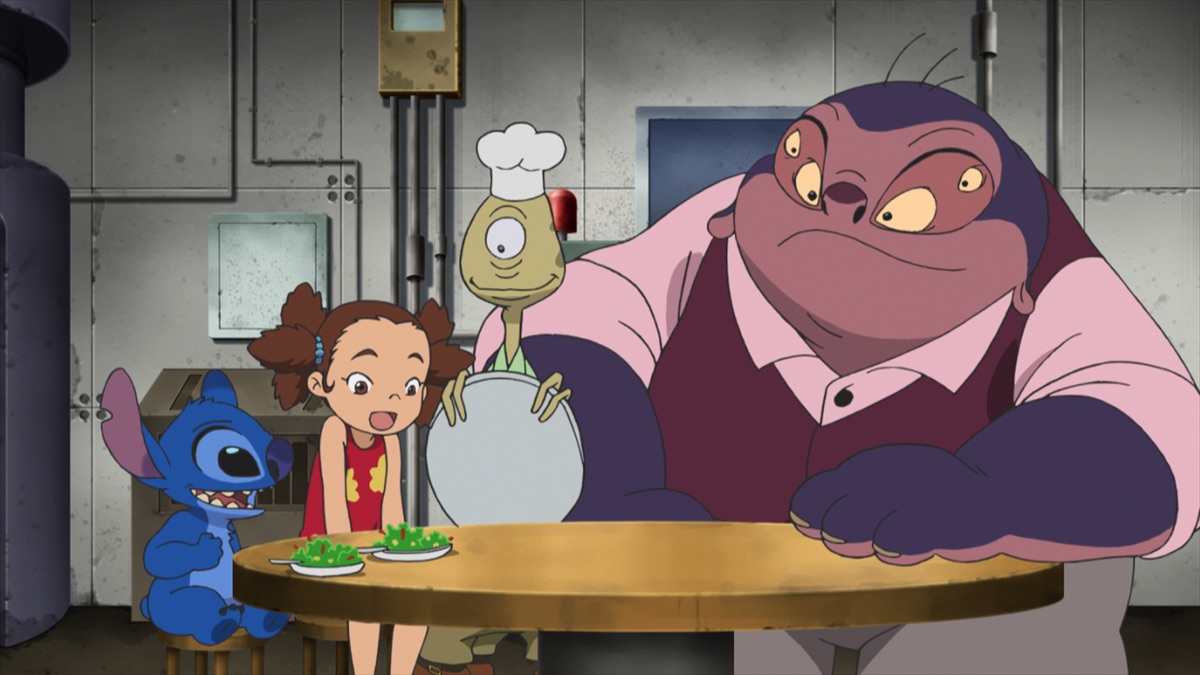
Yuna and Stitch enter a portal created by Experiment 272, Wormhole, and arrive in a parallel world. Another Experiment 626 exists there. This version lives alone and destroys the abandoned city around him with no family or community interrupting the purpose Jumba placed inside his body. Yuna and Stitch try to awaken a sense of ohana in him while their route home begins to close.
My first reaction: Stitch is fighting the life that never received him
The other 626 looks like an opponent because the episode needs movement, but he is also evidence. Stitch gets to see what raw destructive design looks like when no Lilo, Yuna, Nani, Obaa, Jumba, or community offers attachment strong enough to compete with it. The confrontation is not good Stitch versus bad Stitch. It is supported Stitch meeting abandoned Stitch.
That makes every punch uncomfortable in a useful way. Our Stitch cannot prove his growth by defeating the version who lacked the conditions that helped him grow. He has to offer those conditions while protecting Yuna and surviving long enough for the offer to mean anything.
The empty city is a wound before it is a playground
Another 626 destroys a city that appears abandoned. The absence of visible residents does not make the damage consequence-free. Buildings hold infrastructure, records, shelter, history, and evidence of why people left. Ruins can also conceal injured people who could not evacuate.
Yuna should treat the environment as an unresolved disaster scene. Before assuming the parallel Stitch drove everyone away, she and Stitch need to look for signs of evacuation, emergency broadcasts, food, footprints, and functioning systems. The story of the city affects what help is possible.
Calling him another Stitch risks erasing that he is his own person
Both characters are Experiment 626, but shared origin does not make either one a copy without identity. Their experiences, memories, choices, and relationships have diverged. Naming the parallel character only through our Stitch encourages comparison before understanding.
Yuna should ask what he calls himself, whether he understands language, and what he remembers. A chosen name could be the first possession no creator or enemy assigned to him.
Isolation can look like aggression when contact always arrives as threat
If every visitor has tried to restrain, study, punish, or defeat him, the parallel 626 has learned that approach predicts danger. His attack may combine destructive conditioning with an adaptive survival response. That history would not make it safe for Yuna to walk closer. It would change how she communicates.
Distance, visible hands, repeated nonthreatening signals, food placed without strings, and a clear retreat route could lower the pressure. Trust grows from predictable behavior, not one speech about family delivered during combat.
Yuna cannot promise ohana on behalf of a world she is leaving
Yuna wants to awaken family feeling in him, but the portal is closing and she intends to return home. Telling an isolated being that he can belong and then disappearing may repeat abandonment under kinder language. She needs to be honest about time, limits, and what connection she can actually sustain.
A truthful promise might be smaller: we will not hurt you, we will learn your name, we will try to establish a stable route or contact, and we will not leave without explaining. Reliability matters more than emotional grandeur.
Stitch should share his history without turning it into a recipe
Our Stitch can explain that he also destroyed things, mistrusted people, and was treated as a weapon. Lilo and Yuna did not erase his instincts. They gave him relationships in which different choices produced belonging. That story offers evidence that change is possible.
It cannot become a demand that the parallel 626 follow the same sequence or deserve the same family only after behaving correctly. Support should not be a prize held behind obedience. Safety boundaries remain, but care must begin before perfection.
Wormhole created the crossing and needs protection from both sides
Experiment 272 is more than transportation. Its ability creates access between worlds, which makes it vulnerable to anyone seeking escape, invasion, resources, or alternate versions of people. Jumba should not treat Wormhole like a door that can be forced open until the plot finishes.
Wormhole needs consent, rest, and clear information about the strain involved. If the portal closes naturally, keeping it open may injure the experiment or destabilize both environments. Rescue planning should never convert a living being into expendable infrastructure.
The closing portal creates urgency without canceling responsibility
Yuna and Stitch have a right to return home. Remaining indefinitely in an unknown world could strand them and endanger everybody waiting on Izayoi Island. At the same time, rushing out after provoking contact could leave the parallel 626 more distressed and destructive than before.
They need an exit threshold and a handoff plan. If they cannot bring him safely, they can leave supplies, a communicator, location markers, and a promise tied to a specific method of return. Emergency departure should preserve the possibility of future care.
Bringing the parallel 626 home would require consent and quarantine
The compassionate impulse may be to pull him through the portal. He may not understand the destination, and Izayoi Island is not prepared for a second 626 with unknown health, equipment, and triggers. Rescue without consent can become relocation by force.
If he chooses to travel, Jumba should arrange medical screening, a low-stimulation arrival space, and separate identity records. He should never be expected to replace Stitch, compete for Yuna, or prove gratitude for being removed from his world.
Our Stitch may feel threatened by somebody who shares his origin
Another 626 challenges more than physical dominance. Stitch’s uniqueness has shaped his relationships and self-image. Seeing the same body attached to different memories may stir jealousy, fear of replacement, or shame about the destructive capacity he still carries.
Yuna should reassure Stitch without demonizing the parallel version. She can say that relationships are specific and cannot be copied. Caring about another 626 does not divide Stitch into less family.
The parallel Jumba deserves scrutiny for what happened after creation
A lone 626 destroying an abandoned city points back toward the person who made him. Did parallel Jumba disappear, reject him, lose control, or remain nearby while avoiding responsibility? Creation imposes duties that do not vanish when the creation becomes difficult.
Yuna and Stitch should search for laboratory records and messages before writing the entire world as a failed personality test for 626. Systems and adults leave fingerprints on isolation too.
A destroyed city needs survivors centered in any recovery plan
If residents escaped, they may fear returning while 626 remains active. Their safety and accounts matter. They should not be ordered to accept him because our Stitch changed under different circumstances. Forgiveness cannot substitute for housing, repairs, medical care, and credible protections.
A mediated process could separate immediate containment from long-term reintegration. The parallel 626 deserves humane support. Survivors deserve control over proximity and timing.
Containment should reduce harm without recreating a cage
Physical restraint may be necessary if attacks continue and the portal team cannot retreat safely. The least restrictive effective option should be used, monitored, and ended as soon as danger falls. Pain, humiliation, and sensory deprivation would teach the exact lesson Yuna is trying to undo.
Jumba can design barriers that provide space, food, communication, and visibility rather than a box built only for control. A safe environment should help the parallel 626 regulate, not wait for his next explosion.
Ohana is a practice, not a word that overrides fear
The franchise can use ohana like an emotional master key. This episode needs more. Family means showing up repeatedly, telling the truth, setting boundaries, repairing damage, and refusing to discard someone when their needs are inconvenient.
The parallel 626 has no reason to believe the word after one encounter. He can understand its meaning only through what Yuna and Stitch do when he is frightened, aggressive, boring, injured, or unable to return affection.
The two Stitches need a moment without an audience or contest
Combat frames every difference as a ranking. A quiet exchange could reveal imitation, curiosity, shared sensory preferences, or recognition that language cannot reach during a fight. Neither needs to win that moment.
Stitch might offer an object he values or demonstrate a calming ritual Yuna taught him. The parallel 626 could refuse. Respecting the refusal would itself show that this contact differs from capture.
Parallel worlds do not make consequences disposable
Stories sometimes treat another universe as a playground because the main characters can leave. Damage remains real to whoever lives there. Yuna and Stitch cannot abandon broken structures, injured beings, or new conflict on the assumption that their own timeline is the only one that counts.
Before exiting, they should document what happened, minimize new damage, and leave contact information that does not expose Wormhole to exploitation. Ethical travel means accepting that every world is somebody’s home.
Jumba needs a protocol for duplicate experiments
A second 626 raises identity, medical, legal, and safety questions that improvisation cannot answer. Records should distinguish origin worlds without reducing either person to a serial number. Medical care needs to account for possible biological differences. Custody cannot default to whichever Jumba appears first.
The protocol should also prohibit testing one version against another. Their shared design makes comparison scientifically tempting and personally degrading. Neither exists to validate the other.
A communicator would matter more than another speech before departure
Yuna and Stitch have minutes before the portal closes. They cannot compress years of trust into that window, but they can leave a tool that gives the parallel 626 agency after they go. A communicator with pictures, recorded messages, and a clear signal for requesting contact would turn their promise into something he can use rather than something he must remember.
The device should not function as surveillance. He needs an obvious power switch and an explanation of what information it sends. Jumba can provide a separate emergency channel if the city becomes dangerous. Continued connection should begin with consent instead of hiding observation inside a gift.
The parallel 626 may grieve after learning another life was possible
Meeting our Stitch does not automatically inspire hope. It may reveal everything the parallel version did not receive: a name, friends, protection, guidance, and people who returned after conflict. That comparison could deepen anger before it opens possibility. Yuna should not demand gratitude for showing him the contrast.
Grief needs room without becoming permission to attack. He may need distance, sensory regulation, and somebody trained to stay present while he processes loss. Change can begin with mourning the life that should have been offered earlier.
Our Stitch should carry the encounter home as responsibility, not guilt
Stitch did not create the parallel world or cause the other 626’s abandonment. Endless guilt would center his feelings and provide no support across the portal. Responsibility gives him something concrete to do: remember, return, prepare resources, and make sure Jumba cannot dismiss the other experiment as an anomaly.
He can also examine how easily he judges experiments who are earlier in the same struggle. The encounter should make his compassion more patient without asking him to tolerate violence toward Yuna.
What the episode gets right
The premise turns Stitch’s development into visible contrast. Viewers can see that love did not uncover a secretly perfect creature. Relationship gave a designed destroyer enough safety and meaning to practice becoming someone else. That makes his growth earned and his responsibility real.
The episode also lets Yuna carry the moral argument into unfamiliar territory. Her loyalty is tested when the face she trusts appears without the history that earned trust.
What I wanted pushed further
I wanted more evidence about the abandoned world and the parallel 626’s daily life. Loneliness becomes sharper through routines: where he sleeps, what he protects, whether he collects remnants of residents, and what he does when nobody is available to fight.
I also wanted the ending to establish a concrete return plan. Ohana should not become a beautiful promise stranded on the wrong side of a closed portal.
The receipt I am keeping
The receipt is Stitch meeting the accusation hidden inside every redemption story: somebody with his body and design did not receive his luck. He cannot answer by winning. He has to acknowledge the relationships that made another future possible.
My second receipt is Yuna trying to call family into existence while the doorway home is closing. The word means less than whether she leaves a route back.
Final verdict
“Stitch vs. Another Stitch” uses a parallel-world fight to ask whether identity lives in design, choice, or relationship. Its strongest answer is that all three matter, but none of them makes abandonment inevitable or harmless.
A responsible ending protects both Stitches, respects Wormhole, supports any survivors, and creates a concrete path for continued contact. The parallel 626 does not need to become our Stitch. He needs the conditions to discover who he can be.
Keep watching
Return to Season 2 Episode 24 or open the complete Stitch! episode directory.