
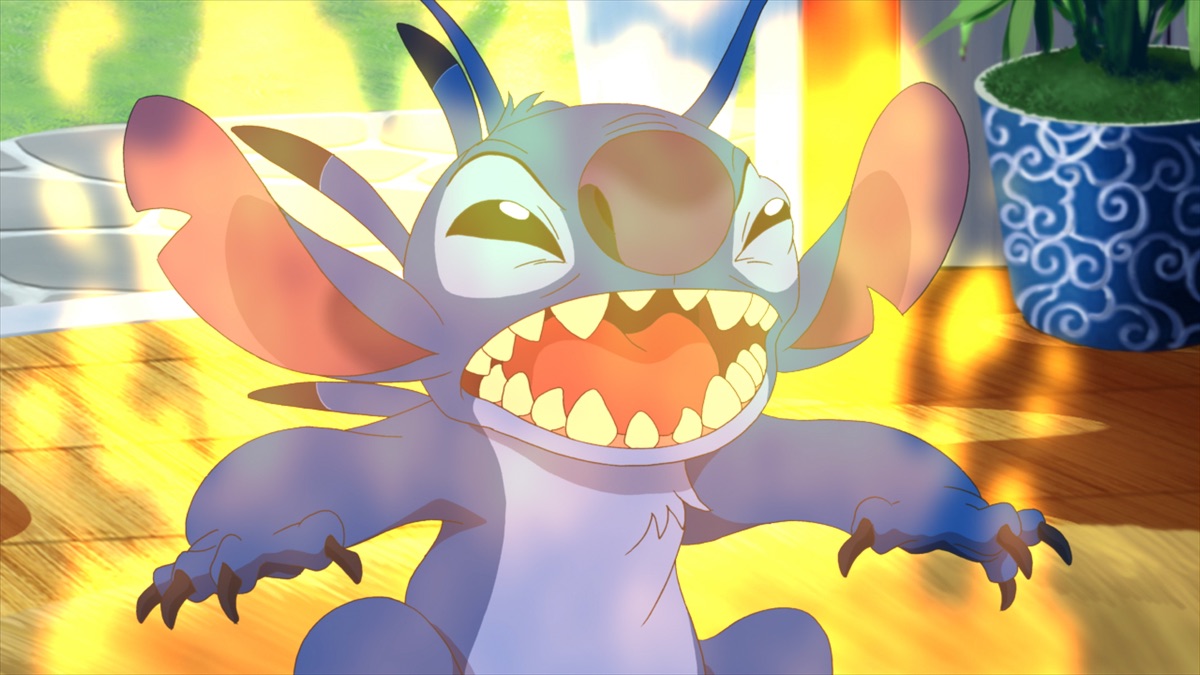
STITCH! · SEASON 2 · EPISODE 15 · REACT
Stitch! Season 2 Episode 15: The Strongest Rival in Love
627 dressed like a prince. Hämsterviel dressed an operation like romance. Angel was still the person who got to choose.
The episode record before the prince starts lying
Episode: Broadcast Season 2, Episode 15
Japanese title: スティッチ危うし!恋の最強ライバル
English card title: The Strongest Rival in Love
First Japanese broadcast: February 9, 2010
Runtime: 22 minutes
Series branch: Stitch! Itazura Alien no Daibōken
Japanese voices central here: Kōichi Yamadera as Stitch, Motoko Kumai as Yuna, and Hiromi Han as Angel
Where to watch: Apple TV Japan carries the official episode listing. Availability changes by region.
Stitch has been fumbling in front of Angel and losing confidence when Experiment 627 appears. Jumba built 627 after Stitch and made him stronger. Hämsterviel sends him into the situation disguised as a human prince. He brings Angel into a castle, surrounds her with jewels and dancing, and wins her attention through a carefully staged identity. Stitch recognizes a trap and fights his old rival, but 627 later saves Stitch and Angel from being crushed by Hämsterviel’s ship.
My first reaction: Angel is not a trophy between two experiments
The episode frames 627 as Stitch’s romantic rival, which makes the conflict easy to read and immediately irritating. Angel is a person making choices under false information. Stitch’s insecurity and 627’s mission matter, but neither gives them ownership over her attention. Whoever defeats the other in combat does not win a girlfriend.
The real problem is deception. Angel is responding to a prince who does not exist, in an environment engineered by Hämsterviel. She cannot give informed consent to a relationship when the other person’s identity, purpose, and danger are concealed. Stitch needs to protect her from the operation without treating protection as proof she belongs to him.
Stitch’s insecurity begins before 627 enters the room
Repeated mistakes in front of Angel leave Stitch feeling inadequate. He interprets each awkward moment as evidence that he is losing value. That makes the polished prince terrifying because 627 seems to embody everything Stitch thinks Angel wants: strength, confidence, wealth, manners, and a dramatic setting.
Yuna should help Stitch separate embarrassment from rejection. Angel can be annoyed by a mistake without deciding he is worthless. Confidence cannot depend on outperforming every possible rival. If Stitch believes affection survives only while he remains the strongest option, every social interaction becomes a competition he must control.
The prince disguise is identity fraud with a ballroom
627 does more than dress well. He creates a false social identity to gain access and trust. The castle, jewels, and dance support the lie by providing status signals Angel is expected to read as safety and legitimacy. Hämsterviel weaponizes romantic storytelling itself.
Angel deserves the truth before she decides whether she enjoys 627’s company. His origin as an experiment would not automatically disqualify him. Stitch is an experiment too. The disqualifying behavior is presenting a fabricated person while secretly advancing an enemy’s plan.
Jewels are not evidence of character
The episode uses gifts to contrast 627’s polished courtship with Stitch’s clumsy affection. Expensive objects can be generous, manipulative, stolen, or strategically deployed. Their meaning depends on source, intent, and whether the recipient can refuse without consequence.
Angel may genuinely enjoy the jewels and dance. Enjoyment does not make her shallow, nor does it prove she prefers wealth to Stitch. People can like a beautiful experience and still reject the liar who arranged it. The story should not punish her for responding to a situation designed to charm her.
Stitch needs to warn Angel without insulting her judgment
A jealous warning often sounds like control: he is bad, I know better, come with me now. Angel may resist because Stitch has offered no evidence and appears threatened by another person’s attention. He should state what he knows about 627, name Hämsterviel’s involvement, and give her a clear exit route.
Respecting Angel’s agency does not require leaving her inside a dangerous deception. It means sharing facts, avoiding ownership language, and protecting her immediate safety while preserving as many choices as the crisis allows.
Yuna can see the operation more clearly than the rivalry
Yuna is less invested in proving which experiment is stronger. She can ask practical questions: who owns the castle, how did the prince arrive, why does Jumba recognize him, and what does Hämsterviel gain? Those questions turn a romantic spectacle back into an evidence problem.
She can also stop Stitch from blaming Angel for being fooled. Sophisticated deception works because it imitates familiar signals of trust. Responsibility belongs to the people who designed the lie. Angel’s task after learning the truth is deciding her response, not apologizing for failing to detect a covert operation instantly.
Jumba created the comparison haunting Stitch
627 exists because Jumba built another experiment after Stitch and made him more powerful. That history gives the rivalry a parental wound. Stitch is not merely facing a romantic competitor. He is facing evidence that his creator tried to surpass him, as if he were an obsolete model.
Jumba owes Stitch an honest conversation about why 627 was created and why greater strength does not determine personal worth. Treating the fight as entertaining sibling competition ignores the fear underneath it. Stitch needs reassurance grounded in relationship and accountability, not another claim that he will always be Jumba’s favorite.
627 is also a person trapped inside somebody else’s comparison
Being labeled stronger than Stitch reduces 627 to a metric. Hämsterviel then uses that metric as leverage, sending him to defeat, humiliate, or replace the earlier experiment. His prince disguise may offer temporary access to an identity valued for charm rather than destructive capacity.
That does not excuse deceiving Angel. It does explain why his eventual rescue matters. Saving Stitch and Angel becomes a choice outside Hämsterviel’s script and outside the rivalry Jumba created. For one moment, 627 acts as more than the stronger replacement.
Hämsterviel turns romance into operational cover
The scheme works because romantic privacy discourages interruption. A prince invites Angel to a castle, and questioning the gesture can look jealous or rude. Hämsterviel exploits the social rule that courtship belongs to the couple, even when one participant is operating under a false identity.
The island needs a safety culture where people can check in without shaming the person on the date. Angel should have independent transportation, a way to contact Yuna, and information about the location. These precautions protect autonomy rather than restricting it.
The fight cannot decide what Angel wants
Stitch and 627 have a physical history, and the confrontation may be unavoidable once the trap becomes violent. The outcome can decide immediate safety. It cannot decide Angel’s relationship. She gets to respond after the truth is known and the danger ends.
If Stitch wins and expects affection as a reward, he repeats the ownership logic behind the rivalry. If 627 wins, strength still does not validate the deception. Combat resolves power. Conversation resolves trust.
627 saving them disrupts the easy villain label
When Hämsterviel’s ship threatens to crush Stitch and Angel, 627 saves them. The act contradicts the plan and places their lives above his assignment. It does not erase the disguise or manipulation, but it creates evidence that he can choose against his handler.
The story should let accountability and moral change coexist. 627 can deserve recognition for the rescue and still owe Angel the truth. Redemption becomes credible through repeated choices, not one heroic gesture that purchases instant forgiveness.
Angel deserves the final conversation with 627
The most important exchange after the rescue belongs between Angel and the person who deceived her. She can ask which moments were planned, whether any affection was genuine, and why he followed Hämsterviel. She decides whether she wants future contact.
Stitch should not answer for her or demand punishment on her behalf. Supporting Angel means staying available, respecting privacy if she wants it, and accepting an answer that may be more complicated than total hatred.
Stitch does not become safe merely because 627 was worse
Episode 14 already showed Stitch trying to alter Angel’s feelings with Hunkahunka. Now he confronts another character manipulating her through identity and spectacle. The parallel should make him uncomfortable. He and 627 use different tools, but both become tempted to manage Angel’s choice.
Stitch can grow by recognizing the pattern rather than declaring himself the good option by default. He needs to earn trust through honesty, apology, and respect. A worse rival cannot complete that work for him.
Angel can enjoy romance and still demand truth
The dance, castle, and jewels may appeal to Angel. The story should not frame those preferences as moral failure. Romance can be theatrical, luxurious, and fun when everybody knows who arranged it and can leave freely.
Her standards do not need to shrink so Stitch feels secure. He can learn what she enjoys without copying a false prince or bankrupting himself. A thoughtful gesture built on knowledge will mean more than a spectacle built on surveillance and lies.
After the rescue, 627 needs protection from Hämsterviel too
Defying Hämsterviel may place 627 at risk of retaliation, confinement, or reprogramming. The group should not send him back merely because he began as an enemy. They can secure him, assess immediate danger, and offer a path away from coercive control while maintaining safeguards.
Support does not require unrestricted trust. Jumba can monitor his abilities, Angel can set no-contact boundaries, and the island can document the deception. Rehabilitation works through structure, not sentimental amnesia.
The castle needs to be treated as a crime scene
Once the disguise collapses, the setting may contain surveillance, traps, stolen property, communication equipment, or evidence of Hämsterviel’s wider plan. Leaving after the romantic climax wastes information and may expose somebody else later.
Jumba and local authorities should secure the site, identify how Angel was transported, and determine whether any substances or technology affected her judgment. A charming environment can still be operational infrastructure.
The rescue does not answer whether 627 felt anything real
627’s decision to save Stitch and Angel raises a question the assignment cannot settle neatly. He may have developed genuine concern for Angel, rejected Hämsterviel’s willingness to kill them, acted from pride, or simply refused to watch another experiment die. Several motives can exist together. The uncertainty is healthier than forcing the act into a romantic confession.
Angel can acknowledge the rescue without deciding that it proves his courtship was sincere. A person may perform one brave act and still have manipulated someone earlier. She needs time and facts, especially because 627’s false identity shaped every private moment. Gratitude should never become a debt payable through affection.
Stitch also needs to resist reading the rescue as a challenge. If 627 helped because he cares about Angel, that feeling does not create a claim on her. If he helped because he has a conscience, Stitch should welcome the moral choice. Either way, the next step belongs to Angel and 627’s accountability, not another duel.
What Stitch can learn about being chosen
Stitch has spent much of his life being measured by function. Jumba built him to destroy, 627 was built stronger, and enemies repeatedly reduce both of them to capability. Romance triggers the same wound when Stitch believes Angel will choose whoever presents the better specifications. He needs to learn that relationship is not product comparison.
Angel knows his chaos, habits, failures, and capacity for repair. If she chooses him, the choice comes from that history rather than his ability to outperform a prince. If she does not choose him, defeating 627 cannot change her answer. Stitch’s worth survives either outcome because no partner should become the sole judge of whether he deserves to exist.
That lesson could make him a safer partner. He can stop treating every attractive stranger as an emergency and start asking whether the relationship itself has honesty, reciprocity, and room for both people. Security grows from repeated evidence, not removing all competition from the island.
What the episode gets right
The episode complicates 627 beyond raw strength. His rescue proves that the experiment introduced as Stitch’s superior can make a moral choice his handler did not order. That is more interesting than another battle deciding which creation punches harder.
It also exposes Stitch’s insecurity without making Angel responsible for curing it. He must face the fear that somebody more polished could replace him and decide whether love means competition or trust.
What I wanted pushed further
I wanted Angel’s perspective to control more of the ending. She is courted under a false identity, placed in danger, and rescued by the same person who deceived her. That combination deserves anger, confusion, and questions rather than a quick return to the rivalry between the men.
I also wanted Jumba to confront the damage created by ranking 627 against Stitch. He built both experiments and left them to carry a hierarchy that Hämsterviel exploits. Creator accountability belongs beside romantic accountability.
The receipt I am keeping
The receipt is 627 holding up the ship that would crush Stitch and Angel. He has the physical power Jumba designed and uses it for a choice Hämsterviel did not want. Strength becomes meaningful only when attached to agency.
My other receipt is the castle. Everything looks like romance until the source of the production becomes visible. A beautiful setting can support love, but it cannot manufacture honesty.
Final verdict
“The Strongest Rival in Love” works when it stops asking which experiment deserves Angel and starts asking what each one does with power. Stitch must warn without owning her. 627 must face the deception inside his courtship. Angel must receive the truth and keep control of the answer.
The rescue gives 627 moral possibility, not a clean slate. Stitch’s loyalty gives him emotional credibility, not possession. Romance survives the episode only when rivalry gives way to consent, evidence, and choices that no fight can settle.
Keep watching
Return to Season 2 Episode 14 or open the complete Stitch! episode directory.