
STITCH! · ORIGINAL SERIES · EPISODE 5 · REACT
Stitch! Episode 5: The Mysterious Electric Alien
Izayoi saw a monster. Stitch recognized a cousin. Hämsterviel knew he had kidnapped a person and used him like equipment.
The episode record before Hämsterviel starts calling coercion a plan
Episode: 5
Japanese title: 謎の電気ビリビリ・エイリアン
English card title: The Mysterious Electric Alien
Original Japanese broadcast: October 29, 2008
Production branch: Stitch!, first Japanese television season
Japanese voices central here: Kōichi Yamadera as Stitch and Shōzō Iizuka as Jumba
Where to watch: Check the official Disney+ catalog in your region, then verify the Japanese production title because streaming card order may differ.
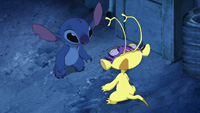
Hämsterviel watches Stitch from a laboratory in space and assumes the good deed counter will lead him to ultimate power. He takes a captured yellow electric life-form, fits him with a device that forces obedience, and orders him to steal the counter. Izayoi experiences the resulting electrical attacks as a ghostlike invasion. Yuna and Stitch go hunting for the supposed monster. During the confrontation, Stitch recognizes that the attacker is one of his experiment cousins. The mystery changes immediately: the threat is also a captive person being used as equipment.
My first reaction: the villain put a shock collar on a cousin and the town called the victim a ghost
The episode wants the electric attacks to feel spooky before the reveal. Fine. What makes the plot hurt is the direction of misidentification. People see frightening behavior and name the controlled person as the danger. Hämsterviel remains distant, clean, and largely invisible. The experiment’s body carries the evidence, absorbs the response, and becomes the object everyone wants removed. The controller gets to look like a strategist while the victim looks like a monster.
That pattern is bigger than this franchise. Systems often punish the person whose distress is visible instead of the person or institution producing it. A child melts down and gets labeled disruptive while the coercive environment disappears. A worker resists and becomes difficult while exploitation remains normal. The electric cousin attacks, so Izayoi organizes around stopping him. Nobody on the ground can see the device or the laboratory. Context is the difference between defense and rescue.
Hämsterviel treats personhood as a technical inconvenience
Hämsterviel does not persuade the experiment. He does not negotiate, threaten openly, or offer a choice. He installs obedience. The “bad child headband” language makes control sound corrective, as if the device fixes behavior rather than overrides autonomy. That naming is part of the abuse. Institutions love gentle labels for violent functions. Compliance becomes treatment. Captivity becomes management. Forced labor becomes assignment.
The experiments are especially vulnerable because Jumba originally described them through purpose. Each one has an engineered ability and a number. Hämsterviel converts that design history into a supply catalog. Electric power means electric weapon. The person’s preference, relationships, fear, and right to refuse disappear behind utility. Stitch recognizes a cousin because he has lived inside the same category. The episode’s moral center begins when function stops being the whole identity.
The counter has become a target because metrics attract people who want control
Jumba built the counter as a teaching device. Stitch sees it as progress toward a wish. Hämsterviel sees it from a distance and assumes it contains or unlocks power. One object now carries three different meanings, none of which ask what the island tradition intended. The device becomes valuable because everybody believes the number can be converted into authority.
This is what metrics do in competitive systems. A measurement created to guide behavior becomes a status marker, a gate, or an asset worth stealing. The score begins directing the institution. Hämsterviel does not care whether Stitch has become kinder. He wants whatever reward sits behind the total. Once the counter can deliver domination, the language of goodness becomes camouflage for a power race.
Stitch recognizes family under hostile behavior
The reveal matters because Stitch has every reason to defend himself. Electricity hurts. The attacker is trying to take something central to his wish. Yet recognition interrupts the simple enemy story. This is one of his cousins. Shared creation history does not automatically produce affection, but it changes what Stitch understands about the attack. He knows Jumba’s experiments are treated as dangerous objects. He knows behavior can be designed, triggered, and manipulated.
Recognition should alter tactics. Defeating the body is no longer enough. The control device has to be removed, the coercion stopped, and responsibility traced back to Hämsterviel. That movement from combat to rescue is real moral growth. Stitch can remain angry about the harm while refusing to define the cousin by actions committed under forced control. Accountability begins with accurate agency.
Yuna enters a family history she did not create
Yuna sees an attacker before she learns the experiment system. She has no reason to know Jumba’s numbering, Hämsterviel’s capture network, or the earlier Hawaiian work of finding homes for cousins. The Japanese branch asks her to absorb an enormous inherited crisis because Stitch arrived on her island. Every returning experiment brings powers, relationships, villains, and unresolved responsibility into her home.
Her willingness to help matters, but the adults must not turn it into an obligation. Yuna is a child and host, not the Galactic Federation’s unpaid rescue department. Jumba created these lives. The Federation failed to establish protections. Hämsterviel exploits the gap. Stitch has family knowledge. Yuna can choose solidarity without becoming the person expected to solve a galaxy’s negligence every Wednesday afternoon.
The island calls him an obake because fear reaches language before facts do
From the community’s perspective, lights fail, electric danger appears, and an unseen force disrupts ordinary life. “Ghost” provides an available explanation. The label organizes fear, but it can also harden into a false identity. Once residents believe a supernatural threat is attacking them, every response begins from removal rather than inquiry. The controlled experiment loses personhood before anyone sees his face.
Stories need mystery, so I am not angry that the episode stages one. I am watching how the resolution repairs the label. If the island learns the truth, the victim deserves to be named as a person who was controlled. If only Yuna and Stitch know, public memory may preserve him as a monster. Rescue includes narrative repair. The community should understand what happened instead of keeping the frightening version because it makes a better rumor.
A control device does not erase every consequence, but it changes responsibility
Coercion complicates harm without making the damage imaginary. People were frightened. Property or infrastructure may have been affected. Stitch was attacked. The victim can participate in repair after liberation if he chooses and is able. That participation should never be framed as proof that he was equally responsible for the controller’s plan.
Agency exists on a spectrum when someone acts under force. The device appears to override choice directly, placing responsibility heavily on Hämsterviel. If moments of resistance remain possible, they show courage rather than guilt for every moment resistance failed. The episode should avoid a cheap apology where the experiment accepts blame so everybody else can move on. Liberation must come before moral judgment.
The rescue team also owes him recovery time. Removing a control device does not instantly restore trust in his body, memory, or surroundings. He may remember attacking people while being unable to stop. He may fear that another command can take him again. He may distrust Jumba because the same scientific culture that created his power made the device imaginable. Safety requires more than one victorious fight. It requires information, choice, medical care, patient relationships, and proof that nobody will install a different form of obedience after declaring it benevolent.
Jumba’s responsibility does not end because Hämsterviel is worse
Hämsterviel is the immediate abuser, but Jumba created a population with specialized destructive abilities and left them vulnerable to capture, activation, resale, and control. The franchise often treats his change of heart as full rehabilitation. I do not. Loving Stitch later does not erase the system that made every cousin exploitable. He owes protection, records, consent-based care, and repair to all of them.
Episode 5 should hit Jumba personally. Another creation is being used precisely as designed, against his will, by a man who understands Jumba’s old logic too well. Hämsterviel is not an unrelated evil. He is a customer for the worldview that treats sentient experiments as programmable tools. Jumba’s redemption becomes real only when he dismantles that worldview inside his own language and practice.
The good deed is rescue, not possession
Stitch may earn counter progress by saving his cousin. The episode needs to keep the action from becoming another transaction. The cousin is not a point dispenser. His liberation matters even if the counter breaks, the Chitama Stone refuses, or nobody praises Stitch. That is the test Episode 2 established. Does another life matter outside the reward system?
Rescue also cannot end with reassignment. Earlier franchise stories often find a “one true place” where an experiment’s ability becomes useful. That can be loving when the person chooses it. It becomes another form of control when family simply assigns a socially acceptable job. The electric cousin deserves safety, choice, and the right to use or refuse his power. Freedom is more than switching employers.
He also deserves relationships that do not begin with gratitude debt. A rescued person does not owe permanent loyalty, cheerful recovery, useful labor, or easy forgiveness to the rescuer. Stitch can save a cousin because saving him is right. The cousin may still need distance, anger, or a home elsewhere. ʻOhana becomes coercive when belonging is offered with an invisible contract. Real family leaves room for refusal and return.
Hämsterviel weaponizes the language of bad behavior
Calling the control object a bad-child device frames obedience as moral improvement. The experiment becomes “good” when he follows Hämsterviel and “bad” when he resists. This is the inverse of the good deed counter, but both devices translate behavior into an external judgment. One awards points. The other forces compliance. Neither can understand conscience.
The parallel should make viewers suspicious of every machine that claims to measure goodness. Jumba’s counter is gentler, but it still places authority outside Stitch. Hämsterviel’s device reveals the endpoint of that logic: the evaluator decides acceptable behavior and the subject’s own reasons become irrelevant. Ethical teaching should increase a person’s capacity to choose. Control technology eliminates the choice and keeps the appearance of order.
The electric power is part of him, not the explanation for him
The episode title identifies the cousin through electricity because that is the mystery’s visible feature. Character coverage must go further. An ability can shape experience without becoming personality. A person who generates electricity may fear touch, enjoy power, hate being used as infrastructure, or have preferences unrelated to voltage. The franchise becomes richer when experiment functions stop acting like complete biographies.
Stitch understands this personally. Destruction is his engineered function, but it does not describe every choice he makes. Recognizing the same gap in a cousin is a form of solidarity. He can see the attack as programmed use rather than essential nature. That recognition should extend to every experiment the series brings back.
What the episode gets right
Episode 5 connects the new season engine to the older experiment mythology without making Izayoi feel like a random stop. Hämsterviel wants the counter. Yuna and the island experience the threat. Stitch recognizes family. The story creates a bridge between Japanese folklore-shaped episodes and the science-fiction personhood conflict at the franchise’s core.
The reveal also changes genre productively. What begins as ghost hunting becomes a rescue from technological coercion. The scary figure is not secretly harmless, because real harm occurs. He is secretly unfree. That distinction asks more from the heroes than winning a fight. They must identify the controller, remove the mechanism, and revise their understanding of the person in front of them.
What I need the series to remember
The cousin needs a life after liberation. Hämsterviel’s control should have consequences beyond one defeat. Jumba should face his role in creating exploitable bodies. Yuna should be allowed to set boundaries around the danger imported into her home. The town’s monster story should be corrected. The counter should not turn rescue into a selfish points transaction.
Most of all, the franchise must keep separating ability from destiny. Electric power does not make someone a weapon. Destructive design does not make Stitch a destroyer forever. A control device can force behavior without rewriting personhood. Family recognition begins when the heroes refuse to confuse what a body can do with what the person owes.
Final verdict
“The Mysterious Electric Alien” is the first Japanese-branch episode to bring Hämsterviel’s created-person abuse directly onto Izayoi. The mystery works because the visible threat hides an invisible controller. Stitch’s recognition of a cousin breaks the monster narrative and turns combat toward rescue. That is exactly the moral move this franchise should make.
I am keeping the episode’s unfinished receipts. Liberation needs follow-through. Jumba owes more than concern. Yuna cannot become unpaid galactic crisis staff. The cousin deserves a name, choices, and a future beyond useful electricity. Hämsterviel wanted a programmable weapon. Stitch’s best good deed is refusing to let the person disappear inside the function.
Keep watching
Return to Episode 4, open the Stitch! anime hub, or continue to Episode 6: Angel, Angel, Angel when published.