
Memory, Sorrow, and Thorn · Canonical Character Profile
Ithineg the Harper
Ithineg is the harper at the center of a Hernystiri tale Cadrach tells Simon over meat and ale in Flett. The book gives the story one irresistible label—“Ithineg and his long, long night”—and Simon finds it hilarious enough to be slightly scandalized that a man of the cloth would tell it. No, the novel does not give us the missing bedroom logistics. We are not making them up.
At a Glance
The harper whose entire surviving adventure is a title, a laugh, and Simon’s raised eyebrows
- Name
- Ithineg
- Role
- Harper
- Tradition
- Hernystiri story figure
- Known tale
- Ithineg and his “long, long night”
- Book 1 storyteller
- Brother Cadrach
- Audience reaction
- Simon is vastly amused and slightly shocked
- Scene
- The Dragon and Fisherman inn at Flett
- Status
- Story or legendary figure; life and death status unrecorded
A Story Told at Flett
Ithineg enters while Simon is hungry, hunted, lonely, and desperate to believe a familiar face
Simon meets Cadrach again during the Belthainn festival at Flett.
The boy has escaped the Hayholt, crossed the forest alone, slept outdoors, and learned that royal law can display a poacher’s corpse as a warning. Hunger and isolation make recognition feel like rescue.
Cadrach buys meat and ale and begins telling stories.
Ithineg belongs to that temporary pocket of warmth. The harper’s “long, long night” helps turn the inn from a dangerous public room into a place where Simon can laugh.
The context matters because Cadrach’s hospitality is real at the level of immediate experience even while his identity and intentions remain unstable. Simon eats. He drinks. He hears a good story. He relaxes enough to stop scanning every face.
That relaxation later leaves him vulnerable when Cadrach’s purse proves empty and the friar abandons him to the innkeeper’s debt.
Ithineg does not cause the betrayal. The story becomes part of how trust is built before it fails.
A canonical profile should connect the harper to this social function without turning him into Cadrach’s accomplice or a person who literally appears in Flett.
“Ithineg and His Long, Long Night”
The title promises everything; the narrative gives us nothing past the audience reaction
The owned Book 1 text identifies Ithineg as a harper and associates him with a “long, long night.”
The repetition is comic. Whatever happened lasted, escalated, or felt prolonged enough to become the tale’s memorable hook.
Simon’s slight shock suggests adult, bawdy, irreverent, morally questionable, or otherwise non-devotional material. It does not tell us which.
The night might involve romance, sex, drink, gambling, deception, travel, music, danger, supernatural trouble, or a ridiculous combination. None of that is confirmed.
The page must not invent lovers, taverns, instruments, beds, curses, dawn escapes, or a punch line merely because the title begs for them.
That restraint does not make the profile boring. The missing body of the story is itself evidence about worldbuilding technique.
Tad Williams lets a title and reaction imply a much larger oral culture beyond the plot. People in Osten Ard know stories the reader receives only as names. Those fragments make the world feel inhabited rather than exhaustively explained.
Ithineg is canonical as the central figure of such a tale. The contents remain unavailable.
Simon Laughs—and Then Wonders About the Friar
The boy’s reaction tells us the story’s tone more securely than any invented plot summary could
Simon is vastly amused by Ithineg’s tale.
He is also a little shocked to hear such a story told by a man of the cloth.
Those two responses provide the best surviving genre labels. The story is funny. It crosses some boundary Simon associates with clerical behavior.
Simon is fifteen, raised largely among Hayholt workers and shaped by Rachel’s discipline, chapel life, servants’ stories, and limited formal understanding of the wider world.
His shock should not be treated as an objective obscenity rating. It reveals his expectations as much as the tale.
Cadrach’s willingness to tell it helps him appear lively, worldly, and companionable. He is not performing the solemnity Simon expects from a friar.
The laughter matters after chapters of fear. Simon briefly experiences pleasure without immediately converting it into destiny, prophecy, or training.
Ithineg’s story therefore provides emotional relief while participating in a larger trust scene. It lets the reader feel why Simon wants Cadrach to be safe company before the contradictions return.
Cadrach Is the Source
A wonderful storyteller can be entertaining, evasive, generous, drunk, frightened, and dishonest in the same afternoon
The narrative calls Cadrach a wonderful storyteller despite a Hernystiri burr that sometimes makes him difficult for Simon to understand.
He tells the Ithineg tale while food and ale soften the room.
That makes his performance canonical. It does not make him an infallible folklorist.
Cadrach has already used inconsistent religious identities. In Flett he claims the Granisian order after previously naming another affiliation. He later produces an empty purse, blames a supposed act of charity, and runs when payment becomes unavoidable.
Those lies do not automatically make Ithineg fictional inside Osten Ard. The appendix and manifest preserve Ithineg as a named story figure. They do require source awareness.
Cadrach may tell a well-known tale faithfully, embellish it, adapt it for a young audience, or exploit its popularity to build rapport. The text does not compare his version with another.
The profile should say “Cadrach tells” rather than “this is exactly what happened.”
That phrasing preserves both pieces of characterization: Ithineg belongs to shared culture, and Cadrach’s relationship to truth is complicated long before the reader understands his full history.
The Harper Inside the Harper’s Tale
Occupation is the one solid identity detail—and it carries its own cultural weight
Ithineg is called a harper.
The title connects him to performance, music, memory, and itinerant or courtly storytelling traditions without specifying which version applies.
The record does not say he composed the tale, narrated his own adventure, played during it, served a ruler, traveled professionally, or owned a particular harp.
We should not treat every harper in Osten Ard as one institution. Sangfugol’s court experience does not automatically define Ithineg’s life. Hernystiri music at the Taig does not provide a costume sheet for a story figure from an unknown era.
Still, the occupation makes the tale self-reflexive. A storyteller named Cadrach tells Simon about a professional performer whose personal adventure became story.
Ithineg’s art may be unrelated to the long night’s events, or it may be the reason the tale survived. The text does not choose.
A future Story 101 page on songs, harpers, and oral memory can connect Ithineg to Eoin-ec-Cluias, Towser, Sangfugol, and Hernystiri tradition while keeping every person’s evidence distinct.
Red Hathrayhinn Is the Neighboring Tale
Cadrach’s repertoire contains more than one scandalous or adventurous story
The same Flett passage says Simon laughs hard at the adventures of Red Hathrayhinn and the Sithi woman Finaju.
That is a separate story.
Ithineg should not be merged with Red Hathrayhinn because both entertain Simon in one sitting. Finaju is not automatically part of Ithineg’s long night.
The grouping tells us about Cadrach’s repertoire and Simon’s mood. One storyteller moves through multiple named tales while the meal continues.
Each story figure receives one canonical profile because the names, roles, and story hooks are different. Their shared Flett context should produce links, not clones.
This distinction also prevents future art from turning all three figures into one crowded tavern scene that falsely suggests they met.
Connections
The storyteller, laughing listener, neighboring legend, and performance tradition around Ithineg
Brother Cadrach
Tells Ithineg’s “long, long night” at Flett and uses performance to create warmth and trust.
Simon
Finds the tale vastly amusing and slightly shocking from a supposed friar.
Red Hathrayhinn
Central figure in a separate adventure Cadrach tells during the same meal.
Finaju
The Sithi woman named with Red Hathrayhinn; she is not confirmed as part of Ithineg’s story.
Sangfugol
A present-day harper whose verified life demonstrates why Ithineg’s occupational title must not be inflated through borrowed details.
Eoin-ec-Cluias
Another remembered performance figure whose anger-song shows the range of stories carried through cultural memory.
Character Image Continuity
A charismatic harper, not a visual fanfic summary of the missing night
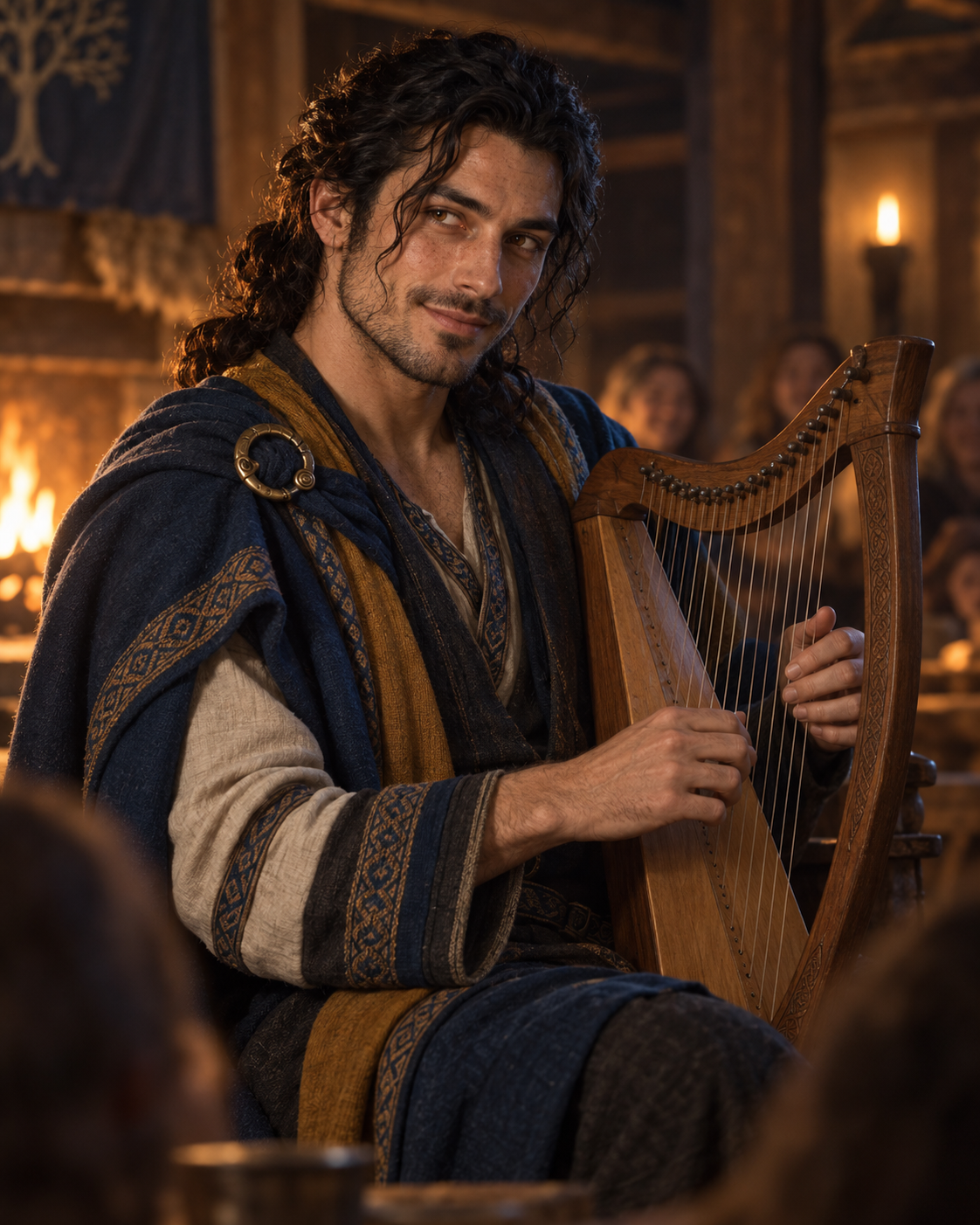
Visual state: approved Hernystiri story-figure interpretation. Ithineg now has one permanent interpretive identity, and this profile is published.
CVM depicts Ithineg as a breathtakingly attractive adult human harper around twenty-nine with a lithe expressive build, dark-amber eyes, warm olive-fair skin, shoulder-length black curls gathered at the nape, short black stubble, and a mischievous intelligent half-smile. Deep peacock-blue, muted-saffron, charcoal, aged-bronze bardic wool, a plain brooch, and one small wooden lap harp create an approved Hernystiri story-figure interpretation rather than a recovered canonical appearance.
Canon supplies no exact age, face, skin, hair, eyes, body, clothing, jewelry, instrument construction, era, companion, setting, or event from the long night.
The possessive “his” supports masculine pronouns in the story title, but it does not provide appearance.
The warm communal performance setting and harp communicate the confirmed role without pretending to reconstruct the adventure. Preserve this exact face, age, body, coloring, curls, stubble, wardrobe, brooch, and harp design across every future use. No bedchamber, lover, spilled wine, dawn escape, or supernatural encounter may be smuggled in as canon.
Ithineg must remain visually distinct from Sangfugol, Eoin-ec-Cluias, Towser, and Cadrach.
The same canonical attachment powers featured image, profile hero, directory card, social metadata, Flett story references, and any oral-tradition explainer. Every use must retain the story-figure interpretation label.
Why Ithineg Matters
He proves a fictional world can feel enormous without explaining every joke
Ithineg receives no direct action in the main plot.
His story still changes a scene.
It makes Simon laugh after hunger and fear. It makes Cadrach charming. It signals a bawdier or more irreverent cultural repertoire than the boy expects from clergy. It gives Osten Ard another remembered life outside kings, swords, and apocalypse.
The profile’s job is not to inflate Ithineg into a secret protagonist. It is to preserve every confirmed layer around the fragment and protect the missing story from fake certainty.
A one-line fandom wiki can list the name. This page explains why the name was worth printing.
On the Record
Book 1 story-within-story evidence, fully spoiled and firmly bounded
This is Ithineg the Harper’s one canonical, full-spoiler character profile.
The owned Kindle edition confirms that Cadrach tells Simon the tale of “the harper Ithineg and his long, long night” at the Dragon and Fisherman inn in Flett. Simon is vastly amused and slightly shocked that a man of the cloth would tell such a story.
The record confirms Ithineg’s name, masculine possessive in the tale’s phrasing, harper role, Hernystiri story classification, “long, long night” hook, Cadrach as Book 1 storyteller, and Simon’s reaction.
It does not confirm the night’s events, Ithineg’s appearance, exact era, family, location, companions, lovers, music, instrument design, conduct, status within his own story, later life, death, or whether Cadrach’s version is complete.
Status: story or legendary figure; life and death status unrecorded.
Visual state: approved Hernystiri story-figure interpretation. The portrait visualizes only charismatic harper performance and warm communal storytelling, not the missing contents of the “long, long night.” Every physical feature, garment, brooch, instrument detail, hall, listener, pose, and lighting choice is CVM interpretation. The same attachment powers featured image, hero, directory card, and social metadata.