
Memory, Sorrow, and Thorn · Canonical Devotional Profile
Murhagh One-Arm
Murhagh One-Arm is the Hernystiri god King Lluth thanks beside Brynioch after Eolair’s company discovers Skali’s raiders before they reach the Taig. The invocation does not erase the scouts. It tells us how a wounded king places mortal vigilance inside a sacred language of gratitude.
At a Glance
The god thanked when mortal scouts keep disaster from reaching the Taig unseen
- Name
- Murhagh
- Epithet
- One-Arm
- Culture
- Hernystiri
- Devotional role
- God invoked in gratitude
- Invoked with
- Brynioch
- Speaker
- King Lluth ubh-Llythinn
- Occasion
- Eolair’s company discovers Skali’s raiders before they reach the Taig
- Status
- Devotional and legendary figure; literal manifestation unverified
Lluth Gives Thanks
The invocation arrives inside a military report, not a miracle scene
Eolair returns after Skali’s surprise attack with a devastated company.
Five men remain able. Two are gravely wounded. Four are dead.
The scouts have nevertheless discovered the raiding party before it reaches the Taig.
King Lluth thanks Brynioch and Murhagh One-Arm.
The gratitude belongs to a moment where survival and loss occupy the same room. The enemy has been detected, but men have died and others may still die of wounds.
Murhagh’s name does not arrive as decorative mythology. It tells us how Lluth interprets the narrow prevention of a greater catastrophe.
The text does not show Murhagh appearing, speaking, guiding Eolair, turning a weapon, confusing Skali, healing the wounded, or causing the discovery.
The One-Arm Epithet
A canonical title gives one bodily fact and withholds every explanation
Murhagh is called One-Arm.
The epithet supports a devotional representation with one arm or one visible arm, but it does not explain how the condition arose.
The record does not confirm birth difference, amputation, sacrifice, punishment, battle injury, self-mutilation, exchange for wisdom, lost duel, ritual offering, or symbolic concealment.
It also does not identify which arm is absent.
No weapon, shield, tool, prosthesis, sacred object, clothing adaptation, or divine ability is attached to the epithet in this scene.
Disability cannot be used as automatic shorthand for brokenness, vengeance, sacrifice, or supernatural compensation.
Murhagh is invoked as a god worthy of thanks. One-Arm is part of the name by which Hernystir knows the figure, not an invitation to write an origin myth on the culture’s behalf.
Future art must be dignified, attractive, and explicit about interpretive reconstruction.
The Scouts Still Did the Work
Divine gratitude and mortal agency coexist without canceling each other
Eolair’s group discovers the raiding party.
The men travel, observe, fight, suffer wounds, and carry information back.
Lluth’s invocation places that outcome within Hernystiri belief. It does not transfer every action from the scouts to the gods.
This distinction matters for the dead. If the page says Murhagh simply “saved the Taig,” it erases the four men who die and the wounded survivors who make the warning possible.
It also erases Eolair’s political interpretation. Skali’s reach means Elias has placed a knife against Lluth’s back while preparing to strike Josua, forcing Hernystir to retain troops instead of reinforcing Naglimund.
The military consequence comes from evidence and judgment.
Murhagh’s devotional presence shapes gratitude. Mortal reconnaissance shapes what leaders know.
The two can coexist without the profile claiming a mechanism the narrative never shows.
Inside Hernystiri Religious Language
Murhagh belongs beside Brynioch without becoming interchangeable with him
Lluth thanks Brynioch and Murhagh One-Arm together.
Brynioch is separately identified as a Hernystiri sky god. The invocation does not automatically give Murhagh the same domain.
Shared worship does not mean shared powers, family, rank, iconography, feast days, priesthood, or mythology.
Murhagh must also remain distinct from Mircha, Rhynn, and other Hernystiri devotional figures.
The main narrative preserves a religious vocabulary larger than any one scene fully explains.
That is precisely why each figure receives one canonical page: connections can be organized without collapsing a pantheon into a generic list of “old gods.”
The profile records where Murhagh’s name is used, by whom, and for what emotional and political purpose. It leaves unsupported theology open.
Gratitude Under Siege
The invocation helps Lluth name what has not yet been taken
Hernystir is already under pressure.
Skali’s raiders threaten the Taig. Elias’s larger strategy isolates Josua’s allies. Lluth’s forces are stretched, his people are vulnerable, and Eolair returns with casualties.
In that setting, gratitude is not naïveté.
Lluth does not deny the danger or refuse strategy because he has thanked the gods. He recognizes that the raiders were found before reaching the royal center and then listens to what that discovery means.
Murhagh’s name belongs to a brief preservation inside continuing catastrophe.
The page should not convert that preservation into divine favoritism. The record does not explain why some scouts live, why others die, or how Hernystiri theology interprets unequal survival.
It only confirms the king’s response: thanks to Brynioch and Murhagh One-Arm.
No Verdict on the Fallen
Thanking a god for survivors does not classify the dead as abandoned
Four scouts die in the encounter and two return gravely wounded.
Lluth’s gratitude cannot be reversed into a judgment that Murhagh favored the five able men, rejected the dead, or measured anyone’s faith through survival.
The narrative gives no such theology.
Nor does it say the fallen failed in courage. Their company succeeds in bringing warning home at terrible cost.
Keeping the dead visible prevents devotional language from becoming a prosperity formula in which good outcomes prove worthiness and casualties imply divine disfavor.
The confirmed meaning is narrower and more humane: the Taig was warned, and a grieving, embattled king gave thanks.
What Is Not Confirmed
No portfolio, mythology, clergy, or manifestation can be reverse-engineered from one prayer
The invocation does not define Murhagh as a war god, scout god, protector of kings, healer, god of disability, god of luck, or guardian of the Taig.
Any of those associations would require additional evidence.
The record also does not identify temples, shrines, priests, offerings, festivals, prayers, holy texts, symbols, sacred animals, colors, relatives, rivals, or worship beyond Lluth’s spoken gratitude.
Nor does the scene prove that Murhagh literally hears or answers.
The belief is canonical. The thanksgiving is canonical. The favorable discovery is canonical. A supernatural causal chain is not demonstrated.
Connections
The king, sky god, scout, enemy, and threatened home around Murhagh
King Lluth
The Hernystiri ruler who invokes Murhagh in gratitude after Eolair’s report.
Brynioch
The sky god thanked beside Murhagh, without proof that their domains are the same.
Count Eolair
Returns with the surviving scouts and the evidence that Skali can reach the Taig.
Skali Sharp-Nose
The invading ruler whose raiders create the danger the scouts discover.
The fallen scouts
Four dead men whose cost must not disappear beneath a simplified miracle claim.
The Taig
The royal and communal center spared an unseen approach but not released from danger.
Why Murhagh Matters
One line of thanks reveals belief without replacing evidence
Murhagh matters because religious language is part of how Osten Ard’s people understand crisis.
Lluth’s invocation makes Hernystiri faith active in political life without turning the scene into a visible miracle.
The epithet also gives the pantheon bodily specificity while denying readers an easy explanation.
A shallow directory would reduce Murhagh to “one-armed god.” A careless one would invent a dramatic lost-arm legend and a war portfolio.
The canonical profile does something richer: it keeps the exact invocation, the casualties, the scout labor, the political conclusion, the paired god, the disability boundary, and every unresolved theological question in view.
Murhagh is culturally real, textually invoked, physically unwitnessed, and important because gratitude itself becomes part of Hernystir’s response to survival.
Image Continuity
Dignified devotional interpretation, never disability spectacle
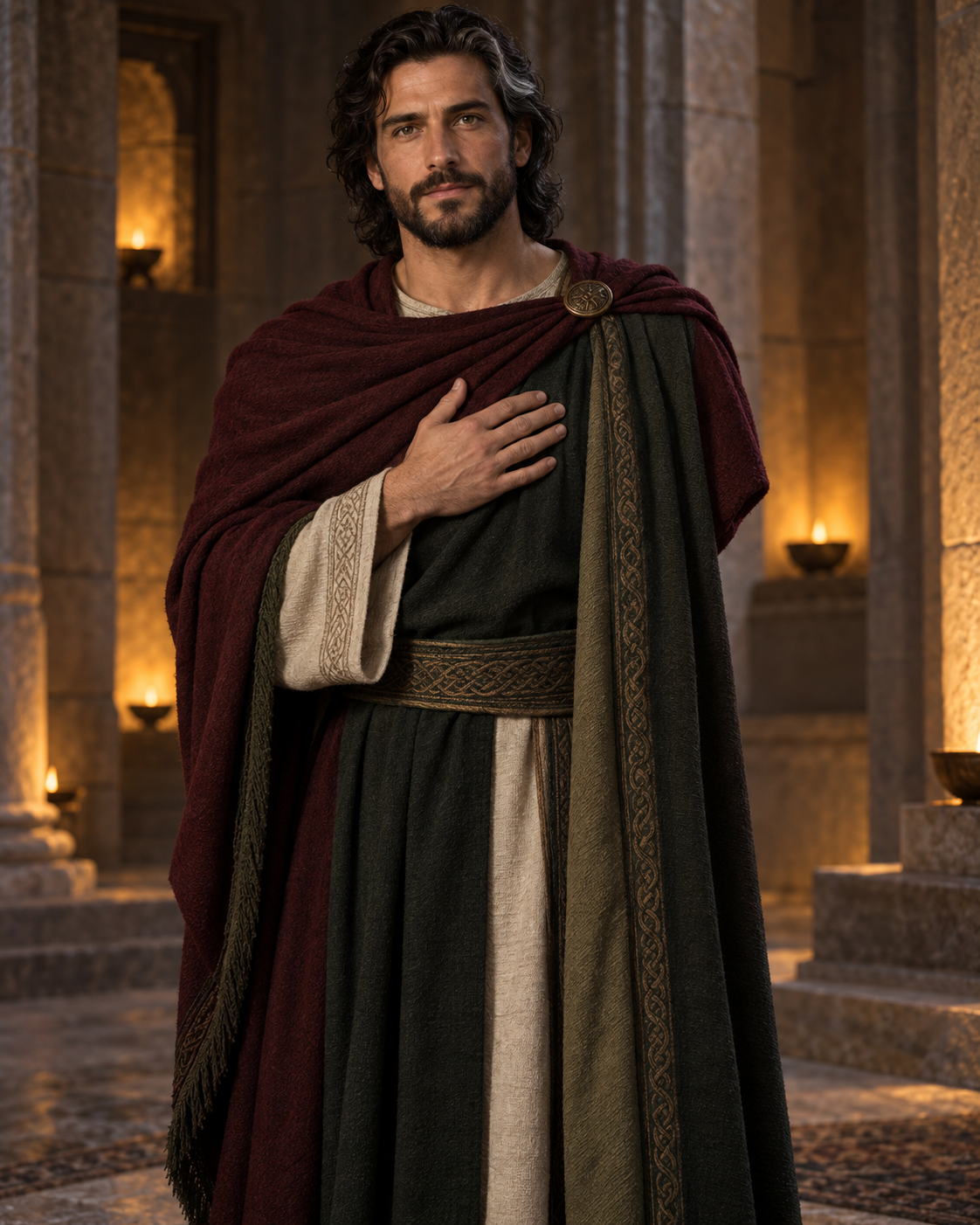
Visual state: approved Hernystiri devotional interpretation. Murhagh now has one permanent symbolic identity and this profile is published.
CVM depicts Murhagh as a breathtakingly handsome adult male figure around thirty-eight: tall and strong, warm fair-to-olive skin, dark-hazel eyes, shoulder-length wavy black hair with one restrained silver temple streak, close black beard, and a calm direct expression. This gendered body and age are interpretive.
The devotional body has exactly one arm, with the left side absent beneath a cleanly tailored asymmetrical mantle. Canon does not identify the missing side or confirm gender beyond conventional god-language, face, skin, hair, eyes, age, height, build, clothing, crown, weapon, scar, wound, prosthesis, or supernatural effect.
The portrait contains no wound, scar, blood, prosthesis, weapon, or implied origin story. Do not turn the absent arm into gore, punishment, villain coding, or a generic imitation of another mythology’s sacrificed god.
Do not borrow Brynioch’s sky iconography, Mircha’s rain language, or Rhynn’s Cauldron.
Preserve this exact symbolic body, face, adult baseline, complexion, eyes, black-hair/silver map, beard, wine/forest/charcoal/bronze clothing, one-arm silhouette, and hand-over-heart gesture across the hero, directory card, Hernystiri religion pages, and the Eolair-return context. The same attachment powers featured image, hero, card, and social metadata.
On the Record
Book 1 devotional evidence with mortal action intact
This is Murhagh One-Arm’s one canonical, full-spoiler devotional profile. The confirmed evidence belongs to The Dragonbone Chair.
The record identifies Murhagh One-Arm as a Hernystiri god. King Lluth thanks Murhagh and Brynioch after Eolair’s company discovers Skali’s raiders before they reach the Taig. Five scouts remain able, two are gravely wounded, and four are dead.
The record confirms the invocation and epithet. It does not confirm a physical appearance, missing-arm origin, domain, weapon, clergy, mythology, family, shrine, ritual, intervention, answer, or causal role in the discovery.
Status: devotional and legendary figure; literal manifestation unverified.
Visual state: approved Hernystiri devotional interpretation. The same canonical attachment powers featured image, hero, directory card, and social metadata while remaining labeled as interpretation rather than a literal manifestation.