
Memory, Sorrow, and Thorn · Canonical Character Profile
Sijandi
Sijandi is the Sithi expedition companion who returns the travelers’ horses and gear, rides north with Jiriki, and shares responsibility with Ki’ushapo for keeping the animals alive below Urmsheim. The climbers get prophecy, ice axes, a dragon, and Thorn. Sijandi gets the job that determines whether their story has a road back. Book 2 names Sijandi again as one of the companions sent ahead when Jiriki must answer his parents’ summons.
At a Glance
The named person responsible for the part of the quest everyone assumes happens automatically
- Name
- Sijandi
- People
- Sithi / Zida’ya
- Role
- Expedition companion and horse-tender
- Book 1 work
- Returns gear, travels north, shelters horses below Urmsheim
- Mission purpose
- Keep the animals alive and preserve the return journey
- Book 2 reference
- Sent ahead with Ki’ushapo under Jiriki’s summons
- Last confirmed state
- Alive at the Book 2 reference
The Horses Come Back
Sijandi helps restore the material world after the travelers enter Sithi protection
At Jao e-Tinukai, the travelers move from suspicion and captivity toward guest status. Binabik explains the Three Swords, Nisses, Jarnauga, Naglimund, Urmsheim, and Ineluki. Jiriki recognizes Simon as his life-debt friend.
Then Sijandi and Ki’ushapo return the travelers’ horses and gear.
The action is easy to read as transition. It is also a meaningful restoration of agency. Horses, packs, weapons, clothing, food, and travel equipment determine whether the mortals can continue their chosen route.
For the Sithi, the task may involve hazardous material. Jiriki explains that his people can handle iron briefly after drinking from certain springs, an adaptation learned after the Days of Black Iron.
The record does not say which objects Sijandi touches, whether the spring protection is personally used here, or how the work is divided with Ki’ushapo. A responsible profile preserves the collective action without inventing a packing list.
Sijandi’s first named contribution is therefore practical diplomacy. Returning property confirms that the relationship has changed from control to cooperation more clearly than a ceremonial speech alone could do.
Jiriki’s Northern Company
Three Sithi travel with the mortals for three distinct reasons
Jiriki joins the search for Thorn because Simon saved his life and because the White Arrow marks a debt of life for life. An’nai accompanies the group to atone for binding the sacred Arrow-Bearer without proper respect.
Sijandi and Ki’ushapo travel for the horses.
The contrast is useful. One motive is blood debt, another is atonement, and another is expedition survival. Sithi participation is not a single mystical impulse or automatic alliance with mortal resistance.
Jiriki openly warns that the Sithi remain one blood with the Norns and remember Ineluki as beautiful and wise. The Gardenborn may understand his vengeance through the history of human conquest rather than mortal categories of obvious evil.
Sijandi’s role unfolds within that unresolved political relationship. Tending the mortals’ transport is cooperation, but it does not erase historical conflict or prove every Sitha shares Josua’s cause.
The books do not record Sijandi’s private view of humans, Ineluki, the Norns, or the swords. Assigning a political speech would turn useful silence into fabricated certainty. The action is enough: Sijandi travels into lethal winter to preserve the party’s living resources.
Across the White Waste
Horse care becomes life support when summer behaves like deep winter
The northern road crosses snow-drowned settlements and a White Waste trapped beneath supernatural weather. Ordinary travel becomes a moving survival problem.
Horses need food, shelter, water, rest, inspection, calming, and protection from cold. The novels do not provide Sijandi’s daily stable ledger, but they state the assignment’s purpose: Sijandi and Ki’ushapo are present to keep the horses alive and prepare for the return journey.
This is not servant scenery. The party’s mobility depends on animals who cannot be treated as immortal props. Every mile north spends strength that must somehow remain available for the way south.
The work also draws on Sithi knowledge and endurance without turning either into unlimited magic. Jiriki’s people are different from mortals, yet they make plans, assign specialists, adapt to iron, and care for vulnerable bodies.
Below Urmsheim
The ascent begins where Sijandi’s responsibility becomes most visible
At Urmsheim’s foothills, Sijandi and Ki’ushapo prepare shelter for the horses. Binabik reveals the specialized climbing equipment made at Naglimund: crampon-like plates, ice axes, and linked harnesses.
The climbers will leave Qantaqa and the horses below. This creates a physical border between two phases of the quest. Above lie ice, Hunën, Igjarjuk, Thorn, and the mountain’s lethal history. Below lies the base that must remain alive.
Sijandi does not climb into the dragon episode. That absence is the job. Someone must accept responsibility for the animals while the rest of the party enters terrain they cannot survive.
The shelter also preserves return as an actual plan rather than a genre assumption. The party is not supposed to reach Thorn and evaporate into legend. If anyone comes back down, transport must still exist.
The profile cannot claim what materials Sijandi uses, how the shelter is shaped, or which horse receives which care. It can name the strategic function: protect living mobility under conditions capable of killing it.
Working Beside Ki’ushapo
Shared labor should not become one character’s footnote
Ki’ushapo receives more visual description and a memorable wrist-wrestling scene with Haestan. Sijandi does not.
That imbalance creates an easy fandom error: credit the work to the more visually vivid companion and reduce Sijandi to an “also present” name.
The text repeatedly pairs them in action. Sijandi and Ki’ushapo return the horses and gear. Both travel north. Both are there specifically to tend the animals. Both prepare shelter at the foothills. Both are sent ahead in Book 2.
The canonical profile should preserve that grammatical equality. Lack of a color palette or comic strength feat does not make Sijandi’s half of the labor less real.
It also means future art must avoid turning Sijandi into a visual copy of Ki’ushapo. Shared role does not equal shared face, braids, clothing, or body. Sijandi’s identity requires a separate owner-approved design.
Sent Ahead
Jiriki trusts the same pair when royal obligation interrupts the road
In Book 2, Jiriki must answer the summons of his parents. He has already sent Sijandi and Ki’ushapo ahead.
The direct reference confirms continuity beyond the Urmsheim mission. The pair remain active companions within Jiriki’s movement and trusted enough to precede him when duty calls.
The moment occurs while Simon refuses to leave Yiqanuc without Binabik and Sludig. Jiriki explains that belonging to the reigning house imposes duty rather than giving him command over everyone.
Sijandi does not speak in the preserved exchange. The departure nevertheless shows the summons becoming action before Jiriki can resolve his conflict with Simon.
People are moving because royal obligation has logistical consequences. Sijandi is again part of the advance work that happens before the more famous character completes the emotional conversation.
The Face We Lock
Missing description remains a source boundary—even after the portrait becomes consistent
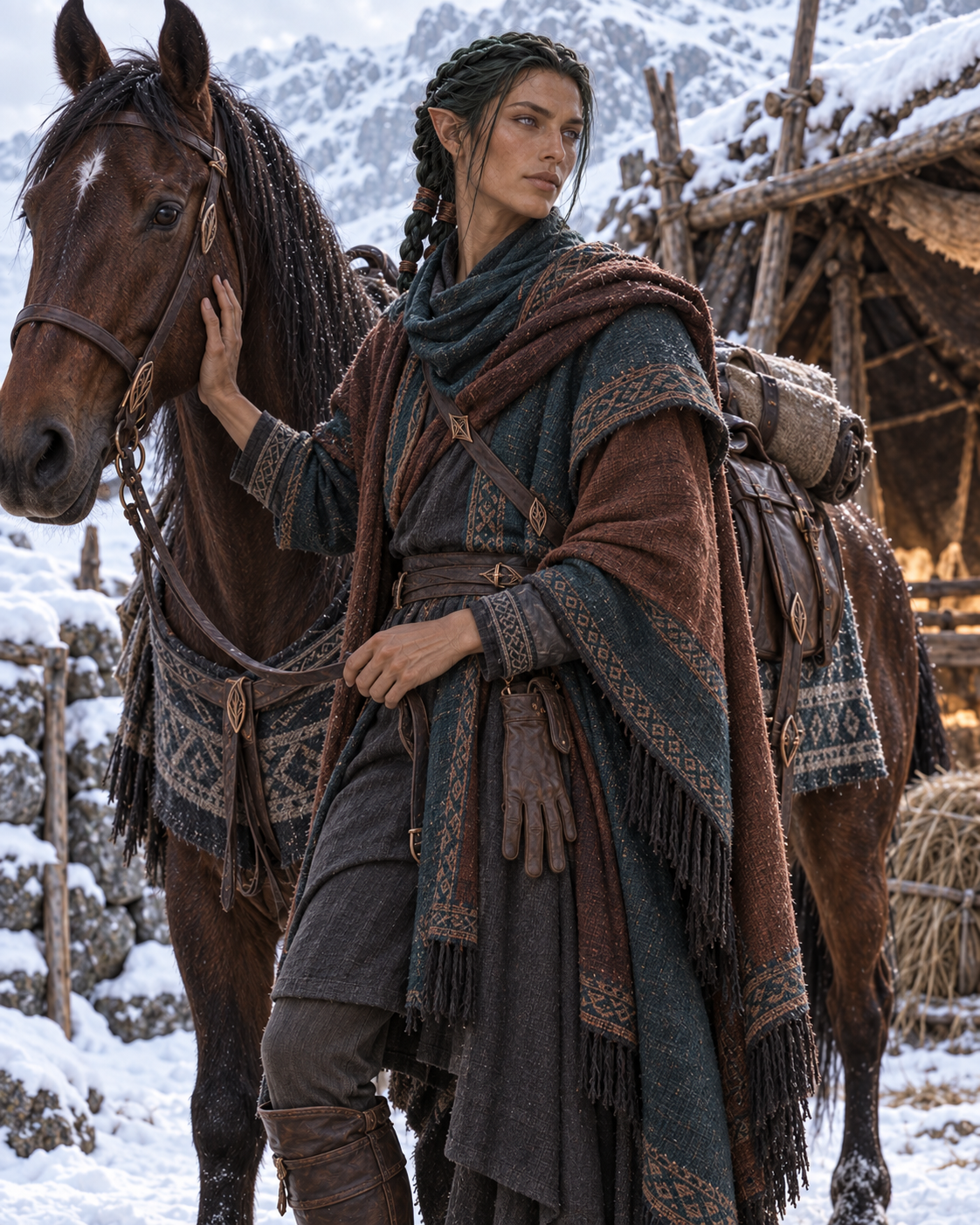
The completed record does not provide Sijandi’s coloring, clothing, height, build, facial features, age, gender presentation, weapons, or house. That is not a reason to omit the profile, and it is not permission to recycle Ki’ushapo’s yellow braids and black-gray outfit.
The approved design uses one breathtakingly beautiful androgynous adult Sitha with a long oval face, rose-copper skin, gray-lilac eyes, dark moss-green braided hair, russet-and-teal expedition layers, and quiet equestrian strength. Every one of those bodily and material choices is CVM editorial reconstruction, not newly discovered canon.
This exact face, age baseline, long-limbed body, complexion, eyes, ears, dark hair, three-braid map, copper cords, russet/teal/charcoal palette, and horse-care presence now govern the directory card, featured image, hero, gear return, White Waste, Urmsheim, Book 2 departure, and every later appearance.
Connections
The companion, prince, climbers, and animals around Sijandi’s expedition work
Ki’ushapo
Shares every named horse-and-gear task and is sent ahead beside Sijandi in Book 2.
Jiriki
Leads the northern company and later sends Sijandi ahead under his parents’ summons.
Simon
The Arrow-Bearer whose search for Thorn depends on the return line Sijandi protects.
Binabik
Explains the mission and designs the mountain ascent that leaves the animals below.
An’nai
Travels in the same Sithi company for a distinct atonement purpose.
The expedition horses
Living transport whose survival is Sijandi’s explicit mission rather than background luck.
Why Sijandi Matters
The page makes invisible expedition labor visible without pretending the books gave more than they did
Sijandi never receives a grand speech, private viewpoint, or combat showcase. The novels still name the person doing work essential to everyone else’s survival.
Returning gear restores agency. Horse care preserves movement. Foothill shelter gives the mountain party a base. Being sent ahead turns Jiriki’s summons into an organized response.
Those actions form a coherent character function. Sijandi is dependable within Jiriki’s company and repeatedly paired with another specialist in tasks where failure would strand the quest.
A fandom hub becomes better than a thin wiki by following consequence, not by inventing childhoods. Sijandi’s rabbit hole is the realization that a Great Sword quest depends on someone below the dragon keeping ordinary animals alive.
On the Record
Books 1 and 2, one canonical expedition companion, and no borrowed appearance
This is Sijandi’s one canonical full-spoiler profile. Book 1 records the return of horses and gear, the northern expedition, the explicit horse-tending purpose, and the shelter prepared below Urmsheim. Book 2 directly names Sijandi as one of the companions Jiriki sends ahead. Books 3 and 4 contain no direct Sijandi receipt.
The record confirms Sijandi as Sithi, associated with Jiriki, paired with Ki’ushapo in expedition labor, responsible for horses, alive on the northern road, and active at the Book 2 summons. It does not confirm age, coloring, face, height, build, gender presentation, clothing, family, house, rank, weapons, dialogue, later destination, or final fate.
The approved identity is deliberately androgynous because the reading record does not establish gender presentation. Exact age, body, face, complexion, eye color, hair, braids, cords, clothing, tack, horse coloring, blanket, packs, shelter, hay, mountain, pose, weather, and light are CVM editorial reconstruction. The identity remains visually distinct from Ki’ushapo and Jiriki while belonging to the same realistic Gardenborn universe.