
Memory, Sorrow, and Thorn · Canonical Character Profile
Ki’ushapo
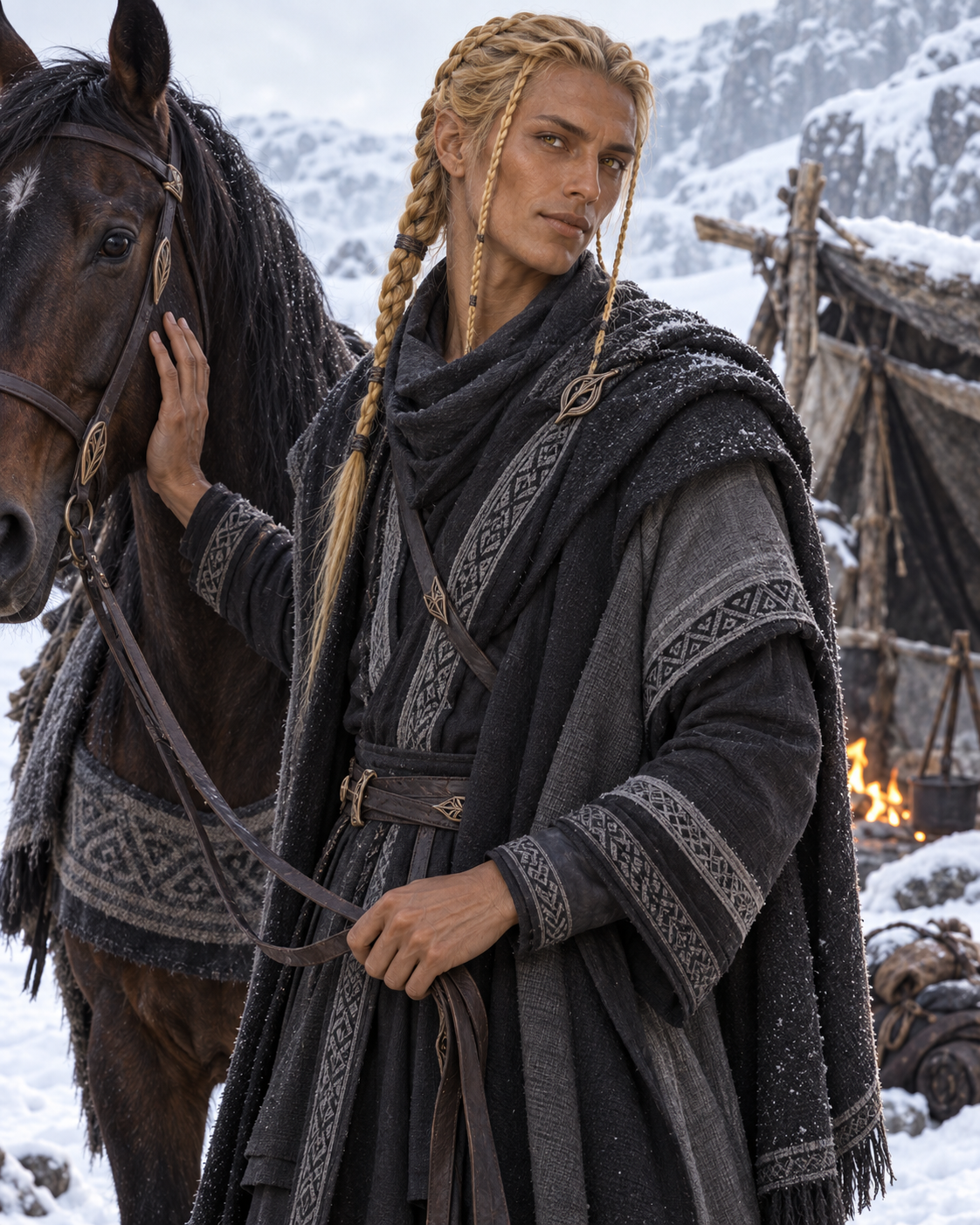
Ki’ushapo is a yellow-braided Sitha hunter in black and gray, slender enough to look almost weightless beside Haestan and strong enough to wrist-wrestle the burly guardsman without moving. He helps return the travelers’ gear, rides north with Jiriki, and tends the horses across the White Waste so the Thorn expedition has a return journey to attempt. Book 2 remembers him again as one of the companions Jiriki sends ahead. His magic trick is logistics performed so well everyone else gets to call the quest heroic.
At a Glance
The slender hunter who keeps the horses alive while legends climb the mountain
- Name
- Ki’ushapo
- People
- Sitha / Zida’ya
- Role
- Hunter, expedition companion, and horse-tender
- Appearance
- Yellow-braided, slender, dressed in black and gray
- Strength receipt
- Wrist-wrestles Haestan without being moved
- Book 1 mission
- Preserve the northern expedition’s horses and return route
- Last direct reference
- Sent ahead with Sijandi when Jiriki answers his parents’ summons
Jao e-Tinukai
He meets starving mortals in a hidden place where bees still make honey
Ki’ushapo appears at the Sithi hunting lodge in Jao e-Tinukai, a sheltered fastness where unnatural winter has not destroyed every ordinary rhythm. Bees still make honey. Food, warmth, song, and light exist inside a world the mortal travelers have learned to experience as scarcity.
He wears black and gray, with yellow hair arranged in braids. The direct image is precise enough to anchor his canonical design without inventing eye color, facial structure, jewelry, or armor.
Ki’ushapo jokes about the starving mortals. The humor marks the cultural gap between hosts and guests without reducing him to cruelty. The travelers arrive suspicious, hungry, and surrounded by beings many humans have treated as demons or vanished folklore.
Jiriki changes their status from captives to guests after hearing Binabik’s account of the Three Swords, Nisses, Jarnauga, Naglimund, Urmsheim, and Ineluki. Ki’ushapo belongs to the household receiving that enormous disclosure.
The lodge scene also reopens an older relationship. Jiriki knows Binabik’s full name and explains that Ookequk learned Sithi speech directly from the Gardenborn. The Qanuc and Sithi once loved one another well. Ki’ushapo therefore meets the travelers inside a reunion history much older than Simon understands.
The Wrist-Wrestling Receipt
Haestan’s size meets Sithi strength and goes absolutely nowhere
Ki’ushapo later wrist-wrestles Haestan. The human guardsman is burly and bearlike; Ki’ushapo is slender and roughly half his weight.
Haestan cannot move him.
The scene demonstrates difference through play rather than battlefield exposition. Ki’ushapo’s body does not advertise strength according to human expectations, yet the contest reveals extraordinary stability and power.
This should govern future art. Making him broad and heavily muscled to explain the result would erase the point. His strength coexists with slenderness.
The contest also adds sociability. These are not two hostile species measuring one another at sword point. They share a physical joke inside temporary safety. Haestan’s inability to budge him becomes cultural contact with excellent comic timing.
Iron Without Simplification
Returning the gear requires an adaptation born from the Days of Black Iron
Ki’ushapo and Sijandi return the travelers’ horses and equipment. Much of that gear belongs to a material world dangerous to the Sithi: iron.
Jiriki explains that the Gardenborn can handle iron briefly after drinking from certain springs. The guarded practice was learned after the Days of Black Iron.
The scene prevents a simple “Sithi cannot touch metal” rule from swallowing lived adaptation. Iron remains harmful and historically traumatic. The Sithi have nevertheless developed limited ways to work around its danger when need requires.
Ki’ushapo’s handling of the expedition’s equipment therefore carries technical and historical weight. It is not merely a stable-hand transition between chapters. His people’s response to conquest makes practical cooperation possible.
The record does not specify whether Ki’ushapo personally drank from a spring in this scene, which objects he touched directly, or how long protection lasts. The page should preserve the general mechanism without assigning undocumented ritual actions to him.
North to Urmsheim
He and Sijandi are assigned the part of the quest that makes survival reversible
Jiriki travels north with An’nai, Ki’ushapo, and Sijandi. An’nai accompanies the party to atone for binding Simon, bearer of the White Arrow, without proper respect.
Ki’ushapo and Sijandi have a different mission. They tend the horses through the snowy wastes and preserve the possibility of a return journey.
The distinction matters. Simon, Binabik, Sludig, Haestan, and their companions are moving toward Urmsheim to find Thorn. The sword quest attracts prophecy, dragon legend, and supernatural dread. Horse survival determines whether any successful climber can move south afterward.
At the mountain’s foothills, Ki’ushapo and Sijandi prepare shelter for the animals while Binabik reveals the crampon-like plates, ice axes, and linked harnesses made at Naglimund. The ascent will leave Qantaqa and the horses below.
This creates a clear expedition boundary. The climbers enter terrain the animals cannot cross. Ki’ushapo remains with the vulnerable transport line rather than joining the most narratively glamorous stage.
His work is not lesser. In lethal cold, horses require shelter, feed, water, calming, inspection, and protection. The record does not itemize every task, so the profile should not pretend to possess a stable log. It does state the purpose plainly: keep the horses alive and prepare for return.
Quest stories often treat mounts as scenery that waits indefinitely. Ki’ushapo’s presence makes waiting into labor performed by a named person.
Jiriki’s Company
He serves a prince whose title means duty rather than effortless command
Ki’ushapo travels under Jiriki’s leadership, but the series carefully complicates what “prince” means among the Sithi.
Jiriki explains that membership in the reigning house gives him obligation, not unrestricted command. He must answer his parents’ summons. He can owe Simon a life-debt and still be constrained by responsibility to his own people.
Ki’ushapo’s work fits that model. He is not ornamental entourage attached to a royal person. He has expedition expertise and a defined survival function.
The record does not reveal whether he volunteered, was assigned, belongs to a permanent household staff, or holds a formal rank. Calling him Jiriki’s hunting companion and horse-tender is supported; inventing a knightly hierarchy is not.
Sent Ahead
Book 2 confirms that Jiriki still relies on Ki’ushapo when duty calls him away
In Book 2, Jiriki must answer his parents’ summons. He sends Sijandi and Ki’ushapo ahead while Simon refuses to leave Yiqanuc without Binabik and Sludig.
The reference is brief but direct. It confirms Ki’ushapo remains within Jiriki’s active company after the Urmsheim expedition and is trusted to move ahead as part of the prince’s response.
It also places him at the edge of a disagreement between Jiriki and Simon. Simon invokes the White Arrow debt; Jiriki recognizes the wound but cannot treat personal obligation as freedom from communal duty.
Ki’ushapo does not participate in the preserved argument, so the profile cannot assign him an opinion. His departure shows the practical side of Jiriki’s summons: people must be sent, routes traveled, and the household reassembled while the prince delays.
This direct Book 2 receipt corrects the inherited Book 1-only directory membership. He belongs in both filtered journeys, even though Book 2 gives him less page space.
Strength Without Spotlight
His two defining feats are refusing to move and making sure others can
Ki’ushapo’s profile contains a satisfying pair. In the lodge, Haestan cannot move his wrist. On the road, Ki’ushapo keeps the expedition’s horses capable of movement.
One feat is comic and spectacular. The other is quiet and logistical. Together they define strength more usefully than a kill count would.
His physical power does not require bulk. His expedition value does not require climbing Urmsheim himself. The character consistently disrupts human assumptions about what capability should look like.
That makes him ideal for the fandom ecosystem’s broader mission. A named supporting character should not disappear simply because his labor occurs below the mountain while prophecy looks upward.
Connections
The prince, partner, challenger, and travelers around Ki’ushapo’s northern work
Jiriki
Leads the northern company and later sends Ki’ushapo ahead when answering his parents’ summons.
Sijandi
Shares the horse-tending mission, returns the travelers’ gear, and prepares the animals below Urmsheim.
Haestan
Wrist-wrestles Ki’ushapo and discovers that visible size predicts absolutely nothing.
Simon
Arrow-Bearer and Jiriki’s life-debt friend, whose quest depends on the transport line Ki’ushapo preserves.
An’nai
Travels north in the same Sithi company for a separate atonement purpose.
Binabik
Explains the sword mission at the lodge and designs the Urmsheim ascent whose base logistics Ki’ushapo supports.
Why Ki’ushapo Matters
He is the named answer to “what happens to the horses during the dragon quest?”
Ki’ushapo gets a joke, a visual signature, a strength demonstration, and a job. None of those pieces should be thrown away because he is not a viewpoint character.
His slender immovability challenges human body assumptions. His black-and-gray clothing and yellow braids establish memorable identity. His jokes give the Sithi social texture beyond solemn immortality.
Most importantly, his expedition role closes a realism gap. The heroes do not abandon living transport in deadly winter and find it waiting by narrative magic. Ki’ushapo and Sijandi stay below to do the work.
Book 2’s brief return confirms that this was not a single disposable assignment. Jiriki continues to rely on him when royal duty demands movement.
On the Record
Books 1 and 2, with a repaired scope and no invented Sithi rank
This is Ki’ushapo’s one canonical full-spoiler profile. Book 1 places him at Jao e-Tinukai, in the wrist match with Haestan, returning gear, riding north, and tending horses below Urmsheim. Book 2 directly names him as one of the companions Jiriki sends ahead. The inherited Book 1-only scope has been corrected to Books 1–2. No direct Ki’ushapo receipt appears in Books 3 or 4.
The record confirms yellow braids, black-and-gray clothing, a slender body roughly half Haestan’s weight, extraordinary wrist strength, joking behavior, hunting-company affiliation, horse care, northern travel, and later service under Jiriki’s summons. It does not confirm exact age, eye color, facial structure, family, house, formal rank, romantic history, weapons, later destination, or final fate.
Visual state: approved canonical White Waste identity. Canon establishes yellow braids, black-and-gray clothing, a slender body roughly half Haestan’s weight, extraordinary strength, hunting-company affiliation, and horse care. CVM reconstructs his exact adult age, face, complexion, green-gold eyes, braid map, costume construction, horse, shelter, pose, weather, and light; none of those unsupported details should be cited as prose evidence.
This exact face, body, yellow-braid map, and black-gray visual language now govern the lodge, wrist match, White Waste, horse-tending, Book 2 departure, directory, hero, social, and later scene art. His canonical attachment must remain the shared source for featured image, visible hero, and every referring card.