
Memory, Sorrow, and Thorn · Canonical Character Profile
Turis
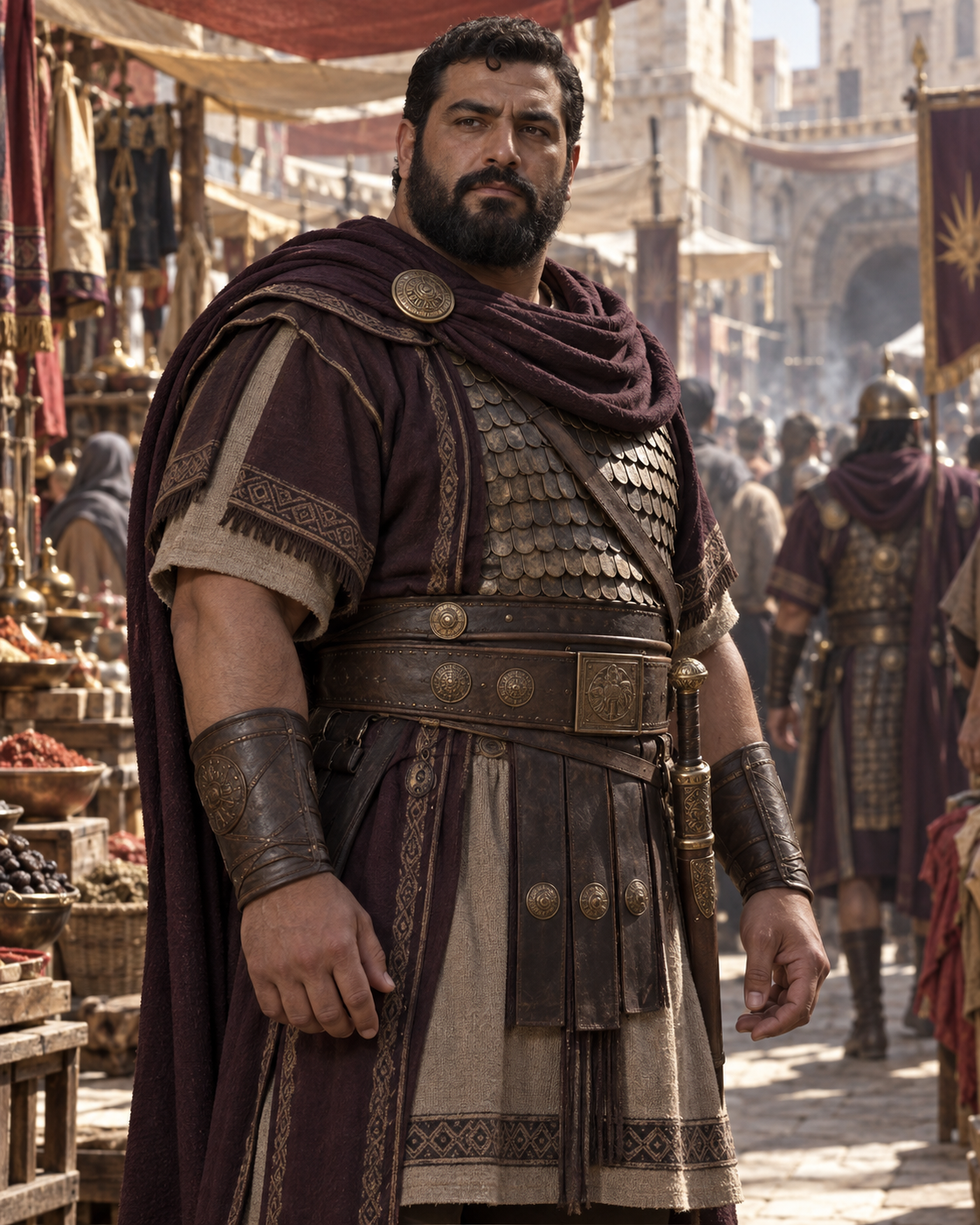
Turis is the heavy, bearded Nabbanai legionary Gelles goads into threatening Simon on Main Row. His uncertain Westerling makes the encounter more dangerous, not less: Simon cannot tell where performance ends, Turis cannot fully control the language of the exchange, and the short stabbing sword at his side makes every joke physical. Gelles directs the sport. Turis is the body the frightened boy must believe.
At a Glance
The heavy bearded soldier whose partial comprehension becomes part of Gelles’s game
- Name
- Turis
- Affiliation
- Nabbanai legionary
- Appearance
- Heavy and bearded
- Language
- Uncertain command of Westerling speech
- Weapon context
- Part of a legionary group carrying short stabbing swords
- Companion
- Gelles and other Nabbanai soldiers
- Major action
- Threatens Simon after Gelles provokes him
- Status
- Alive after the Book 1 market scene; later fate unconfirmed
Main Row
Turis enters Simon’s first dazzling view of the world as one of its immediate dangers
Erchester’s market gathers people from across Osten Ard beneath stitched-skin awnings and smoke trapped over Main Row.
Simon sees hawkers, musicians, gamblers, provincial visitors, Rimmersmen, Hernystiri, Warinsterners, Perdruinese, and Nabbanai legionaries.
The soldiers fascinate him. They look polished and carry themselves with the swagger he associates with wider adventure.
Turis is heavy and bearded. The direct description gives him mass and a mature masculine presence without specifying exact age, height, hair color, or body composition.
His group carries short stabbing swords. Even sheathed, those weapons define the power imbalance between trained adult soldiers and one isolated castle boy.
Simon cannot follow the legionaries’ mutual insults. Their speech makes him an outsider before the teasing turns directly toward him.
Turis’s presence turns Simon’s romantic military gaze into embodied fear. The world beyond the Hayholt is colorful and culturally rich; it is also full of adults who can make a child’s confusion into public sport.
The Body of the Joke
Gelles provokes, but Turis supplies the threat Simon cannot safely dismiss
Gelles directs Turis’s attention toward Simon and provokes him into threatening the boy.
The encounter may entertain the soldiers, but Simon cannot know how theatrical the threat is. Turis is large, armed, and partly separated from him by language.
That uncertainty is the engine of the cruelty. A harmless joke requires shared confidence that nobody will be hurt. Simon receives no such guarantee.
Turis’s physical presence is not inherently villainous. Being heavy and bearded does not make him brutal. His action in the scene—participating in the intimidation—creates the moral evidence.
The page should not portray him as a mindless weapon operated by Gelles. Gelles initiates and manipulates the exchange, but Turis remains an adult soldier responsible for the threat he performs or means.
Nor can the profile prove exactly how seriously Turis intends it. The danger lies in Simon having no safe way to test that intention.
Partial Language, Full Power
Turis may understand less of the conversation while still controlling more of its consequences
The ledger describes Turis’s command of Westerling as uncertain.
That does not mean he is unintelligent. Multilingual difficulty is not cognitive failure, and the profile must not turn accent or partial comprehension into comic stupidity.
Gelles uses the language gap to his advantage. He can frame Simon’s words for Turis, provoke responses, and convert the boy’s literal answers into amusement for the wider group.
Turis may miss nuance, but he does not lack power. His adult status, uniform, companions, size, and weapon continue to shape the encounter.
This reverses a familiar assumption. Fluency usually appears as authority, yet Turis can be linguistically disadvantaged within the conversation and still physically dominate Simon.
The exact language spoken among the Nabbanai soldiers is not identified in the receipt. The page should not invent vocabulary, accent spelling, or mistranslated dialogue.
Future editorial copy must also avoid phonetic caricature. “Uncertain Westerling” is the evidence; broken comic speech manufactured for flavor is not.
Simon’s Purse and Household Claim
Proof of identity does not persuade a group committed to making every answer funny
Simon shows that he has his own purse and says he belongs to the High King’s household.
These are attempts to establish that he is neither a beggar nor an unprotected stray.
The legionaries mock the claims and King John’s authority. Turis remains part of the group applying that humiliation even though the record foregrounds Gelles as the bright-eyed instigator.
The scene does not isolate which soldier speaks each mockery. A responsible profile should not transfer every group line specifically into Turis’s mouth.
What is confirmed is participation in the encounter and delivery of the threat after provocation.
Simon learns that institutional belonging offers little protection when an audience has already decided the performance requires his embarrassment.
Turis Is Not Gelles
The two legionaries share a scene but occupy different positions inside its cruelty
Gelles is young, bright-eyed, thinly mustached, drunk, and socially agile enough to keep redirecting the joke.
Turis is heavy, bearded, and less certain in Westerling. His contribution is imposing physical threat.
The distinction must govern profiles and art. They should not receive the same face, body, age impression, or directory copy simply because they stand together.
It should also govern accountability. Gelles’s manipulation does not absolve Turis. Turis’s threat does not erase Gelles’s authorship of the trap.
Group cruelty distributes roles. One person chooses the target, another makes danger credible, and an audience rewards both.
The market encounter becomes sharper when each part remains visible rather than reducing everyone to “some mean soldiers.”
A Heavy Body Is Not a Moral Code
Turis’s size changes Simon’s risk calculation; it does not explain Turis’s character
The text describes Turis as heavy because Simon experiences his physical presence as part of the threat.
That description must not become visual shorthand for stupidity, appetite, laziness, or brutality. None of those traits follows from body size.
Turis is accountable for participating because he threatens a frightened child within an armed group. The wrongdoing lies in conduct and power, not flesh.
Future art can make him broad, heavy, formidable, and hot at once. It should never slim him to make attractiveness possible or exaggerate him into a comic brute.
Cadrach’s Intervention
Another adult ends the danger by navigating the social performance Simon cannot
Brother Cadrach intervenes before the soldiers’ game escalates.
His religious robe, confident humor, and adult social fluency allow him to redirect the encounter.
The record does not preserve Turis privately apologizing, objecting, or reconsidering. The threat ends because the group’s attention is successfully managed.
Cadrach later steals Simon’s purse, complicating the rescue without changing Turis’s conduct.
Simon leaves the scene having encountered two different adult dangers: soldiers who humiliate openly and a friar who helps charmingly before robbing him.
Turis does not reappear to face consequence or reveal what the exchange meant to him.
Connections
The instigator, frightened boy, amused soldiers, and friar around Turis
Gelles
Provokes Turis and uses the language gap to direct the humiliation.
Simon
The isolated castle boy who must treat Turis’s threat as physically real.
The Nabbanai legionaries
The armed audience whose numbers and laughter reinforce the encounter.
Brother Cadrach
The friar who intervenes and redirects the soldiers away from Simon.
King John
The High King whose household Simon invokes and whose authority the group mocks.
Main Row
The multilingual public market where Turis’s size and uniform become social leverage.
Why Turis Matters
He makes the joke dangerous enough to become part of Simon’s education
Gelles provides the wit of the cruelty; Turis gives it weight.
His scene shows that a threat does not become harmless merely because some participants find it funny.
He also demonstrates why language difference must be handled carefully. Turis’s limited Westerling neither makes him innocent nor makes him stupid. It changes who controls the framing.
For Simon, the encounter dismantles another piece of military glamour. Polished foreign soldiers can be fascinating, attractive, and casually cruel in the same minute.
Turis needs no later villain career to matter. The brief scene captures how group power assigns one adult the role of weapon and one child the role of entertainment.
On the Record
Book 1 only, one market threat, no caricature of language or body
This is Turis’s one canonical full-spoiler profile. His direct appearance occurs in Book 1 during Simon’s market day. No additional Turis receipt appears in Books 2–4.
The record confirms that he is a Nabbanai legionary, heavy, bearded, uncertain in Westerling, accompanied by Gelles and other soldiers carrying short stabbing swords, and provoked by Gelles into threatening Simon.
It does not confirm exact age, face, height, hair color, eyes, rank, unit, birthplace, family, exact words, seriousness of intent, political ideology, later duty, remorse, survival, death, or final fate.
Visual state: approved editorial reconstruction. CVM depicts Turis as a handsome, imposing adult Nabbanai legionary around thirty-eight, with a very large powerfully built body, broad chest, thick waist, strong arms, deep-olive complexion, dark-brown eyes, close dark curls, and a full dense black beard. His dark-plum and sand layers, restrained bronze scale armor, leather belt, and one sheathed short stabbing sword keep him grounded in the Main Row military context without turning size or partial Westerling into caricature. Preserve this exact face, heavy body, beard, coloring, wardrobe, armor, and weapon across featured image, hero, directory card, social metadata, and every later market reconstruction; never slim him, give him a stupid expression, or clone young thin-mustached Gelles.