
Memory, Sorrow, and Thorn · Canonical Character Profile
Gelles
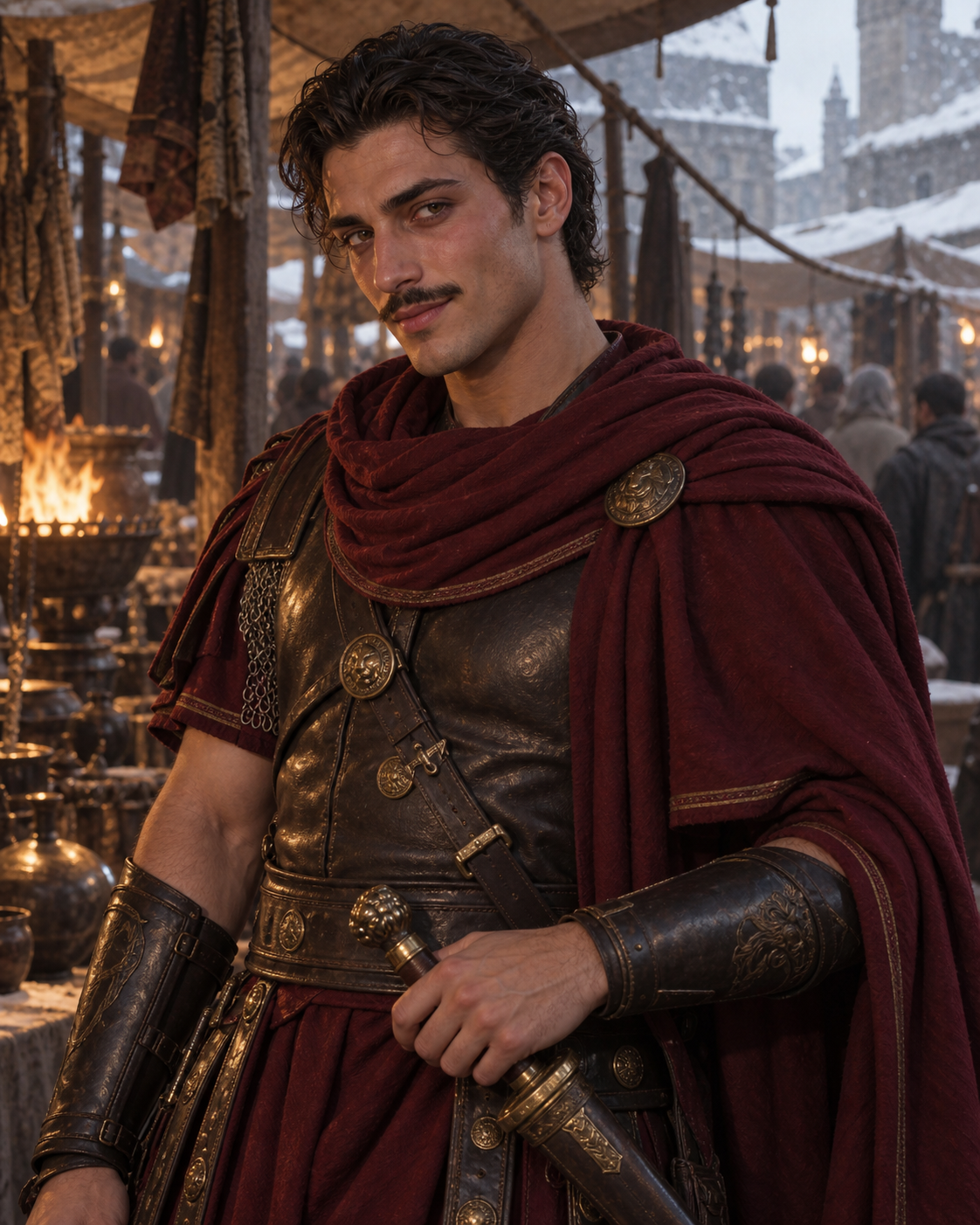
Gelles is the bright-eyed young Nabbanai legionary with a thin dark mustache who turns Simon into market-day entertainment. Drunk, polished, and protected by his group, he provokes the heavy bearded Turis into threatening a boy who cannot understand their mutual insults, then folds Simon’s fear and literal answers back into the joke. Gelles does not lose control. He makes another man’s confusion do the dirty work.
At a Glance
The smiling young soldier who understands every layer of a joke built on Simon’s fear
- Name
- Gelles
- Affiliation
- Nabbanai legionary
- Age
- Young adult; exact age unconfirmed
- Appearance
- Bright-eyed with a thin dark mustache
- Condition
- Drunk during the encounter
- Weapon context
- Part of a group carrying short stabbing swords
- Companion
- Turis and other Nabbanai legionaries
- Status
- Alive after the Book 1 market scene; later fate unconfirmed
Main Row on Market Day
Gelles performs military swagger inside a crowd already dazzled by difference
Simon enters Erchester’s market during a rare day of freedom. Main Row runs beneath stitched-skin roofing, with stone braziers, smoke, snow, hawkers, gamblers, cutpurses, musicians, travelers, and people from across Osten Ard.
Nabbanai legionaries stand out. Simon admires their polish and swagger before he understands what their attention can cost him.
The soldiers carry short stabbing swords. Their equipment makes the encounter physically unequal even before anyone draws steel.
Gelles is young, bright-eyed, and marked by a thin dark mustache. His attractiveness and military polish are not evidence of kindness. The scene uses social charm as part of the danger.
He is drunk enough to turn cruelty into sport, but intoxication does not erase structure. Gelles tracks Simon’s answers, Turis’s reactions, and the group’s laughter well enough to keep directing the exchange.
The market provides an audience and anonymity. A castle boy alone among armed foreigners can be made ridiculous without anyone important treating the moment as an incident.
Gelles’s scene punctures Simon’s romantic view of soldiers. Martial glamour is not only battlefield courage; it can also be young men using uniform, language, and numbers to bully someone smaller.
Cruelty as Group Entertainment
Gelles engineers the threat, then enjoys Simon’s attempt to answer it sincerely
Gelles provokes Turis into threatening Simon.
Turis is heavy and bearded, with uncertain command of Westerling speech. Gelles understands enough of both the soldiers’ shared language and Simon’s responses to control the misunderstanding.
Simon answers literally because he is frightened and trying to survive an interaction whose rules keep shifting.
Gelles treats those literal answers as additional material. Each attempt by Simon to clarify himself becomes another layer of entertainment for men who already know he lacks equal footing.
The behavior is not a duel of wit. Gelles possesses armed companions, linguistic control, adult status, and the confidence of a soldier in public space. Simon possesses a purse and the fragile claim that he belongs to the High King’s household.
When Simon proves he has money, the soldiers do not grant him dignity. When he invokes King John’s household, they mock the claim and John’s authority.
Gelles therefore makes humiliation self-sealing. Evidence that Simon is not a beggar becomes proof he is ridiculous in a different way.
Language as Leverage
Gelles weaponizes translation without ever needing to formally translate
Simon cannot follow the legionaries’ mutual insults. Turis’s grasp of Westerling is uncertain. Gelles occupies the advantaged middle.
He can provoke Turis, interpret Simon’s fear, and cue the group’s response while neither target fully controls the exchange.
This is not proof that Gelles is an official interpreter or fluent in every language present. It is proof that he understands enough to manipulate the moment.
Language determines who recognizes a threat as performance and who must treat it as real. Turis may be playing along, genuinely angered, or moving between both; Simon cannot safely assume theatricality.
Gelles can enjoy that uncertainty because the consequences do not fall on him.
The scene also shows how cosmopolitan spaces can remain hostile. Erchester’s market gathers cultures and languages, but proximity does not automatically create mutual respect. Difference becomes material for swagger.
Future copy must keep Gelles’s role distinct. Turis embodies the heavy physical threat. Gelles directs the social machinery that makes the threat funny to the group.
The High King’s Household
Simon reaches for institutional protection and discovers the soldiers can mock that too
Simon announces that he belongs to the High King’s household.
Inside the Hayholt, that connection gives him duties, adults who know him, and a place within a vast institution. In the market, it sounds implausible coming from a poorly positioned boy.
Gelles and the others mock both the claim and John’s authority. The response strips Simon’s identity of protective value.
The moment occurs as John is dying and delegations crowd the Hayholt. Political confidence is already fraying, though Simon does not yet understand the scale.
The profile should not assign Gelles a developed anti-John ideology. Drunken mockery can express military cynicism, foreign swagger, group performance, or simple cruelty. The words are confirmed; a coherent political program is not.
What Simon learns is immediate: invoking power does not help when the audience does not recognize him as someone entitled to borrow it.
Drunk Is Context, Not an Alibi
Gelles’s intoxication helps explain the atmosphere without erasing deliberate control
The ledger records Gelles as drunk enough to turn cruelty into sport.
Alcohol lowers restraint and intensifies the soldiers’ group swagger, but Gelles remains responsive. He selects Simon, provokes Turis, follows the boy’s answers, and keeps converting them into fresh jokes.
The page should neither diagnose addiction nor excuse conduct. One drunken market scene cannot establish Gelles’s sober personality, yet the behavior occurring within that scene still belongs to him.
This matters for art as well. Flushed skin, loosened posture, or a cup may communicate intoxication. A clownish face, collapsing stance, or comic stupor would misrepresent the social precision with which he targets Simon.
He is dangerous because he is entertained, armed, and attentive—not because he has ceased to understand what is happening.
Cadrach Changes the Scene
A plump friar succeeds where Simon’s truth and household claim fail
Brother Cadrach intervenes. His gray robe, tonsure, weathered pink face, humor, and confident speech give him social tools Simon lacks.
He redirects the legionaries and creates an exit from the humiliation.
Gelles’s response is not recorded as a private moral reversal. The encounter ends because another adult can operate within the soldiers’ social register.
The rescue is complicated by what follows. Cadrach befriends Simon, asks for a tour, buys chestnuts, offers a melancholy puppet-show lesson, and steals his purse.
That later betrayal does not make Gelles less cruel. It does make Simon’s first market experience a chain of unequal adult performances: overt mockery from soldiers, charming intervention from a thief, and a child left paying for both.
Gelles never returns to explain, apologize, or face consequence in the completed record.
Connections
The threatened boy, heavy companion, amused group, and friar who interrupts Gelles
Simon
The castle boy whose fear and literal answers Gelles turns into entertainment.
Turis
The heavy bearded legionary Gelles provokes into delivering the immediate threat.
The Nabbanai legionaries
The armed peer group whose laughter and presence make Gelles’s game safe for him.
Brother Cadrach
The socially agile friar who intervenes and ends the soldiers’ sport.
King John
The ruler whose household Simon invokes and whose authority the soldiers mock.
Main Row
The multilingual market space where military glamour becomes public humiliation.
Why Gelles Matters
He is Simon’s first clean receipt that soldiers can be glamorous and contemptible at once
Simon wants adventure and admires military polish. Gelles demonstrates that appearance and courage are not the same as character.
He also reveals cruelty as collaborative craft. Turis supplies size and threat; the group supplies audience; Gelles supplies timing and linguistic control.
The scene is small compared with massacres and sieges, but it belongs to the same moral education. Power often announces itself first through what people believe they may do to someone unlikely to be defended.
Gelles’s profile does not need a later villain career. One complete interaction already shows how efficiently charm, uniform, alcohol, and group laughter can make humiliation feel consequence-free.
On the Record
Book 1 only, bright-eyed cruelty confirmed, later life left unwritten
This is Gelles’s one canonical full-spoiler profile. His direct appearance occurs in Book 1 during Simon’s market day on Main Row. No additional Gelles receipt appears in Books 2–4.
The record confirms that he is a young Nabbanai legionary, bright-eyed, thinly dark-mustached, drunk, accompanied by Turis and other soldiers carrying short stabbing swords, and responsible for provoking and sustaining the mockery of Simon.
It does not confirm exact age, height, build, hairstyle, eye color, rank, unit, birthplace, family, later duty, private politics, sobriety behavior, remorse, survival, death, or final fate.
Visual state: approved editorial reconstruction. CVM depicts Gelles as a devastatingly handsome young adult Nabbanai legionary with a lean fit build, warm olive complexion, bright amber-brown eyes, dark wavy hair, a precise thin dark mustache, a controlled wine flush, refined burgundy-and-bronze military layers, and one short sheathed stabbing sword in Main Row’s winter market. Preserve this exact face, body, mustache, coloring, wardrobe logic, and amused cruelty in every later scene. Keep him visually distinct from heavy bearded Turis, and never turn intoxication into slapstick. The same canonical attachment powers featured image, hero, directory card, and social metadata.