
Memory, Sorrow, and Thorn · Canonical Character Profile
Utë
Utë is a soldier of Saegard, named with Hani and Thrinin among the dead after Bukken attack armed people on open ground. The text does not give Utë a speech, a face, or a staged final blow. It gives the northern council something harder to dismiss: another person whose death proves the creatures have abandoned their remembered limits.
At a Glance
The Saegard soldier whose one surviving line changes the danger map
- Name
- Utë
- Confirmed association
- Saegard
- Role
- Soldier
- Named alongside
- Hani and Thrinin
- Enemy
- Bukken / Boghanik
- Confirmed event
- Unprecedented attack against armed people on open ground
- Strategic meaning
- Evidence that remembered Bukken behavior has changed
- Status
- Dead
A Soldier of Saegard
Utë belongs to a place before the council turns the name into evidence
The surviving report identifies Utë as a soldier of Saegard.
That phrasing supplies occupation and association. It does not automatically settle birthplace, ancestry, citizenship, household, command structure, or gender.
The roster identifies Hani as a young Rimmersman and Thrinin as a Rimmersman soldier. Utë is specifically a soldier of Saegard. The shared northern context makes a Rimmersgard connection plausible, but plausibility is not the same thing as a stated identity.
A complete profile should preserve that difference instead of copying Thrinin’s people field into Utë’s record because the names appear in one sentence.
“Soldier” still tells us Utë was part of organized defense or armed service. The exact rank, term of service, training, pay, oath, commander, and equipment are not recorded.
Saegard itself survives in this evidence through its people. Hani, Thrinin, and Utë give the place a human cost long before a directory can turn it into a pin on a map.
The text does not confirm whether all three came from the same household, patrol, company, or generation. Their shared association may reflect community, garrison, unit, or the way the witness grouped casualties.
Future site architecture should connect Utë to Saegard and the Book 1 Bukken incident without manufacturing a biography from what remains unknown.
The Open-Ground Assault
Utë is armed, in the open, and still killed when the old safety pattern breaks
Utë dies when Bukken attack soldiers on open ground.
The event is alarming because both target and terrain violate northern expectations. Bukken are remembered as creatures of the earth and concealment, scarce even in regions where people accept their existence. They do not ordinarily leave hiding to assault armed groups outside.
This attack overturns that practical knowledge.
The record does not preserve the number of Bukken, the size of the camp, time of day, exact location, weather at the instant of attack, tactical formation, or duration of the fighting.
It does not say where Utë stood, what weapon Utë carried, whether an alarm was raised, how many attackers were resisted, or whether the three named soldiers died together.
No final words, wounds, body recovery, or burial are described.
Those missing details are not invitations. A sword raised in a last stand may look excellent on a card, but if the book does not assign that act to Utë, neither should the site.
The confirmed action belongs to the enemy: Bukken attack in a way witnesses consider unprecedented. The confirmed consequence belongs to the soldiers: Hani, Thrinin, and Utë die.
Utë’s profile earns its depth by explaining what the evidence means and where it stops—not by laundering cinematic guesswork into canon.
How the Death Reaches Naglimund
Utë becomes part of a council argument about who gets believed before winter swallows everyone
The death is discussed in the political and supernatural crisis converging at Naglimund.
Isgrimnur arrives dispossessed. Elias has declared him traitor, Skali has been given Elvritshalla, Isorn is held as leverage, Saint Hoderund has been massacred, and northern roads have become lethal.
The Bukken report enters beside those mortal crimes, not in a separate fairy-tale chapter. That placement forces the council to decide whether unnatural danger belongs in the same reality as taxes, titles, prisons, and armies.
Southern skepticism initially treats Bukken as legend. Northern witnesses know their scarcity and customary behavior well enough to recognize the attack as abnormal.
Utë’s name matters inside that credibility fight. The claim is not merely “monsters are restless.” A soldier of Saegard is dead, along with two other named people.
The report remains bounded testimony. The narrative does not place the reader inside the assault, and Jarnauga is not identified as the person who watched Utë fall.
That distinction protects the page from turning later interpretation into an eyewitness scene. It also lets readers see how knowledge actually travels during war: survivor to lord, road to fortress, report to council, incident to hypothesis.
Utë’s story reaches the room because somebody carried the names.
One Receipt in Jarnauga’s Chain
The death supports the warning; it does not independently explain the hand behind it
Jarnauga’s argument accumulates evidence.
Summer has been displaced by deep cold. Hunën move south into the Wealdhelm. Bukken attack armed people in the open. Stormspike’s forges burn through the night. Norns act beneath Utuk’ku. The pattern exceeds Elias’s human tyranny.
From those layers, Jarnauga points toward Ineluki.
Utë’s death supports the Bukken layer. It does not prove that Ineluki personally selected Utë, issued a specific order, enchanted every attacker, or observed the assault.
The profile should not reverse-engineer a command chain merely because the reader later understands the larger war.
This is one of the series’ recurring strengths: supernatural conclusions remain attached to human evidence and fallible interpretation. People compare reports, memories, manuscripts, dreams, and physical objects rather than receiving a tidy villain briefing.
Utë is part of the physical cost inside that method. The casualty is not a footnote after the lore reveal. The casualty is one reason the reveal must be taken seriously.
Hani, Thrinin, and Utë
Three canonical people share one event without becoming one copy-pasted casualty
The report names Hani, Thrinin, and Utë together.
That establishes common event context and a Saegard connection. It does not erase the small distinctions the text preserves.
Hani is called a young Rimmersman. Thrinin is called a Rimmersman soldier. Utë is called a soldier of Saegard.
We should not infer that Utë is older because Hani alone is labeled young. We should not infer that Utë is non-Rimmersman because the descriptor is absent. We should not assign a different rank simply to make three cards feel varied.
Their canonical profiles can share links to the Bukken event, council evidence, Saegard, Isgrimnur, and Jarnauga. Their prose should remain independently written and their future identities absolutely distinct.
A shared scene image belongs on an event page. Each character card must use that character’s featured image, which must also appear as the profile hero and social image.
No recolored clones. No convenient helmet hiding the fact that nobody designed a face. No random weapons handed out like party favors.
Minimal evidence demands stricter identity control, not less.
Identity Without Guessing
The name is canonical; gender, face, and body remain genuinely open
The record supplies the name Utë and the role soldier of Saegard.
It does not provide pronouns or a gender marker in the surviving reading notes. The spelling and accent should not be used as a substitute for textual evidence.
Until the owned edition supplies a confirmed pronoun elsewhere, directory copy should avoid assigning one. This is not coyness. It is basic source discipline.
The same restraint applies to appearance. Northern context does not automatically mean pale skin, blond hair, beard, fur armor, enormous height, or a horned helmet.
The owner’s visual standard still applies: future identity art should be attractive, age-correct, realistic fantasy work with credible military function. “Attractive” is an art direction, not permission to invent royalty, magic, glamour makeup, or a romance lead’s costume.
Before generating, the exact passage or glossary should be checked again for any pronoun, people label, or appearance receipt not captured in the ledger. Once approved, that face and body become locked across every use.
Connections
The fellow dead, witnesses, analyst, and hostile winter around Utë
Hani
A young Rimmersman of Saegard named among the dead in the same assault.
Thrinin
A Rimmersman soldier killed during the same open-ground Bukken attack.
The Bukken
The creatures whose changed terrain and target pattern makes Utë’s death strategically alarming.
Duke Isgrimnur
Brings the northern crisis and casualty testimony into the Naglimund council.
Jarnauga
Places the attack within a larger chain of abnormal winter evidence pointing toward Ineluki.
Saegard
The named community or military association attached to Utë’s surviving identity.
Character Image Continuity
A distinct soldier shown alive before any restrained event art
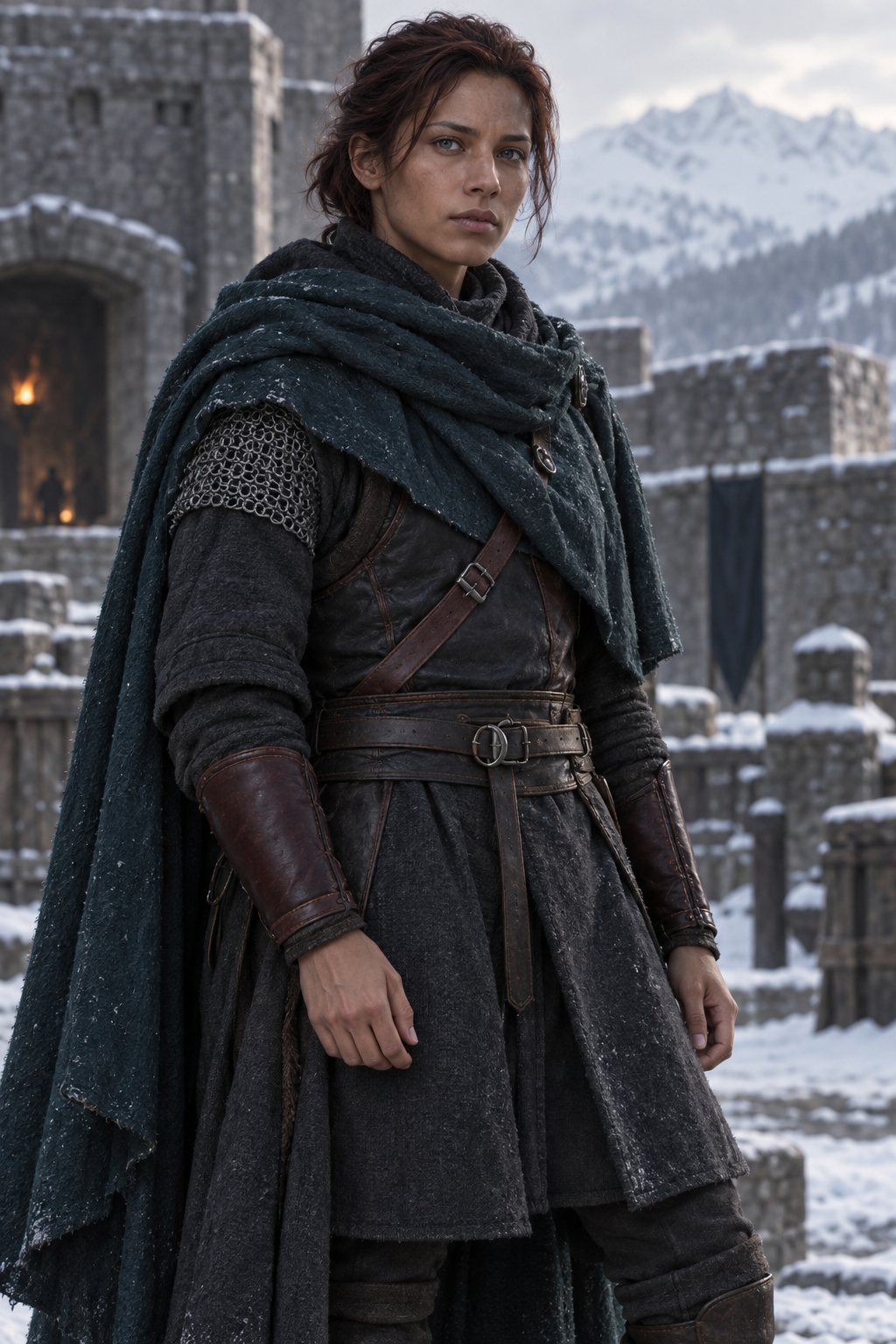
Visual state: approved editorial reconstruction. Utë now has one permanent attractive, androgynous adult identity while the profile continues to avoid assigning gender or pronouns the text does not supply.
CVM depicts Utë as an arresting androgynous adult around twenty-nine, with a tall sturdy athletic build, cool medium-brown skin, storm-gray eyes, a balanced angular-oval face, straight dark-auburn jaw-length hair partly tied back, and no facial hair. This reconstruction remains visually distinct from Hani, Thrinin, Stortfot, Sludig, Isgrimnur, and every other northern figure.
Canon supplies no confirmed gender, exact age, people, skin, hair, eyes, face, height, build, clothing, armor, weapon, heraldry, wounds, or death pose.
The approved canonical portrait shows Utë alive and vigilant in a snowy northern stone garrison, wearing charcoal wool, a weathered deep-teal cloak, oxblood leather, and restrained iron mail. Gore, corpse staging, monsters, weapons, heraldry, and an invented final action are absent.
Shared Saegard styling may use coherent climate, textiles, equipment logic, and military materials after those choices are approved. It must not make the three casualties visually interchangeable.
Event art can depict the broken safety pattern—armed people on open ground confronted by creatures that should have remained below. It cannot assign Utë an unrecorded duel, rescue, warning, or last action.
Preserve this exact face, androgynous presentation, adult baseline, sturdy athletic body, complexion, eyes, auburn hair map, charcoal/deep-teal/oxblood wardrobe, and restrained mail across featured image, hero, directory card, social metadata, and all later scene references. Any Bukken-event art must evolve from this locked living identity without inventing Utë’s individual death action.
Why Utë Matters
The smallest canonical unit is still a person, not “and others”
Utë receives almost no individual narrative space.
That is precisely where a comprehensive fandom hub proves whether it means what it says.
A shallow directory would retain famous rulers and quest companions while compressing casualties into “several soldiers.” This ecosystem keeps the name, role, place, event, evidence path, and unknowns intact.
Utë matters to the plot because the death helps demonstrate changed Bukken behavior. Utë matters to the world because Saegard’s losses make supernatural escalation local. Utë matters editorially because named people should not disappear the moment their evidence becomes useful to a larger hero’s argument.
The page does not pretend the text supplied a secret epic biography. It refuses to discard the life that the text did name.
On the Record
Book 1 wartime testimony, fully spoiled and explicit about every limit
This is Utë’s one canonical, full-spoiler character profile. The confirmed evidence belongs to The Dragonbone Chair through the northern casualty report discussed at Naglimund.
The record identifies Utë as a soldier of Saegard and names Utë with Hani and Thrinin among the dead after Bukken attack armed people on open ground in behavior northern witnesses consider unprecedented.
The death contributes to the wider evidence chain involving displaced winter, Hunën movement, Stormspike’s active forges, Norn activity, Utuk’ku, and Jarnauga’s warning about Ineluki.
The record does not confirm Utë’s gender, exact age, people, family, rank, appearance, equipment, individual action, killer, wounds, final words, body recovery, burial, or direct relationship with the other named soldiers.
Status: dead; killed during the open-ground Bukken assault.
Visual state: approved editorial reconstruction. The post now uses one canonical attachment across featured image, hero, directory card, and social metadata. The complete reading record still supplies no gender or pronouns, so the profile preserves the name Utë rather than converting visual presentation into textual fact.