
Memory, Sorrow, and Thorn · Canonical Legendary Profile
Khaerukama’o the Golden
Khaerukama’o the Golden is the oldest named dragon ancestor in the Book 1 record: forebear of Hidohebhi, and through Hidohebhi part of the line descending toward Shurakai and Igjarjuk. One sentence stretches behind every dragon Simon knows—and wisely refuses to pretend the family tree is complete.
At a Glance
The farthest named dragon in the ancestry Jiriki gives Simon
- Name
- Khaerukama’o
- Epithet
- The Golden
- Nature
- Ancient dragon / wyrm ancestor
- Descendant
- Hidohebhi
- Later descendants
- Shurakai and Igjarjuk descend from Hidohebhi
- Source of lineage
- Jiriki’s explanation to Simon
- Narrative scope
- Historical and legendary ancestry; no direct appearance
- Status
- Unknown; the record does not confirm life or death
The Dragon Lineage
Khaerukama’o stands behind the two dragons whose bodies reshape Simon’s world
Jiriki tells Simon that dragons diminish by generation.
Igjarjuk and Shurakai descend from Hidohebhi. Hidohebhi descends from Khaerukama’o the Golden.
That is the confirmed chain.
The wording does not specify parent-child reproduction at every step. “Descend from” can contain intervening generations, branches, or a broader ancestral relationship.
The profile therefore does not call Khaerukama’o Shurakai’s literal grandparent as though the genealogy were a three-line household chart.
The importance is scale. Shurakai’s skull becomes the canopy over the Dragonbone Chair. Igjarjuk scars Simon on Urmsheim. Both are already creatures capable of overwhelming human history.
If they belong to diminished generations, Khaerukama’o represents a remoter magnitude the present can name but not directly witness.
“The Golden”
The epithet is visual evidence, but not a complete character design
Khaerukama’o is called the Golden.
That supports a golden visual identity. It does not tell us whether the reference describes scales, radiance, fire, treasure, age, rank, sunlight, metal, or symbolic prestige.
Future art may make gold the central palette because the epithet is canonical, but it cannot claim a precise hue, pattern, metallic surface, or glow.
The title also distinguishes Khaerukama’o from Hidohebhi, Shurakai, and the white dragon Igjarjuk.
It does not establish moral goodness. Gold is a color or honorific, not a personality verdict.
No confirmed action tells us whether Khaerukama’o protects, destroys, teaches, hunts, sleeps, hoards, speaks, or interacts with mortals or Sithi.
The page keeps the magnificence promised by the name while refusing to paste a generic Western dragon biography beneath it.
Diminishing by Generation
Jiriki describes a decline in dragons without defining every dimension of it
Jiriki says dragons diminish by generation.
The statement could involve size, strength, longevity, magical capacity, wisdom, fertility, cosmic importance, or several qualities together.
The available evidence does not define the metric.
We should not convert “diminish” into an exact power ranking or a chart of wingspans.
Nor does generational decline mean later dragons are weak. Shurakai rules the Hayholt’s history until Prester John kills it. Igjarjuk nearly kills Simon and leaves a wound that changes how others understand him.
Khaerukama’o’s place at the oldest named edge magnifies those descendants retrospectively. The line moves from an almost unpictured ancestral dragon toward creatures whose bones, blood, scars, teeth, and scales enter mortal and Sithi stories.
The decline also fits the trilogy’s broader landscape of loss. Sithi cities fall, Witnesses break, songs preserve what living memory cannot, and even dragons appear farther from an earlier fullness.
That thematic connection is interpretation, not proof that one universal mechanism causes every diminishment.
The Greater Wyrm
Dragon ancestry sits beside an image looping through waking, dreaming, past, and future
Jiriki shows Simon a looking glass said to be a scale of the Greater Wyrm.
The Greater Wyrm circles waking, dreaming, past, and future with its tail in its mouth.
In the same conversation, Jiriki explains the descent from Khaerukama’o through Hidohebhi toward later dragons.
The proximity creates a powerful dragon cosmology, but it does not prove Khaerukama’o is the Greater Wyrm.
The names are not interchangeable.
Nor does it prove Jiriki’s mirror scale came from Khaerukama’o, Hidohebhi, Shurakai, or Igjarjuk.
The mirror gives Simon a “true summer” vision of Enki-e-Shao’saye. That function belongs to the object and Jiriki’s explanation, not automatically to Khaerukama’o’s personal powers.
A future Story 101 page can map dragon bodies as material culture—bones, teeth, scales, scars, and swords—while preserving each object’s actual provenance and uncertainty.
Shurakai and Igjarjuk
The descendants make the ancestor imaginable without giving us permission to copy them
Shurakai and Igjarjuk descend from Hidohebhi, who descends from Khaerukama’o.
Shurakai and Igjarjuk are not identical twins. Their known contexts, coloration, geography, and narrative functions differ.
Khaerukama’o should likewise receive a distinct canonical identity when art is approved.
The ancestor cannot simply be an enlarged Shurakai painted gold or a recolored Igjarjuk.
At the same time, a coherent dragon lineage should share thoughtful anatomical logic once the site’s definitive designs exist.
Consistency means related visual biology with individual identity—not copy-paste bodies and not four unrelated fantasy species.
The text does not tell us which traits pass down, so visual continuity must remain an owner-approved interpretive system rather than a claim of described anatomy.
Connections
The descendant, later dragons, Sithi witness, and mortal listener around Khaerukama’o
Hidohebhi
The named dragon descendant forming the next confirmed link in the ancestral chain.
Shurakai
Later descendant whose skull becomes the Dragonbone Chair’s canopy.
Igjarjuk
Later white-dragon descendant whose encounter with Simon transforms the journey.
Jiriki
The Sithi prince who supplies the lineage and explains generational diminishment.
Simon
The young listener whose knowledge of dragons expands beyond the two that shape his own life.
The Greater Wyrm
A distinct cosmic dragon image discussed nearby, not confirmed as Khaerukama’o.
Why Khaerukama’o Matters
The oldest named ancestor makes dragon history larger than the monsters humans defeat
Khaerukama’o matters because mortal history tends to remember dragons at the moment a hero fights them.
Jiriki’s lineage reaches farther back.
Shurakai is not only John’s slain dragon. Igjarjuk is not only Simon’s mountain ordeal. Both belong to a diminishing ancestry with names older than the human victories built around their bodies.
Khaerukama’o restores scale without requiring a direct scene.
The profile also demonstrates how the fandom ecosystem handles an immense but lightly described being. It can trace genealogy, language, narrative consequence, visual boundaries, and thematic weight without inventing lairs, battles, dialogue, or powers.
The result is deliberately open: oldest named dragon ancestor, golden by epithet, physically unseen, historically enormous, and not reducible to anybody’s trophy.
Oldest Named Is Not First
The surviving genealogy reaches Khaerukama’o; it does not declare creation begins there
Khaerukama’o is the oldest dragon named in Jiriki’s compact chain.
That does not prove Khaerukama’o is the first dragon, creator of dragonkind, parent of every dragon, or oldest being in Osten Ard.
A lineage can stop where a speaker stops, where names remain useful, or where cultural memory becomes inaccessible.
The distinction is especially important beside the separate Greater Wyrm image, whose cosmic circle cannot simply be folded into Khaerukama’o’s biography.
The page therefore uses “oldest named ancestor” rather than “original dragon.”
This leaves the genealogy expandable if later evidence supplies an earlier being or another branch without forcing a retcon of confident fanon.
An Unresolved Status
Ancient absence is not a death certificate
The record gives no living appearance of Khaerukama’o and no account of death.
Extreme age alone cannot settle status in a world containing Gardenborn immortality, spectral persistence, sleeping powers, and dragons whose life spans are not measured here.
“Historical status unknown” is therefore more accurate than either “alive” or “deceased.”
It also prevents future art from staging a canonical corpse, tomb, final battle, or present-day awakening without textual support.
Character Image Continuity
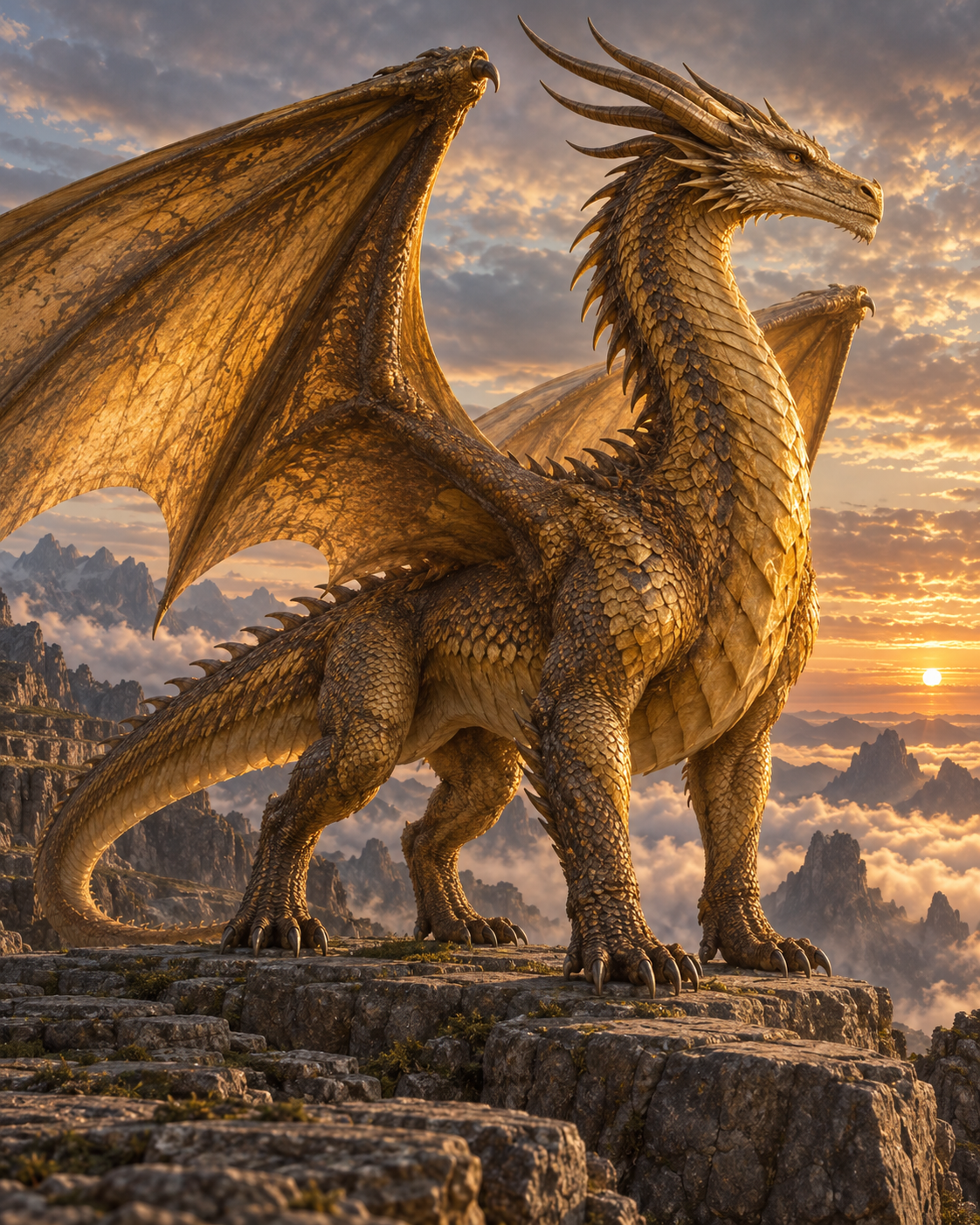
A magnificent ancestral dragon with one approved identity
Visual state: approved legendary reconstruction. Khaerukama’o now has one permanent interpretive ancestral-dragon identity, and this profile is published.
CVM depicts Khaerukama’o as an immense ancestral dragon with exactly four powerful legs, two vast shoulder wings, one long serpentine neck, one elongated head, one tail, warm old-gold and sunlit-amber scales deepening to antique bronze, natural amber eyes, and a heavy swept-back multi-horn crown. The body shares the approved lineage plan with Shurakai and Igjarjuk while remaining broader, longer-necked, more heavily crowned, and unmistakably distinct.
Canon supplies no size, sex, age, anatomy, number of limbs, wings, horns, eyes, teeth, scales, breath, injuries, habitat, treasure, expression, or current condition.
Gold remains the governing visual signal, but the precise old-gold, amber, antique-bronze scale map and every other anatomical detail are interpretive.
Do not identify Khaerukama’o as the Greater Wyrm. Do not reuse a descendant’s finished image with a color filter.
Preserve this exact anatomy, cranial silhouette, horn crown, golden surface logic, scale map, limb count, wing structure, and ancestral design across the hero, directory card, lineage diagram, dragon Story 101 pages, and every retrospective scene. The same canonical attachment powers featured image, hero, directory card, and social metadata.
On the Record
Book 1 lineage evidence with ancient status unresolved
This is Khaerukama’o the Golden’s one canonical, full-spoiler legendary profile. The confirmed evidence belongs to The Dragonbone Chair during Jiriki’s explanation of dragon generations.
The record confirms Khaerukama’o is the oldest named dragon ancestor in this chain and bears the epithet “the Golden.” Hidohebhi descends from Khaerukama’o; Shurakai and Igjarjuk descend from Hidohebhi. Jiriki says dragons diminish by generation.
The record does not confirm whether intervening generations exist, what quality diminishes, Khaerukama’o’s appearance beyond the epithet, sex, age, size, powers, behavior, home, relationships, deeds, death, survival, or identity as the Greater Wyrm.
Status: historical status unknown. The narrative neither shows Khaerukama’o alive nor confirms death.
Visual state: approved legendary reconstruction. The image does not claim a witnessed present-day body or settle Khaerukama’o’s life status, sex, habitat, behavior, powers, or identity as the Greater Wyrm. Every physical and environmental feature beyond the golden epithet and lineage context is CVM reconstruction. The same attachment powers featured image, hero, directory card, and social metadata.