
Memory, Sorrow, and Thorn · Canonical Character Profile
Tethtain the Holly King
Tethtain is the Hernystiri Holly King who enters the Hayholt and never comes out. That single remembered journey gives him a place among the Six Kings, a mound above Kynslagh-bay, and one of the castle’s cleanest unsolved disappearances. The record is tiny. The implications are enormous.
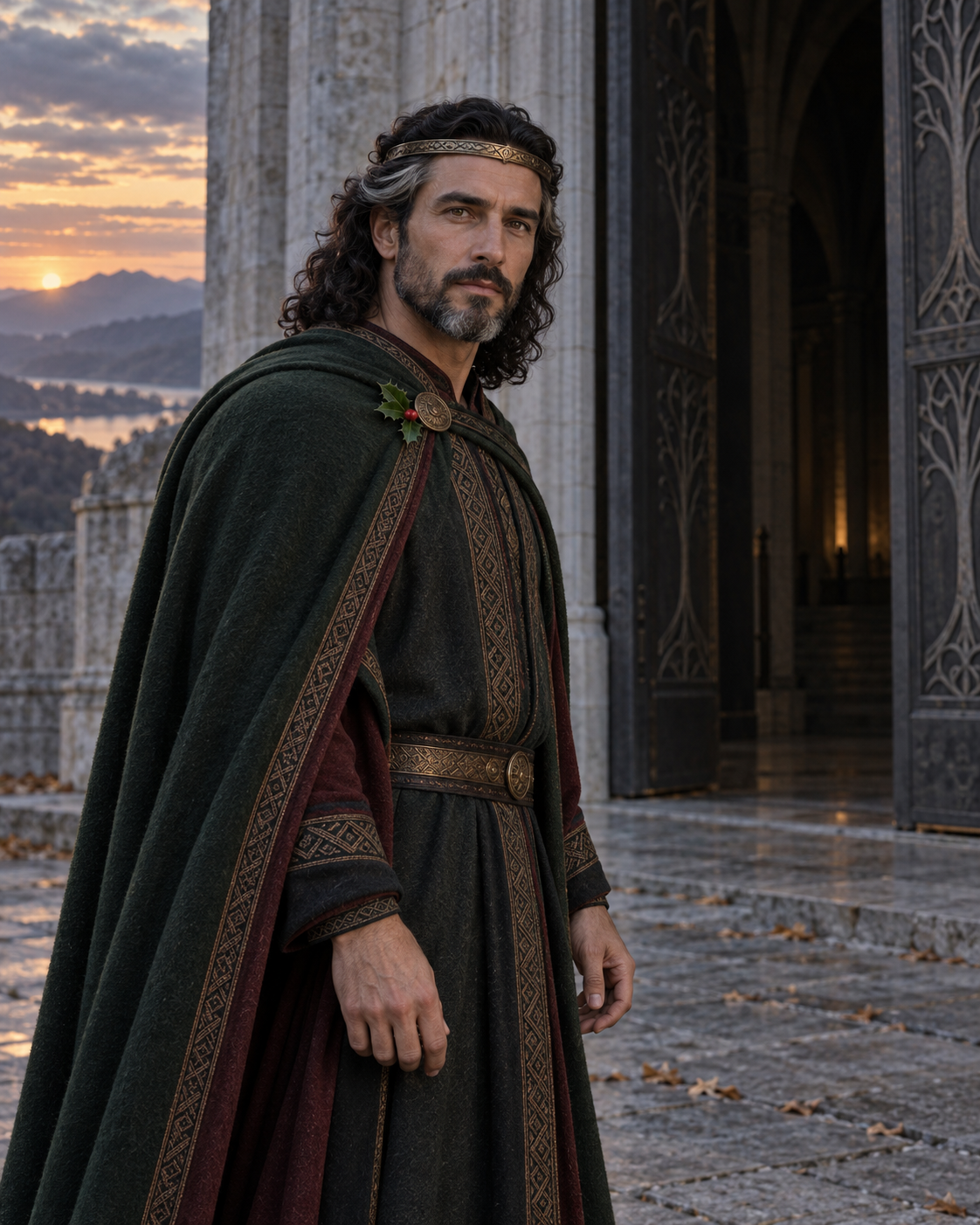
At a Glance
The king whose last confirmed action is crossing the Hayholt’s threshold
- Name
- Tethtain
- Title
- Holly King
- Culture
- Hernystiri
- Royal association
- One of the Six Kings remembered at the Hayholt
- Last confirmed action
- Enters the Hayholt’s gate and never emerges
- Monument
- Statue among the Six Kings
- Burial tradition
- Named among the kings associated with the mounds above Kynslagh-bay
- Status
- Dead or presumed dead; historical figure
The Holly King
The epithet marks identity while withholding its origin
Tethtain is remembered as the Holly King.
Holly carries recognizable winter, sacred, royal, and folkloric associations for readers, but the novel’s brief record does not define which of those meanings belongs to him.
It does not confirm a holly crown, household badge, seasonal office, religious order, grove, ritual contest, magical power, or association with the later song of King Hemlock and Prince Holly.
The safest reading is also the strongest: “Holly King” is Tethtain’s canonical epithet, one by which Hernystiri identity remains attached to his name after the biography around it has disappeared.
That cultural marker distinguishes him from the three Rimmersman kings placed opposite his statue and from Sulis of Nabban and Eahlstan of Erkynland.
He is not a generic green man imported from another mythology. He is a Hernystiri ruler remembered inside Osten Ard’s own political past.
He Entered and Never Came Out
The disappearance survives as action, destination, and absence
The Six Kings rhyme says Tethtain enters the Hayholt’s gate and never emerges.
Those are the confirmed elements. He approaches the castle, crosses its threshold, and is not seen coming back out.
The record does not identify which gate, who admits him, whether he arrives freely, why he comes, who accompanies him, whether he is armed, whom he intends to meet, or how long anyone waits before declaring him lost.
“Never came out” does not by itself prove murder.
It also does not prove imprisonment, sacrifice, transformation, secret escape, supernatural capture, voluntary concealment, or death inside the Hayholt.
The larger castle history makes all of those imaginatively tempting. The Hayholt is built over Asu’a, threaded with passages, occupied by successive regimes, and capable of swallowing people politically as well as physically. Temptation is not evidence.
Tethtain’s profile therefore preserves the disappearance as an unresolved historical event rather than selecting the most dramatic theory.
The language also makes the gate the story’s central object. His final memory is not a battlefield or throne. It is a boundary crossed once.
Among the Six Kings
Tethtain gives Hernystir a permanent place in the Hayholt’s royal memory
The Dragonbone Chair stands surrounded by statues of six rulers remembered before Prester John.
Fingil, Hjeldin, and Ikferdig—the three Rimmersman kings—stand on the left. Sulis, Tethtain, and Eahlstan stand on the right.
Tethtain’s placement joins a Nabbanai exile and an Erkyngu fisher-king rather than forming one dynasty. The grouping is a memory of successive mortal claims on the castle, not proof that these three ruled together or shared a cause.
Simon knows their stories through a childhood rhyme. When he enters the throne room, song becomes sculpture and architecture.
The text does not describe Tethtain’s statue face, pose, clothing, crown, weapon, or heraldry. Those details cannot be borrowed from Eahlstan’s radiance, Sulis’s pinched sadness, or Ikferdig’s fear and doubt.
Nor does the statue prove Tethtain ruled the Hayholt in an ordinary administrative sense. The rhyme calls him king and makes the castle his final destination; the exact nature or duration of his authority remains unstated.
What is indisputable is memorial inclusion. Later Erkynlanders considered his story important enough to stand around the royal throne.
The Mounds Above Kynslagh-bay
A burial rhyme gives Tethtain a mound without solving what happened to his body
The Six Kings song names six rulers beneath six mounds over deep Kynslagh-bay.
Later, Simon encounters the royal barrows on Swertclif and recites the six names before adding Prester John’s newer cairn.
Tethtain therefore belongs to the burial tradition surrounding the headland.
That does not establish a witnessed recovery of his remains from the Hayholt. A mound can be a tomb, memorial, cenotaph, or later royal claim; the available evidence does not specify which applies to Tethtain.
The tension is important. The song says he never comes out, yet the royal landscape gives him a mound.
Rather than resolving that tension by invention, the profile keeps both receipts visible. His people or later rulers remember him as one of the dead kings even though the story of his disappearance preserves no confirmed return of a body.
When John is buried nearby in the Sea-Arrow, the headland becomes a physical archive of kingship. Tethtain’s inclusion prevents that archive from belonging only to Rimmersmen and Erkynlanders.
Hernystir and the Hayholt
A vanished king becomes an early thread between two political worlds
Tethtain’s cultural identity matters because Hernystir remains politically distinct during Simon’s era.
King Lluth, Maegwin, Gwythinn, and Eolair inherit a living Hernystiri tradition under pressure from Elias and Skali. Tethtain belongs to a much older layer of contact with the Hayholt.
The record does not prove descent between Tethtain and Lluth’s house. It does not identify Tethtain’s capital, territory, clan, religion, language use, or relationship to later Hernystiri institutions.
His presence nevertheless blocks the false idea that the Hayholt’s history is exclusively an Erkyngu royal story.
Before John’s dynasty, a Hernystiri king crossed its gate and became part of its permanent memorial order.
Whether that represents alliance, conquest, invitation, challenge, pilgrimage, hostage-taking, or tragedy remains unknown.
Connections
The castle, kings, song, and later Hernystiri memory around Tethtain
The Hayholt
Tethtain’s final confirmed destination and the site from which he never returns.
The Six Kings
The memorial group that preserves his name, epithet, statue, and disappearance.
Sulis the Apostate
The Nabbanai Heron King placed on the same side of the Dragonbone Chair.
Eahlstan Fiskerne
The Erkyngu Fisher King completing the throne room’s right-hand group.
Simon
The castle boy who carries Tethtain’s history first as rhyme, then as monument and barrow name.
Hernystir
The culture named with Tethtain, preserving a connection older than Lluth’s present-day struggle.
Why Tethtain Matters
He makes absence an organized piece of history instead of an invitation to fanon
Tethtain matters because his disappearance demonstrates how little evidence a powerful historical memory may preserve.
His story has a name, culture, epithet, destination, monument, and burial tradition. It does not have a confirmed cause.
That gap is not permission to make the profile boring. It is the mystery’s shape.
The Hayholt consumes Tethtain’s visible future, while later people continue to sing and sculpt him. Political memory can preserve status even after it loses mechanism.
He also widens the castle’s history beyond the ruling culture of the present. A Hernystiri king stands permanently within the throne room’s account of legitimate or memorable kingship.
A complete fandom hub should make those relationships easy to navigate while refusing to turn a two-line mystery into an invented wiki novel.
Character Image Continuity
An attractive historical Hernystiri king, not generic holly cosplay
Visual state: approved editorial reconstruction. Tethtain now has one permanent living historical identity and this profile is published.
CVM depicts Tethtain as a devastatingly handsome mature Hernystiri king around forty-one: tall elegant warrior-king build, amber-brown eyes, warm olive-fair skin, shoulder-length black curls with restrained gray at both temples, close black-and-gray beard, and calm resolve. He remains visually distinct from Lluth, Gwythinn, Eolair, Fingil, Sulis, and Eahlstan.
Canon supplies no face, hair, eyes, age, height, build, facial hair, clothing, crown, armor, weapon, scars, or holly object. The design uses forest/charcoal/burgundy wool, a simple bronze circlet, and exactly one tiny three-leaf/two-berry holly sprig at the clasp as clearly labeled interpretive symbolism.
Do not give him a modern Christmas wreath, a generic druid costume, or a copied version of later Hernystiri clothing presented as fact.
Preserve this exact face, mature baseline, body, complexion, eyes, black-curl/gray map, beard, forest/charcoal/burgundy/bronze styling, circlet, and tiny holly sprig across the directory card, hero, Six Kings imagery, Swertclif context, and Hayholt disappearance scenes. The same attachment powers featured image, hero, card, and social metadata.
On the Record
Book 1 historical evidence with the disappearance unresolved
This is Tethtain’s one canonical, full-spoiler character profile. His evidence is concentrated in The Dragonbone Chair through Simon’s Six Kings rhyme, the throne-room statues, and the royal mounds above Kynslagh-bay.
The record confirms Tethtain is a Hernystiri ruler called the Holly King, remembered among the Six Kings, represented by a statue, and associated with the royal mound tradition. It confirms the transmitted story that he enters the Hayholt and never emerges.
The record does not confirm his family, reign dates, territory, appearance, reason for entering, companions, destination inside the castle, killer, captor, remains, funeral, exact mound contents, supernatural encounter, or cause of death.
Status: dead or presumed dead; historical figure. His disappearance is canonical; its solution is not supplied.
Visual state: approved editorial reconstruction. One canonical attachment powers featured image, hero, directory card, and social metadata; the living threshold scene preserves the unresolved disappearance and labels every unsupported visual detail as CVM reconstruction.