
Memory, Sorrow, and Thorn · Canonical Historical Profile
Sir Colmund of Rodstanby
Colmund begins as Camaris’s squire, inherits the black sword Thorn when his legendary master disappears, reclaims Rodstanby, and then follows stories of Igjarjuk’s hoard into the north with thirteen people. Decades later, Simon finds the company arranged beneath the Uduntree, a kneeling skeleton holding Thorn as if the expedition’s last duty was to make the sword discoverable.
At a Glance
The sword-bearer whose failed expedition becomes the successful map
- First role
- Squire to Sir Camaris
- Later rank
- Sir Colmund, Baron of Rodstanby
- Relic
- Last verified historical bearer of Thorn before Simon
- Expedition
- Leaves Saint Skendi in 1131 with a party of thirteen
- Destination
- Urmsheim and the rumored hoard of Igjarjuk
- End status
- Dead with the expedition beneath the Uduntree; exact individual remains unconfirmed
The Evidence Trail
One missing knight requires oral memory, manuscript, monastery bookkeeping, and a frozen crime scene
Colmund’s history does not arrive from one omniscient chronicle. Towser remembers Camaris giving Thorn to his squire. Morgenes and Nisses establish the sword’s larger identity. Father Strangyeard finds a surviving Saint Skendi household ledger. The northern party then reaches the physical remains under the Uduntree.
Each source does different work. Towser’s living memory explains the handoff. The archive fixes a date, group size, and route point. The frozen cave confirms that a company reached the sword’s final hiding place. Thorn itself is the surviving object that makes the accounts meet.
The profile should preserve those layers because the series makes research an adventure skill. Colmund is found not by prophecy alone, but by taking an old jester seriously and reading monastery accounts closely enough to turn “never returned” into a direction.
Camaris’s Squire
The greatest knight gives the greatest sword to the young man beside him
Before Camaris disappears near Harcha Island, he entrusts Thorn to Colmund. The handoff corrects the popular assumption that the knight carried the sword into the sea when he was swept overboard.
Camaris’s choice suggests practical trust. A squire manages weapons, horses, armor, messages, and the thousand unromantic tasks that keep heroic reputations alive. Giving Thorn to Colmund may be emergency custody rather than ceremonial succession, but it leaves the squire holding an object powerful factions will recognize even while sheathed.
Towser supplies the missing memory at Naglimund. Urgent men might dismiss his need to talk, yet the old jester remembers the precise human transfer the official record lost. Colmund’s profile begins in the gap between legend and the servant-level witness who saw where the sword actually went.
Rodstanby
He does not vanish immediately; first he becomes the man who takes his home back
After receiving Thorn, Colmund reclaims Rodstanby and becomes its baron. That detail prevents his life from collapsing into “Camaris’s squire who got lost.” He returns from service with enough authority and force to recover a dispossessed place.
The surviving ledger does not explain whom he reclaims it from, what campaign is required, or how long he governs. Those omissions matter. “Reclaims Rodstanby” establishes achievement without giving permission to manufacture a full local war.
His rise also changes the stakes of the later expedition. A baron leaves land, status, and duties to pursue the white dragon’s rumored hoard. Whether the motive is wealth, Thorn, loyalty, curiosity, or a mixture is not directly recorded.
Saint Skendi · Founding-year 1131
Thirteen travelers pass through a monastery and become a line in household accounts
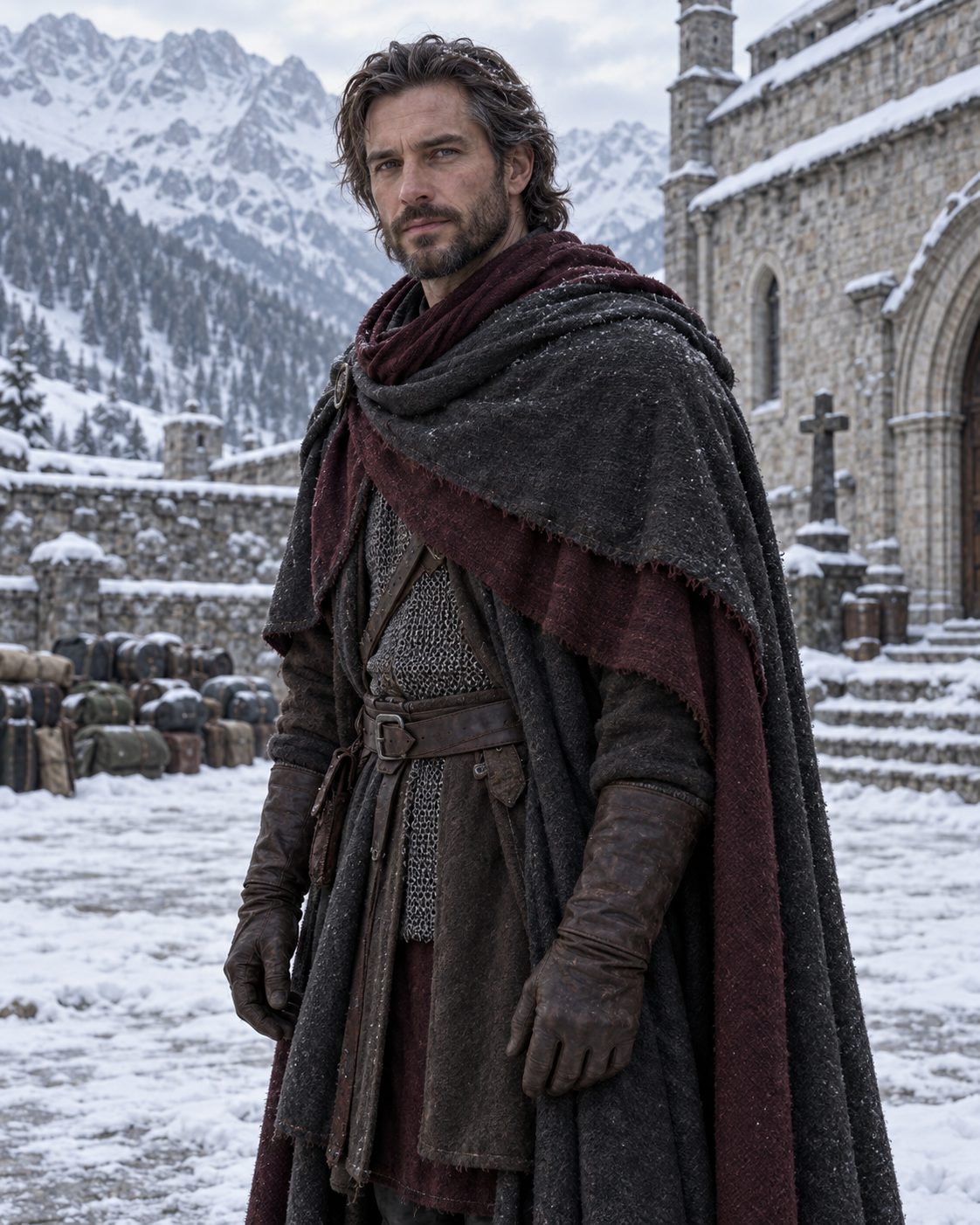
Strangyeard’s salvaged monastery ledger records Colmund reaching Saint Skendi with a party of thirteen in Founding-year 1131. The company is following tales of white Igjarjuk’s hoard toward Urmsheim.
The record also preserves a reference to the unknown “Rhymer’s Tree.” At the time of the Naglimund research, the phrase is unresolved rather than a confirmed map label. The path points into ice, trees, rock, and Qanuc country, but the archive cannot walk it for them.
Thorn is described as black with a silver hilt and famous enough that enemies recognize it while sheathed. Carrying the sword therefore makes Colmund’s party visible as well as formidable. The ledger proves departure, not motive, safety, or final route.
The Rhymer’s Tree
A corrupted or transmitted name becomes useful only when landscape and dream catch up to it
The northern search eventually identifies the Uduntree: a thousand-foot frozen waterfall formed by years of snowmelt over a stone spine. It resembles an impossible white tree and matches the branched tower woven into Simon’s earlier dreams.
“Rhymer’s Tree” functions as a transmitted clue rather than a clean modern coordinate. The search succeeds because archival language, Qanuc knowledge, visual geography, and Simon’s dream-image begin overlapping.
Colmund’s failed return leaves the clue behind. The company cannot bring Thorn south, but the trace of where they went becomes part of the rescue path decades later.
Beneath the Uduntree
The expedition lies down one by one and turns its last room into an archive
The searchers find a carefully walled cave holding the ice-preserved skeletons of Colmund’s company. The bodies appear to have lain down one by one rather than fallen in a single visible battle. A kneeling skeleton holds the wrapped black sword Thorn between its hands.
The tableau implies intention, but its precise story remains unrecovered. The ledger does not identify every skeleton, prove which one is Colmund, or establish whether cold, hunger, injury, magic, disease, or another cause killed each traveler.
What survives is arrangement. The wall protects the space. The party remains together. Thorn is wrapped and presented rather than discarded. Even if the company cannot escape, somebody prepares the sword to outlast them.
Thorn After Colmund
The sword changes weight, wakes for Simon, and makes the old expedition even stranger
Thorn is longer than a man’s outstretched arms, black from point through guard and pommel except for a silver-cord grip, and edged so sharply it splits light. Haestan and Sludig together can barely shift it.
After Grimmric is struck, Simon touches the sword again and lifts it alone as if the weight has vanished. He feels warmth and a pulse like a waking serpent beneath the cold surface. The object may have intention; Simon later believes it used him and wanted to be brought to Urmsheim.
That possibility changes how we read Colmund without solving him. Did Thorn influence the northward expedition? Did Colmund choose Urmsheim independently because of the hoard stories? The evidence does not answer. A good profile keeps the question open instead of retroactively turning the baron into a puppet.
Connections
The people who carry Colmund’s story after Colmund cannot
Sir Camaris
Legendary master who entrusts Thorn to his squire before disappearing near Harcha Island.
Towser
Living witness whose memory corrects the belief that Camaris took Thorn into the sea.
Father Strangyeard
Archivist who finds the Saint Skendi ledger fixing Colmund’s party, year, and northern trail.
Simon
Later bearer who follows the evidence to the cave and experiences Thorn’s impossible change in weight.
Igjarjuk
White dragon whose rumored hoard draws Colmund toward Urmsheim and whose eruption follows Thorn’s recovery.
Thorn
Black sword linking master, squire, barony, lost expedition, frozen dead, prophecy, and Simon.
Why Colmund Matters
He turns research from exposition into a chain of human custody
Colmund matters because artifacts do not move themselves through history—except, perhaps, when Thorn begins behaving as though it can. A squire receives the sword. A baron carries it north. Monks record a visit. A company protects it in death. A jester remembers. A priest reads. A new party follows.
The route also validates kinds of knowledge heroic councils routinely undervalue. Towser’s memory and a household ledger solve what formal legend cannot. The sword quest depends on listening across class, genre, and time.
Colmund remains a person rather than a waypoint because the evidence shows choices: serving Camaris, accepting custody, reclaiming Rodstanby, gathering thirteen travelers, going north, and participating in whatever final arrangement preserves Thorn. The motives behind those choices remain respectfully unresolved.
On the Record
Scope, status, chronology, and visual boundaries
This is Sir Colmund’s one canonical full-spoiler historical profile. His meaningful record is concentrated in The Dragonbone Chair, where the Naglimund research and Urmsheim discovery reconstruct his path. He is dead by the time Simon reaches the Uduntree.
The evidence confirms service as Camaris’s squire, custody of Thorn, recovery of Rodstanby, baronial rank, arrival at Saint Skendi in 1131 with thirteen people, pursuit of Igjarjuk’s rumored hoard, failure to return, and the expedition’s skeletons beneath the Uduntree. It does not prove which skeleton is Colmund, why the group died, or whether Thorn influenced the expedition.
No reliable physical description survives. CVM depicts Colmund as a devastatingly handsome adult around thirty-six: tall lean-muscled campaign build, gray-green eyes, weathered fair skin, swept-back medium dark ash-brown hair frosted at the temples, a short dark beard, and a steady thoughtful expression. Charcoal, deep-oxblood, muted-steel, and weathered-brown expedition layers place him alive at Saint Skendi without an invented crest or substitute sword. Preserve this exact face, adult baseline, body, coloring, hair/frost map, beard, wardrobe, and contained authority across Camaris handoff, Rodstanby, Saint Skendi, expedition, cave context, directory, hero, and social art. The same attachment powers all canonical placements. A kneeling skeleton may symbolize the company’s stewardship, but captions must never label it Colmund as confirmed fact unless stronger evidence is found.