
Memory, Sorrow, and Thorn · Canonical Character Profile
Grimmric
Grimmric carries no royal blood and receives no enchanted destiny. He carries Thorn, a hawkish face, bad teeth, a father’s winter song, and enough stubborn life to survive ice before a black arrow ends him. The song outlives the singer, helping the expedition find the Uduntree where mortal and Sitha are buried together.
At a Glance
The soldier whose old winter song becomes expedition intelligence
- People
- Erkynlander
- Role
- Soldier in the Thorn expedition and Simon’s road companion
- Appearance
- Slender, hawkish, bad teeth, watchful eyes
- Voice
- Scratchy but tuneful
- Inheritance
- His father’s winter song about the false holy visitor Old One-Eye
- End status
- Dead; struck by a black arrow and buried beside An’nai beneath the Uduntree
The Visual Receipt
Hawkish, watchful, and allowed to be attractive without deleting the bad teeth
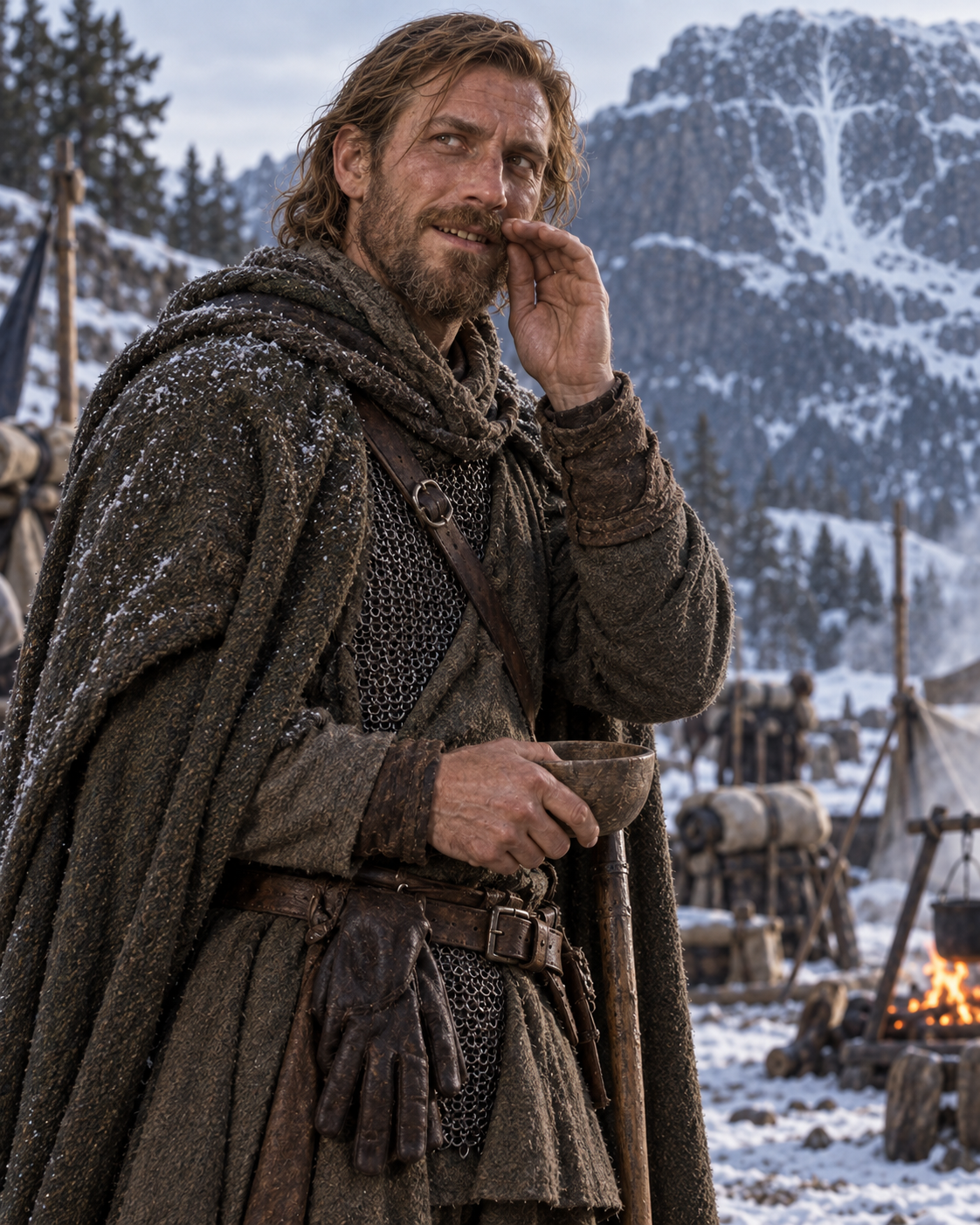
Grimmric is slender and hawkish, with watchful eyes and visibly poor teeth. His singing voice is scratchy but tuneful. These details survive the site’s hot-fantasy treatment rather than being airbrushed into a different person. Attractive does not require cosmetic sameness; his sharp face, alert intelligence, lived-in smile, and lean road-hardened body remain compelling because they are specific.
The approved portrait fixes one tall rope-muscled adult around thirty-four, with a long hawkish face, hazel-gray eyes, dark-blond hair and beard, weathered fair skin, and visibly irregular period teeth. Those colors, age, and finer facial details are reconstruction. His equipment belongs to an ordinary Erkynlander soldier on an under-supplied winter expedition, never a jeweled prince or borrowed Sithi warrior. Clothing can deteriorate across pursuit, snow, ice rescue, and attack, but identity cannot.
Book 1 · The Dragonbone Chair
One of the people who makes the Thorn expedition possible without becoming its headline
Grimmric joins the northern search led by Binabik with Simon, Haestan, Ethelbearn, Sludig, Qantaqa, and the rest of the small company. Their purpose is to bring Thorn toward Josua, but the road immediately begins charging lives for every mile. Ethelbearn dies during the Haethstad pursuit; Grimmric survives the fighting bloodied beside Haestan and Sludig.
When An’nai’s Sithi hunters capture the group, Grimmric remains bound with Haestan, Sludig, and Binabik while Simon is treated separately as the White Arrow bearer. The separation gives the sacred-law dispute a human edge. A mistake about one protected traveler still leaves his companions restrained and vulnerable.
Grimmric’s most consequential contribution begins as ordinary camp culture. He whistles and sings the old winter song his father taught him. Its false holy visitor is Old One-Eye, a figure Sludig recognizes as Udun the Rimer. Binabik can then connect the Rimer’s Tree with the Uduntree. Family folklore becomes navigational and linguistic evidence.
The moment matters because Grimmric does not know he is holding a clue when he begins. Knowledge often survives in forms scholars dismiss: a rough seasonal tune, a parent’s memory, a regional nickname, the bit everybody can hum even when nobody can cite a manuscript. The expedition needs archives and learned interpretation, but it also needs somebody who remembers what his father sang.
The Ice
Survival becomes a rope shared by people who cannot afford one dramatic rescuer
On the mountain road, an ice slab cracks beneath Grimmric. He falls and nearly pulls every roped mortal after him. The danger is collective because the rope that protects each traveler also transmits weight across the group. Binabik anchors the line; Jiriki and An’nai lash their ice axes to it; the company retrieves Grimmric senseless and shaking with fever.
Binabik’s Qanuc elixir revives him. The rescue resists the solo-hero shape. No single person can claim it. Sitha tools, Qanuc medicine and mountain skill, mortal bodies, rope discipline, and shared refusal all keep one ordinary soldier alive.
His recovery is not permission for the story to pretend nothing happened. The expedition continues with a man the cold has already carried to the edge. Every step after the crevice is borrowed effort, not proof that endurance cancels injury.
The Black Arrow
He survives the mountain’s accident and dies inside somebody else’s design
Later violence comes with black arrows and an enemy system larger than the travelers can see. Grimmric is struck and collapses. The narrative cuts toward Nakkiga and Utuk’ku, binding the small body on the mountain to the northern power directing the assault.
His death is confirmed after the immediate chaos. He and An’nai are buried together beneath the Uduntree. The joined grave is rare across five centuries, Jiriki says, and folds Grimmric’s name into the Sithi Dance of Years beside An’nai’s deeds.
The burial completes a relationship the first capture could not predict. Grimmric began bound under An’nai’s mistaken authority. They travel together after correction, face the mountain together, die in the same violence, and share ground beneath the tree the soldier’s inherited song helped identify.
The Winter Song
A scratchy voice carries a map nobody knew was a map
Grimmric’s father’s song disguises ancient knowledge inside a story about a false sacred visitor. Old One-Eye becomes Udun the Rimer once Sludig supplies the cultural bridge. Binabik then reads “the Rimer’s Tree” as the Uduntree. None of the three men possesses the solution alone.
The chain is editorial gold because it demonstrates how knowledge moves: inheritance preserves a phrase, regional religion identifies the figure, comparative reasoning finds the location. The result is not folklore defeating scholarship. It is folklore becoming legible through collaborative scholarship.
Grimmric’s bad teeth and scratchy voice are part of the receipt. The crucial song does not arrive from a perfect bard on a lit stage. It comes from a soldier whose father gave him something memorable enough to survive. Information does not become less important because its carrier lacks polish.
Book 2 · Stone of Farewell
The dead remain active in the decisions of the living
Grimmric’s direct life ends in the northern expedition, but Book 2 makes the loss part of Simon’s moral pressure. When Simon proposes desperate action after Binabik and Sludig receive a death sentence, Haestan invokes Ethelbearn and Grimmric. Losing Thorn through suicidal theater would make their effort fruitless. Their deaths become a reason to think more carefully, not a demand for louder revenge.
After Haestan also dies, Simon descends Sikkihoq enraged that birds, rabbits, moss, and sunset continue while Haestan, An’nai, Grimmric, and Morgenes do not. The list crosses rank, people, age, and intimacy. Grimmric belongs among the dead whose reality breaks Simon’s easy theology of deserving.
This limited Book 2 relevance is why the canonical record carries both Book 1 and Book 2 scope. It does not pretend Grimmric survives or grant him invented scenes. It preserves explicit memorial force.
Connections
The company that hears, rescues, mourns, and remembers him
Simon
Road companion and later mourner. Grimmric’s death becomes part of Simon’s argument against meaningless sacrifice and easy divine justice.
Haestan
Fellow Erkynlander survivor and the man who invokes Grimmric’s sacrifice when Simon wants to gamble the mission on a hopeless rescue.
Sludig
Recognizes Old One-Eye as Udun the Rimer, turning Grimmric’s inherited lyric into a usable cultural bridge.
Binabik
Connects the song to the Uduntree, anchors the ice rescue, and uses Qanuc medicine to call Grimmric back from the cold.
An’nai
First his mistaken captor, later his companion and grave-mate beneath the Uduntree.
Grimmric’s father
Never physically present, yet decisive through the winter song he passed to his son.
Why He Matters
The world turns because ordinary people remember things nobody labeled important
Grimmric’s function is not to secretly become great. It is to demonstrate that importance can remain ordinary. He fights, travels, sings, falls, is rescued, dies, and receives a grave. The song matters because it is specific to him, not because destiny selected his bloodline.
His profile also protects a broader truth from protagonist gravity. Thorn does not move north because Simon wills it hard enough. Soldiers like Grimmric absorb pursuit, carry gear, share ropes, preserve local knowledge, and die before anyone can promise that their labor will be repaid.
The joined burial with An’nai turns his name into a cross-cultural memory without dissolving either man’s identity. Five centuries of rarity do not make the grave valuable because it is unprecedented content. The grave matters because two people who began divided by fear and authority ended inside the same company.
A Shared Grave
The Uduntree holds both the clue and the people who paid to reach it
The old song helps identify the tree before Grimmric ever sees it. Later the tree becomes his burial place. That symmetry could become too neat if death were treated as poetic decoration, but the scene keeps the bodies and grief present.
Jiriki’s statement about rarity places the burial inside Sithi history. Grimmric enters the Dance of Years not as a generic mortal but through deeds witnessed on the road. An’nai enters beside him with his own record. Shared ground does not require interchangeable stories.
On the Record
Scope, spoilers, and evidence limits
This is Grimmric’s one canonical full-spoiler profile. Book 1 contains his direct expedition, song, ice rescue, death, and burial. Book 2 explicitly carries him through Haestan’s argument and Simon’s grief. He is not assigned to Books 3 or 4 without evidence.
The visual record confirms a slender hawkish man with bad teeth, watchful eyes, and a scratchy but tuneful voice. The approved age, exact height and body, facial geometry, eye/hair/skin colors, beard, clothing, bowl, staff, camp, mountain view, white-tree visibility, weather, and light are editorial reconstruction.
Every future card, hero, scene, song, death, or memorial illustration must use this same approved identity. His imperfect teeth must remain visible without grotesque caricature, while black-arrow and burial imagery must preserve the person rather than using his body as spectacle.