
Memory, Sorrow, and Thorn · Canonical Character Profile
Baron Godwig
Baron Godwig of Cellodshire enters the story through other bodies. His red-and-blue Cellodshiremen gain Naglimund’s battlement at Dendinis’ Tower and are driven back at terrible cost. In Book 2, Godwig’s severed head hangs above the Hayholt’s Nearulagh Gate among nine others labeled “traitors.” The novels never give him a heroic close-up or even confirm his personal position during the assault. They give something colder: a lord’s name organizing soldiers, then a corpse reorganized into state propaganda.
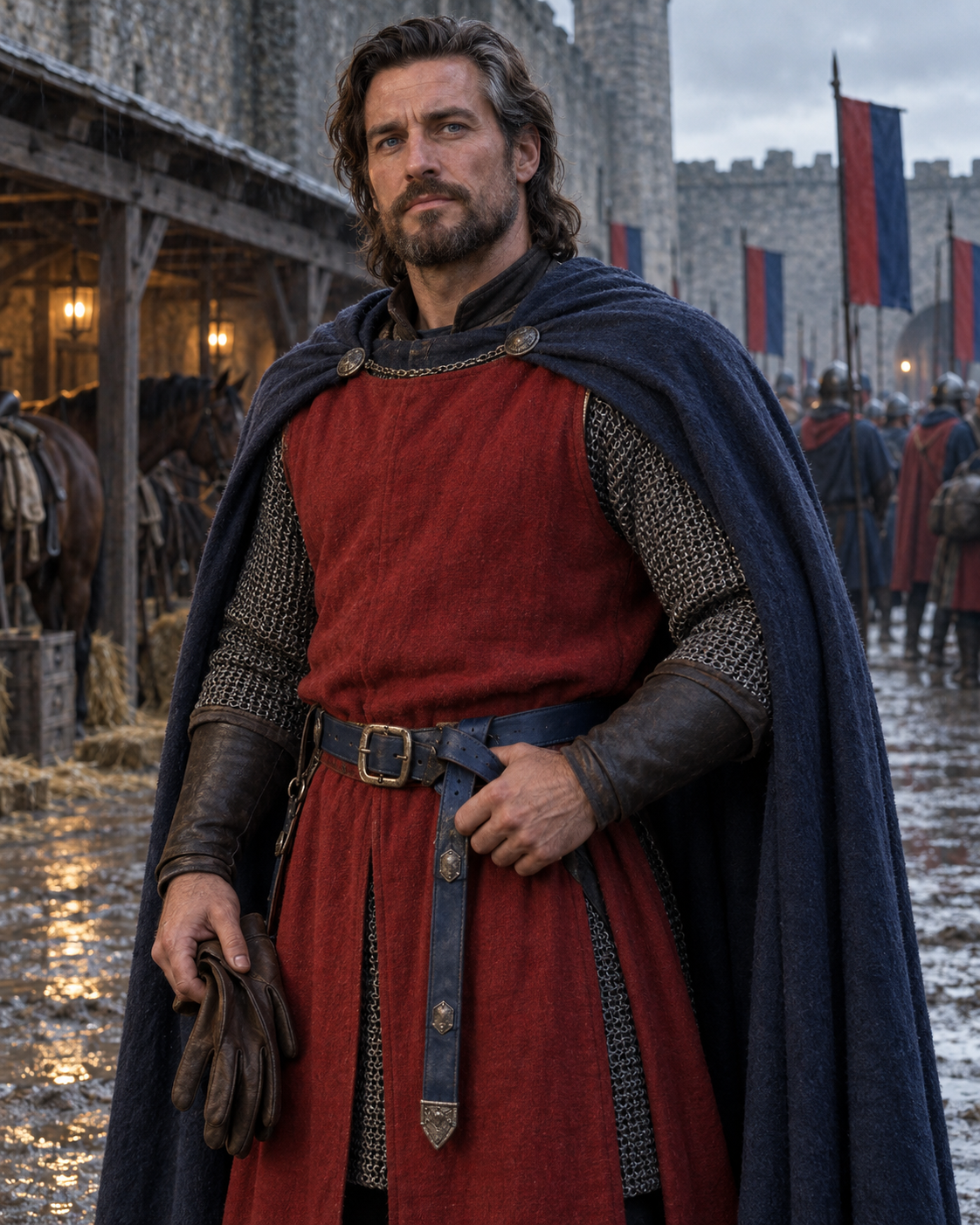
At a Glance
The baron whose name survives first as a military banner and then as a warning
- Name
- Godwig
- Title
- Baron
- Holding
- Cellodshire
- Colors
- Red and blue, worn by his Cellodshiremen
- Book 1 action
- His troops breach Naglimund’s battlement at Dendinis’ Tower
- Book 2 fate
- Dead; severed head displayed as a “traitor”
- Death circumstances
- Not confirmed in the completed record
Baron of Cellodshire
A real place enters the war through colors, soldiers, and one aristocratic name
Godwig is Baron of Cellodshire, an Erkynlandish territory whose men appear in red and blue during Elias’s assault on Naglimund.
The colors matter because medieval-style warfare depends on visible affiliation. In smoke, snow, ladders, shouting, and crowded battlements, clothing and devices tell defenders which force has reached them.
Godwig’s name organizes that affiliation. The soldiers are not anonymous pieces in Elias’s army; they are Cellodshiremen attached to a baron whose local authority has been drawn into the king’s war against Josua.
The record does not supply Godwig’s castle, family, age, face, coat of arms, personal politics, or reason for serving Elias in the assault. Red and blue belong to the troops’ visible identity; a future portrait should not invent a complicated heraldic beast merely because the palette survives.
Cellodshire later becomes the invented origin for Miriamele’s “Lady Marya” disguise, daughter of a fictional Baron Seoman. That use confirms the shire’s plausibility as a noble territory but does not connect the disguise to Godwig personally. The page must not turn a convenient lie into family history.
The Breach at Dendinis’ Tower
Godwig’s men reach the wall before Deornoth and Grimstede throw them back
On the ninth day of Yuven, Elias launches the great assault on Naglimund. Six hide-covered siege towers move toward the walls beside catapults, a ram, miners’ frames, ladders, archers, and overwhelming numbers.
At Dendinis’ Tower, Godwig’s red-and-blue Cellodshiremen gain the battlement. The phrase records success at the most dangerous point of siege warfare: attackers survive the ladders and reach the defenders’ level.
Deornoth and Sir Grimstede’s men counterattack and force the ladders away at heavy cost. Grimstede suffers a ragged wound through calf and boot. Deornoth’s damaged shoulder worsens.
Godwig’s troops also pay heavily. Elias can spend soldiers like apple peelings because his army has depth; Naglimund cannot replace every defender who falls. The Cellodshiremen’s breach becomes part of that arithmetic.
The record does not say Godwig personally climbs, watches from below, commands from another position, or is even physically present at Dendinis’ Tower. “Baron Godwig’s men” confirms military affiliation, not the baron’s location.
This boundary matters because heroic profile writing loves inserting commanders into the center of action. Godwig’s documented role is feudal and organizational. His name reaches the battlement through the men fighting there.
Whose Side Was He On?
Serving Elias at Naglimund does not answer every question about Godwig’s allegiance
Godwig’s men attack a stronghold held by Josua. In that battle, their service advances Elias’s campaign.
The completed record does not reveal whether Godwig chose Elias enthusiastically, obeyed the crowned king under feudal obligation, faced coercion, changed sides later, or became suspect for an unrelated reason.
That uncertainty becomes crucial in Book 2 when his head is labeled traitorous. The display proves the regime classified him as an enemy by then. It does not explain the path from Naglimund attacker to executed “traitor.”
Political allegiance in the collapsing kingdom is not a single permanent tag. Lords can obey, resist, calculate, defect, be accused falsely, or become inconvenient to the same ruler they once served.
Godwig’s page should preserve the chronology without forcing a neat conversion arc. First, his soldiers fight under Elias’s assault. Later, Elias’s Hayholt displays Godwig’s severed head. The missing explanation is part of the record.
Above Nearulagh Gate
The regime turns ten dead people into architecture
By Book 2, the Hayholt is crowded with Thrithings mercenaries and South Islanders. Chambermaids flee. Corridors feel unfamiliar. Summer remains cold and wet.
Above the Nearulagh Gate hang ten severed heads identified as traitors. Baron Godwig is among them. Chancellor Helfcene is another.
The display converts execution or post-death mutilation into public instruction. Everyone entering or leaving reads the gate through the bodies: status cannot protect you, service cannot guarantee safety, and the king decides whose death becomes treason.
Godwig’s title sharpens the threat. This is not punishment confined to nameless thieves or captured foot soldiers. A baron’s head can be detached from the body that wore courtly rank and installed beside others as a state-controlled sentence.
The books do not confirm where Godwig was killed, whether he received a trial, who executed him, how long the head has hung, or what happened to the body. The display is direct evidence of death and regime classification, not a complete execution record.
Future imagery should treat this as political horror, not gore content. The canonical hero must be the living man. A separate gate scene can communicate distance, repetition, weather, and public intimidation without using mutilation as a clickable spectacle.
The Quotation Marks Around “Traitor”
A label over a corpse tells us what power wants remembered, not automatically what happened
The ledger places “traitor” in quotation marks because the category belongs to the regime’s display. A severed head cannot answer the accusation.
Godwig’s earlier association with Elias makes the label especially revealing. If his men fought Josua at Naglimund, then treason is not simply a stable list of everyone who opposed the king from the beginning.
The accusation may record defection, disobedience, court purging, fabricated guilt, or events absent from the completed receipts. Choosing one would be invention.
What the display proves is Elias’s political world becoming narrower and more violent. Former or apparent service offers no permanent protection when suspicion becomes governance.
Godwig’s body is also deprived of personal narrative. The state supplies the final caption. A full profile restores chronology around that caption so readers can see the unresolved contradiction instead of absorbing propaganda as biography.
A Baron Seen Through Other Bodies
Godwig’s profile is about representation in its harshest forms
The novels do not stage Godwig speaking. They show the social extensions of his identity.
In Book 1, soldiers carry his territorial name and colors into battle. His authority is visible through living men who risk death under it.
In Book 2, the regime uses his severed head to represent treason. His identity is visible through a dead body power has rearranged.
Both images concern who controls meaning. A baron’s banner tells soldiers where they belong. A king’s gate tells survivors what the dead supposedly were.
Godwig never receives a viewpoint from which to challenge either representation. The fandom profile cannot manufacture one. It can place the two public uses side by side and refuse to pretend the gap between them is resolved.
Connections
The commanders, defenders, and fellow victim around Godwig’s surviving record
King Elias
Launches the Naglimund assault served by Godwig’s men; his regime later displays Godwig as a traitor.
Deornoth
Leads the counterattack that drives the Cellodshiremen from Dendinis’ Tower.
Sir Grimstede
Commands defenders at the breach and is wounded while helping throw back Godwig’s troops.
Josua
Holds Naglimund against the army in which the Cellodshiremen fight.
Chancellor Helfcene
Another titled victim whose severed head appears in the same Hayholt display.
The Cellodshiremen
Red-and-blue soldiers through whom Godwig’s name first enters the active war.
Why Godwig Matters
He shows how feudal identity can be spent twice: once in battle and once in terror
Godwig’s soldiers give Elias bodies for the wall. Godwig’s severed head gives the regime a body for the gate.
The first expenditure uses local allegiance to fuel war. The second uses aristocratic death to discipline everyone who remains.
Because the transition is unexplained, Godwig also exposes the instability of labels. A lord can be associated with royal assault and later classified as royal traitor without the narrative offering a clean ideological biography.
A thin wiki entry might resolve the discomfort by inventing a defection or ignoring the first scene. A rigorous fandom page keeps both receipts and lets the contradiction reveal how quickly Elias’s state consumes its own supporters.
On the Record
Books 1 and 2, death confirmed, allegiance transition unresolved
This is Baron Godwig’s one canonical full-spoiler profile. Book 1 names his red-and-blue Cellodshiremen during the breach at Dendinis’ Tower. Book 2 confirms his death by displaying his severed head above Nearulagh Gate under the regime’s “traitor” label. No direct Godwig receipt appears in Books 3 or 4.
The record confirms his title, territorial association with Cellodshire, troop colors, his men’s role in Elias’s assault, death before the Hayholt display, and public classification as a traitor. It does not confirm his appearance, age, family, heraldry beyond colors, personal presence at Naglimund, motive, later change of allegiance, arrest, trial, execution method, killer, burial, or the location of his body.
The approved living identity presents Godwig at about forty-four: tall and powerfully athletic, with a striking long-square face, high cheekbones, straight strong nose, deep-blue eyes, weathered fair skin, collar-length dark-chestnut hair with one gray left-temple streak, and a close chestnut beard. His exact age, face, build, eyes, hair, beard, clothing, armor, gloves, simple divided banners, assembly yard, weather, and light are editorial reconstruction. This exact identity now governs living portrait, Cellodshire, Naglimund context, directory, hero, social, and any later restrained death-display image. The gate may communicate state terror from a distance; it may never replace the living man as his canonical image or turn mutilation into clickbait.