
Memory, Sorrow, and Thorn · Canonical Character Profile
Lucuman
Lucuman is Naglimund’s bent, limping stablekeeper—the man who sees Qantaqa, decides “devil-beast,” ropes her by the neck, and drops her into a slaughter pit. Then Simon climbs down and demonstrates the revolutionary animal-care technique of knowing the creature before trying to kill her.
At a Glance
The stablekeeper whose fear turns a guest’s companion into slaughter stock
- Name
- Lucuman
- Role
- Naglimund stablekeeper
- Appearance
- Bent, sour-faced, and limping
- Target
- Qantaqa
- Confirmed actions
- Misgenders her, calls her a devil-beast, ropes her neck, confines her in a muddy slaughter pit, and later helps haul her out
- Confronted by
- Simon
- Other witness/helper
- Sangfugol
- Status
- Alive when last confirmed at Naglimund
The “Devil-Beast” Verdict
Lucuman reaches for a category before he reaches for knowledge
Qantaqa arrives at Naglimund as Binabik’s wolf companion.
Lucuman repeatedly calls her a devil-beast. He also misgenders her.
These are not harmless vocabulary slips. His category determines his treatment: he sees something frightening and unfamiliar, assumes danger is its essence, and acts as though violence requires no further evidence.
The text does not say Qantaqa attacks Lucuman, threatens a horse, bites a worker, or injures anyone before confinement.
Her size and wolf nature can reasonably frighten a stablekeeper responsible for animals and people. The page does not need to pretend fear itself is irrational.
The failure comes afterward. Lucuman allows fear to substitute for observation, communication, or an attempt to locate the people traveling with her.
He does not know Qantaqa’s name, sex, bond with Binabik, loyalty to Simon, or history of saving lives. Simon does.
The Slaughter Pit
The setting reveals what Lucuman thinks should happen next
Lucuman ropes Qantaqa by the neck and puts her into a muddy slaughter pit.
The location matters. This is not a secure guest enclosure, an empty stall, or temporary quarantine designed around care.
A chopping block is available within the pit. Simon later uses it as a step to help Qantaqa climb out, transforming an object associated with killing into rescue leverage.
The ledger confirms Qantaqa has been thrown down and confined. It does not record a completed attempt to kill her, an injury inflicted by Lucuman, or an explicit order from Josua.
We should therefore describe the deadly implication without inventing a blow that never lands.
Lucuman’s authority is local and practical. As stablekeeper, he can control where an animal is kept and recruit others into his fearful interpretation.
That small authority is enough to create mortal danger when nobody first asks whose companion she is.
Simon Climbs Down
The rescue works because relationship supplies knowledge fear refused to gather
Simon does not rescue Qantaqa by standing safely above the pit and announcing that he is a knightly hero.
He climbs in.
He wins her recognition through scent and touch, checks her body for injury, and uses the chopping block as a ramp.
Then he orders the frightened men to haul while he lifts.
Lucuman and Sangfugol help pull Qantaqa free. The rescue ends with her unhurt and reunited with Binabik.
Simon also corrects Lucuman’s misgendering.
The sequence is practical, physical, and relational. Simon understands Qantaqa as an individual. He knows how she recognizes him, checks what condition she is in, changes the geometry of the pit, and forces available labor into cooperation.
Lucuman’s eventual assistance matters, but it does not erase the confinement. He helps after Simon supplies the plan and pressure.
The record does not preserve an apology, changed belief, later friendship with Qantaqa, punishment, or continued hostility.
Fear, Prejudice, and Responsibility
Lucuman is not condemned for limping or fearing a wolf; he is accountable for what he does with fear
Lucuman is bent, limping, and sour-faced.
Those physical facts must not become a morality code.
His disability does not cause cruelty. His appearance does not prove cowardice. Future art cannot exaggerate his body into a grotesque visual punishment.
The relevant moral evidence is behavioral: he repeatedly dehumanizes—or more precisely demonizes—Qantaqa, assumes violence is justified, and confines her without understanding her relationships.
The scene also keeps him human rather than mythically evil. He is frightened. When Simon takes control, Lucuman helps haul.
That complexity does not absolve him. Ordinary fear in an ordinary worker can still create a killing place.
Naglimund is crowded with refugees and preparing for war. Pressure may help explain an anxious environment, but the text does not explicitly attribute Lucuman’s conduct to siege stress, previous animal attacks, religious belief, or orders.
Explanation must remain evidence-bounded.
Qantaqa’s Personhood
The scene tests whether belonging is recognized only when a human sponsor arrives
Qantaqa cannot explain herself in Lucuman’s language.
Without Binabik present, her history disappears from the stablekeeper’s view. She becomes a category instead of a relationship.
Simon restores that context by entering the pit and behaving as someone already known to her.
The rescue does not turn him into her owner. Qantaqa’s primary bond is with Binabik, and the series repeatedly frames that bond through mutual honor rather than possession.
Lucuman’s mistake therefore is not simply that he mishandles somebody else’s property. He fails to recognize a thinking, bonded companion whose conduct could have been learned before lethal containment.
The profile should keep Qantaqa centered as the harmed party instead of converting the episode into a charming story about Simon’s bravery alone.
Connections
The wolf, young rescuer, harper, and fortress around Lucuman
Qantaqa
The wolf companion Lucuman misidentifies, ropes, and confines before Simon rescues her.
Simon
Challenges Lucuman, enters the pit, checks Qantaqa, builds the escape, and directs the hauling.
Sangfugol
Present at the rescue and helps haul Qantaqa from the pit.
Binabik
Qantaqa’s bonded companion, absent during confinement and reunited with her afterward.
Naglimund
The refugee-crowded stronghold where Lucuman exercises small but dangerous stable authority.
The chopping block
A slaughter object Simon turns into the step that makes escape possible.
Why Lucuman Matters
He gives the epic a small-scale demonstration of how categories authorize harm
Lucuman matters because not every threat in the trilogy arrives wearing black armor or carrying a Great Sword.
Sometimes danger is a worker with a rope, a frightening label, and enough authority to put a misunderstood creature into a pit.
The scene also marks Simon’s growth. He solves the problem through loyalty, bodily risk, observation, leverage, and command—not fantasy violence.
Lucuman’s participation in the hauling keeps the episode from becoming a simple monster-versus-hero diagram. People can cause harm, be confronted, and still become necessary to repair the immediate crisis.
The absence of a recorded apology prevents a tidy redemption arc. We know Qantaqa escapes. We do not know whether Lucuman learns.
A complete fandom profile can be honest about that limit while still showing why this sour stablekeeper earns a canonical place in the Book 1 ecosystem.
Character Image Continuity
Age-correct and human, with disability never used as ugliness shorthand
Visual state: approved editorial reconstruction. Lucuman now has one permanent identity and this profile is published.
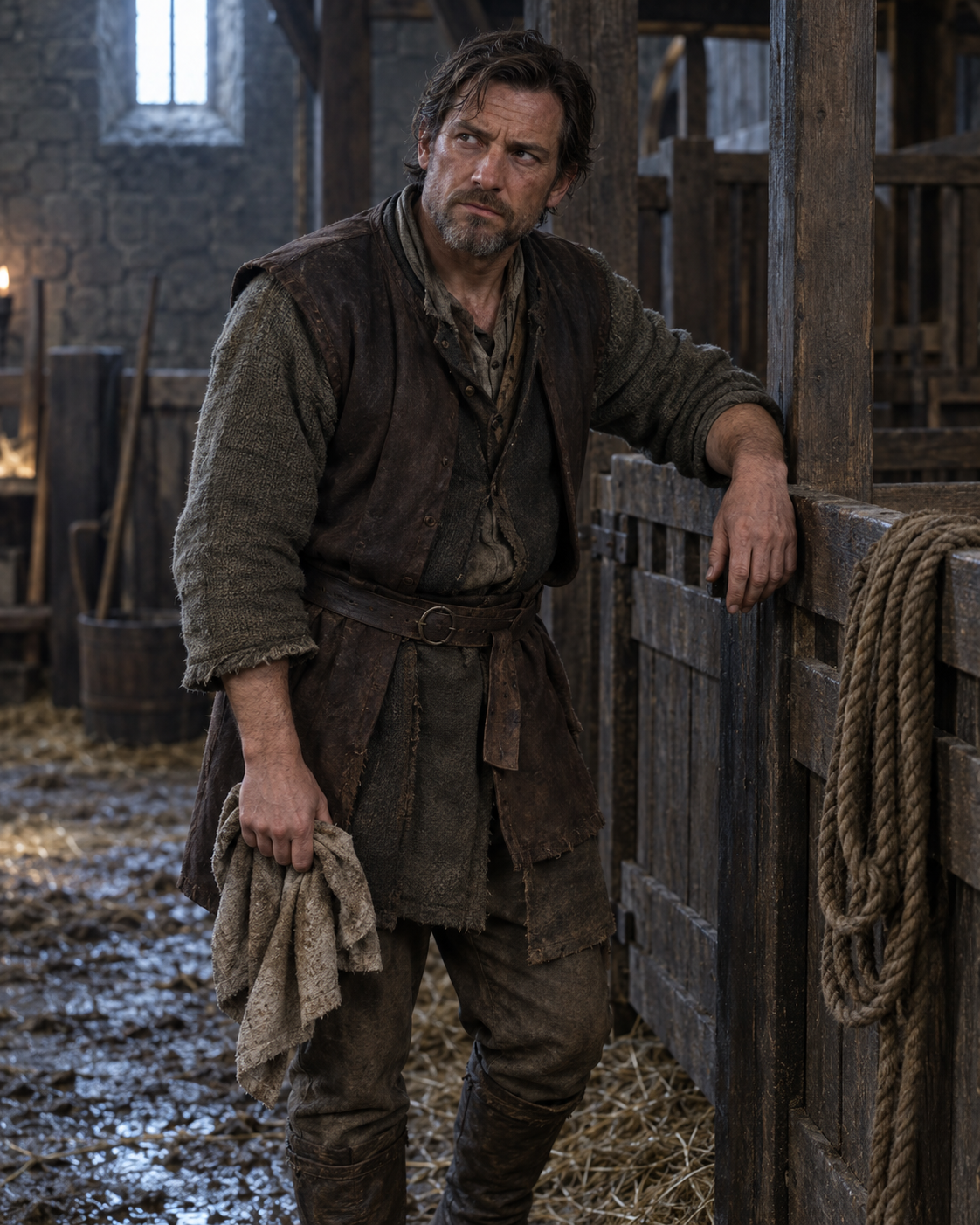
CVM depicts Lucuman as a ruggedly attractive adult around forty-three: sturdy working build, weathered fair skin, gray-green eyes, dark-brown hair touched with gray, short practical beard, and a wary sour expression. His asymmetric stance and supported lean communicate the canonical impairment without turning his body into a morality code.
Canon supplies no exact age, skin, hair, eyes, height, build beyond bent posture, facial hair, clothing, scars, jewelry, or cause of impairment. Those visual details remain explicitly editorial reconstruction.
The approved portrait places him in Naglimund’s cold timber stable with muddy straw, a plain rope coil, and a folded working cloth. Preserve this exact face, adult baseline, body, coloring, hair-and-gray map, beard, worn charcoal-brown wardrobe, posture logic, and guarded expression across every reuse. Qantaqa may appear in later scene art only with her approved canonical identity and correct sex.
Do not visually imply that Lucuman’s body makes him cruel. Expression and action can communicate suspicion; disability remains a neutral physical fact.
The same canonical attachment powers featured image, hero, directory card, and social metadata. Preserve the same face, age, body, gait logic, and stable clothing across Qantaqa rescue imagery and Naglimund pages.
On the Record
One Book 1 scene, a complete action chain, and no invented aftermath
This is Lucuman’s one canonical, full-spoiler character profile. His confirmed appearance belongs to The Dragonbone Chair at Naglimund.
The record confirms he is a bent, sour-faced, limping stablekeeper. He calls Qantaqa a devil-beast, misgenders her, ropes her neck, and confines her in a muddy slaughter pit. Simon enters, earns Qantaqa’s recognition, checks her for injury, uses a chopping block as a step, and directs Lucuman and Sangfugol to haul while he lifts.
Qantaqa escapes unhurt and reunites with Binabik.
The record does not confirm Lucuman’s age, family, disability’s cause, earlier life, orders, prior encounters with wolves, intended execution method, apology, punishment, later treatment of Qantaqa, changed beliefs, or fate after Naglimund.
Status: alive when last confirmed at Naglimund. This repairs the earlier generic “status unknown” placeholder.
Visual state: approved editorial reconstruction. The same canonical attachment powers featured image, hero, directory card, and social metadata; all unsupported physical and costume details remain disclosed as CVM reconstruction.