
Memory, Sorrow, and Thorn · Canonical Character Profile
Baron Heahferth
Young, chestnut-curled, and polished in silvery armor beneath three yellow flowers, Baron Heahferth looks exactly like the nobleman who expects rank to make a hunt obey him. It does not. Ingen Jegger quietly owns the hounds, the mission, and the danger. Heahferth ignores the one warning that might save him, rides onto the Gate of Stags, and falls with his horse and men when the ancient bridge folds into the Aelfwent.
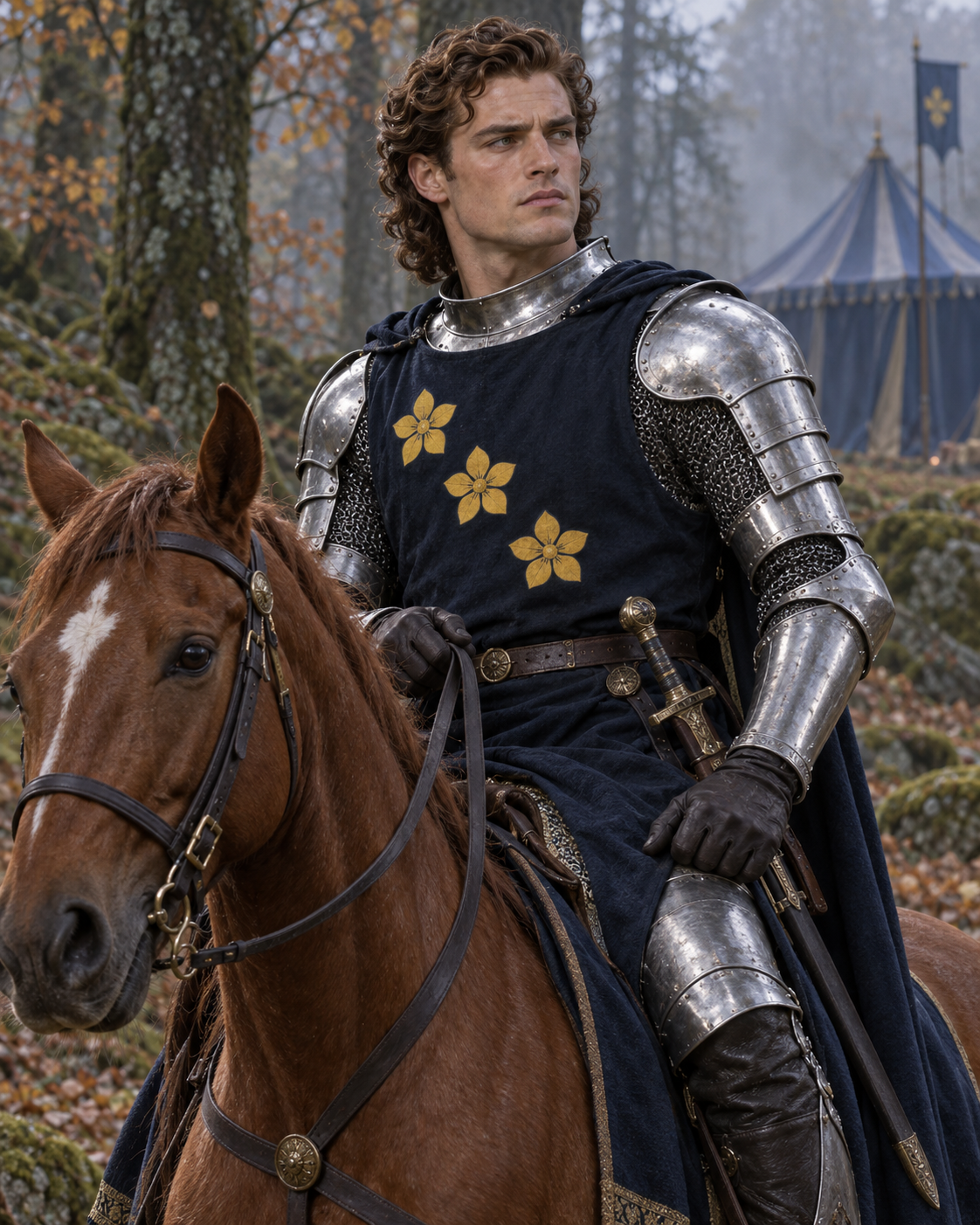
At a Glance
The handsome local baron who has the title while Ingen Jegger has the hunt
- Name
- Heahferth
- Title
- Baron; local Erkynlandish lord
- Appearance
- Young, clean-shaven, strong chin, curling chestnut hair
- Dress
- Silvery armor beneath a blue-black surcoat
- Arms
- Three diagonal yellow flowers
- Horse
- Chestnut
- Court alignment
- Regular at Elias’s court and crony of Count Fengbald
- Fate
- Falls into the Aelfwent when the Gate of Stags collapses
A Familiar Face at Elias’s Court
Heahferth enters the forest carrying the confidence of proximity to power
Simon recognizes Heahferth as a regular at Elias’s court and a companion of Count Fengbald.
That affiliation places him within the social world surrounding the new High King: younger nobles whose access, laughter, and advancement help make Elias’s rule look normal even as coercion deepens around it.
The record does not give Heahferth a private conversation with Elias or prove personal knowledge of the Storm King’s bargain. Court attendance and friendship with Fengbald establish alignment, not omniscience.
His visual presentation is exquisitely legible. He is young and clean-shaven, with a strong chin and curling chestnut hair. He wears a blue-black surcoat over silvery armor, marked with three diagonal yellow flowers, and rides a chestnut horse.
This is not anonymous henchman design. Heahferth looks like a courtly military noble with a recognizable house, resources, and public identity.
The flowers are especially effective. Ingen Jegger and the altered white hounds carry hard northern terror into the scene; Heahferth arrives with bright heraldry and polished feudal legitimacy. The respectable surface does not make the hunt respectable.
He may resent what the pursuit has become, but he still accompanies it. His reluctance concerns damaged hounds, trespassed boundaries, and Ingen’s command—not a recorded moral objection to hunting escaped children for Elias.
The Title Is Local; the Mission Is Not
Ingen strips Heahferth’s authority without ever needing to strip his heraldry
Heahferth’s mounted party arrives beneath the rock where Simon, Binabik, the disguised Miriamele, and the gravely injured Leleth hide.
At least twenty altered white hounds crowd below. The animals bear a Stormspike brand and Elias’s coiling-dragon kennel buckle, joining northern power to the High King’s material resources.
Heahferth resents the dead dogs and protests the hunt moving beyond his lands. Those complaints reveal a territorial understanding of authority: he expects local rank to govern men, animals, and pursuit inside recognizable boundaries.
Ingen Jegger answers with quiet menace and superior operational knowledge. He identifies that the quarry killed the hound, insists Elias urgently wants the two escaped prisoners, and redirects the pack after Qantaqa’s false trail.
The exchange exposes the hierarchy. Heahferth may be a baron, but Ingen controls the unnatural machinery. The local lord’s title has ceremonial and territorial weight; the huntmaster possesses the king’s mission, the hounds’ obedience, and the confidence of someone backed by a more frightening power.
Gelöe later treats Heahferth as the lesser concern and identifies Ingen as the true danger. Her judgment is not flattery or insult. It is tactical triage.
When the fugitives cross Gelöe’s lake, Heahferth’s striped blue tents mark one camp. A sentry nearly sees the boat before Gelöe’s owl diversion pulls his attention away.
Heahferth remains persistent enough to continue the pursuit toward Da’ai Chikiza. Being overawed by Ingen does not make him harmless.
Prisoners, Not Quarry
Heahferth helps translate Elias’s political demand into a hunt for two girls
The pursued “boy” is Miriamele in disguise. The smaller child is her handmaid Leleth, already brutalized and close to death.
Heahferth and Ingen refer to escaped prisoners and pursue them with mounted men and altered hounds. They do not yet understand that Simon and Binabik have joined the girls.
The language of quarry matters. It converts people Elias wants returned into a tracking problem. Ingen’s anger when archers risk killing them is not mercy; he needs the captives alive.
Heahferth’s participation gives the supernatural hunt a conventional political shell. A known Erkynlandish baron and his men can make the operation appear like royal law enforcement even while Stormspike-marked animals and a sacred northern hunter drive it.
The record never states how much Heahferth knows about Leleth’s injuries or the hounds’ transformation. His responsibility rests on confirmed action: he joins and continues the pursuit.
Gate of Stags
Heahferth receives a precise warning, ignores it, and rides his command into the river
At Da’ai Chikiza, archers strike Binabik through the back and graze Simon. Ingen curses the shooters for risking captives meant to be taken alive.
Heahferth arrives mounted behind Ingen’s force and continues the pursuit toward the Gate of Stags, one of the ancient chalcedony structures crossing the Aelfwent.
Ingen warns him not to take his horse onto the bridge.
Heahferth ignores the warning and leads roughly a dozen men onto it. The structure sways. His horse bolts forward. The chalcedony arch folds inward, dropping Heahferth, his mount, and his men into the violent river below.
The ledger does not record a body recovery or later survival. In the context of the collapse and current, he is treated as dead or presumed dead.
The bridge’s agency remains unresolved at this point. Miriamele wonders whether the living Sithi city acted against the pursuers. Simon initially rejects that idea. Ingen’s warning suggests he anticipated danger, but anticipation does not prove he knew the exact cause.
The profile must not upgrade a haunting possibility into “Da’ai Chikiza deliberately killed Heahferth.” Age, structural weakness, overload, supernatural agency, or a mixture remain open.
What is not open is the decision. Heahferth has already watched Ingen demonstrate superior knowledge of the hounds and pursuit. At the bridge, he rejects another specific warning and commits his men along with himself.
His death is therefore not merely private bravado. Rank turns a bad choice into a group disaster.
Connections
The king’s favorite, the true huntmaster, and the fugitives Heahferth cannot recover
Count Fengbald
Heahferth’s court associate and social link to Elias’s favored young nobility.
Ingen Jegger
Quietly dominates the hunt, redirects the hounds, and gives the bridge warning Heahferth ignores.
Miriamele
The disguised princess pursued as an escaped prisoner and required alive by Elias’s hunters.
Leleth
Miriamele’s gravely wounded young handmaid, also treated as escaped quarry.
Gelöe
Judges Heahferth the lesser threat and helps the fugitives evade his lakeside camp.
The mounted followers
Approximately a dozen men follow Heahferth onto the failing Gate of Stags and fall with him.
Why Heahferth Matters
He shows how polished local power becomes expendable beside Elias’s darker machinery
Heahferth is not powerless. He has land, men, heraldry, armor, court access, and the command reflex that sends followers behind his horse.
Yet Ingen’s authority operates on a different axis. The huntmaster is tied to the altered hounds, the northern bargain, and Elias’s urgent private demand.
The collision reveals how the king’s regime uses ordinary aristocratic legitimacy while building systems those aristocrats neither control nor fully understand.
Heahferth also sharpens the trilogy’s treatment of leadership. His choice does not end with his own fall. Men ride where he rides.
The Gate of Stags refuses his assumption that forward motion proves command. Ancient Osten Ard contains structures, histories, and dangers that do not care how recognizable a baron’s flowers are at court.
On the Record
Book 1 only, death presumed from the collapse, supernatural agency left unresolved
This is Baron Heahferth’s one canonical full-spoiler profile. His court identification, forest pursuit, lakeside camp, Da’ai Chikiza attack, and fall at the Gate of Stags all occur in Book 1. No direct receipt appears in Books 2–4.
The record confirms his youth, clean-shaven face, strong chin, curling chestnut hair, silvery armor, blue-black surcoat, three diagonal yellow flowers, chestnut horse, Elias-court presence, Fengbald association, local territorial concern, subordination to Ingen within the hunt, disregard of the bridge warning, and fall into the Aelfwent with horse and followers.
It does not confirm exact age, height, eyes, family, seat, private motives, knowledge of the Norn alliance, knowledge of Leleth’s injuries, body recovery, burial, or the precise physical or supernatural cause of the bridge collapse.
The approved living identity preserves every confirmed marker: one exceptionally handsome clean-shaven young baron with a strong chin, chestnut curls, silvery armor, blue-black surcoat bearing exactly three diagonal yellow flowers, and a chestnut horse. Exact age, body, face, eye color, skin, curl map, armor construction, flower design, sword, horse markings, tack, camp, forest, pose, weather, and light are CVM reconstruction.
This same identity governs court, hunt, camp, bridge, directory, hero, and social imagery. The collapse may change condition only in secondary art and cannot replace the living canonical baseline.