
Memory, Sorrow, and Thorn · Canonical Character Profile
Firsfram of Runchester
Firsfram never walks on-page. He is the father young pikeman Ostrael remembers while watching the impossible black storm descend on Naglimund—the father who vanished during the winter and left no confirmed body, explanation, or return. Firsfram’s profile is therefore an absence record. The books do not give us his face or fate. They give us the son still carrying him when the sky becomes another thing that can swallow people.
At a Glance
The missing Runchester father whose absence follows Ostrael onto Naglimund’s wall
- Name
- Firsfram
- Home
- Runchester
- Family
- Father of Ostrael
- Direct appearance
- None; known through Ostrael’s identification and memory
- Last confirmed event
- Vanishes during the winter
- Cause
- Unconfirmed
- Body or return
- Neither recorded
- Status
- Missing; survival or death unconfirmed
Of Runchester
Firsfram’s place survives in the way Naglimund identifies his son
Ostrael is introduced as the son of Firsfram of Runchester.
The construction preserves family and place together. Ostrael’s identity reaches backward through his father and outward toward a home from which he has been absent.
The record does not define Runchester’s size, Firsfram’s social rank, landholding, trade, or household role in this entry. “Of Runchester” establishes association, not automatically lordship.
Josua remembers Ostrael’s name and how long the young man has been away from home. That attention makes the family designation more than administrative labeling.
Firsfram belongs to the life Ostrael has left behind while serving as pikeman and scout-report bearer at Naglimund.
The page must not assume the father approved his son’s service, trained him, owned weapons, farmed, kept an inn, or held office. Those would be plausible lives, not confirmed ones.
What survives is relational geography: a missing father, a young soldier, and Runchester as the home connecting them.
Vanished in Winter
The verb confirms disappearance and refuses every cleaner ending
Firsfram vanishes during the winter.
The record does not say he leaves voluntarily, becomes lost, is taken, is killed, freezes, joins an army, encounters supernatural forces, or suffers ordinary violence.
No body is named. No witness supplies a final sighting. No message resolves the absence.
“Missing” is therefore the only responsible canonical status. Marking him dead would convert probability into fact; marking him alive would do the same in the opposite direction.
Winter in Book 1 is not neutral weather. Roads fail, villages suffer, unnatural cold expands, northern power moves south, and ordinary travel becomes dangerous.
That context makes Firsfram’s disappearance ominous without identifying its mechanism. He may belong to the wider human cost of the unnatural season, but the text does not connect his vanishing to a named attacker or magical event.
The uncertainty should remain visible in directory cards and profile metadata. A clean database value must not flatten an unresolved family wound into certainty.
Remembered by Ostrael
Firsfram’s only interior consequence appears in the son watching another impossible threat arrive
Ostrael is a young Naglimund pikeman with blunt square features, a face once sun-reddened and now faded by a sunless spring, and visible terror he struggles to suppress.
He brings Josua the scout report that Elias has reached Greenwade Ford with the attacking force less than ten leagues away.
Later, Ostrael watches the black storm approach Naglimund and remembers his father.
The placement connects personal disappearance to continental catastrophe without proving causation. A father vanished in winter; now the son sees weather become a blank in reality, funneling downward with lightning and incessant drumming.
Ostrael’s memory establishes that Firsfram remains emotionally present. It does not tell us the exact thought, childhood history, affection level, conflict, or final conversation.
The storm soon reveals thousands of Norns, armored Hunën, and the Red Hand. Ostrael’s father-memory arrives just before private dread becomes visible invasion.
This makes Firsfram part of the emotional scale of the siege. Ostrael is not merely afraid of dying. He comes from a family already altered by unexplained winter loss.
A Father, Not a Backstory Device
Ostrael’s courage does not authorize us to manufacture the man who raised him
Ostrael serves as scout-report bearer and stands as the third guard at the green-tent parley. Josua chooses him, remembers him, and sees the fear he carries.
It would be easy to credit Firsfram with teaching discipline, courage, horsemanship, weapons, duty, or loyalty.
None of that is in the record.
Parents influence children, but the exact form is not recoverable merely by reading the adult child backward. Ostrael’s conduct belongs first to Ostrael.
Firsfram’s canonical importance rests on relationship and loss. He is the person whose disappearance remains active in his son’s mind.
A complete profile can preserve that connection while refusing the sentimental invention of a perfect father or the dramatic invention of a troubled one.
The Unnatural Winter’s Human Scale
Firsfram represents what catastrophe looks like before armies reveal themselves
By the time Norns appear outside Naglimund, the wider crisis has already produced months of disrupted seasons, dangerous roads, hunger, silence, rumor, and missing people.
Firsfram’s disappearance belongs to that pre-invasion uncertainty.
His family does not receive a battlefield report or marked grave. Winter simply removes him from known life.
This is how supernatural war first reaches ordinary households: not always as a named monster, but as somebody failing to return.
The profile should connect him to that scale without declaring him a confirmed victim of Ineluki, Pryrates, Norns, Bukken, bandits, or weather. Context creates meaning; it does not create a culprit.
Missing Is Its Own Status
Unknown survival is not a softer synonym for death
A confirmed death requires evidence that Firsfram died. A presumed death would require circumstances strong enough for the narrative or witnesses to treat survival as exceptionally unlikely. His record supplies neither.
It says he vanished during winter.
The canonical status must therefore remain missing. That word preserves two painful possibilities at once: he may be dead beyond recovery, or alive somewhere no message has crossed.
Directory cards must not simplify him to “Dead” for visual neatness. They also must not use “Alive” merely because no corpse appears.
The uncertainty is part of Ostrael’s emotional condition. Mourning a confirmed death and waiting through disappearance are not interchangeable experiences.
Every scope that displays Firsfram should use the same evidence-bounded status unless later primary text produces a resolution. Search snippets, SEO descriptions, related cards, and image captions must not leak a more confident fate than the canonical profile.
How to Picture an Unseen Man
Art may establish a consistent interpretation without pretending it recovered canon
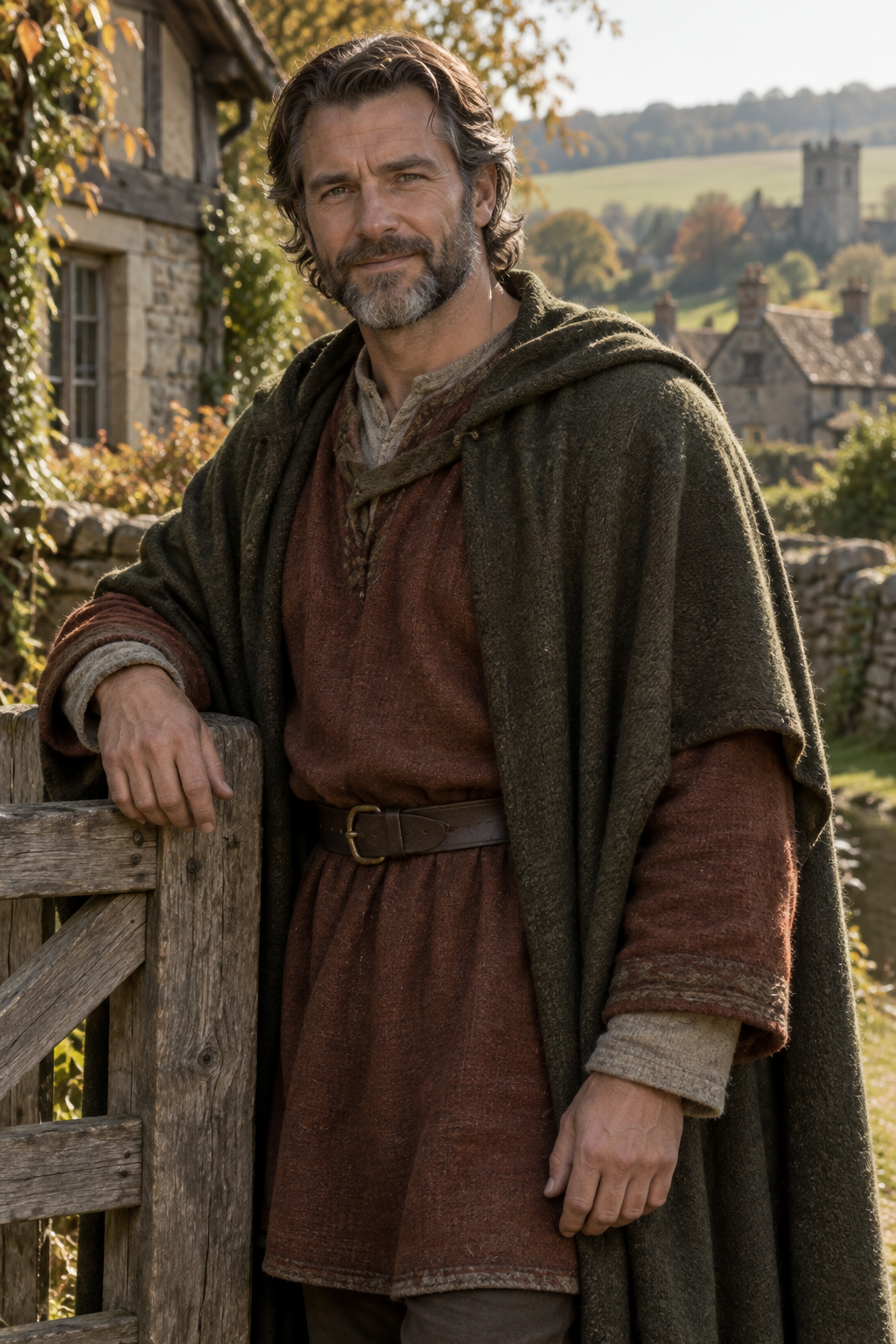
Firsfram has no direct appearance, so his approved face, body, hair, eyes, age impression, and clothing are designed rather than transcribed. CVM depicts an exceptionally handsome adult Erkynlander father around forty-eight with a sturdy broad-shouldered build, gray-green eyes, warm fair skin, dark-chestnut hair silvered at the temples, and a close chestnut-and-silver beard.
The honest hero is this living family-memory portrait associated with Runchester: russet, moss, charcoal, and undyed-wool layers beside an ordinary village gate in mild autumn. It does not place him in a blizzard, under attack, or walking toward a known fate.
Similarity to Ostrael may be used carefully as family visual language once both identities are approved, but father and son cannot become age-shifted copies. Separate faces and bodies must remain recognizable.
The caption and media metadata should identify the image as CVM’s canonical visual interpretation, not an official portrait or a scene confirmed by the novel.
Consistency matters most where evidence is least specific. This exact face, body, coloring, hair/beard map, wardrobe, and gentle remembered presence must recur every time Ostrael remembers him; uncertainty about fate cannot become an excuse to generate a different missing father.
Connections
The son, prince, fortress, and winter around Firsfram’s unresolved absence
Ostrael
Firsfram’s son, a young pikeman who remembers him as the black storm approaches Naglimund.
Prince Josua
Remembers Ostrael’s name and long absence from home, preserving his individual identity.
Runchester
The home association carried in both Firsfram’s designation and Ostrael’s service identity.
Naglimund
The fortress where Firsfram’s absence returns to Ostrael under siege pressure.
The unnatural winter
The confirmed season of disappearance, ominous context whose exact role remains unresolved.
The black storm
The approaching phenomenon that triggers Ostrael’s father-memory before revealing the invaders.
Why Firsfram Matters
He gives Ostrael’s fear a family history and the winter a missing-person receipt
Firsfram matters because his absence shows the war’s human consequences before the enemy army becomes visible.
He matters because Ostrael carries more than military duty onto the wall. The young soldier has already lived through unexplained loss.
His unresolved status also tests the honesty of the hub. Better organization does not mean replacing every unknown with a confident answer.
A complete fandom record can say exactly what happened, who remembers it, what context surrounds it, and which explanations remain unsupported.
Firsfram’s page therefore preserves absence as evidence rather than treating it as empty space.
On the Record
Book 1 only, no direct appearance, missing status non-negotiable
This is Firsfram of Runchester’s one canonical full-spoiler profile. He is identified and remembered in Book 1 through Ostrael. No direct Firsfram receipt appears in Books 2–4.
The record confirms his name, Runchester association, fatherhood of Ostrael, disappearance during the winter, and continued place in Ostrael’s thoughts as the black storm approaches Naglimund.
It does not confirm exact age, face, hair, eyes, body, clothing, occupation, rank, family beyond Ostrael, relationship quality, disappearance location, cause, captor, death, survival, return, body, funeral, or final fate.
Visual state: approved editorial reconstruction. Future hero, directory, social, Ostrael-memory, and family art must preserve this exact attractive adult Erkynlander identity while treating every physical choice as interpretation. Do not show a corpse, attacker, magical cause, or solved disappearance. The same canonical attachment powers featured image, hero, directory card, and social metadata.