
Memory, Sorrow, and Thorn · Canonical Character Profile
Baron Ordmaer of Utersall
Baron Ordmaer brings one hundred Utersall men to Naglimund, joins the Raed, and recognizes Elias’s habit of replacing resistant rulers with compliant agents. When the siege reaches the walls, the fat, physically massive baron holds a breach alone for long minutes, kills four attackers, and keeps the rest back until help arrives. He dies of the wounds. Ordmaer is not brave “despite” his body. That body is the wall when the wall opens.
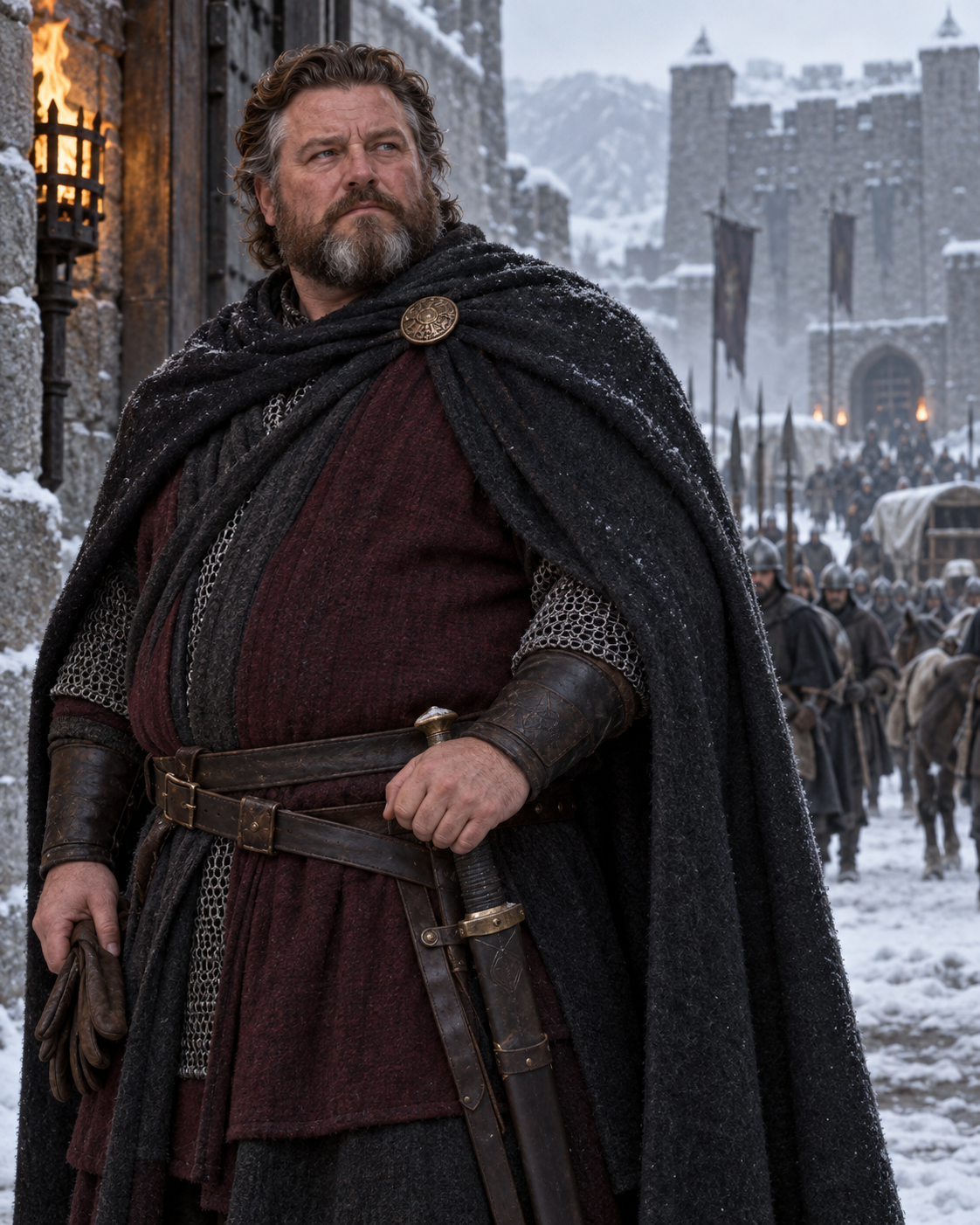
At a Glance
The baron who becomes a human fortification when Naglimund’s stone fails
- Name
- Ordmaer
- Title
- Baron of Utersall
- Appearance
- Fat and physically massive
- Reinforcement
- Brings one hundred Utersall men
- Council position
- Supports Naglimund and recognizes Elias’s proxy strategy
- Final defense
- Holds a breach alone and kills four attackers
- Fate
- Dies of siege wounds; body carried to the chapel
One Hundred from Utersall
Ordmaer turns local lordship into bodies Naglimund can actually defend with
Naglimund’s commons fill with refugees from the Frostmarch, Greenwade valley, Utanyeat, and surrounding farms. Weather, banditry, and Guthwulf’s passage have pushed civilian crisis inside the fortress before Elias’s formal assault begins.
Ordmaer arrives with one hundred Utersall men. Ethelferth brings two hundred from Tinsett, Gwythinn brings Hernystiri, and other local lords contribute to a coalition still deciding what it is.
One hundred is not decorative scale. The men require food, sleeping space, equipment, command, and a reason to accept death under Josua’s walls. Their presence makes Utersall’s political choice material.
Ordmaer’s own body is described with equal material directness: fat and physically massive. The books do not apologize for the combination or use it to disqualify him from combat.
The arrival receipt does not specify whether the Utersall force consists of retainers, levies, volunteers, or a mixture. It confirms that Ordmaer does not attend Naglimund alone to offer speeches. He brings a significant portion of the fortress’s finite manpower.
Inside the Horseshoe
He joins the council where regional grievances become a pattern of deliberate replacement
Ordmaer sits among roughly fifty lords, soldiers, clergy, emissaries, and witnesses at the Naglimund Raed. The horseshoe of tables contains people who agree that Elias is dangerous without agreeing on war, evidence, succession, or supernatural cause.
When Isgrimnur reports that Elias has named him traitor and handed Elvritshalla to Skali Sharp-nose, Ordmaer and Gwythinn recognize a broader political method.
Elias neutralizes resistant regional powers through compliant agents. Skali replaces Isgrimnur. Guthwulf and Fengbald operate elsewhere as instruments of crown pressure. The pattern turns individual dispossession into governance strategy.
Ordmaer’s recognition matters because he is himself a territorial lord. He understands what it means when the crown treats a region’s lawful authority as replaceable by someone more obedient.
The record does not preserve his exact speech or personal dispute with Elias. It confirms his interpretation within the council and his alignment with the people naming the pattern.
His political insight and later physical defense belong together. Ordmaer does not die for an abstract prince alone. He fights inside a coalition responding to a king who has made local lordship conditional on compliance.
Fat, Massive, and Fully Martial
The text refuses the body hierarchy fantasy art keeps trying to reinsert
Ordmaer is fat. He is also physically massive, capable of occupying a wall gap and killing four attackers while holding others back.
These facts are not in tension. The profile should not translate “massive” into a secretly lean body beneath armor, nor treat “fat” as comic contrast before revealing surprising competence.
His body has weight, reach, strength, vulnerability, and tactical presence. In a narrow breach, size can become control of space.
Attractiveness likewise does not require slimming him. The owner’s hot-fantasy standard applies through face, presence, strength, confidence, costume, and composition while retaining the canonically large fat body.
The record supplies no exact age, height, hair, eyes, beard, scars, armor, heraldry, or weapon. Future design has room, but body type is not one of the open questions.
The Wall Opens
Ordmaer holds the gap alone long enough for help to become possible
Elias begins the great assault with siege towers, catapults, a ram, miners’ frames, ladders, archers, and overwhelming numbers. Separate sections of Naglimund fail under pressure.
At one breach, Ordmaer stands alone for long minutes. He kills four attackers and keeps the rest back until help arrives.
The duration is essential. A single dramatic strike would be heroism as image. Holding for minutes is endurance under repeated contact while the defenders elsewhere try to understand where the line is breaking.
The narrow space likely magnifies his physical presence, but the text does not provide exact architecture, footing, weapon, or sequence of kills. The page should not storyboard a fight the record does not contain.
What it confirms is tactical effect. Ordmaer prevents attackers from converting a gap into a flowing entry point. Every moment he remains there buys time for other defenders to reach him.
His action also changes the meaning of “alone.” He is physically alone in the breach, not socially abandoned. Help is moving. The one hundred men he brought and the larger Naglimund coalition exist around the moment even when none can occupy the gap beside him yet.
The defense succeeds locally and destroys him bodily. Ordmaer dies of the wounds he receives.
Casualty Arithmetic
Elias can replace attackers; Naglimund cannot replace Ordmaer
At Dendinis’ Tower, Deornoth realizes Elias can spend soldiers like apple peelings while every defender lost is irreplaceable.
Ordmaer embodies that imbalance. His death removes a baron, council participant, local commander, political interpreter, and the man who brought one hundred Utersall fighters.
The four attackers he kills matter tactically. They do not balance the account. Elias’s army contains depth; Naglimund’s coalition depends on each named and unnamed defender remaining functional.
This is why the series refuses a clean kill-count understanding of valor. Ordmaer wins his patch of stone and still leaves the defense weaker for the next assault.
The page should not claim the Utersall men collapse after his death or identify a successor. Their response is unrecorded. The structural loss exists whether or not they continue fighting effectively.
Carry Him to the Chapel
Josua’s order restores the dead baron from obstacle to person
After Ordmaer dies of his wounds, Josua orders that his body be carried to Naglimund’s chapel.
In an active siege, bodies create immediate practical problems. They block movement, distress survivors, and require labor the living can barely spare.
The chapel order does more than clear the wall. It places Ordmaer within a community of mourning and sacred care rather than leaving the man who became a fortification to remain part of the fortification.
The record does not confirm a funeral, prayer, burial, who carries him, or whether the chapel survives long enough to complete any rite. The Harrowing will soon destroy Naglimund.
Even so, the command establishes intention. Josua recognizes that the dead defender should be moved with dignity.
Future art must follow the same principle. Ordmaer’s canonical portrait should be living. A breach scene may show strain and danger. The body being carried should never become the directory’s clickbait substitute for the baron himself.
Connections
The prince, allied lord, council voices, and defenders around Ordmaer’s final stand
Prince Josua
Leads the coalition Ordmaer supports and orders his body carried to the chapel.
Lord Ethelferth
Fellow regional supporter who brings two hundred Tinsett men to Naglimund.
Prince Gwythinn
Shares Ordmaer’s recognition that Elias uses compliant agents to displace resistant rulers.
Duke Isgrimnur
Provides the dispossession evidence that helps Ordmaer identify the crown’s proxy strategy.
Baron Godwig
Another regional lord tied to the attacking side through Cellodshire troops at a separate breach.
The Utersall men
One hundred fighters whose presence materializes Ordmaer’s support and whose lord dies on the wall.
Why Ordmaer Matters
He connects body, territory, and political resistance in one uncompromising stand
Ordmaer arrives as a regional contribution: one baron, one holding, one hundred men.
At the Raed, he shows that local leadership also brings interpretive knowledge. He recognizes what Elias is doing when the king replaces resistant authorities with loyal instruments.
At the breach, political representation becomes physical. The massive body of Utersall’s lord occupies the place where the kingdom’s defense has failed.
His death gives the coalition’s stakes a name and shape. This is not a generic noble sacrifice polished for legend. It is a fat man holding a narrow space long enough for help, dying of damage the scene does not glamorize, and being carried away because his personhood survives usefulness.
On the Record
Book 1 only, death confirmed, body type non-negotiable
This is Baron Ordmaer of Utersall’s one canonical full-spoiler profile. His arrival with one hundred men, Raed participation, political inference, solitary breach defense, four kills, fatal wounds, and transfer to the chapel all occur in Book 1. No direct Ordmaer receipt appears in Books 2–4.
The record confirms his title, Utersall holding, fat and physically massive body, military contribution, Naglimund support, recognition of Elias’s proxy strategy, long solitary defense, four attackers killed, death from wounds, and chapel order. It does not confirm exact age, face, hair, eyes, beard, height, family, heraldry, armor, weapon, exact wounds, last words, funeral, or burial.
The approved living identity is one exceptionally handsome, genuinely fat and physically massive mature baron with a broad rectangular face, steel-blue eyes, ruddy fair skin, dark auburn hair graying at the temples, and a close auburn-gray beard. Exact age, body proportions, face, coloring, hair, beard, clothing, mail, sword, brooch, soldiers, carts, fortress, pose, weather, and light are CVM reconstruction.
This same identity governs arrival, Raed, wall, aftermath, directory, hero, and social imagery. Fatal-wound and chapel scenes must remain restrained and cannot replace his living canonical baseline.