
Memory, Sorrow, and Thorn · Canonical Character Profile
Baron Wuldorcene of Caldsae
Wuldorcene is the Baron of Caldsae and one of Naglimund’s named dead after a month of siege. Josua lists him beside Baron Ordmaer, Sir Grimstede, and hundreds of yeomen while realizing Elias’s attacks have become strangely cursory. Wuldorcene’s death is not a decorative casualty: it helps expose that the High King is spending lives to keep the fortress sealed until something worse arrives.
At a Glance
A baron counted among the cost of defending a fortress Elias is not seriously trying to take
- Name
- Wuldorcene
- Title
- Baron
- Holding
- Caldsae
- Allegiance
- Prince Josua and Naglimund’s defenders
- Confirmed campaign
- The month-long siege of Naglimund
- Named among
- Bitter losses including Baron Ordmaer, Sir Grimstede, and hundreds of yeomen
- Narrative function
- Human cost inside Josua’s realization that Elias’s assaults are cursory
- Status
- Dead during the siege
Baron of Caldsae
The title gives Wuldorcene land and rank; it does not supply an imaginary dynasty
Wuldorcene is named as Baron of Caldsae.
That formulation establishes a territorial title and places him within the landed leadership supporting Naglimund. It does not tell us whether Caldsae is his birthplace, ancestral estate, royal appointment, inherited barony, or recently acquired holding.
The text does not name his spouse, parents, children, household officers, banner, castle, tenants, or political history.
Nor does it explain when or why he joined Josua. His presence among Naglimund’s losses confirms allegiance in action. It does not preserve the negotiation that produced it.
That boundary is useful. Rebellion is not made only from characters whose complete motives receive chapters. A fortress coalition also depends on local and regional lords whose decision to bring themselves, retainers, or authority into danger may survive only through a title and a casualty list.
Caldsae should eventually receive a linked place entry if the owned text yields further geographic evidence. Until then, the site should not invent borders, colors, economy, climate, or neighboring estates.
Wuldorcene’s title belongs on his directory card because it is canonical identity, not because aristocracy makes him more valuable than the unnamed yeomen who die beside the named lords.
The Naglimund Coalition
Wuldorcene joins a defense already losing people faster than Elias can be made to care
Naglimund gathers refugees, local lords, Hernystiri, Rimmersmen, emissaries, soldiers, workers, clergy, and the remnants of older loyalties around Prince Josua.
The fortress is strong. Its political and logistical position is not. Supply lines are long, allies are uncertain, and Elias commands numbers the defenders cannot replace.
Wuldorcene belongs to the coalition that stays.
The record does not identify his arrival date, troop count, council speech, assigned tower, lodging, or relationship with Josua. It does not say whether he attended the earlier Raed under a title variant or entered with later reinforcements.
His death proves presence more securely than imagined dialogue ever could.
Named lords around Naglimund perform different confirmed functions. Baron Ordmaer brings one hundred Utersall men and later holds a breach. Sir Grimstede commands near Dendinis’ Tower and is wounded. Lord Ethelferth openly supports Josua in council. Wuldorcene’s individual action is not preserved.
The profile should therefore connect him to the collective defense without borrowing Ordmaer’s four kills, Grimstede’s ladder counterattack, or another lord’s speech.
Shared campaign is not shared biography.
Named Among the Bitter Losses
Josua’s list confirms death even though the novel withholds the blow
After roughly a month of siege, Josua tells Jarnauga that Naglimund has held Elias off with bitter losses.
He names Baron Ordmaer, Sir Grimstede, and Wuldorcene of Caldsae, then includes hundreds of stout yeomen.
In that grammatical and narrative context, Wuldorcene is counted among the dead. The earlier placeholder “status unknown after the fall” was too weak and is repaired here.
The line does not explain how Wuldorcene dies. He may have fallen during the first assault, a later probe, missile exchange, sortie, accident, sickness, or another siege event. The text supplies no wound, weapon, opponent, location, witness, final words, body recovery, funeral, or successor.
Assigning him a glorious wall-top duel would steal detail from better-attested deaths and turn a clear status receipt into fan fiction.
The list also places hierarchy and scale in one breath. Two titled men and one knight are named; hundreds of yeomen remain collective. The contrast is not proof that aristocratic lives mattered more to Josua. It shows how records preserve some identities and compress others.
A comprehensive fandom page should name Wuldorcene accurately while refusing to treat the anonymous hundreds as background texture.
Why Elias Is Barely Attacking
Wuldorcene dies inside a siege whose visible purpose is not victory but containment
Josua senses that Elias’s assaults have become cursory.
Naglimund has suffered grievously, yet the royal army is not pressing the kind of sustained conventional attack its numerical advantage should allow. The pattern feels wrong.
Jarnauga recognizes the likely strategy: Elias is keeping the defenders inside while waiting for another force. The High King does not need to storm the walls if time and containment deliver the fortress to something else.
That realization changes how Wuldorcene’s death reads. He is not simply one cost of a failed royal assault. He is part of the price Elias is willing to pay—and force Josua to pay—to maintain a trap.
The strategy weaponizes asymmetry. Elias can replace men more easily. Naglimund cannot replace a baron, knight, local commander, or hundreds of yeomen. Even “cursory” attacks drain the defense.
Elias later withdraws his human army and destroys the remaining siege engines. The retreat initially resembles relief. It is actually clearance for the black storm and Stormspike host.
Wuldorcene does not live to see the final supernatural breach. His death helps create the attrition that leaves the fortress weaker when Norns, Hunën, Bukken, and the Red Hand arrive.
The page should not claim Elias knew Wuldorcene personally or targeted him. His relationship to the king is structural: one ruler chooses the trap, one allied baron dies inside it.
Ordmaer, Grimstede, Wuldorcene, and the Yeomen
The same casualty sentence contains different amounts of surviving evidence
Baron Ordmaer receives a direct death scene. He holds a breach alone, kills four attackers, dies of his wounds, and is carried toward the chapel.
Sir Grimstede receives a specific wall role and a ragged wound through calf and boot. Yet Josua’s later phrasing places him among bitter losses, creating a status tension that his canonical profile must resolve from the full sequence rather than a single line.
Wuldorcene receives title, holding, allegiance context, and death—nothing more individual.
The hundreds of yeomen receive collective courage and scale but not names.
These unequal records should not be cosmetically flattened. Wuldorcene does not inherit Ordmaer’s scene just because both are barons. The yeomen should not be silently converted into Wuldorcene’s personal troops.
Instead, the site can show how siege history is assembled from different evidence densities: direct action, wound report, retrospective casualty list, and aggregate count.
That structure is richer than pretending every defender had a camera following them.
Connections
The prince, fellow losses, besieging king, and fortress around Wuldorcene
Prince Josua
Leader of Naglimund’s coalition and the speaker who names Wuldorcene among the siege dead.
Baron Ordmaer
A fellow named loss whose direct breach defense and death are separately preserved.
Sir Grimstede
A wall commander named in the same retrospective loss list after suffering a documented calf wound.
King Elias
Commands the containing siege whose limited assaults drain Naglimund while a supernatural force approaches.
Jarnauga
Hears Josua’s accounting and recognizes that the royal army appears to be holding the defenders in place.
The yeomen of Naglimund
Hundreds of unnamed defenders whose deaths share the same sentence and must not become invisible beneath titled casualties.
Character Image Continuity
A distinct Caldsae baron shown alive, not a spare dead noble in borrowed armor
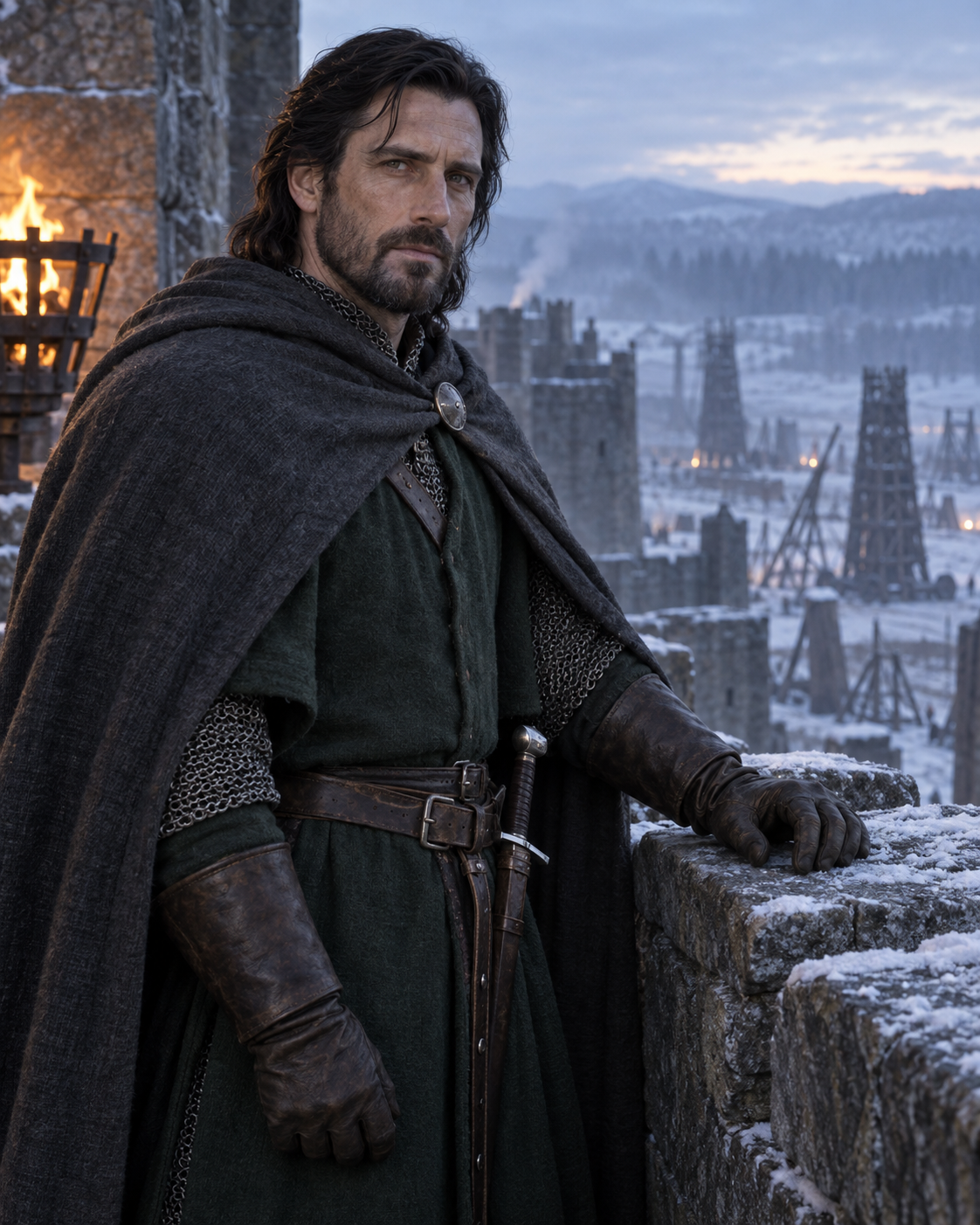
Wuldorcene’s approved identity shows an exceptionally attractive adult Erkynlandish baron around thirty-nine with a tall lean-strong field-command build, narrow rectangular face, pronounced cheekbones, tapered jaw, storm-gray eyes, weathered fair skin, subtly aquiline nose, collar-length near-black hair, and a short near-black beard.
Canon supplies none of those bodily details. It also supplies no clothing, armor, weapon, heraldry, family resemblance, injury, or individual death scene; all visible choices are CVM editorial reconstruction.
His dark pine-green wool, smoke-gray cloak, practical mail, worn leather, pewter clasp, sheathed plain sword, and snowbound wall walk create restrained siege-era authority without inventing a Caldsae coat of arms.
The primary identity shows Wuldorcene alive. A corpse, helmet, distant wall figure, or blood-covered silhouette cannot substitute for this character portrait.
Siege art may place this exact identity at Naglimund without assigning Ordmaer’s breach, Grimstede’s wound, Eadgram’s engines, or another defender’s documented action.
The same face, body, coloring, hair, beard, and material language must power featured image, profile hero, directory card, social metadata, siege timeline references, and every later callback.
Why Wuldorcene Matters
His death turns Josua’s tactical intuition into an accounting of what containment costs
Wuldorcene’s direct evidence is limited to title and loss. His placement makes that evidence matter.
Josua is explaining why the siege feels wrong. Elias has enough power to attack harder, but he is spending just enough to keep Naglimund trapped. Wuldorcene’s name sits inside the cost of that strategy.
He also shows how coalitions are consumed. The fortress loses titled allies, experienced fighters, and hundreds of ordinary defenders before the supernatural host crosses the garden.
A shallow entry would say “Baron of Caldsae; fate unknown.” The owned passage allows a firmer and more useful conclusion: he joined Naglimund, died during its month of defense, and became one of the names through which Josua measured a trap already closing.
On the Record
Book 1 siege testimony, fully spoiled and status-corrected
This is Baron Wuldorcene of Caldsae’s one canonical, full-spoiler character profile. His confirmed evidence appears in The Dragonbone Chair during Josua and Jarnauga’s conversation near the end of the siege of Naglimund.
The owned Kindle edition identifies Wuldorcene as Baron of Caldsae and places him among the bitter losses suffered while Naglimund holds Elias’s forces off for approximately a month. The same sentence names Baron Ordmaer, Sir Grimstede, and hundreds of yeomen.
The context supports dead status during the siege. It does not confirm his exact arrival, troop count, council participation, assigned post, actions, weapon, wound, killer, final words, body recovery, funeral, heir, family, or the political history of Caldsae.
Wuldorcene dies before Elias withdraws the human army and the Stormspike host destroys Naglimund.
Status: dead during the month-long siege; exact death event unrecorded.
The approved living portrait is an evidence-bounded CVM editorial reconstruction. Its single local attachment powers the featured image, visible hero, directory card, and social metadata.