
Memory, Sorrow, and Thorn · Canonical Character Profile
Lord Constable Eadgram
Eadgram is Naglimund’s lord constable: the defense officer Josua trusts to turn warning into readiness, keep drink away from the gatehouse, and make two small slingstones do the work of weapons the fortress does not have. His oil-filled winesacks burn four abandoned siege towers and briefly make Elias discover that even Sorrow cannot order rain. Then the Red Hand melts the gate and Eadgram dies inside the defense he prepared.
At a Glance
The officer who makes a besieged castle dangerous with discipline and whatever is still available
- Name
- Sir Eadgram; Lord Constable Eadgram
- Office
- Lord Constable of Naglimund
- Allegiance
- Prince Josua and Naglimund’s defenders
- Specialty
- Fortress readiness and defensive engine improvisation
- Signature countermeasure
- Oil-filled winesacks, slingstones, and pitch arrows
- Status
- Killed when the Red Hand and Norn host breach Naglimund
- Appearance
- Not directly described in the owned text
The Warning
Josua gives him one sentence because the constable already knows what readiness requires
When Ostrael reports that Elias has reached Greenwade Ford, fewer than ten leagues away, Josua orders Eadgram to ready every spear and bow and keep wine from the gatehouse.
The order is short, but its two halves reveal Naglimund’s defense problem. Weapons must be placed in hands immediately. Human weakness must also be managed. A fortress can have walls, towers, and loyal soldiers and still fail because the gate watch is drunk, slow, or inattentive at the wrong hour.
Eadgram’s office sits where logistics, discipline, and architecture meet. He does not receive a grand speech about courage. He receives a readiness state to create. The novel trusts the title “lord constable” to imply a system of posts, stores, patrols, engines, and people that must move together before the enemy arrives.
This is why his later tactic does not feel like a random clever moment. It grows from the same professional attention: know what is available, know what can fail, and convert ordinary material into time.
A Fortress Counting Everything
Naglimund cannot spend soldiers or equipment the way Elias can
The siege is defined by asymmetry. Elias can spend men like apple peelings because he possesses more bodies than the defenders can replace. Naglimund must count every death, every breach, every missile, and every working engine.
Eadgram has two small slingstones. They are not magnificent engines capable of smashing the royal host. Four abandoned hide-covered siege towers stand within reach after the first assault. The towers remain dangerous even when empty: they can be recovered, repaired, or used as shelter for another advance.
The constable’s answer begins with winesacks filled with oil. The choice is tactically precise and materially revealing. Containers associated with the very drink Josua has ordered away from the gatehouse become delivery vessels for fire. Scarcity does not produce purity; it produces recombination.
He throws the oil-filled sacks with the slingstones, coats the towers, and follows with pitch arrows. Four ignite. The defense cannot destroy Elias’s numerical advantage, but it can deny equipment and make the enemy pay for abandoning engines close to the wall.
The Burning Towers
His counterattack forces Elias to reveal that the king expects the sky to obey
As the towers burn, Elias rides out carrying Sorrow and commands rain to extinguish them. At first, Naglimund’s defenders laugh. A king shouting at weather looks absurd from the battlements.
The laughter fades when no rain comes and everyone understands that Elias is not performing madness for intimidation. He genuinely expected obedience. The failed command reveals both the scale of power surrounding him and a limit within it.
Eadgram’s fire creates that revelation. Without the burning towers, Elias has no reason to test or display the expectation. A practical defensive action produces strategic intelligence: the king believes his alliance gives him authority over weather, but the authority is not automatic or absolute.
The moment also lets ordinary engineering answer supernatural spectacle. Eadgram does not defeat Sorrow. He uses oil, leather, stone force, and fire well enough that the cursed-sword king must respond personally—and fails to reverse the damage on command.
What Is His—and What Is Not
The first-day defense is collective, and Eadgram’s profile should preserve the division of labor
Other defenders hold different parts of Naglimund. Isorn fights from the wall with a borrowed bow. Einskaldir answers massed numbers with contempt. Baron Godwig’s Cellodshiremen reach the battlement near Dendinis’ Tower before Deornoth and Sir Grimstede’s defenders force the ladders away. Baron Ordmaer holds another breach and dies after killing four attackers.
Those actions establish the battle around Eadgram; they are not his personal accomplishments. His confirmed contribution is readiness and the engine-based tower countermeasure.
Keeping the roles separate makes Naglimund more organized rather than less dramatic. A fortress survives its first assault through many specialized decisions: scouts report, princes command, constables allocate, engine crews launch, archers ignite, local commanders rally, and wounded people keep holding walls.
Eadgram’s importance lies precisely in being one indispensable node within that system. He is not made smaller because he did not personally duel the king.
The Final Breach
The defense built for armies meets an enemy that turns the gate’s material rules off
Guthwulf understands that Naglimund cannot be taken quickly by ordinary siege. Starvation would require months, miners remain far from the walls, and the fortress has already survived the first assault.
Elias’s withdrawal is therefore not surrender. It clears space for Stormspike’s host. An unnatural black storm brings thousands of Norns, armored Hunën, Bukken inside the gardens, and the five pale riders of the Red Hand.
The riders abandon stable physical form and become tall, faceless scarlet flame. They melt the gate’s iron fastenings. Norns enter with fire-tubes; Hunën smash defenders aside; the castle becomes an inferno.
Eadgram is killed alongside Ostrael, Brother Eglaf, court women, soldiers, and civilians. The ledger does not preserve an individualized final blow or speech. His death belongs to the systemic collapse of a defense defeated by supernatural breach rather than ordinary siegecraft.
That does not invalidate his work. The burning towers helped Naglimund survive the human assault and exposed Elias’s expectation of power. No amount of competent preparation could make two slingstones answer an enemy capable of turning into flame and melting the gate.
Competence Without Plot Armor
The novel lets good work matter even when the worker still dies
Eadgram’s arc is brutally short: prepare, improvise, succeed locally, die when the scale changes. That shape is not narrative punishment for insufficient heroism.
His work buys time, destroys usable enemy equipment, strengthens morale, and reveals information. The final catastrophe arrives through forces outside the assumptions of conventional fortress defense.
Fantasy often treats competent supporting officers as furniture until a named hero needs an order delivered. Eadgram receives something better. His specific tactic is memorable enough to belong in the siege ledger, and his death is recorded among the people consumed when military conflict becomes supernatural annihilation.
Connections
The command chain and defenders surrounding Naglimund’s constable
Prince Josua
Commander who trusts Eadgram to convert the Greenwade warning into complete fortress readiness.
Ostrael
Young pikeman whose scout report triggers the preparations and who later dies in the same breach.
Deornoth
Senior field commander whose wall defense exposes the human cost of Elias’s numerical advantage.
Sir Grimstede
Local wall commander defending Dendinis’ Tower while Eadgram coordinates engine countermeasures.
Elias
Besieging king forced by Eadgram’s fire to reveal his genuine expectation that rain will obey.
The Red Hand
Supernatural riders whose flame-form melts the gate and destroys the conventional defense system.
Why Eadgram Matters
He makes Naglimund feel defended by people who understand their jobs
Eadgram supplies organizational credibility. Josua’s resistance is not held together only by charismatic speeches and exceptional sword fighters. It depends on someone remembering the gatehouse wine, inventorying engines, choosing containers, and coordinating fire.
His countermeasure also becomes one of the siege’s best tonal reversals. Defenders laugh at Elias until they understand the king expected weather control. The joke reveals horror because Eadgram created a problem large enough to provoke the attempt.
Finally, his death marks the boundary between warfare Naglimund can answer and supernatural force that bypasses its defenses. The constable does not fail. The battlefield changes species.
On the Record
Book 1 only, no canonical face, and no borrowed battlefield achievements
This is Eadgram’s one canonical full-spoiler profile. His direct readiness order, defensive tactic, and death occur in Book 1. The existing Book 1 scope is retained.
The record confirms his names/titles, office at Naglimund, Josua’s readiness order, two slingstones, oil-filled winesacks, pitch arrows, four burning siege towers, Elias’s failed rain command, and death during the Red Hand/Norn breach. It does not supply age, face, build, coloring, heraldry, family, prior campaigns, private thoughts, final words, or an individually witnessed death blow.
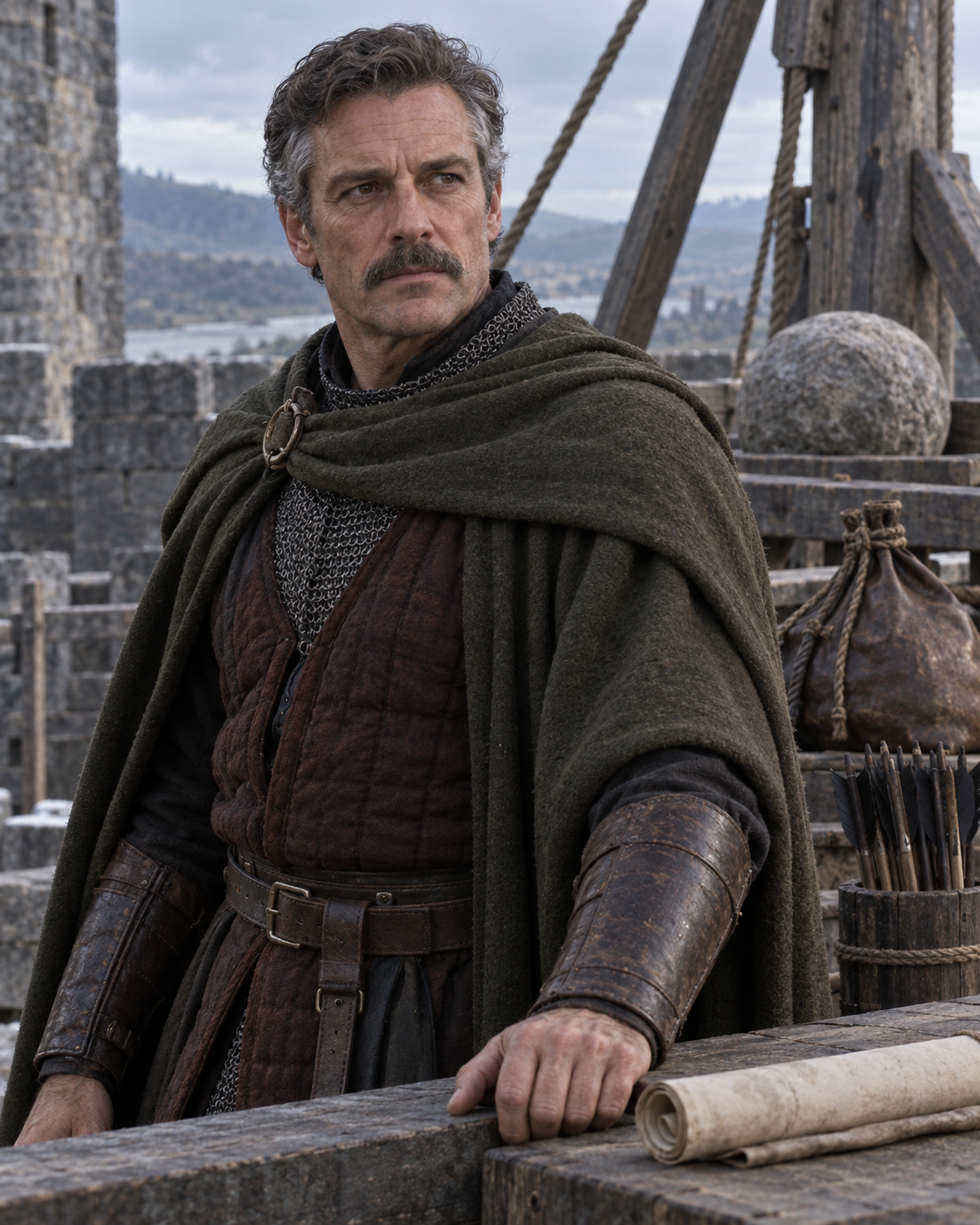
Visual state: approved editorial reconstruction. CVM depicts Eadgram as an exceptionally handsome seasoned Erkynlandish defense officer around forty-seven with a tall sturdy campaign-fit build, steel-brown eyes, weathered fair skin, short dark ash-brown hair substantially silvered at the temples, and a close salt-and-pepper mustache. Charcoal, deep-russet, muted-steel, and dark-olive working layers, restrained mail, worn leather, a timber engine, slingstone, tied winesack, pitch arrows, and an unmarked plan visualize his confirmed defensive labor without invented heraldry, scars, weapon, or rank ornament. Preserve this exact face, mature baseline, body, coloring, silver map, mustache, wardrobe, and command presence at the command post, slingstone crews, burning towers, gatehouse, and final breach. Death art must remain dignity-first and non-gory. The same attachment powers featured image, hero, directory card, and social metadata.