
Memory, Sorrow, and Thorn · Canonical Character Profile
Cifgha
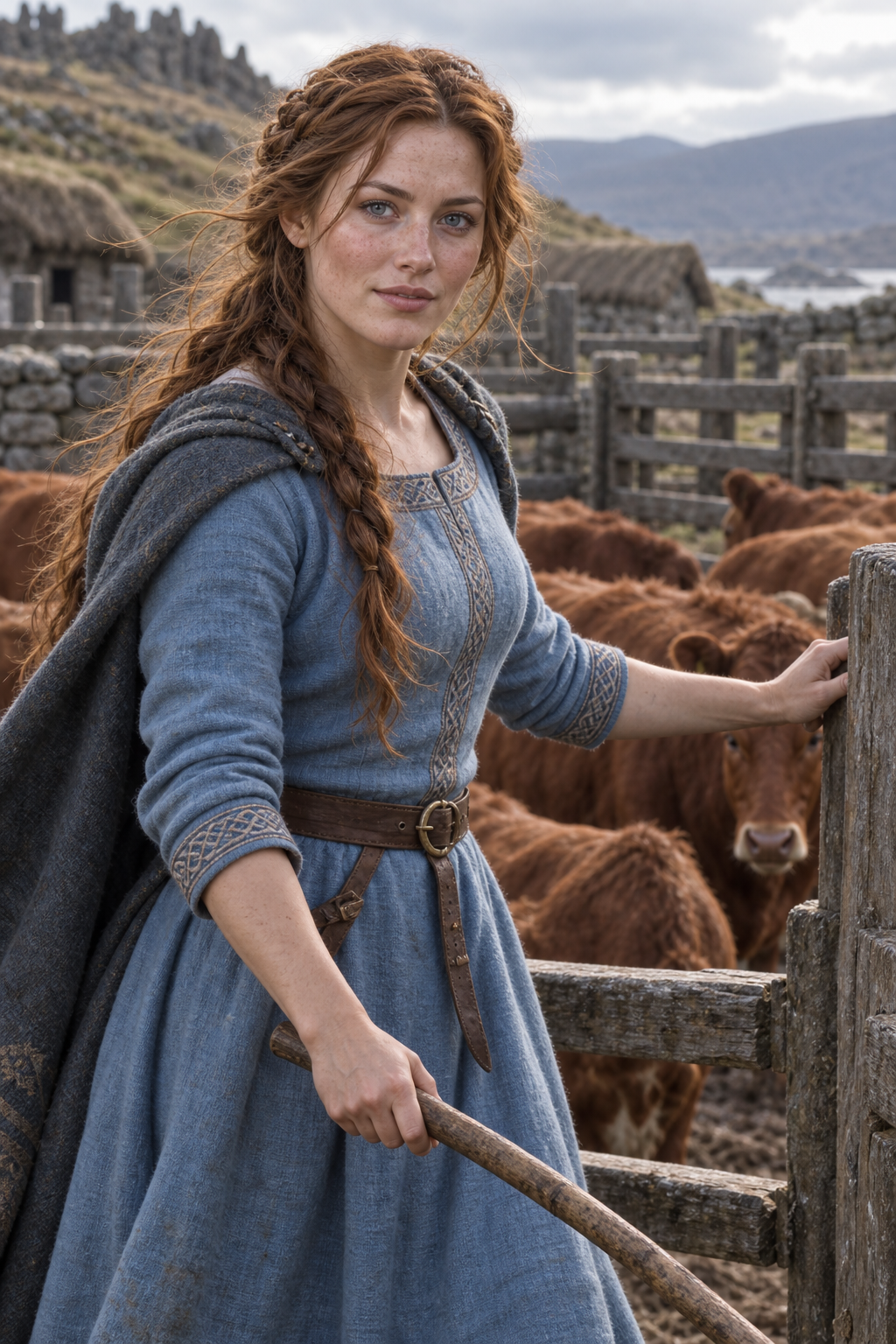
Cifgha is a young Hernystiri woman who helps Maegwin drive the Taig’s red cattle into a crowded paddock as the men prepare for battle. She calls it men’s work; Maegwin answers that whatever work remains is women’s now. Later, Skali displays a struggling hostage in Cifgha’s light-blue dress—but distance denies Maegwin, and us, the right to say with certainty that the captive is Cifgha.
At a Glance
The cattle-worker whose dress becomes evidence when her body cannot be identified
- Name
- Cifgha
- People
- Hernystiri
- Age
- Young adult; exact age unconfirmed
- Confirmed clothing
- Owns or wears a light-blue dress
- Work
- Helps move the Taig’s red cattle before battle
- Companions
- Maegwin, Gwelan, and other young women
- Possible later sighting
- A struggling hostage displayed by Skali wears Cifgha’s dress
- Status
- Uncertain; possibly captured, identity not confirmed
Before the Men Leave
Cifgha’s first scene begins with bodies, noise, livestock, and work that cannot wait
Hernystir is preparing for battle. Men gather weapons and organize departure while the Taig’s household tries to secure what must survive behind them.
Maegwin leads Cifgha, Gwelan, and other young women in forcing the red cattle into a crowded paddock.
The task is physical and difficult. Cattle do not become symbols merely because war is approaching. They have mass, fear, movement, and their own refusal to fit neatly into human plans.
The crowded paddock also signals scarcity of safe arrangements. Animals represent food, breeding stock, wealth, and the future capacity of households to recover after violence.
Cifgha is not named as a court lady, warrior, servant, or farmer. She is a young woman present at the Taig and working within Maegwin’s group. The page should not assign class more precisely than the text does.
Her labor matters because preparation for war is larger than arming fighters. Somebody must move the animals, secure stores, manage children, tend the wounded, and keep ordinary life from scattering when military labor leaves.
The trilogy lets Cifgha enter through that material reality rather than a decorative introduction.
“Men’s Work”
Her objection gives Maegwin the opening to redefine who owns the remaining labor
Cifgha calls handling the cattle men’s work.
The line should not be flattened into laziness. It names an existing division of labor at the Taig and the abrupt redistribution created by mobilization.
Maegwin answers that if the men are leaving, the work that remains belongs to women unless Cifgha would rather take sword and spear. Women must learn to handle their own “spiders,” using a local comparison that refuses delicacy as an excuse.
The exchange carries irritation, pressure, and practical instruction. Maegwin is not delivering a modern workplace seminar. She is reorganizing survival while her country loses time and people.
Cifgha’s resistance helps make the change visible. Without her line, the scene could pretend women have always handled every task effortlessly. Her objection records that the boundary exists and that crisis is forcing it open.
The ledger does not preserve Cifgha’s reply, whether she becomes skilled, whether she resents Maegwin, or whether the cattle are all secured safely.
Her continued presence in the work group indicates participation at that moment. It does not authorize a complete political awakening arc invented on her behalf.
Beside Maegwin
Cifgha witnesses leadership before Maegwin is permitted to name herself a leader
Maegwin is a princess, but the cattle scene does not give her a ceremonial platform. She is dirtying herself in the same urgent labor she commands.
Cifgha’s question allows us to see how Maegwin leads: through blunt reframing, shared physical work, and refusal to wait for gendered permission.
This does not make Cifgha merely a prop for the princess. Minor characters make leadership relational. A command has weight because somebody hears it, resists it, and must decide whether to continue.
Cifgha and Gwelan also establish a cohort around Maegwin. Hernystir’s crisis is not experienced only by its royal family. Young women across the Taig are pulled into new labor before invasion reaches its worst violence.
The record does not establish friendship among the three. Shared work is confirmed; intimacy, loyalty, jealousy, and later reunion are not.
The Girl in the Light-Blue Dress
A familiar garment suggests Cifgha while distance keeps identity unresolved
Later, Maegwin and Eolair approach the Moir Brach while King Lluth lies feverish and nearly speechless in the Grianspog refuge.
Skali Sharp-nose waits below with roughly fifty men and a wagon of hostages. He demands information about Simon and Princess Miriamele and threatens the captives to force cooperation.
Among them, Maegwin sees a struggling girl wearing Cifgha’s light-blue dress.
The distance is too great for positive identification. Maegwin cannot confirm that the captive is Cifgha.
The garment is evidence, not identity. Cifgha may be wearing it. Another person may have borrowed, received, stolen, or been forced into it. Visibility may be distorted by distance and terror.
This uncertainty is not a technical nuisance to remove. It is part of Skali’s violence. Hostage display reduces people to recognizable signs—dress, body shape, movement—while denying loved ones the closeness needed to know whom they are seeing.
The page must therefore use “possible captive” and “status uncertain.” Marking Cifgha globally dead, alive, or captured would claim more than Maegwin can verify.
The dress carries emotional force because it connects the hostage wagon to the earlier cattle yard. A color attached to ordinary work reappears inside political terror.
Skali then reveals the mutilated body of Prince Gwythinn. That confirmed horror surrounds the uncertain sighting without resolving it.
Identity Under Coercion
Cifgha’s unresolved status is a receipt for what war does to knowledge
Fandom databases prefer clean statuses: alive, dead, captured, unknown. Cifgha’s record refuses the comfort of a confident checkbox.
Before the invasion, she is directly seen working at the Taig. Later, a person in her dress is displayed among Skali’s hostages. No confirmed face, name-call, escape, body, or reunion closes the gap.
The responsible status is not “captured.” It is “uncertain; possibly captured.”
That phrasing preserves both the evidence and the violence of not knowing. Maegwin’s community is scattered, communications are broken, and enemies manipulate partial recognition.
A complete profile can make uncertainty legible rather than treating it as incompleteness to be patched with fandom repetition.
Connections
The princess, fellow worker, invader, and hostage community around Cifgha
Princess Maegwin
Leads Cifgha’s cattle work and later recognizes her light-blue dress at the hostage wagon.
Gwelan
Another young woman working beside Cifgha and Maegwin at the Taig.
Skali Sharp-nose
Displays the hostages and uses threatened bodies to demand information.
Count Eolair
Accompanies Maegwin when the distant hostage in Cifgha’s dress is seen.
Prince Gwythinn
His confirmed mutilated body is delivered after the uncertain hostage sighting.
The Taig’s young women
The wider labor group learning to preserve animals and households as men depart.
Why Cifgha Matters
She connects the labor of keeping a country alive to the terror designed to break it
Cifgha’s first scene shows adaptation before invasion: women taking up work that social custom assigned elsewhere.
Her possible second scene shows what the enemy attacks: not only armies and kings, but the people doing the ordinary labor of continuity.
The light-blue dress becomes a fragile bridge between those moments. It is memorable enough for Maegwin to recognize and insufficient for certainty.
Cifgha therefore matters without requiring a secret destiny. She gives Hernystir’s crisis a young woman’s labor, objection, garment, and unresolved absence.
Her profile is strongest when it refuses to solve that absence merely because databases dislike ambiguity.
On the Record
Book 1 only, possible capture unconfirmed, identity art held to the living Taig scene
This is Cifgha’s one canonical full-spoiler profile. Her cattle-yard appearance and possible hostage sighting occur in Book 1. No direct Cifgha receipt appears in Books 2–4.
The record confirms that she is a young woman at the Taig, works with Maegwin, Gwelan, and others to move red cattle, calls the task men’s work, and owns or is associated with a light-blue dress. It also confirms Maegwin later sees a struggling hostage in that dress but cannot identify the person at distance.
The record does not confirm exact age, face, hair, eyes, body, class, family, later work, political views, capture, survival, death, escape, or final fate.
CVM’s approved editorial reconstruction depicts Cifgha as an exceptionally attractive young adult Hernystiri woman with a strong freckled face, gray-blue eyes, and long copper-brown hair partially braided for work. Her light-blue wool dress preserves the one confirmed visual marker. This exact face, body, coloring, hair map, dress, and grounded labor presence are now fixed across every hero, directory card, social image, and later scene. Hostage imagery may use distance and uncertainty but must never present the captive as definitively Cifgha.