
Memory, Sorrow, and Thorn · Canonical Character Profile
Count Arthpreas of Cuihmne
Arthpreas enters the story at the edge of death, surrounded by the wreckage of Hernystir’s defense. He still gives Miriamele what the battlefield can offer: names, allegiance, warning, and one startled recognition that tears a hole in Cadrach’s disguise.
At a Glance
The count who turns his last breath into a field report
- Realm
- Hernystir
- Title
- Count of Cuihmne
- Heraldry
- Twin meadowlarks on his surcoat
- Battlefield
- Innishcrich
- Cause
- Mortally wounded during Skali’s Raven-warrior attack
- Final status
- Dead in Book 1, Chapter 36
The Visual Receipt
A winged helm, a mustached face, and armor that has already told the story
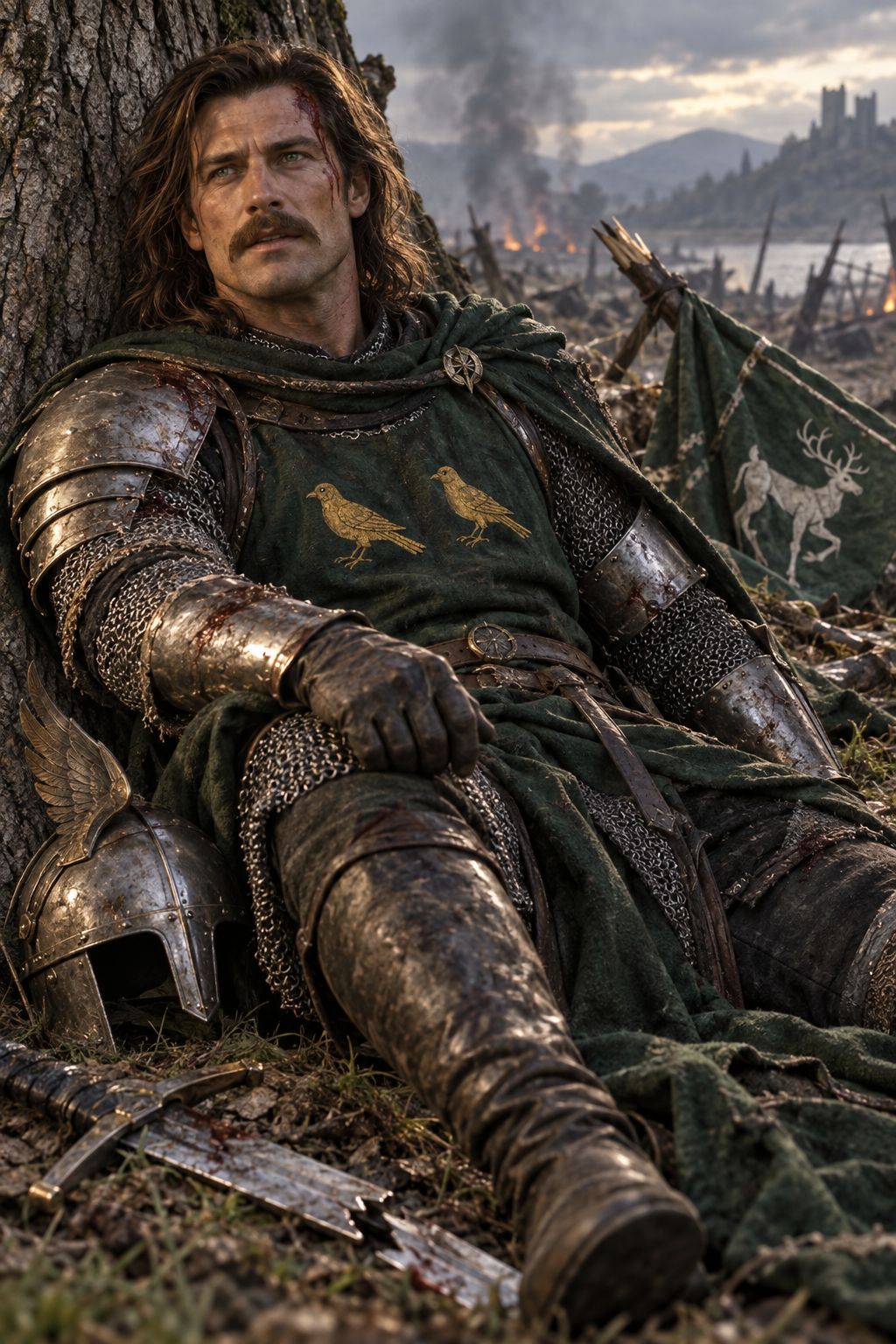
Miriamele finds Arthpreas half-propped against the base of an oak. He wears armor whose remaining polished surfaces still catch the light, but the metal has been battered and blood has dried beneath it. His half-helmet carries a winged crest. When Cadrach lifts away the mask, a mustached face appears beneath streams of blood.
His shattered sword lies beside him with a broken pole and Hernystir’s green White Stag banner. Cadrach identifies him by the two meadowlarks stitched on his surcoat: the heraldic mark of Cuihmne, near Nad Mullach.
CVM’s approved editorial reconstruction presents an exceptionally handsome adult Hernystiri count whose dignity survives catastrophic wounds: moss-green living eyes, shoulder-length dark-brown hair with copper strands, a strong dark-auburn mustache, battered armor, exactly two gold meadowlarks on deep green, a wing-crested half-helmet, shattered sword, and the recovered White Stag banner. Hair, eyes, age, skin tone, armor decoration, and heraldic colors remain disclosed design choices. This exact identity must persist whenever his final scene is reconstructed.
Book 1 · The Dragonbone Chair
The survivor beneath the White Stag
Innishcrich
Miriamele and Cadrach arrive after the battle has moved west
From the hillside, Miriamele sees a flat of bloodied earth, ruined metal, smoke, and bodies. Most of the dead appear Hernystiri. The battle itself has already moved beyond them, leaving ravens and human scavengers behind.
Miriamele spots one metallic gleam that does not move like carrion. She and Cadrach descend and find Arthpreas still breathing. The count’s position beside the White Stag matters: his company apparently recovered the royal banner even while Skali’s assault destroyed them.
The last testimony
He names the attackers, mourns his men, and asks whether the king survived
Miriamele gives him water and tells him the Stag is safe. Arthpreas reports that Skali’s Raven-warriors were everywhere and that his brave boys are dead. His thoughts turn immediately to King Lluth, with enemy northerners surrounding the Hernystiri ruler.
The statement is fragmented by pain, blood, and failing breath, so the hub treats it as dying eyewitness testimony rather than an omniscient battle summary. Even so, it gives Miriamele direct evidence of Skali’s reach and the destruction already overtaking the realm she meant only to cross.
Padreic
Arthpreas recognizes the man Cadrach insists no longer exists
Then the count looks at Cadrach and calls him Padreic. He asks whether his old friend has come back. Cadrach briefly takes the wounded hand, but Arthpreas dies before any reunion can become explanation.
Cadrach says the count mistook him and admits only that Arthpreas was a good man. The denial cannot erase the recognition. Arthpreas’s last scene therefore does double duty: it records the war outside and breaks open the buried identity traveling beside Miriamele.
The return owed
Miriamele refuses to leave him as anonymous scenery
Miriamele removes the armored gauntlet, wraps it in the torn green banner, and puts it in her saddlebag so some piece of him can return to his family. She also insists that they spend enough time covering his body with stones.
Arthpreas cannot choose what happens after death. Miriamele chooses that his title, banner, hand, and body will not simply dissolve into the landscape of someone else’s quest.
Connections
The people carried inside his final words
Miriamele
She gives him water, listens, protects the recovered banner, preserves his gauntlet for his family, and covers his body.
Cadrach / Padreic
Arthpreas recognizes an old friend beneath the monk’s current identity. His certainty becomes one of the clearest early receipts for Cadrach’s buried past.
King Lluth
The dying count asks after his king while warning that enemies surround him. Loyalty survives longer than the battlefield command structure.
His “brave boys”
Arthpreas mourns the men destroyed around him. The intimate phrase keeps the dead from becoming only an army count.
Skali
Skali’s Raven-warriors inflict the destruction Arthpreas reports, converting Elias’s political grant into Hernystiri bodies.
Cuihmne and Nad Mullach
His title and meadowlarks locate him inside Hernystir’s landed network. Miriamele’s gauntlet bundle is meant to carry proof back toward that home.
Why He Matters
A minor character can still hold major evidence
Arthpreas matters because the chapter refuses to let a battlefield be only atmosphere. His name, heraldry, title, men, allegiance, and last concern turn the dead plain into a human record. He also gives Miriamele her first direct encounter with the political catastrophe she has entered.
And then he recognizes Padreic. A man with barely enough breath to speak becomes more reliable about Cadrach’s past than Cadrach is willing to be. That is not a sprawling biography, but it is a sharp canonical purpose.
Reading a Battlefield
The scene builds evidence from bodies, objects, heraldry, and one failing witness
Miriamele and Cadrach arrive after the decisive movement has passed. They cannot watch the formations or hear the commands that produced the ruin. What remains is forensic: most bodies appear Hernystiri; scavengers work the field; armor and weapons lie broken; smoke marks violence beyond the immediate ground; the White Stag banner has been recovered; Arthpreas still breathes beside it.
Cadrach’s ability to read the twin meadowlarks turns cloth into identification. The count’s winged helmet, mustached face, battered armor, and title then attach one body to Cuihmne’s political geography. Arthpreas’s fragmented report names Skali and the Raven-warriors, establishes the loss of his men, and reveals concern for Lluth. No single detail supplies an omniscient account. Together they make a defensible record.
That method matters across a series where rumor travels faster than verification. A dying witness may be sincere and still know only his part of the field. Arthpreas does not explain the complete Hernystiri campaign, Skali’s full plan, or Lluth’s current position. The profile preserves the strength of what he can testify to without upgrading pain-fractured speech into a god’s-eye battle map.
The Name Padreic
Recognition briefly restores a relationship Cadrach has tried to declare dead
Cadrach survives by separating his present name from Padraiec ec-Crannhyr, the learned man and League associate he believes his crimes destroyed. Arthpreas does not encounter that argument. He sees the face before him, calls him Padreic, asks whether his old friend has returned, and reaches across the gap with the remaining life in his hand.
The count dies before he can provide biography, accusation, forgiveness, or proof of what their friendship contained. That absence is essential. His recognition verifies connection; it does not authorize the hub to invent shared campaigns, private jokes, or a sentimental reconciliation Cadrach never accepts.
Cadrach’s response is still revealing. He takes the wounded hand and later calls Arthpreas a good man, then retreats into denial. The exchange shows that “Padreic is dead” is not a factual statement everyone else must obey. It is Cadrach’s moral sentence against himself. Arthpreas’s last recognition makes the buried identity relational: another person remembers someone worth greeting.
The Gauntlet and the Stag
Miriamele turns battlefield remains into an obligation of return
Removing the armored gauntlet is intimate, practical, and politically legible. Wrapped in the torn White Stag banner, it carries the count’s body, allegiance, and the realm’s damaged symbol in miniature. Miriamele cannot transport the dead man through occupied country, but she refuses to let his family receive only silence.
She also insists on covering the body with stones. The delay creates risk and changes none of the war’s strategic facts. It matters because the alternative would turn Arthpreas into landscape as soon as his information had been extracted. Burial work acknowledges that a witness remains a person after he is no longer useful.
The act belongs to Miriamele’s political education. She is traveling under disguise through a war partly organized around her family, yet the cost reaches her through an individual who asks after Lluth and mourns his “brave boys.” Kingdoms stop being colored territories when she must hold water to a dying count’s mouth and decide what can still be carried home.
On the Record
Scope, spoilers, and evidence limits
This is Count Arthpreas of Cuihmne’s one canonical full-spoiler profile for Book 1 and the franchise directory. It is grounded in the completed owned-edition ledger and freshly reverified against Chapter 36, pages 498–500.
The text does not supply his family members’ names, age, earlier campaigns, private history with Padreic, or the exact blow that kills him. Those details remain unknown. Visual state: approved editorial reconstruction. The same canonical attachment powers featured image, hero, directory card, and social metadata; future scene art must preserve this exact face, body, mustache, coloring, hair, armor, and heraldic logic without escalating the violence into decorative gore.